
You ask a large language model for legal advice or medical triage, and it answers with absolute confidence. But here is the uncomfortable truth: that confidence is often misplaced. As of 2026, we are still grappling with the fact that Generative AI systems remain largely opaque black boxes. They don't "know" things in the way humans do; they predict patterns. This gap between what users expect (truth) and what models provide (probability) creates a massive risk.
If you are deploying these tools in business or critical sectors, you cannot just say "the AI said so." You need to explain why it might be wrong. Explainability isn't just about making the tech transparent; it's about managing trust. It’s about telling your stakeholders exactly where the machine breaks down. Let’s look at how to actually communicate these limitations without drowning your audience in jargon.
The Core Problem: Why Perfect Transparency Is Impossible
Let’s kill a myth right away: fully explainable generative AI is likely impossible for current architectures. We aren’t talking about a temporary bug that will be patched in the next update. We are talking about fundamental mathematical constraints.
Large Language Models (LLMs) like GPT-4 or Claude operate on billions of parameters interacting in non-linear ways. When a model generates an answer, it doesn’t follow a single logical chain you can trace back to a specific rule. Instead, it activates a distributed network of weights. Researchers at MIT CSAIL found that as parameter counts exceed 100 billion, explainability effectiveness drops by roughly 37% per order of magnitude. This is the "scaling paradox": bigger models get smarter, but harder to interpret.
Think of it this way. A traditional decision tree says, "If income > $50k AND age > 30, approve loan." That is explainable. An LLM says, "The pattern of tokens in this context statistically correlates with approval," while activating thousands of hidden layers simultaneously. You can’t point to one neuron and say, "That’s why it approved the loan." The Federal Reserve Bank of New York explicitly stated in 2025 that attributing output to specific input combinations in deep neural networks is not conclusively possible. If regulators demand perfect causal explanations, many modern AI systems simply fail the test.
Common Failure Modes You Must Disclose
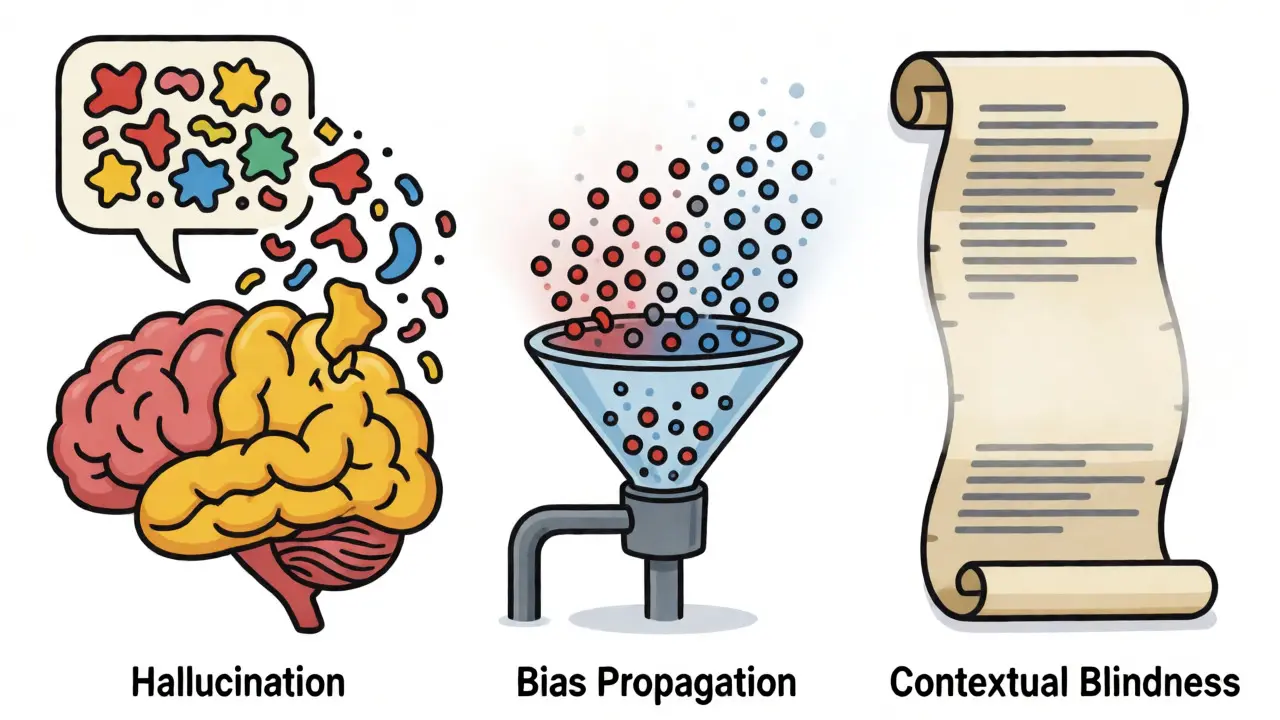
Since you can’t explain every internal step, you must explain the known ways the system fails. Ignoring these leads to catastrophic user errors. Here are the three big ones you need to put front and center in any deployment.
- Hallucination: This is the tendency of LLMs to generate plausible-sounding but factually incorrect information. Recent audits of commercial systems show hallucination rates between 18% and 32%. The model isn’t lying; it’s completing a pattern. It prioritizes fluency over factual accuracy because its training objective was next-token prediction, not truth verification.
- Bias Propagation: Models learn from human data, which includes human prejudices. Google’s internal studies detected gender bias in 27% of career-related responses. If you deploy an AI for hiring screening, it might subtly favor male-coded language not because of a coded rule, but because of statistical correlations in historical resumes. You must disclose that the output reflects training data biases, not objective reality.
- Contextual Blindness: LLMs have a finite context window. Even with long-context capabilities, attention mechanisms degrade over distance. A model might ignore a crucial constraint mentioned early in a prompt if the conversation gets too long. This isn’t a memory loss issue; it’s an architectural limitation of transformer attention heads.
Techniques That Help (And Where They Fail)
So, how do we make these black boxes slightly less dark? We use post-hoc explanation methods. But beware: these tools have their own limits when applied to generative AI.
| Technique | How It Works | Limitation in GenAI | Best Use Case |
|---|---|---|---|
| SHAP/LIME | Approximates model behavior locally using simpler surrogate models. | Accuracy drops to 42-55% on LLMs vs 85% on traditional ML. Too slow for real-time chat. | Batch analysis of high-stakes decisions (e.g., loan approvals). |
| Chain-of-Thought (CoT) | Prompts the model to generate intermediate reasoning steps. | The reasoning steps are often fabricated post-hoc rationalizations, not the actual computation path. | Math problems or logic puzzles where step-by-step validation helps. |
| Retrieval-Augmented Generation (RAG) | Grounds outputs in external documents with citations. | Doesn't explain why the model chose a specific document or ignored others. | Factual Q&A where source verification is critical. |
Notice the trap with Chain-of-Thought. Users see the AI write out its steps and assume those are the actual thoughts. Often, the model writes the conclusion first and then generates plausible reasons to support it. Anthropic’s research on Claude 3.5 confirmed that internal decision pathways don’t always match the generated text. So, when you tell users "here is why the AI answered," you are giving them a narrative, not necessarily the mechanical truth.
Communicating to Different Stakeholders
One size does not fit all. Dr. Rumman Chowdhury argues that the challenge isn’t technical-it’s communicative. You need different levels of detail for different people.
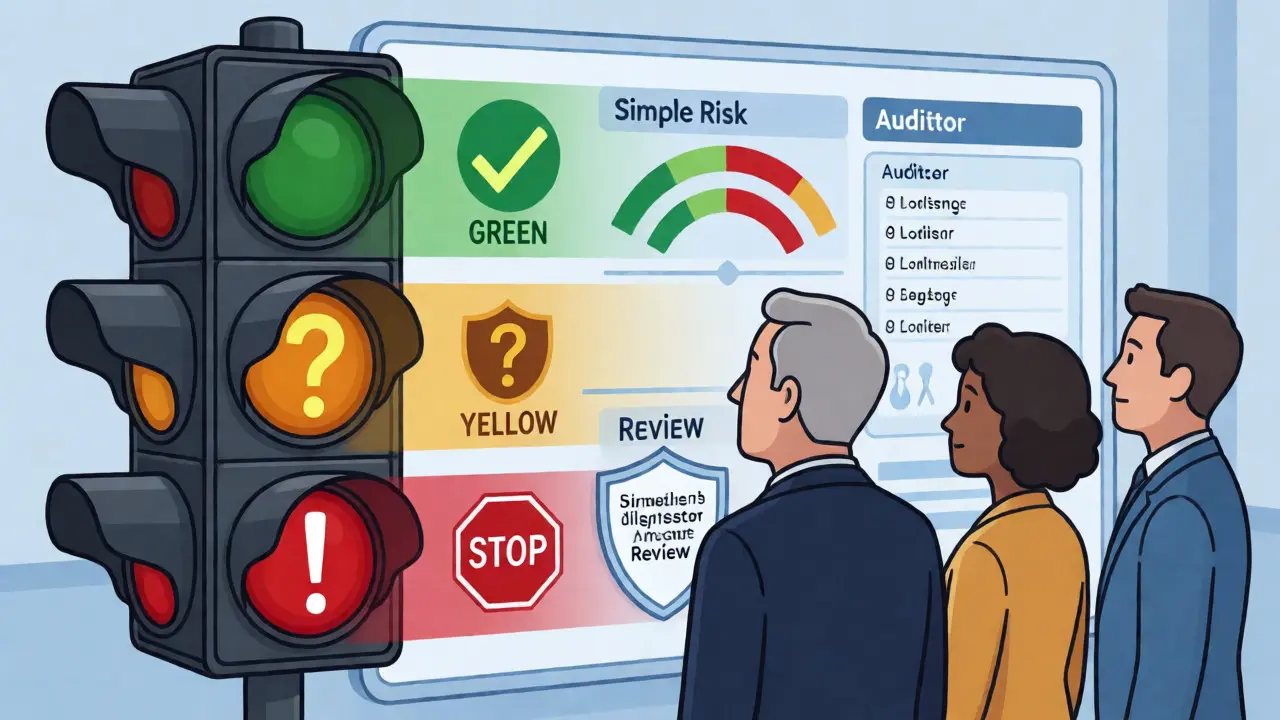
For Business Executives: Skip the SHAP values. They don’t care about feature importance scores. They care about risk. Tell them: "This model has a 20% error rate on edge cases. We have implemented a human-in-the-loop review for any output flagged with low confidence." Focus on uncertainty quantification. Deloitte’s survey showed 68% of executives misinterpreted technical metrics. Give them traffic lights: Green (High Confidence), Yellow (Review Needed), Red (Do Not Use).
For End-Users: Keep it simple. If a chatbot gives financial advice, add a disclaimer: "I am an AI assistant. I may make mistakes. Please verify important numbers with a professional." Don’t hide this in the footer. Put it near the input box. Users need to know that the AI is a probabilistic tool, not an oracle.
For Regulators and Auditors: They need documentation. Show them your testing framework. Which datasets did you use? What were the failure modes identified during stress testing? Did you check for bias? NIST’s AI Risk Management Framework suggests providing "risk-proportional" explanations. If the AI drives a car, you need detailed logs. If it summarizes news, a general statement on training data sources might suffice.
Building Trust Through Radical Honesty
Trust isn’t built by pretending the AI is perfect. It’s built by admitting where it isn’t. Organizations that succeed in 2026 are those that adopt a "failure-first" communication strategy.
Instead of saying "Our AI is accurate," say "Our AI is accurate 90% of the time on standard queries, but struggles with niche medical terms." This sets realistic expectations. When the AI inevitably makes a mistake, users won’t feel betrayed because you warned them. IBM’s cost analysis showed that crafting tailored explanations takes 30-40% more resources, but it pays off in reduced liability and higher user retention.
Consider the EU AI Act, which mandates "sufficient explanation" for high-risk systems. It doesn’t require perfect explainability. It requires meaningful transparency. You satisfy this by documenting your model’s limitations, monitoring its performance drift, and providing clear disclaimers. You are not trying to open the black box completely; you are putting a label on the outside that says, "Handle with Care: Probabilistic Engine Inside."
Actionable Checklist for Deployment
Before you launch your next generative AI feature, run through this list. If you can’t answer yes to these, you aren’t ready to scale.
- Identify High-Risk Outputs: Which outputs could cause harm if wrong? (Financial, health, legal). Apply stricter explanation requirements to these.
- Implement Uncertainty Scores: Can your system output a confidence score? If not, can you approximate it? Display this to users.
- Test for Hallucinations: Run adversarial prompts designed to trick the model. Document the failure modes you find.
- Audit for Bias: Check outputs across demographic groups. Are there systematic disparities?
- Create User-Facing Disclaimers: Write plain-language warnings about limitations. Avoid legalese.
- Establish Feedback Loops: Allow users to flag incorrect outputs. Use this data to retrain or adjust prompts.
Explainability in generative AI is not a destination; it’s a continuous practice. The technology will evolve, and new architectures might offer better transparency. But until then, your job is to bridge the gap between complex mathematics and human understanding. Be honest about the limits. Your users-and your lawyers-will thank you.
Can generative AI ever be fully explainable?
Most experts believe full explainability is mathematically impossible for current deep learning architectures due to their non-linear, distributed nature. While techniques like mechanistic interpretability are improving, achieving 100% causal transparency for billion-parameter models remains unlikely before 2035. The goal is practical, risk-proportional explainability rather than perfect transparency.
What is the difference between explainability and interpretability?
Interpretability refers to the degree to which a human can understand the cause of a decision based on the model's structure (like a decision tree). Explainability is the process of providing reasons for a specific output, often using post-hoc techniques (like SHAP or LIME) to approximate the model's behavior. In generative AI, we mostly deal with explainability because the models themselves are not inherently interpretable.
Why do Chain-of-Thought explanations sometimes lie?
Chain-of-Thought prompting encourages the model to generate reasoning steps alongside the answer. However, research shows these steps are often post-hoc rationalizations. The model may determine the answer via statistical patterns and then generate a plausible-sounding justification that doesn't reflect the actual computational path taken by the neural network.
How does the EU AI Act affect explainability requirements?
The EU AI Act, effective August 2026, mandates that high-risk AI systems provide sufficient information to enable users to interpret the system's output. It does not require perfect technical transparency but demands meaningful explanations appropriate to the context and potential impact on users' rights and safety.
What is the biggest risk of poor explainability in business?
The biggest risk is misplaced trust leading to costly errors. If users believe an AI is infallible because it sounds confident, they may skip necessary verification steps. This can result in regulatory fines, reputational damage, and operational failures, particularly in regulated industries like finance and healthcare.
Onyinyechi Nwosu
September 8, 2026 AT 08:04this is so true and honestly i feel like most people just dont get that the ai is guessing not knowing
Brannen Hall
September 8, 2026 AT 13:26you are overcomplicating this. explainability is a buzzword for people who cant build better models. if it works it works. stop trying to make math talk.
Brenna Gonedrman
September 9, 2026 AT 01:30OH MY GOD YES!!!
I have been screaming into the void about this for YEARS!! The fact that companies pretend these bots are smart little humans is absolutely INSANE!! We need to stop lying to ourselves and our customers!! It is scary how much blind trust people put in things they do not understand!! This post is exactly what everyone needs to read right now because we are sleepwalking into a crisis of confidence!!
Kyle Ware
September 10, 2026 AT 15:35good point on the risk management side. we use similar traffic light systems in our healthcare deployments and it helps clinicians know when to double check. the key is making the uncertainty visible without causing alert fatigue.
Vishnu Vardhan Reddy M S
September 11, 2026 AT 15:20Oh wow, another article telling us that AI is basically a fancy autocomplete with anxiety issues. Love the enthusiasm! But seriously, the part about CoT being post-hoc rationalization is spot on. I've seen so many devs fall in love with those 'reasoning' steps only to realize the model was just hallucinating a justification after picking an answer at random. Great reminder to keep checking your sources.
alex kobri
September 12, 2026 AT 19:27the opacity isn't a bug it's a feature of complexity
we try to map human logic onto neural nets but maybe the goal shouldn't be total transparency but rather functional reliability. if the car stops when you hit the brakes does it matter if you can trace every electron? probably not. we just need to know where the brakes fail.
Deb Kortyna, MBA
September 14, 2026 AT 07:20The assertion that perfect transparency is impossible is well-founded; however, one must consider the regulatory landscape. The EU AI Act demands sufficient explanation, which implies a legal obligation rather than merely a technical aspiration. Ignoring this distinction could lead to significant compliance liabilities for enterprises deploying high-risk generative models.
Zach Loescher
September 14, 2026 AT 08:01i wonder if there is a middle ground between black box and white box. maybe hybrid models where the core prediction is opaque but the output layer has interpretable constraints. feels like we are still figuring out the best way to balance performance with trust.