Ever wonder how a chatbot went from reciting canned responses to writing your emails? It wasn't magic. It was math. Specifically, it was a century-long journey through probability theory, neural networks, and massive computing power. If you've ever felt overwhelmed by terms like "transformers" or "LLMs," you're not alone. Most people think generative AI appeared overnight with ChatGPT. But the truth is far more interesting. This technology has been brewing since the early 1900s, evolving through several "AI winters" where funding dried up because the tech just couldn't deliver.
The Mathematical Roots: Markov Chains
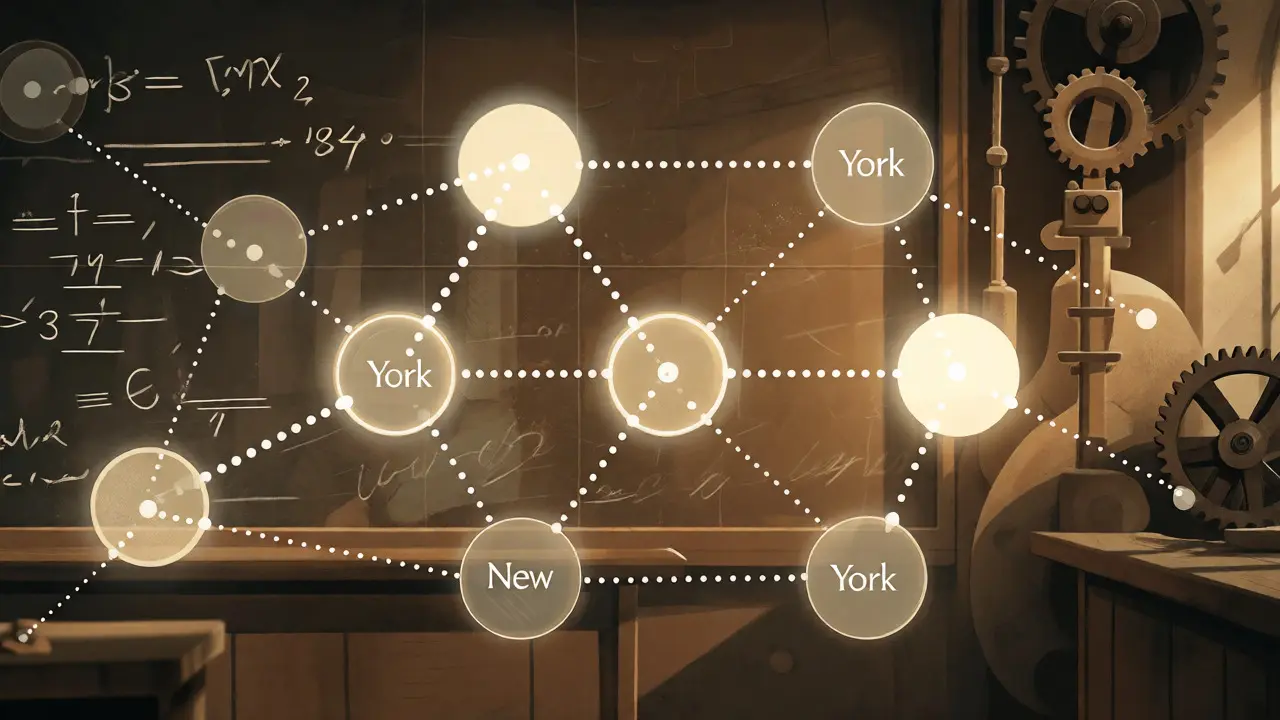
It all started with a Russian mathematician named Andrey Markov. Around 1913, he developed what we now call Markov chains. Think of these as simple prediction engines. They look at the current state and guess the next one based on probabilities. For example, if you see the word "New," a Markov model might predict "York" comes next because that's what happened most often in the training data. These models didn't understand language; they just counted patterns. Yet, they laid the groundwork for every sequence-generating system we use today.
By the 1950s, researchers were using variations like Hidden Markov Models (HMMs) to process speech. These systems could model time-series data better than simple counts. But they hit a wall. They couldn't remember long conversations or complex structures. If you asked an HMM-based system to translate a long sentence, it often forgot the beginning by the time it reached the end. That limitation would haunt the field for decades.
The Birth of AI and Early Failures
In 1956, John McCarthy coined the term "Artificial Intelligence" at the Dartmouth Summer Research Project. Optimism was sky-high. People thought machines would soon match human intelligence. Alan Turing had already proposed his famous test in 1950, shifting the focus from internal consciousness to observable behavior. If a machine acts smart, does it matter if it thinks?
The first real taste of generative AI came with ELIZA in the mid-1960s. Created by Joseph Weizenbaum at MIT, ELIZA used pattern matching to simulate conversation. It didn't generate new ideas; it just swapped words around. But humans loved it. They talked to it like a therapist, ignoring its mechanical nature. This became known as the "ELIZA Effect." We tend to anthropomorphize computers, even when they're just stringing together pre-written phrases.
Then came the crash. Expectations outpaced reality. By the mid-1970s, funding evaporated. This period, known as the first AI Winter, stalled progress for years. Researchers realized that simple rule-based systems couldn't handle the complexity of the real world. We needed something that could learn, not just follow rules.
The Rise of Neural Networks
Frank Rosenblatt changed the game in 1958 with the perceptron. This was the first operational neural network capable of learning from diverse data. Unlike rigid programs, the perceptron adjusted its internal weights based on errors. It was crude by today's standards, but it proved machines could learn from experience.
Progress was slow until Recurrent Neural Networks (RNNs) emerged in the 1980s. RNNs added memory. They could process sequences by maintaining an internal state that considered prior inputs. Suddenly, AI could handle time-dependent data like text or audio. But RNNs had a fatal flaw: they struggled with long-term dependencies. Information from the start of a long paragraph would fade away before reaching the end.
Jürgen Schmidhuber solved this in 1997 with Long Short-Term Memory (LSTM) networks. LSTMs introduced specialized memory cells that could retain information across extended sequences. Think of it as adding sticky notes to the brain. If something was important, the LSTM remembered it. By 2001, Schmidhuber demonstrated that LSTMs could learn formal languages that traditional models couldn't touch. This bridged the gap between symbolic reasoning and neural processing.
The Generative Breakthrough: GANs and VAEs
For a while, AI was mostly about classification-telling cats from dogs. Generating new content was hard. That changed in 2014 when Ian Goodfellow introduced Generative Adversarial Networks (GANs). GANs work like a counterfeit artist and a detective. One network generates fake data, and another tries to spot the fakes. They compete, forcing the generator to get better. This approach revolutionized image generation.
Around the same time, Variational Autoencoders (VAEs) offered a different path. Instead of competing, VAEs learned to compress data into a latent space and then reconstruct it. This allowed for smooth interpolation between data points. You could morph one face into another seamlessly. While GANs dominated headlines for their realism, VAEs provided stability and probabilistic insights.
Diffusion models also entered the scene around 2015. Initially overshadowed by GANs, they worked by gradually adding noise to an image and then learning to reverse the process. This method turned out to be incredibly stable and high-quality, eventually powering tools like Stable Diffusion and Midjourney.
The Transformer Revolution
The pivotal moment arrived in 2017. A team at Google published "Attention is All You Need," introducing the Transformer architecture. This paper eliminated recurrence entirely. Instead of processing words one by one, transformers used self-attention mechanisms to weigh the importance of every word in relation to every other word simultaneously.
This shift enabled massive parallelization. LSTMs processed sequences sequentially, which was slow. Transformers could process entire sentences at once, leveraging modern GPUs efficiently. The computational trade-off was significant: transformers required O(n²) memory for attention matrices, but given the exponential growth in GPU power, this was acceptable. NVIDIA's hardware advancements accelerated transformer training by 10-100x compared to CPU-based LSTM implementations.
OpenAI capitalized on this immediately. In 2018, they released GPT-1, the first Generative Pre-trained Transformer. It wasn't perfect, but it showed promise. Then came GPT-2 in 2019 with 1.5 billion parameters, and GPT-3 in 2020 with 175 billion parameters. As models scaled, they exhibited emergent capabilities. Few-shot learning became possible. You could ask GPT-3 to summarize a text or write code with just a few examples, no fine-tuning required. Larger LSTM implementations rarely exceeded 100 million parameters due to instability, so this scale jump was unprecedented.
Current State and Limitations
Today, transformers dominate the landscape. Tools like DALL-E and Midjourney combine transformers with diffusion models to create photorealistic images from text. GPT-4, released in March 2023, processes inputs up to 25,000 words and demonstrates improved reasoning. But these systems aren't without flaws.
They are computationally expensive. Training GPT-3 consumed approximately 1,300 megawatt-hours of electricity. They also struggle with precise mathematical reasoning despite strong linguistic performance. Geoffrey Hinton, often called the Godfather of AI, worries that transformers lack explicit world models. They predict the next word, but do they understand the physics behind it? Probably not.
Enterprise adoption reflects both excitement and caution. Gartner predicts 80% of enterprises will deploy generative AI by 2026, up from less than 5% in 2023. However, many implementations fail due to poor data strategies. Integration requires re-engineering existing pipelines. Developers report challenges with controlling output consistency and managing costs.
| Architecture | Year Introduced | Key Mechanism | Primary Limitation |
|---|---|---|---|
| Markov Chains | ~1913 | Probabilistic state transitions | No long-term memory |
| LSTM | 1997 | Gated recurrent units | Sequential processing (slow) |
| GANs | 2014 | Generator vs. Discriminator | Training instability |
| Transformers | 2017 | Self-attention mechanism | O(n²) memory complexity |
What Comes Next?
The market is exploding, projected to reach $110.8 billion by 2030. Open-source alternatives like Meta's Llama 2 have gained traction, offering customizable options. But researchers know transformers aren't the final answer. New architectures like Mamba, which uses state-space modeling, aim to overcome the quadratic complexity issue. Retrieval-Augmented Generation (RAG) is becoming standard practice to reduce hallucinations by grounding models in external data.
We are still in the early chapters. Current models excel at mimicking human-like text, but true understanding remains elusive. The next breakthrough might come from combining transformers with energy-based models or neuro-symbolic approaches. Until then, we keep scaling up, hoping that quantity eventually leads to quality.
Why did AI go through "winters"?
AI winters occurred when hype exceeded technological capability. In the 1970s and 1980s, early systems failed to deliver on promises of general intelligence, leading to drastic cuts in government and corporate funding. Progress resumed only when new algorithms and hardware made viable applications possible.
How do Transformers differ from LSTMs?
LSTMs process data sequentially, meaning they must read a sentence word-by-word, which limits speed and long-range memory retention. Transformers use self-attention to process all words simultaneously, allowing them to capture relationships between distant words much more effectively and train faster on parallel hardware.
Are Generative AI models conscious?
No. Current models, including those based on Transformers, do not possess consciousness or subjective experience. They predict the next token in a sequence based on statistical patterns learned during training. While they can mimic conversation convincingly, they lack an internal understanding of meaning or intent.
What is the ELIZA Effect?
The ELIZA Effect refers to the tendency of humans to attribute intelligence and emotion to computer programs, even when the program is simply using basic pattern matching. Named after the 1960s chatbot ELIZA, it highlights how easily users can be fooled by superficial conversational cues.
Why are Transformers so expensive to run?
Transformers require massive amounts of computational power due to their large number of parameters and the quadratic memory cost of self-attention mechanisms. Training large models like GPT-3 consumes megawatt-hours of electricity, and inference requires high-end GPUs with substantial VRAM, driving up operational costs.
Charles Reah
September 27, 2026 AT 13:12It is fascinating to see the lineage from Markov chains to modern LLMs. As someone who has mentored many junior developers, I often tell them that understanding the history prevents us from repeating past mistakes. The shift from sequential processing in RNNs to parallel attention mechanisms in Transformers was not just an engineering tweak; it was a fundamental paradigm shift. We must remember that while we celebrate the capabilities of GPT-4, the computational cost remains a significant barrier for smaller enterprises. It is crucial for new engineers to grasp these foundational concepts rather than treating AI as a black box. Let's ensure we are building on solid ground.
Kieran Mitchell
September 29, 2026 AT 03:58Absolutely!!! This article finally gets it right!!! For years, the media has been screaming about 'magic' and 'consciousness,' but this post cuts through the BS with cold, hard facts!!! The transition from LSTM to Transformers wasn't some accident-it was inevitable because American tech giants like Google and OpenAI had the GPU infrastructure to crush everyone else!!! People need to stop pretending that open-source models can compete with the raw power of US-based closed models!!! The O(n²) complexity mentioned here is exactly why only those with massive capital can play in this game!!! It’s not just about math; it’s about dominance!!!
Sean Eagen
September 30, 2026 AT 13:50you guys are missing the point entirely. its not about gpu dominance or whatever. its about ethics. we are training machines on data scraped without consent and calling it progress. markov didn't steal your diary entries. these companies did. we should be ashamed of how lazy our industry has become. just scaling up parameters isn't intelligence, it's brute force bullying. fix the data pipeline before you brag about watts consumed.
LoriBeth Blair
October 1, 2026 AT 20:54This is all wrong. You're conflating correlation with causation. The reason Transformers won isn't just parallelization; it's the specific architecture of self-attention allowing for better gradient flow during backpropagation. Anyone who actually reads the original papers knows that LSTMs suffer from vanishing gradients, which is why they couldn't scale beyond 100 million parameters effectively. Saying it's just about 'GPU power' is a layman's oversimplification that ignores the mathematical elegance of the solution. If you don't understand the difference between a hidden state and an attention matrix, you shouldn't be commenting on technical history. This post is decent, but your comments reveal a lack of depth.
william mcstay
October 3, 2026 AT 01:09Agreed with the nationalist take above. While others worry about ethics, we focus on results. The US leads because we invest in hardware first. Simple as that.