
Imagine asking a super-smart friend to calculate 12345 * 6789. They might get it wrong. But if you hand them a calculator, they nail it every time. This is the core problem with Large Language Models (LLMs): they are brilliant at language but terrible at precise execution. They hallucinate facts and stumble on basic math because they predict words, not truths. Enter Toolformer, a breakthrough approach that teaches models to grab their own calculators and search engines when needed.
Toolformer is a method for training language models to autonomously decide when and how to use external tools via simple APIs. Developed by researchers at Meta AI and presented at NeurIPS 2023, this technique doesn't just bolt tools onto a model; it integrates them into the model's very thought process through self-supervision. You don't need thousands of human-labeled examples showing exactly when to call an API. Instead, the model figures it out itself. This article breaks down how Toolformer works, why it matters for building reliable AI agents, and where its limits lie.
The Core Problem: Why LLMs Need Help
Standard LLMs like GPT-3 or Llama are trained to predict the next token in a sequence. This makes them incredible writers and coders, but poor fact-checkers. If you ask a standard model "What is the capital of Australia?", it relies on statistical patterns from its training data. It might say Sydney because that word appears frequently near "capital" and "Australia" in news articles, even though Canberra is the correct answer. Worse, if you ask it to perform arithmetic, it often fails because it hasn't learned the algorithm of multiplication; it has only memorized common number sequences.
Prior solutions involved fine-tuning models on specific tasks or using complex frameworks like ReAct (Reasoning and Acting). These approaches required extensive human annotation-people had to manually label thousands of examples saying, "Here, you should use the calculator," or "Here, you should search Wikipedia." This is expensive, slow, and rigid. What if the model finds a different way to solve the problem than the human annotator expected? Toolformer solves this by letting the model teach itself.
How Toolformer Works: The Self-Supervised Loop
The magic of Toolformer lies in its ability to generate its own training data. It starts with a pre-trained language model, specifically the 6.7 billion parameter GPT-J model. The goal is to fine-tune this model so it inserts API calls into text naturally, just as a human would insert a footnote or a citation.
The process follows a rigorous four-step cycle:
- Sample Potential Calls: The model scans a large dataset of raw text. For each segment, it proposes potential API calls. For example, if it sees "The population of Tokyo is...", it suggests calling a knowledge base API.
- Execute the Calls: The system actually runs these proposed API calls. It queries the calculator, searches Wikipedia, or translates text.
- Filter for Utility: This is the critical step. The model checks if the result of the API call helps it predict the subsequent tokens better. If inserting the result "Canberra" reduces the loss (error rate) for predicting the rest of the sentence compared to not using the tool, the call is kept. If the tool adds noise or confusion, the call is discarded.
- Fine-Tune: The model is then trained on the filtered dataset, which now contains high-quality examples of useful tool usage.
This loop ensures that the model only learns to use tools when they actually help. It doesn't force a calculator call on a poem, nor does it ignore a search engine when asked about recent events. The supervision comes from the model's own performance metrics, not human bias.
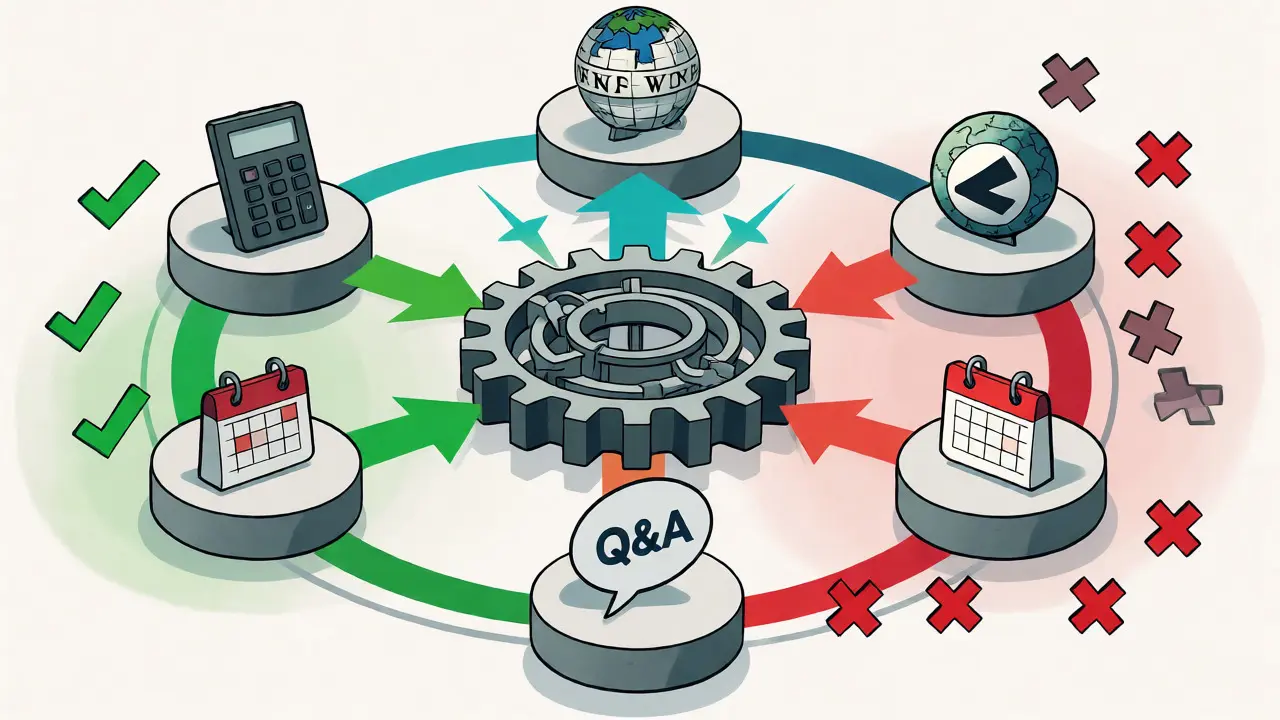
The Toolbox: Five Key APIs
Toolformer wasn't designed to be a universal agent capable of booking flights or sending emails right out of the box. It was tested with five specific, stateless tools. "Stateless" means the API doesn't remember previous interactions; each call is independent. This simplifies the integration significantly.
| API Type | Function | Example Use Case |
|---|---|---|
| Calculator | Mathematical operations | Solving sqrt(144) or 100 / 7 |
| Q&A System | Extractive question answering | Answering factual questions from context |
| Wikipedia Search | Information retrieval | Looking up entity definitions or history |
| Translation | Language conversion | Translating phrases between languages |
| Calendar | Date and time lookup | Determining day-of-week or holidays |
By representing these APIs as text sequences, Toolformer treats them like any other part of the vocabulary. An API call looks like a special token sequence inserted into the text stream. When the model generates text, it can output this sequence, pause, wait for the API response, and then continue generating based on that new information. This seamless integration is what allows the model to maintain fluency while gaining precision.
Performance: Small Model, Big Results
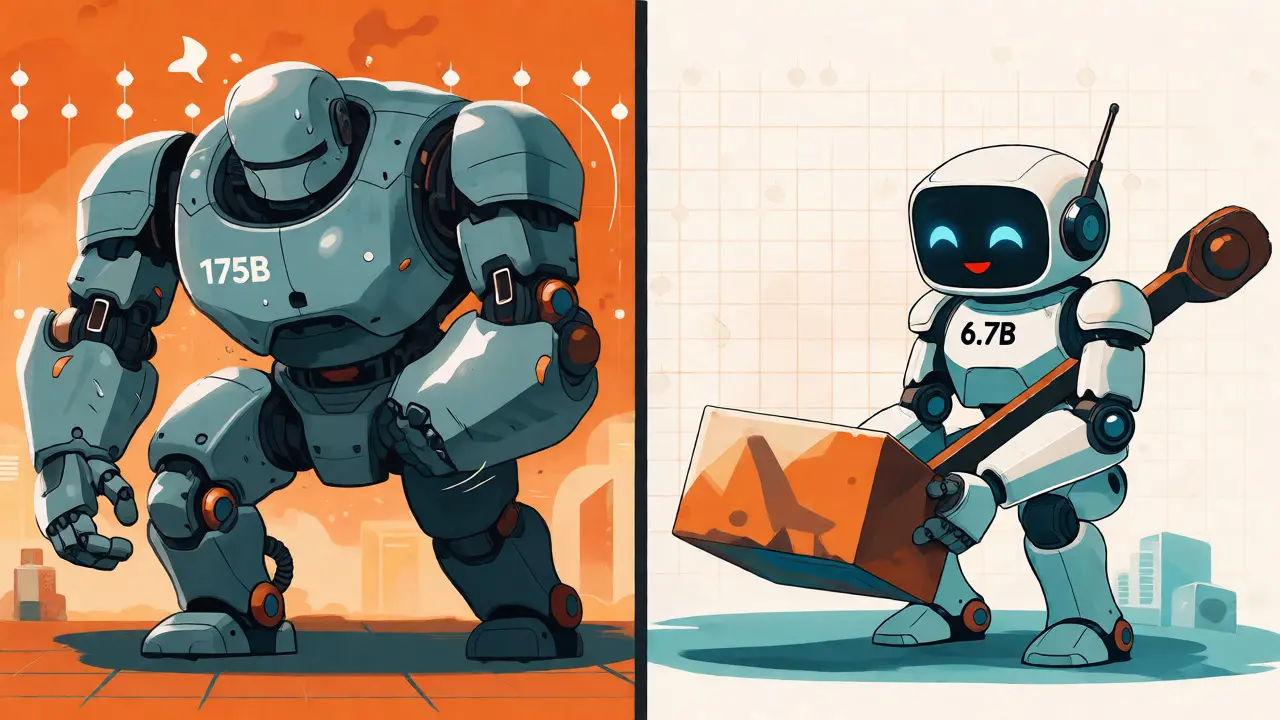
You might expect that adding tools requires a massive model. Toolformer proves otherwise. By fine-tuning the relatively small 6.7B parameter GPT-J model, researchers achieved zero-shot performance that competed with much larger models like GPT-3 (175B parameters).
On mathematical reasoning benchmarks, Toolformer significantly outperformed the baseline GPT-J model. It didn't just guess; it calculated. On open-domain question answering, it leveraged Wikipedia searches to provide accurate answers where the original model would have hallucinated. Crucially, it did this without sacrificing its core language modeling abilities. The model didn't become robotic or lose its creative writing skills. It simply gained the option to verify facts and do math when necessary.
This efficiency is a game-changer. Running a 6.7B model is far cheaper and faster than running a 175B model. If you can achieve similar accuracy on key tasks by teaching a smaller model to use tools, you save significant computational resources. For developers building apps, this means lower latency and lower costs per query.
Limitations: The Stateful Barrier
Despite its elegance, Toolformer has clear boundaries. The primary limitation is its reliance on stateless APIs. A calculator gives the same answer for 2+2 regardless of whether you asked it yesterday or today. Wikipedia search returns static information. But real-world tasks often involve state.
Consider booking a hotel room. You need to know the dates, the location, the price, and availability. If you change the date, the price changes. The system must track the conversation history (the state) to make sense of subsequent requests. Toolformer struggles here because its architecture doesn't inherently manage complex dialog states. It treats each interaction somewhat independently. While later frameworks like ASTRO (Autoregressive Search-Taught Reasoner) attempt to address some of these reasoning gaps, Toolformer itself remains best suited for tasks where the tool's output is deterministic and context-independent.
Another constraint is the definition of "usefulness." The model filters API calls based on whether they reduce prediction loss on the next few tokens. Sometimes, a tool provides crucial long-term context that doesn't immediately improve the next word prediction. In such cases, the model might discard a helpful call. However, in practice, most immediate utility aligns well with predictive accuracy.
Why This Matters for Future AI Agents
Toolformer represents a shift from "prompt engineering" to "capability augmentation." Previously, we tried to trick models into being smarter by giving them better instructions. Toolformer suggests we should give them better limbs. As AI moves toward autonomous agents, the ability to self-supervise tool use is critical. We cannot manually annotate every possible scenario where an agent needs to check a stock price or convert currency.
The methodology also highlights a philosophical point: what humans think is useful isn't always what a model finds useful. By letting the model decide, we avoid imposing our biases on its learning process. This leads to more robust generalization. If a new API becomes available, you can add it to the toolbox with minimal demonstrations, and the model will learn to integrate it based on its own performance feedback.
For developers, this means less time spent crafting perfect prompts and more time designing clean, text-based APIs. The future of LLM applications isn't just about bigger models; it's about smarter integrations. Toolformer shows that a modestly sized model with the right tools can outperform a giant model flying blind.
Does Toolformer require human annotations?
No, Toolformer uses a self-supervised approach. It only requires a handful of human-written demonstrations per API to initialize the process. The bulk of the training data is generated automatically by the model evaluating the usefulness of its own API calls against a large unlabeled dataset.
Can Toolformer handle complex tasks like booking flights?
Not directly. Toolformer is optimized for stateless APIs like calculators and search engines. Tasks requiring Dialog State Tracking, such as booking flights or managing shopping carts, involve maintaining context across multiple turns. Toolformer's current implementation struggles with these stateful interactions, though newer research builds upon its foundation to address this.
How does Toolformer compare to ReAct?
ReAct (Reasoning and Acting) typically relies on chain-of-thought prompting and explicit action spaces defined by humans. Toolformer differs by using self-supervised fine-tuning. It learns to insert API calls implicitly within the text generation process, rather than following a structured prompt template. This makes Toolformer more scalable regarding annotation efforts.
What model size is recommended for Toolformer?
The original paper used the 6.7 billion parameter GPT-J model. This demonstrates that you do not need massive 100B+ parameter models to benefit from tool integration. Smaller, efficient models can achieve competitive performance on tool-dependent tasks when properly fine-tuned with the Toolformer methodology.
Is Toolformer a commercial product?
No, Toolformer is a research framework and methodology published by Meta AI. It is not a standalone software product you can buy. Developers implement its concepts by fine-tuning existing language models and integrating custom APIs according to the self-supervised training pipeline described in the paper.
Anthony .
October 4, 2026 AT 09:52This is such a cool perspective! 🤔 It really makes you think about how we define intelligence. Maybe the smartest thing isn't knowing everything, but knowing when to ask for help. 🌟 That's a beautiful metaphor for life too, honestly. We don't have to be perfect calculators; we just need to know which tools to pick up. 🛠️💡
Lauren Martin
October 5, 2026 AT 22:55Let's cut through the fluff. This isn't some magical breakthrough; it's basic optimization wrapped in academic jargon to secure funding. The self-supervised loop is essentially brute-force filtering with extra steps. You're paying for compute to figure out what any competent engineer would hard-code in ten minutes. The 'utility filter' is just a loss function check, nothing more. Stop pretending this is novel reasoning. It's statistical curve fitting with an API wrapper. If your model can't handle stateful interactions without massive architectural overhauls, it's not an agent; it's a toy. The industry loves these incremental tweaks because they look good on slides but fail in production environments where latency and context management actually matter. 🙄📉
Ian Mason-Laurence
October 7, 2026 AT 22:31It is worth noting that the original Toolformer paper explicitly limits its scope to stateless APIs for a reason. Many commenters here seem to overlook the distinction between simple retrieval augmentation and complex agentic workflows. The GPT-J baseline was chosen specifically to demonstrate parameter efficiency, not to replace frontier models entirely. Furthermore, the reduction in perplexity is a direct result of improved token prediction probabilities, not necessarily semantic understanding. One must be careful not to anthropomorphize the probability distributions. The model does not 'decide' in the human sense; it minimizes cross-entropy loss. Precision in terminology matters if we are to advance the field correctly.
Tommy Cahyadi
October 9, 2026 AT 01:27Sure, sure. Another way to make us pay more for electricity so Big Tech doesn't have to write better code. 😒
Marisa Marroquin
October 9, 2026 AT 07:03I find the elegance of this approach quite poetic, in a cold, digital sort of way. It’s like teaching a poet to use a dictionary mid-sentence without breaking their rhythm. The idea that the model learns *when* to pause and consult external truth is fascinatingly humble. It suggests that humility-admitting one doesn’t know-is computable. I appreciate the restraint in using smaller models; there is a certain beauty in doing more with less, rather than just throwing raw power at the problem until it breaks. ✨📚
Ejike Ugwu
October 9, 2026 AT 10:09They are hiding the real cost from us.
Think about it. Why do they want small models? Because they want to run them on YOUR device. They are training us to rely on their cloud APIs. Once the model knows it needs a calculator, who owns the calculator? Meta. Who owns the search engine? Meta. You are just feeding data into their black box. It looks like progress, but it is dependency.
We are becoming dumb users of smart machines that we cannot control. Wake up. The 'self-supervision' is just them watching us watch them. 👁️👀
Kathy Mccoy
October 9, 2026 AT 15:35I love seeing these kinds of innovations! It’s great that researchers are finding ways to make AI more reliable without needing huge amounts of labeled data. For anyone trying to build their own agents, this is a solid foundation. Keep experimenting and remember that every tool you add should serve a clear purpose for your user. You’ve got this! 💪😊
evelyn starcher
October 10, 2026 AT 15:32Finally, someone admits LLMs are stupid without tools! 🇺🇸🦅 We built the best tech in America, but our models still can't count right. It's embarrassing. But hey, at least Meta figured it out before China did. We need to keep pushing American innovation. Don't let those other countries catch up with their cheap labor and copycat research. USA! USA! 🇺🇸🇺🇸🇺🇸
Shaina Silver-Baird
October 11, 2026 AT 19:28The implications of autonomous tool selection are deeply unsettling. Consider the privacy ramifications: if a model decides to query Wikipedia or a calendar API, it is transmitting contextual data to third-party servers. We assume this is benign, but metadata leakage is a well-documented phenomenon in distributed systems. Furthermore, the reliance on 'stateless' interactions creates a fragmented memory structure. Is the model truly learning, or is it merely indexing? The lack of persistent state means that each interaction is isolated, potentially leading to inconsistent behavioral patterns over time. We must scrutinize the underlying infrastructure assumptions before celebrating this as a solution to hallucination. It may simply be moving the error rate from generation to retrieval.
Kathleen Johnson
October 12, 2026 AT 17:42While the methodology is sound, the article glosses over the computational overhead of the sampling phase. Generating potential calls for every segment is expensive. Also, the comparison to ReAct is lazy; ReAct allows for iterative refinement, whereas Toolformer is largely single-pass. The 'limitation' section is too brief. Statefulness is not just a barrier; it is the fundamental difference between a chatbot and an assistant. Calling this a 'breakthrough' feels like marketing hyperbole typical of NeurIPS papers. Good effort, though. 🤷♀️