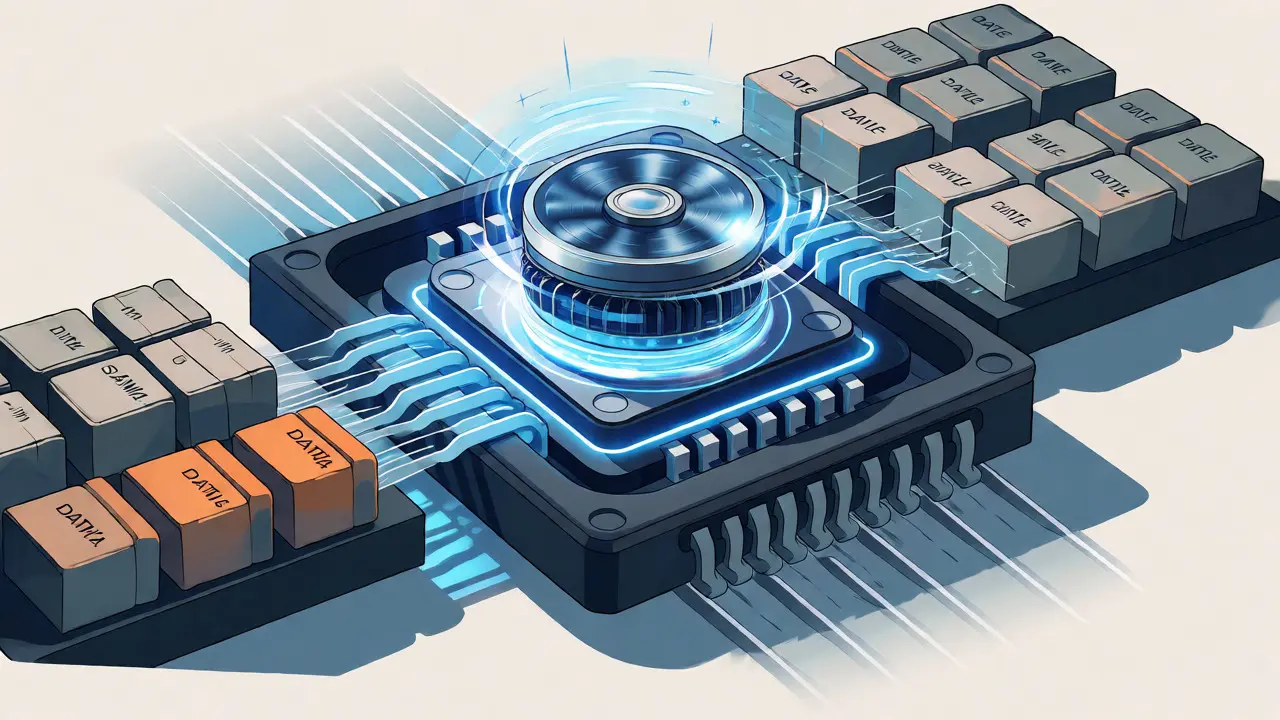
You want to make your AI smarter. You add more parameters, feed it more data, and run it longer. But then you hit a wall. It’s not a code bug or a training error; it’s physics. The Large Language Models are hitting hard physical limits in the hardware that powers them. We are currently living through a paradox where our desire for larger models outpaces the speed at which we can build chips, cool servers, and supply electricity.
If you’re building or deploying AI, understanding these bottlenecks is no longer optional-it’s essential for budgeting and strategy. Let’s break down exactly why scaling LLMs is becoming exponentially harder, focusing on memory, power, and interconnects.
The Memory Wall: Compute Is Fast, Data Movement Is Slow
The biggest headache in LLM scaling isn’t raw calculation speed; it’s moving data around. Modern GPUs like the NVIDIA H100 and H200 are incredibly fast at math. They can perform trillions of operations per second. But they spend a huge chunk of that time just waiting for data to arrive from memory. This is known as the memory-compute imbalance.
Here’s the reality: A single H100 has 80GB of High Bandwidth Memory (HBM). The newer H200 bumps this to 141GB. Sounds like a lot? For a 70-billion parameter model, it’s barely enough. When you factor in optimizer states, gradients, and activations needed for training, a full-precision (FP32) setup requires roughly 280GB of memory just to hold the state of the model. That means you cannot fit even a mid-sized model on a single modern GPU without aggressive tricks.
- Registers: Ultra-fast but tiny capacity.
- L2 Cache: Faster than main memory but still limited.
- VRAM (HBM): The largest pool, yet often the bottleneck.
Because VRAM is finite, developers rely on quantization-reducing precision from FP32 to FP16 or INT8-to squeeze models into available space. While this saves memory, it introduces numerical instability and can degrade model quality. You’re trading accuracy for feasibility.
Power and Thermal Limits: The Silent Killer of Scaling
People often forget that AI clusters are essentially heat generators. An NVIDIA H100 GPU draws up to 700 watts under full load. Multiply that by a cluster of 1,000 GPUs, and you’re looking at 700 kilowatts of continuous power draw. And that’s just the chips. Add networking, storage, and cooling systems, and the total facility power demand skyrockets.
Data centers have hard caps on how much power they can deliver per rack. Many facilities are already maxed out. If you want to double your model size, you might need to double your power infrastructure, which takes years to build and costs millions. Liquid cooling solutions, necessary for high-density racks, can cost over $50,000 per cabinet. At a certain point, economic and physical constraints on power delivery stop you before technical limits do.
Interconnect Bottlenecks: Talking Between Chips
Scaling usually means splitting a model across multiple GPUs. This requires those GPUs to talk to each other constantly. Inside a server, NVLink provides massive bandwidth-up to 900 GB/s between adjacent GPUs. But when you scale beyond a single node, communication slows down dramatically.
Cross-node communication relies on technologies like InfiniBand, offering around 200 GB/s. In a 1,000-GPU cluster, synchronizing gradients becomes a major bottleneck. GPUs sit idle waiting for data from their peers rather than computing. This is why simply adding more GPUs doesn’t always yield linear performance gains. The network becomes the limiting factor.
| Constraint Type | Training Impact | Inference Impact |
|---|---|---|
| Memory Capacity | Must store weights, gradients, and optimizer states (high demand) | Only needs weights and KV cache (lower demand) |
| Compute Power | High sustained compute for backpropagation | Spiky compute bursts; latency-sensitive |
| Interconnect | Critical for gradient synchronization across nodes | Less critical if model fits on one node; otherwise sharding overhead |
| Cost Driver | Cluster size and duration | Throughput per user and concurrency |
Mixture of Experts: A Band-Aid or a Cure?
To bypass some of these memory limits, researchers turned to Mixture of Experts (MoE) architectures. Instead of activating every neuron for every token, MoE routes inputs to specific "expert" sub-networks. This allows models to grow in total parameter count while keeping active parameters manageable during inference.
Research frameworks like MoE-Lens show that optimizing MoE serving can boost throughput by up to 4.6x compared to standard dense models. However, MoE isn’t free. It introduces complex routing logic and load balancing issues. If one expert gets overloaded while others sit idle, you waste hardware. Furthermore, the communication overhead to route tokens to the right experts can eat into the efficiency gains. MoE helps mitigate hardware constraints, but it doesn’t eliminate them.
Sequence Length: The Quadratic Trap
Transformers have a dirty secret: their computational complexity scales quadratically with sequence length. Double the context window, and you quadruple the memory and compute required for attention mechanisms. Moving from a 4,096-token context to an 8,192-token context doesn’t just double your needs; it makes them four times heavier.
This creates a severe constraint for applications needing long-context reasoning. To support 100,000+ token contexts, you either need massive batches (impossible due to memory) or new architectural approaches like sparse attention or retrieval-augmented generation (RAG). These alternatives shift the burden from pure compute to system complexity, introducing new failure points and latency risks.

Economic Reality: The Cost of Scaling
Let’s talk money. An H100 GPU costs approximately $40,000. A serious training run for a frontier model might require thousands of these units. But the GPU is only part of the bill. Infrastructure-cooling, power distribution, networking switches, and physical space-can consume 30-40% of the total budget.
A $1 billion budget sounds infinite until you realize it buys about 25,000 GPUs, minus the cost of the buildings and cables to keep them running. Cameron R. Wolfe’s analysis on RL Scaling Laws highlights that "proper investment of available compute" requires acknowledging that unlimited resources don’t exist. Economic constraints effectively cap the practical size of models for all but the wealthiest tech giants.
What Comes Next?
We aren’t seeing a revolution in chip design that instantly solves these problems. Instead, we see evolutionary improvements. The move from H100 to H200 increased memory by 75%, but that’s a drop in the bucket compared to the exponential growth of model sizes. Future progress depends on two things: better algorithms that use less hardware (like efficient fine-tuning and MoE) and specialized hardware designed specifically for transformer workloads.
For now, the smartest strategy isn’t just buying more GPUs. It’s optimizing how you use them. Techniques like mixed-precision training, gradient checkpointing, and careful batch sizing are no longer advanced tricks-they are survival skills.
Why can't we just add more GPUs to solve memory issues?
Adding GPUs increases total aggregate memory, but it introduces communication overhead. Data must be synchronized across GPUs via slower interconnects (like InfiniBand) compared to local VRAM. Beyond a certain cluster size, the time spent communicating gradients exceeds the time saved by parallel computation, leading to diminishing returns.
How does quantization help with hardware constraints?
Quantization reduces the precision of numbers stored in memory (e.g., from 32-bit floats to 8-bit integers). This shrinks the model size by 2-4x, allowing larger models to fit on existing hardware. However, it can lead to slight accuracy losses and requires careful implementation to avoid numerical instability during training.
Are Mixture of Experts (MoE) models cheaper to run?
Not necessarily. While MoE models activate fewer parameters per token (saving compute), they require more total memory to store all experts. They also incur higher complexity in routing and load balancing. Inference costs may decrease for specific tasks, but training MoE models is often more expensive and complex than dense models.
What is the impact of sequence length on hardware?
Transformer attention mechanisms scale quadratically with sequence length. Doubling the context window quadruples the memory and compute required for attention calculations. This severely limits batch sizes and forces trade-offs between context length and throughput unless using optimized sparse attention methods.
Is power consumption a real barrier to scaling AI?
Yes. Modern GPUs consume 700W+ each. Large clusters require megawatts of power, straining data center electrical grids. Cooling these systems also consumes significant energy. Power availability and thermal management often become the limiting factors before hardware performance capabilities are fully utilized.