Why AI Export Controls Are No Longer Optional
It’s 2026. Your team in Berlin trains an AI model using cloud compute from a U.S.-based provider. Your researcher in Bangalore accesses the same model through a shared portal. Your product launches in Singapore - but you didn’t check if it’s restricted. One mistake, and you could face a $1 million fine, a shipment delay of weeks, or worse - being blocked from selling to half the world.
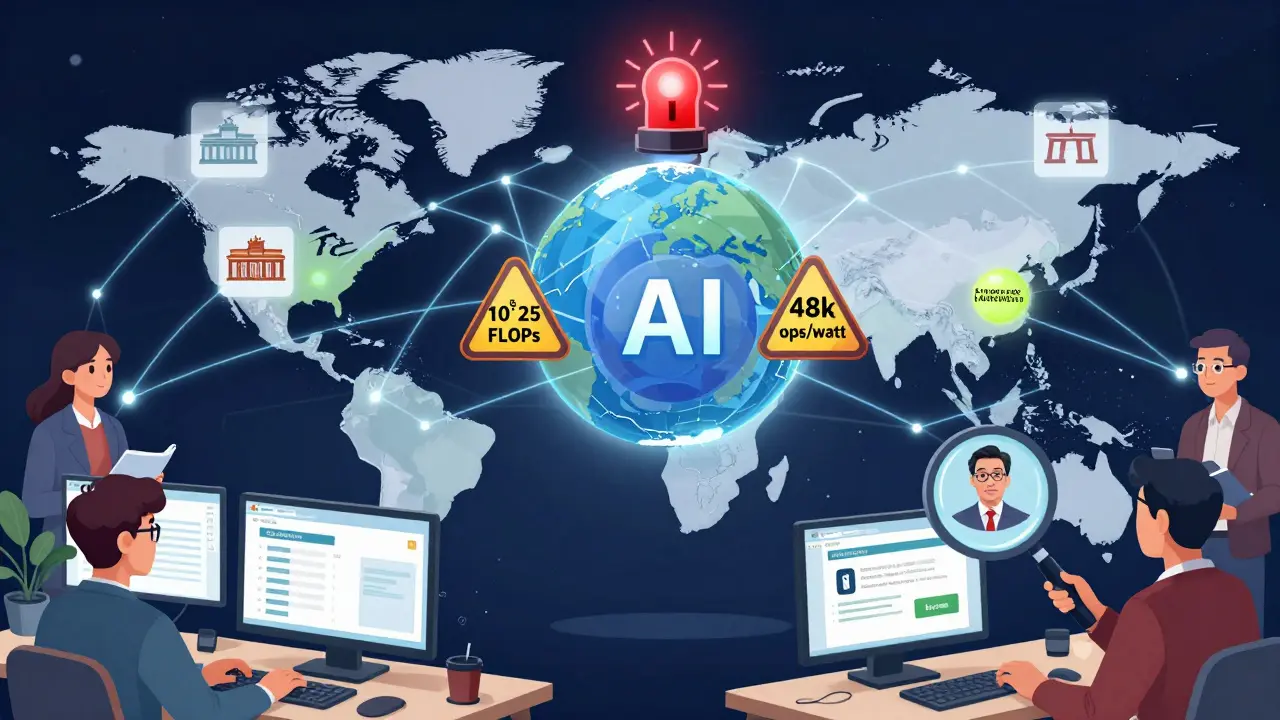
Export controls for AI models aren’t just legal paperwork anymore. They’re a make-or-break part of how global teams operate. The Bureau of Industry and Security (BIS) updated its rules on February 5, 2025, targeting AI models trained with more than 10^25 floating-point operations or those running at 48,000 AI operations per second per watt. These aren’t vague guidelines. They’re enforceable thresholds with real penalties.
And it’s not just the U.S. The EU’s Critical Entities Resilience Act (CERA) kicks in early 2026. The Wassenaar Arrangement now includes AI controls across 42 countries. If your team works across borders, you’re already in the crosshairs.
What Gets Controlled - And What You Might Be Missing
Most companies think export controls only apply to hardware or listed software. That’s a dangerous assumption. The real risk isn’t in the model itself - it’s in how it’s used.
The BIS rule doesn’t ban specific AI models. It bans exports based on performance. If your model can train faster than 10^25 operations, or run efficiently enough to outperform known military-grade systems, it’s controlled - even if you built it yourself in-house.
And here’s what most teams overlook: the “catch-all” rule. Even if your model doesn’t hit the performance threshold, if it’s going to a country or end-user that could use it for weapons, surveillance, or cyberattacks - you still need a license. The Department of Commerce created this rule in the 1990s for things like ordinary routers that could be repurposed. Now it applies to AI. A 2023 CSET analysis found that 68% of compliance failures came from ignoring catch-all controls, not the listed ones.
Examples? A language model trained to detect fraud in banking systems might be fine in Canada. But if that same model ends up in a country under sanctions, used to identify dissidents through social media scans - boom. You’re in violation.
Deemed Exports: The Hidden Trap in Your Office
Let’s say your team has a researcher from China working in your San Francisco office. They’re accessing your proprietary AI model on a local server. No physical export. No shipping. No cloud transfer.
Still a violation.
This is called a “deemed export.” Under U.S. law, sharing controlled technology with a foreign national on U.S. soil counts as an export to their home country. 57% of companies reported major compliance gaps in tracking who accessed what - especially in R&D labs where engineers move freely between teams.
It gets worse. If your model is controlled and a foreign national from a sanctioned country logs into your system from home in Mumbai, that’s also a deemed export. Your VPN doesn’t hide it. Your access logs might not even track it.
Companies that handle this well use automated access controls tied to nationality, location, and role. Microsoft’s Dynamics 365 can flag these scenarios, but only if you’ve configured it correctly. Many teams don’t. They assume “we’re all on the same network, so it’s safe.” That’s how audits go sideways.
Centralized vs. Decentralized Compliance: Which Works for Your Team?
Do you have one compliance officer in headquarters managing everything? Or do you have local experts in each region handling their own rules?
Smaller companies (under $500M revenue) often go centralized. It’s cheaper. One team, one system, one set of policies. BIS case studies show this cuts compliance costs by 28%.
But if you’re a global tech firm with offices in 12 countries? 63% of Fortune 500 companies choose decentralized. Why? Because regulations clash. The EU bans certain AI uses outright. The U.S. lets you export with a license. India has no formal rules yet - but could block your product tomorrow.
Decentralized teams need more people, but they adapt faster. A compliance officer in Tokyo knows local enforcement trends. One in Frankfurt understands GDPR overlaps with export rules. A single HQ team might miss those nuances.
Hybrid is the new norm. Most companies use a mix: core policies from HQ, local execution with regional officers. But this only works if systems are connected. If your Berlin team uses a different tool than your Singapore team, you’re flying blind. Integration matters more than structure.
Automation Isn’t a Luxury - It’s a Survival Tool
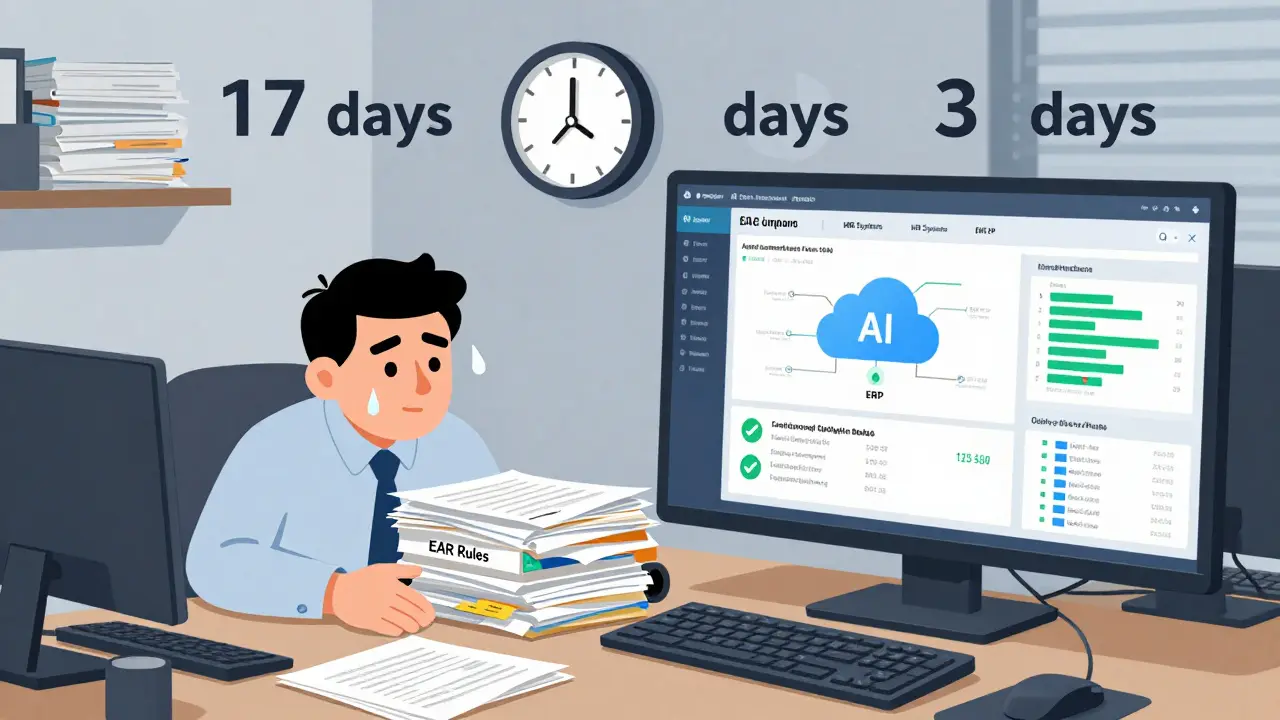
Manual export screening? It’s 17 days per shipment on average, according to S&P Global’s 2024 benchmark. That’s not just slow - it kills momentum. If your product launch is delayed because compliance couldn’t clear a model in time, you lose market share.
Automated systems cut that to 3 days. How? They pull data from your ERP (SAP, Oracle), your cloud platforms (AWS, Azure), your HR systems (who’s accessing what), and cross-check it against 195+ regulatory databases in real time.
AI tools trained on historical export data and regulatory texts hit 92% accuracy in classifying models. That’s not perfect - but it’s way better than a human reading 500 pages of EAR rules every week.
But here’s the catch: automation needs data. LLM-based tools need at least 50,000 past export records to learn what’s risky. If you’re a startup with only 2,000 transactions? Your AI tool will generate false positives 35% of the time. That means your team spends hours reviewing alerts that aren’t real threats.
Companies that win use tools like Microsoft Dynamics 365 with Power Platform extensions. They build custom rules - like “block exports to Russia if model exceeds 10^25 ops and was trained on U.S. cloud.” They don’t rely on out-of-the-box settings. They tune them.
What Your Compliance Program Is Missing
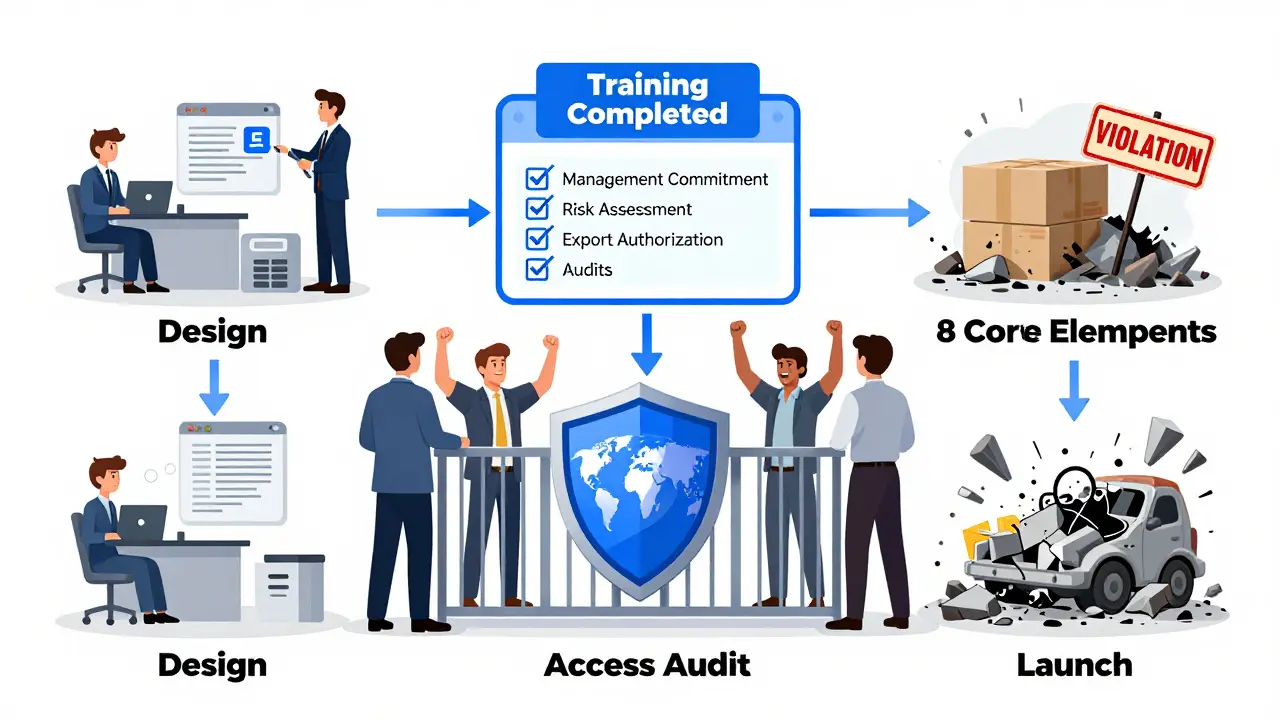
The Bureau of Industry and Security says an effective export compliance program has eight core elements. Most companies nail two: training and recordkeeping. They miss the rest.
Here’s what’s often missing:
- Management Commitment - Is your CEO talking about export controls in all-hands meetings? Or is it just the legal team’s problem?
- Risk Assessment - Do you map your models to jurisdictions, end-users, and potential misuse scenarios every quarter? Or do you wait for an audit to find out you’re exposed?
- Export Authorization - Do you have a clear process to request and track licenses? Or is it an email chain that gets lost?
- Audits and Violations - Are you proactively auditing? Or only fixing things after a fine hits?
McKinsey found that companies treating compliance as a checklist fail. Those embedding it into R&D, procurement, and sales workflows succeed. That means: when a new AI model is designed, compliance is in the room. Not after the code is written.
One semiconductor firm reduced violations by 89% by adding a compliance checkpoint at the “model training completed” stage in their product pipeline. Before that? 70% of their models were flagged after launch - too late to fix.
Training Your Team - Not Just the Software
AI export controls aren’t like GDPR. You can’t just buy a course and check the box. The rules change monthly. The thresholds are technical. The consequences are severe.
Microsoft’s certification program requires 80 hours of training just on AI classification. That’s not optional. In 2025, McKinsey found compliance teams without AI expertise were 4.2x more likely to miss critical restrictions.
What does good training look like?
- Real-world scenarios: “Your model is used to optimize drone flight paths. Is that a military end-use?”
- Role-specific modules: Engineers learn how to measure compute usage. Legal learns license types. Sales learns what to ask customers.
- Quarterly refreshers: Not annual. Quarterly. Because the rules change that fast.
One team in Toronto started running monthly “Compliance War Games” - simulating export scenarios with fake customers and hidden sanctions. Their violation rate dropped 64% in six months.
The Cost of Getting It Wrong - And Right
Penalties can hit $1 million per violation - or twice the value of the transaction. But the real cost? Lost opportunity.
Companies that handle compliance well get faster market access. They ship products faster. They win contracts in restricted markets because they can prove they’re low-risk. McKinsey tracked companies that navigated the 2019-2020 Entity List restrictions - they grew 3.2x faster than peers who didn’t.
On the flip side: 68% of companies that treat compliance as a back-office function get blocked from key markets. One AI startup in Austin lost a $12M deal with a European bank because they couldn’t prove their model didn’t use U.S.-origin training data. They didn’t even know it mattered.
Market data shows the export compliance software market will hit $7.8 billion by 2025. That’s not because companies are being forced to spend - it’s because they’re realizing the cost of not spending is higher.
Where to Start - A Realistic 90-Day Plan
You don’t need to fix everything tomorrow. But you need to start now.
Here’s a practical 90-day plan:
- Week 1-2: Map your AI models. List every model your team has trained or uses. Note where it was trained, what compute was used, and who has access.
- Week 3-4: Identify controlled models. Check if any hit the 10^25 ops or 48k ops/watt thresholds. Use free tools from BIS or CSET to estimate compute.
- Week 5-8: Audit access. Who can access these models? Are foreign nationals using them? Are they in sanctioned countries? Use your IT team to pull access logs.
- Week 9-12: Pick one tool to pilot. If you’re small, start with Excel + manual checks. If you’re large, test Dynamics 365 or a similar platform. Don’t buy everything at once.
Don’t wait for a fine to wake you up. The next audit is coming. The next shipment is already queued. The next model is being trained right now.
Final Thought: Compliance Is a Competitive Edge
Export controls aren’t about slowing you down. They’re about making sure you don’t get stopped.
Companies that treat compliance as a strategic function - not a legal burden - move faster, enter new markets sooner, and build trust with global partners. The teams that win aren’t the ones with the biggest budgets. They’re the ones who understand the rules before the regulators do.
Start today. Your next product launch depends on it.
Taylor Hayes
January 21, 2026 AT 11:45Just read this and had to pause. I work in a startup where we’re building AI for healthcare diagnostics, and I never realized our model might be flagged just because it’s efficient. We’re using AWS, our lead dev is from India, and we’re planning to deploy in Brazil next month. This isn’t just legal stuff - it’s a real operational nightmare waiting to happen. Thanks for laying it out so clearly.
Sanjay Mittal
January 23, 2026 AT 01:26As someone working in Bangalore, I’ve seen this firsthand. We had a project get frozen for 3 months because our US team didn’t realize that even accessing a model from here counts as a deemed export. No one told us. No training. Just silence until the audit came. The real problem? Most engineers think ‘export’ means shipping hardware. It’s not. It’s data, access, knowledge - all of it. Fix this before your team gets blindsided.
Mike Zhong
January 23, 2026 AT 13:49Let’s be real - this whole system is a corporate witch hunt dressed up as ‘national security.’ You’re telling me a model trained on cloud compute that happens to be fast is now a weapon? Who decided 10^25 ops is the magic number? Did they test it on a toaster? The fact that companies are paying millions for ‘compliance software’ while actual hackers laugh at this nonsense is the real tragedy. This isn’t regulation - it’s economic protectionism with a fancy acronym.
Jamie Roman
January 23, 2026 AT 21:15I’ve spent the last 6 months trying to get my team to even *talk* about this, and honestly? It’s been like teaching calculus to pigeons. Engineers care about accuracy. Product teams care about launch dates. Legal? They’re buried in emails. The biggest gap isn’t the tech - it’s the culture. Nobody feels responsible. We need to stop treating compliance like a box to check and start treating it like a shared mission. I started a weekly 15-minute ‘Compliance Check-In’ in our standups - just one question: ‘Did anyone touch a model with foreign access this week?’ It sounds dumb. It’s saved us from two near-misses already. Small steps. Big impact.
Salomi Cummingham
January 25, 2026 AT 20:22Oh my god. I just read this and my hands are shaking. I work in a London-based AI firm with a team in Lagos, a developer in Seoul, and we use Azure. We thought we were ‘fine’ because we’re not in the US. But the ‘deemed export’ thing? That’s terrifying. I had a colleague from Nigeria working remotely from home last month - and she had full access to our model. We didn’t even know it was a thing. I just sent an email to HR to flag her nationality in the system. I’m not proud of how late we are. But I’m proud we’re fixing it now. This isn’t fear-mongering - it’s survival. And we owe it to our team to get it right.
Johnathan Rhyne
January 27, 2026 AT 04:58Y’all are treating this like it’s rocket science. It’s not. It’s just paperwork with extra steps. And no, ‘48k ops/watt’ isn’t some mystical threshold - it’s a number pulled out of someone’s butt after too much coffee. Also, ‘deemed export’? That’s not even a real legal term - it’s bureaucratic jargon invented to make lawyers feel important. And don’t get me started on ‘hybrid compliance.’ Sounds like someone tried to make a PowerPoint look like a strategy document. Just use a spreadsheet. And stop calling it ‘automation’ - if your tool can’t tell the difference between a fraud detector and a drone controller, it’s not AI, it’s a glitchy toaster.
Jawaharlal Thota
January 27, 2026 AT 13:23From India - I’ve seen this play out in three different companies. The real issue isn’t the rules. It’s the lack of training. Engineers here aren’t taught export controls in college. They learn it on the job - if they’re lucky. Most get thrown into a project, told to ‘make it fast,’ and then someone from compliance drops a bomb: ‘You can’t use this model outside the US.’ No warning. No context. Just panic. What we need isn’t more software - it’s mandatory, bite-sized training for every engineer before they touch a model. 20 minutes. One real example. That’s all it takes. I’ve done it in my team. Violations dropped to zero. No fancy tools. Just clarity.
Lauren Saunders
January 28, 2026 AT 02:57Oh please. Let’s not pretend this is about security. This is about keeping American AI dominance intact by weaponizing bureaucracy. You think a startup in Nairobi or Jakarta can afford Microsoft Dynamics 365? Of course not. So they’re forced to use open-source models - which are *less* controlled - and then you call them ‘non-compliant’? The irony is delicious. The real ‘export control’ is the one that stops innovation from ever leaving Silicon Valley. And you’re all just cheerleading it like it’s patriotism. Cute.
sonny dirgantara
January 29, 2026 AT 04:59lol i just realized my guy in tokyo has been using our model from his phone. we never even thought about it. oops.