You built the chatbot. You ran the pilot. You got a few good headlines from your marketing team using Generative AI to draft emails. But did it actually move the needle on your bottom line? If you’re sitting there wondering if your company is ahead of the curve or just burning cash on shiny objects, you aren’t alone. As of Q1 2026, while 78% of organizations claim to use AI in at least one function, only a tiny fraction have cracked the code on consistent, scalable ROI. The gap between "we tried it" and "it works for us" is where most companies are stuck.
| Metric | Current Status (2026) | Implication for Leaders |
|---|---|---|
| Global Adoption Rate | 78% of orgs using AI in ≥1 function | Adoption is no longer a differentiator; execution is. |
| Pilot Failure Rate | ~70% fail due to poor adoption/integration | Focus on workflow integration, not just model accuracy. |
| ROI Multiplier | 3.7x return per dollar invested | High-maturity adopters see 3x higher returns than testers. |
| Top Barrier | Lack of expertise (74.7%) | Upskilling staff matters more than buying new tools. |
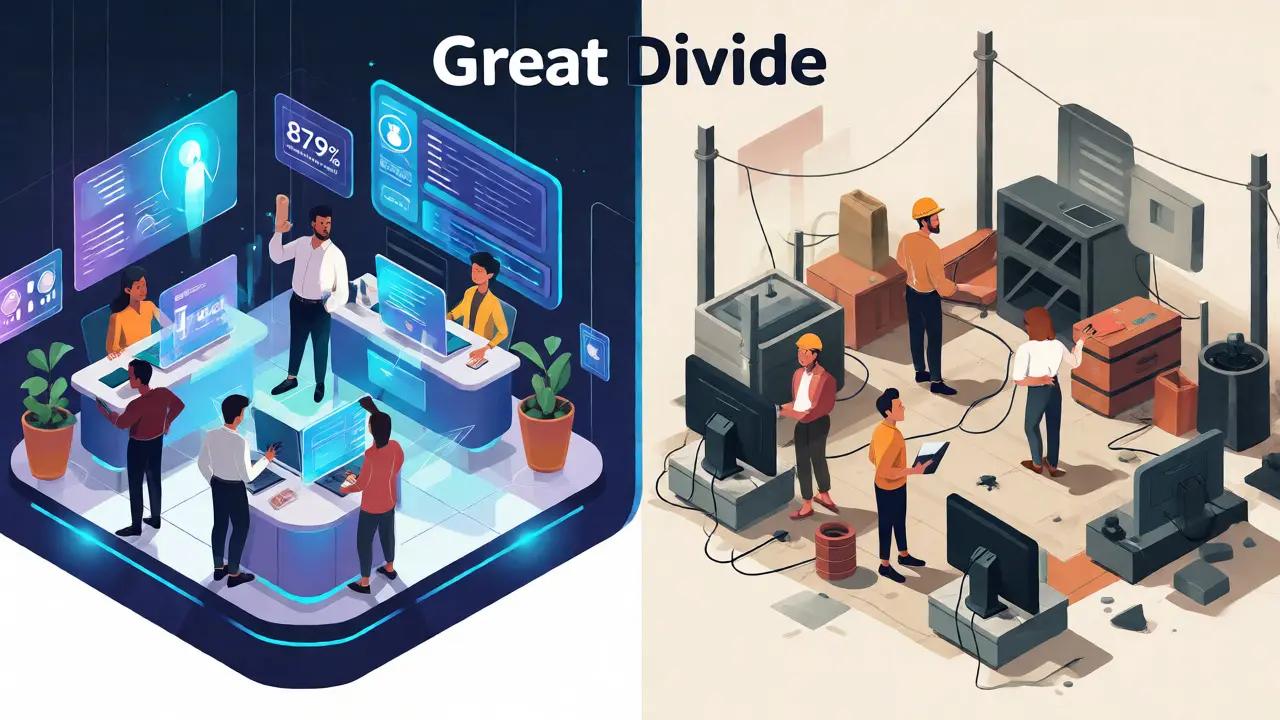
The Great Divide: Who Is Actually Winning with GenAI?
It’s tempting to look at the global stats and assume everyone is moving at the same speed. They aren’t. The data shows a massive split between industries that treat AI as a core operational tool and those that still view it as a novelty. Customer service and eCommerce are leading the pack because the path to ROI is crystal clear: faster response times equal happier customers and lower labor costs. In contrast, healthcare and finance are moving slower, but when they do succeed, the benefits are profound. Why? Because these sectors operate under strict governance frameworks that force them to be rigorous about data quality and compliance before scaling.
Let’s look at Sweden, which offers a fascinating microcosm of this disparity. Their ICT sector boasts an 87.9% adoption rate, while Transport & Storage sits at a meager 12.2%. Construction? It’s barely touching the technology at 1.4%. This isn’t just about tech-savviness; it’s about workflow repeatability. Industries with repetitive, data-rich tasks like coding, customer support tickets, or financial reporting can automate chunks of work immediately. Industries relying on physical labor or complex, unstructured regulatory environments struggle to find immediate, high-value use cases. If your industry falls into the latter group, don’t panic. It means your competitors aren’t stealing your lunch yet, but it also means you need a longer runway to prove value.
Decoding the Four Stages of AI Maturity
Most executives think maturity is about how many licenses you’ve bought. It’s not. It’s about how deeply AI is embedded in your decision-making processes. We can break down the current landscape into four distinct stages, based on insights from MIT Sloan and Gartner.
- Stage 1: Experimentation: You’re playing around. Teams use ChatGPT or similar tools individually. There’s no central governance, and results are anecdotal. Most companies were here in 2023-2024.
- Stage 2: Pilot & Proof of Concept: You’ve identified specific use cases. Maybe you automated invoice processing or deployed a chatbot for Tier 1 support. These are isolated successes. You’re measuring metrics, but the systems often live in silos, disconnected from your core CRM or ERP.
- Stage 3: Operational Integration: This is the tipping point. AI agents are integrated directly into business workflows. They trigger actions in other systems. For example, an AI doesn’t just summarize a customer complaint; it updates the ticket status, alerts the account manager, and drafts a follow-up email. Only about 6% of organizations have fully implemented agentic AI at this level.
- Stage 4: Strategic Transformation: AI is everywhere. It informs product development, pricing strategies, and supply chain logistics. The organization has a top-down AI strategy, not just bottom-up experimentation. This is where the 3.7x ROI multiplier lives.
Dr. Elena Rodriguez from MIT Sloan noted that 2025 was the year we realized generative AI had a "value-realization problem." Companies were building cool things that didn’t make money. In 2026, the focus has shifted decisively to Stage 3 and 4. If you’re still in Stage 1, you’re likely wasting resources on tools that don’t talk to each other.
Why 70% of Pilots Fail (And How to Avoid the Trap)
Here’s the uncomfortable truth: seven out of ten AI pilots die quietly. They don’t get killed by bad algorithms; they get killed by bad integration and human resistance. A Reddit user recently described their marketing team’s failure perfectly: "Our GenAI pilot failed because we didn't properly integrate with CRM data - outputs were generic and unusable." Sound familiar?
The primary culprit is data quality. 44.3% of companies cite data issues as a major barrier. If your historical data is messy, labeled poorly, or trapped in legacy silos, your AI will hallucinate or produce garbage. One manufacturing executive admitted to wasting six months on predictive maintenance because their sensor data wasn’t properly labeled. The second biggest killer is the lack of expertise. Nearly 75% of non-adopting companies say they simply don’t know how to implement these tools. It’s not enough to hire a data scientist; you need people who understand both the tech and the business process.
To avoid the graveyard of failed pilots, start small but think big. Pick one high-friction, low-complexity task. Automate it end-to-end. Ensure the output feeds directly back into your main system. Don’t try to boil the ocean by automating everything at once. Prove the ROI on one workflow, then scale.

Industry Benchmarks: What Good Looks Like
If you want to know if you’re behind, compare yourself to these benchmarks. Note that these figures reflect production-level usage, not just experimentation.
| Sector | Adoption Rate | Primary Use Case | Key Challenge |
|---|---|---|---|
| ICT / Tech | 87.9% | Coding assistance, content generation | Talent retention, rapid obsolescence |
| Manufacturing | 18-22% | Predictive maintenance, supply chain optimization | Data labeling, IoT integration |
| Finance | 15-18% | Risk assessment, fraud detection, customer service | Regulatory compliance, explainability |
| Healthcare | 15-20% | Admin efficiency, diagnostic support | Data privacy (HIPAA/GDPR), clinical validation |
| Retail / eCommerce | High | Personalization, inventory management | Integration with POS/eCommerce platforms |
| Construction | 1.4% | Project scheduling, document analysis | Fragmented workforce, low digital literacy |
B2C companies are generally further ahead than B2B. About 41% of B2C firms classify themselves as "Achievers" in AI maturity, compared to 31% of B2B firms. This makes sense: B2C interactions are high-volume and standardized, making them easier to automate. B2B deals are complex, relationship-driven, and harder to algorithmize. However, B2B companies that do succeed often see higher margins because they’re replacing expensive, specialized labor.
The Human Factor: Skills and Governance
Technology is easy; people are hard. The biggest predictor of success isn’t the model you choose-it’s whether your employees trust and use it. In Sweden, 77% of companies provide AI training, recognizing that workforce readiness is critical. Without it, you get shadow IT, where employees paste sensitive data into public chatbots without permission, creating security nightmares.
Governance is no longer optional. With the EU AI Act now in full swing, companies must track how AI decisions are made. "Sovereign AI"-keeping data within national borders-is becoming a competitive advantage, especially in Europe. If you’re handling customer data, you need clear policies on what can be fed into LLMs and where the data resides. Trust erodes quickly if customers feel their data is being used carelessly. High-maturity companies are implementing "human-in-the-loop" controls, ensuring that AI suggests actions but humans approve critical ones.

Measuring Success: Beyond Vanity Metrics
Stop counting how many prompts your team wrote. Start measuring time saved and revenue generated. Generative AI users report time savings equivalent to 1.6% of all work hours. That sounds small, but across a large organization, it’s millions of dollars. More importantly, AI has the potential to increase global labor productivity by up to 1.3% since ChatGPT’s introduction.
For successful implementations, look for these signs:
- Response Time Reduction: Customer service teams cutting response times by 37% while maintaining 92% satisfaction scores.
- Error Rate Decrease: Fewer manual entry errors in finance or HR operations.
- Content Velocity: Marketing teams producing 2x the volume of personalized content without hiring more writers.
- Decision Speed: Executives getting synthesized reports in minutes instead of days.
If you can’t tie your AI initiatives to one of these outcomes, you’re likely in the "experimentation" phase, not the "production" phase. Be honest with yourself. Are you building capabilities, or are you building cost centers?
Next Steps for Leaders
The window for easy wins is closing. By 2026, Gartner predicts 40% of enterprise applications will embed task-specific AI agents. If you’re not integrating AI into your core apps now, you’ll be playing catch-up in 2027. Here is your action plan:
- Audit Your Data: Before buying more tools, fix your data. Clean it, label it, and ensure it’s accessible via API.
- Identify One Workflow: Pick a repetitive, painful process. Automate it completely. Measure the ROI rigorously.
- Invest in Training: Teach your staff prompt engineering and AI ethics. Make them comfortable with the tools.
- Establish Governance: Create a simple policy for data privacy and AI usage. Prevent shadow IT.
- Scale Gradually: Once the first workflow proves ROI, replicate the pattern in adjacent departments.
The future isn’t about replacing humans with robots. It’s about augmenting human capability with machine speed. The companies winning today are those that treat AI as infrastructure, not magic. They build pipelines, not just pilots. Where does your organization stand on the maturity curve?
What is the average ROI for generative AI investments?
According to recent industry reports, companies achieve an average ROI of 3.7x for every dollar invested in generative AI. However, this figure varies significantly by maturity stage. High-maturity adopters who have integrated AI into core workflows see returns nearly three times higher than those still in the early testing phases.
Which industries are adopting generative AI fastest?
The ICT (Information and Communication Technology) sector leads with adoption rates exceeding 87% in some regions. Customer service, eCommerce, and finance follow closely due to clear ROI pathways in automation and personalization. Sectors like construction and agriculture lag significantly, with adoption rates below 5%, largely due to fragmented workflows and lower digital infrastructure.
Why do so many AI pilots fail?
Approximately 70% of AI pilots fail primarily due to poor integration with existing business systems and inadequate data quality. Other major factors include a lack of internal expertise, unclear ROI metrics, and employee resistance. Successful projects typically focus on solving specific, high-pain-point problems rather than attempting broad, autonomous transformations.
How long does it take to implement generative AI in an enterprise?
Basic deployment typically takes 3 to 6 months. However, achieving full production integration, where AI agents interact seamlessly with core business systems like CRMs and ERPs, usually requires 12 to 18 months. The timeline depends heavily on data readiness and organizational change management efforts.
Is generative AI safe for regulated industries like healthcare and finance?
Yes, but with strict governance. Regulated industries face higher barriers due to compliance requirements like HIPAA or GDPR. They often use private, sovereign AI solutions to keep data within secure boundaries. While adoption rates are lower (15-20%), these sectors report strong benefits in administrative efficiency and risk reduction once proper guardrails are established.