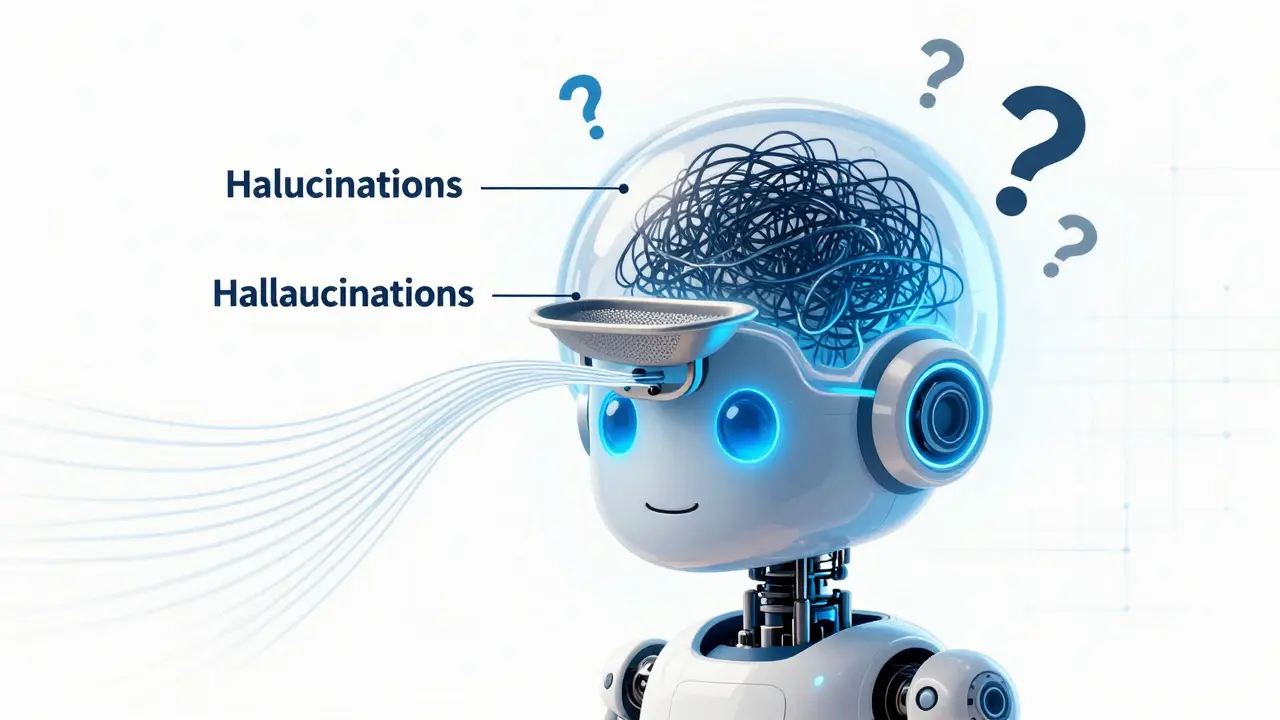
Large language models are incredibly useful, but they have a nasty habit of making things up. We call these fabrications hallucinations. For a chatbot writing poetry, a made-up metaphor might be charming. For a medical AI diagnosing a patient or a legal tool summarizing case law, it is dangerous. The industry has spent years trying to fix this by retraining models from scratch, which is expensive and slow. But what if you could stop the lies without touching the model weights? That is exactly what contrastive prompting does.
This technique acts like a fact-checker built directly into the generation process. Instead of just asking the model for an answer, you force it to compare different versions of its own thoughts. By highlighting the differences between confident, factual outputs and uncertain guesses, the model learns-on the fly-to stick to the truth. It is an inference-time trick, meaning it happens when the user asks the question, not during the months-long training phase.
What Is Contrastive Prompting?
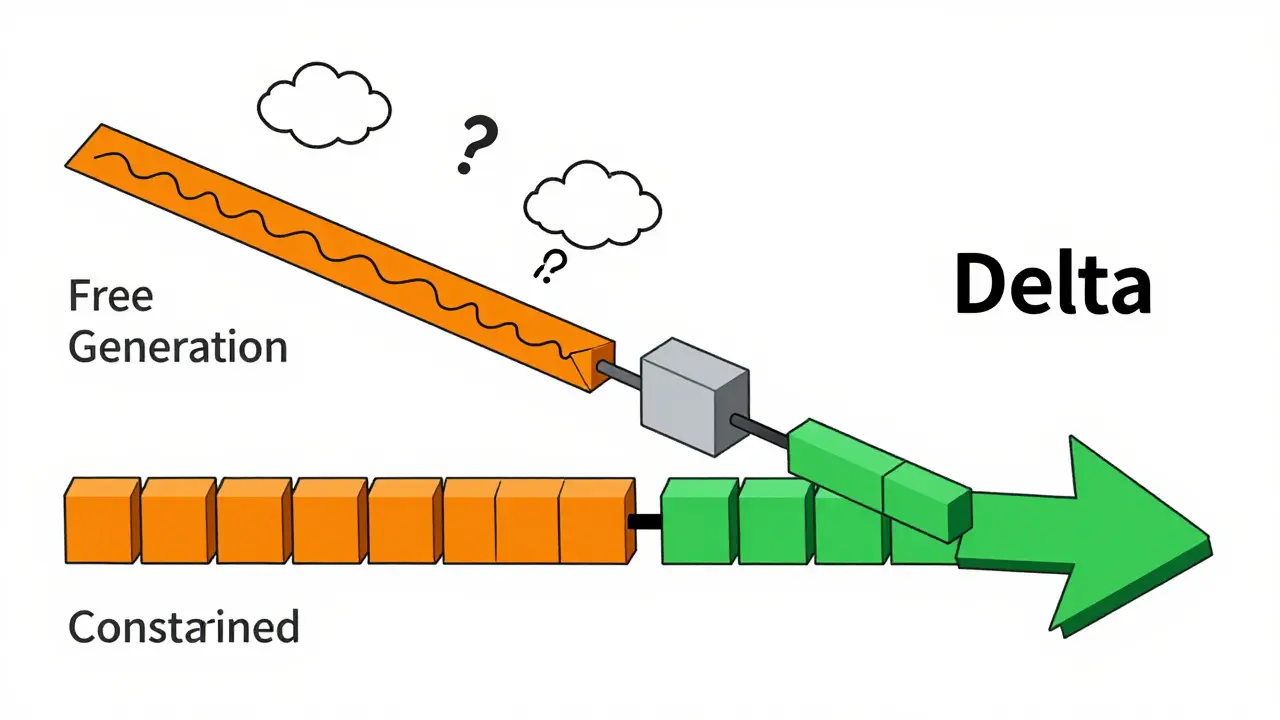
At its core, contrastive prompting is a method that reduces errors by comparing probabilities. Imagine you are trying to remember a friend's phone number. You aren't sure about the last digit. In standard decoding, the model picks the most likely next word based on what came before. In contrastive prompting, the model looks at two scenarios: one where it generates freely and one where it is constrained or guided differently. It then calculates the difference between these two states.
If a token (a piece of text) has a high probability in the 'free' state but a low probability in the 'constrained' state, the model assumes that token is likely noise or a hallucination. It suppresses it. If the token is strong in both, it keeps it. This simple mathematical comparison forces the model to prioritize information that is robust and consistent, rather than just statistically probable.
The beauty of this approach is efficiency. You do not need millions of dollars in GPU time to fine-tune a new version of Llama or GPT. You just change how the model decodes its output. This makes it accessible for developers who want better accuracy immediately.
The Main Methods: Delta, ALCD, and DoLA
Since the concept was formalized in 2023, several specific implementations have emerged. Each has its own strengths depending on your use case. Here is how the big players stack up:
| Technique | Full Name | How It Works | Best For | Hallucination Reduction |
|---|---|---|---|---|
| Delta is the foundational framework for contrastive decoding. | Delta Framework | Generates two parallel outputs (original vs. modified prompt) and selects tokens with higher probability in the original. | General purpose, easy integration | ~25-30% average reduction |
| ALCD is an adaptive constraint strategy for specialized tasks. | Alternate Layer-wise Contrastive Decoding | Dynamically adjusts the scale of contrastive tokens during generation using adaptive constraints. | Medical extraction, complex domains | 28.4% lower than greedy decoding |
| DoLA is Depth of Language Analysis focusing on layer probabilities. | Depth of Language Analysis | Contrasts final layer log probabilities with intermediate layers (e.g., layer 20) to emphasize factual knowledge. | Factual adherence, RAG pipelines | 18.7% lower than greedy decoding |
Delta is the foundational framework for contrastive decoding. First proposed in 2023, it is the simplest to understand. It runs the model twice: once normally, and once with a slight modification to the prompt. It then subtracts the probabilities. If the model is confident about a fact, that confidence shows up strongly in the subtraction. If it is guessing, the signal gets canceled out. It is lightweight and adds only about 15-22% latency to your response time.
ALCD is an adaptive constraint strategy for specialized tasks. Released in late 2024 by researchers at Tsinghua University, ALCD takes things further. It doesn't just use a fixed contrast; it adapts. In medical tasks, for example, some parts of a sentence are critical (drug names) while others are fluff (connective words). ALCD dynamically adjusts how hard it pushes against potential hallucinations based on the context. Tests showed it reduced hallucinations by 28.4% compared to standard methods in medical concept extraction.
DoLA is Depth of Language Analysis focusing on layer probabilities. Developed by Vectara, DoLA looks inside the transformer architecture itself. Large models have many layers. Early layers often hold general knowledge, while later layers handle style and coherence. DoLA compares the final layer's predictions with an intermediate layer (like layer 20 in a 32-layer model). This helps separate actual facts from stylistic flourishes that might lead to fabrication.
Why Use Contrastive Prompting Over Other Methods?
You might wonder why we don't just use Chain-of-Thought (CoT) or Retrieval-Augmented Generation (RAG). Those are great tools, but they have blind spots. CoT can help a model reason through a problem, but if the premise is wrong, the reasoning leads to a confident lie. RAG provides sources, but the model can still misinterpret those sources.
Contrastive prompting works differently. It attacks the problem at the token level. According to Galileo AI's 2024 analysis, structured prompts that combine planning with critical evaluation reduce hallucinations by 23-37%. When you add contrastive decoding to that mix, the results improve further. Datadog’s AI team found that combining contrastive prompting with their "LLM-as-a-judge" approach achieved 89.7% accuracy in detecting hallucinations, beating single-method approaches by over 12 percentage points.
However, it is not a silver bullet. Dr. Marcus Johnson from MIT warned in late 2024 that these methods can make models overly conservative. If you push the contrast too hard, the model might refuse to answer questions where it isn't 100% sure, even if a partial answer would be helpful. You lose fluency for accuracy. Finding the right balance is key.
Implementation Challenges and Costs
Implementing contrastive prompting requires more than just copying a snippet of code. It demands a good understanding of how transformers work. You need to know about token probability distributions and logit scaling. For a developer familiar with LLM inference pipelines, the learning curve is about 2-3 weeks.
The biggest hurdle is parameter tuning. How much contrast is enough? Too little, and the hallucinations remain. Too much, and the text becomes robotic or incomplete. Developers report spending significant time adjusting these thresholds. On GitHub, the open-source Delta repository has thousands of stars, but users frequently complain about the lack of clear documentation for advanced parameters. The Hugging Face community rated ALCD's documentation at 4.2/5, but Delta's official docs scored only 3.1/5 due to missing explanations.
There is also a cost in speed. Contrastive decoding usually means running the model multiple times per step or performing extra calculations. This adds latency. In real-time applications like live customer support bots, an extra 200-300 milliseconds per response can feel sluggish. For batch processing or asynchronous tasks, this delay is negligible. But for interactive apps, you need to weigh the accuracy gain against the user experience hit.

Who Should Adopt This Now?
Not every AI project needs contrastive prompting. If you are building a creative writing assistant, let the model dream. Fabrication is part of creativity. But if you are in a high-stakes domain, this technology is becoming essential.
- Healthcare: With 43% of enterprise implementations going here, medical AI is the primary beneficiary. Extracting adverse drug events or patient history requires zero tolerance for error.
- Legal Tech: Summarizing contracts or case laws cannot afford to invent clauses. Legal firms are adopting these tools to ensure compliance and accuracy.
- Financial Services: Generating financial reports or analyzing market trends requires factual precision. A hallucinated stock price or regulation can have real-world consequences.
The EU AI Act updates in late 2025 require "appropriate technical measures to mitigate hallucinations" in high-risk systems. This regulatory pressure is pushing companies toward solutions like contrastive prompting. Gartner predicts that by 2027, 78% of enterprise LLM deployments will include some form of contrastive decoding.
Future Trends and Hybrid Approaches
The field is moving fast. In October 2025, Meta AI released Visual Contrastive Decoding (VCD) to tackle object hallucinations in vision-language models. This shows the technique is expanding beyond text. Google DeepMind also announced plans to integrate multi-model contrastive techniques into Gemini in early 2026, aiming for another 15-20% drop in errors.
The consensus among experts is shifting from "which method is best" to "how do we combine them?" The most robust systems now use a hybrid approach: RAG to provide context, contrastive prompting to ensure factual alignment during generation, and post-generation verification (like LLM-as-a-judge) to catch any remaining slips. This layered defense is the new standard for reliable AI.
Dr. Lisa Torres from the AI Ethics Institute cautioned against false confidence. Just because a model uses contrastive prompting doesn't mean it is perfect. It reduces risk, but it does not eliminate it. Human oversight remains critical, especially in life-or-death decisions.
Does contrastive prompting require retraining the LLM?
No. Contrastive prompting is an inference-time technique. It modifies how the model generates text at the moment of request, without changing the underlying model weights. This makes it much faster and cheaper than fine-tuning or retraining.
How much latency does contrastive decoding add?
It typically adds 15-22% to the generation time. In practical terms, this might mean an extra 200-300 milliseconds per response. For real-time chat applications, this can be noticeable, but for background processing or document analysis, it is usually acceptable.
Which method is best: Delta, ALCD, or DoLA?
It depends on your use case. Delta is best for general-purpose applications due to its simplicity. ALCD excels in specialized domains like medicine where adaptive constraints help. DoLA is ideal when you need to separate factual knowledge from stylistic generation, particularly in RAG pipelines.
Can contrastive prompting completely eliminate hallucinations?
No. While it significantly reduces hallucinations (by 20-40% in various tests), it does not eliminate them entirely. Experts recommend combining it with other strategies like Retrieval-Augmented Generation (RAG) and human-in-the-loop verification for critical applications.
Is contrastive prompting compatible with existing RAG systems?
Yes. Contrastive prompting integrates seamlessly with Retrieval-Augmented Generation pipelines. In fact, combining RAG (for context) with contrastive decoding (for factual alignment) is considered a best practice for high-accuracy AI applications.
What are the risks of using contrastive prompting?
The main risk is over-conservatism. If the contrastive strength is set too high, the model may become hesitant, omitting relevant information to avoid potential inaccuracies. This can lead to less fluent or incomplete responses. Careful tuning of parameters is required to balance accuracy and usability.