
When your company starts using generative AI to write customer emails, draft legal briefs, or generate product images, you don’t just need better tools-you need better control. Without structure, AI can drift into biased outputs, leak sensitive data, or violate regulations. That’s where governance committees for generative AI come in. They’re not optional anymore. They’re the checkpoint between innovation and risk.
Why Your Company Needs a Governance Committee
In 2023, 78% of Fortune 500 companies set up AI governance teams. By early 2025, that number had climbed past 85% in finance and healthcare. Why? Because the EU AI Act and U.S. Executive Order 14110 made it clear: if you’re using generative AI, you’re responsible for how it behaves. And regulators aren’t asking for reports-they’re demanding proof of oversight. A governance committee isn’t just a group of people meeting monthly. It’s a formal structure that ensures every AI use case is evaluated for safety, fairness, legality, and business value. At The ODP Corporation, their committee found 14 compliance gaps in customer service bots within six months. At JPMorgan Chase, they reviewed 287 AI projects and approved 85%-without a single regulatory fine. The alternative? Chaos. One company rejected a $1.2M marketing tool because committee members didn’t understand the difference between fine-tuning and prompt engineering. Another saw a 57% spike in compliance violations because they let departments run AI on their own. Governance isn’t about slowing things down. It’s about making sure you’re moving in the right direction.Who Belongs on the Committee
A good AI governance committee isn’t made up of executives who read tech blogs. It’s built from seven core functions, each with a specific role:- Legal - Ensures compliance with laws like the EU AI Act, CCPA, and sector-specific rules.
- Ethics and Compliance - Defines what’s morally acceptable. Is it okay for AI to mimic a customer’s voice? Is it fair if it favors certain demographics?
- Privacy - Reviews data sources. Did you train the model on customer emails without consent? Are you storing prompts that contain PII?
- Information Security and Architecture - Checks for vulnerabilities. Can someone jailbreak the model? Is it connected to internal systems it shouldn’t be?
- Research and Development - Brings technical truth. They explain what the model can and can’t do, not just what marketing says.
- Product Management - Represents users. What’s the real use case? Is this solving a problem-or just chasing hype?
- Executive Leadership - Sets the tone. They approve budgets, remove roadblocks, and make sure the committee has real power.
RACI: Who Does What
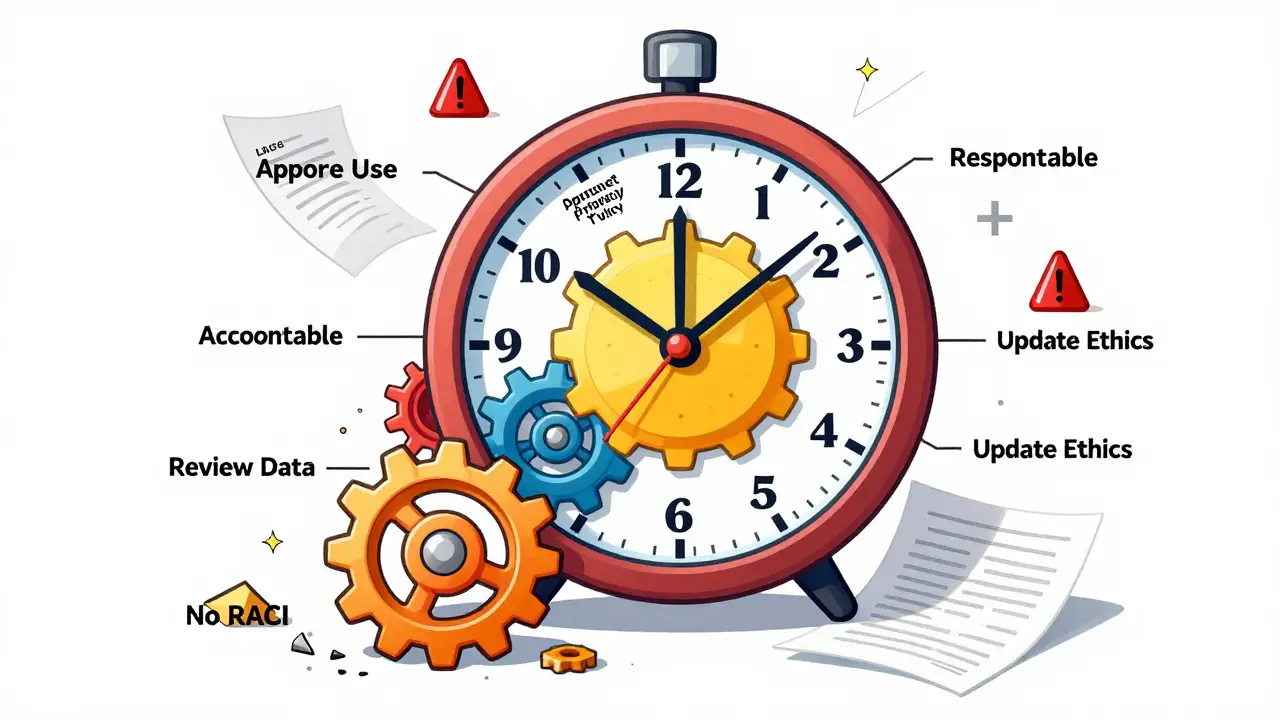
RACI isn’t just a corporate buzzword. It’s the glue that holds a governance committee together. Without it, roles blur, accountability vanishes, and decisions stall. Here’s how it breaks down in practice:| Activity | Responsible | Accountable | Consulted | Informed |
|---|---|---|---|---|
| Approve new AI use case | Product Management | Committee Chair | Legal, Privacy, Security | Business Units |
| Review data sources | Privacy Team | Privacy Lead | Engineering, Legal | Executive Leadership |
| Update ethical guidelines | Ethics Team | Committee Chair | Legal, External Advisors | All Departments |
| Monitor model drift | Engineering | Security & Architecture | Product, Ethics | Executive Leadership |
| Report compliance status | Legal | Committee Chair | Internal Audit | Board of Directors |
Cadence: How Often to Meet
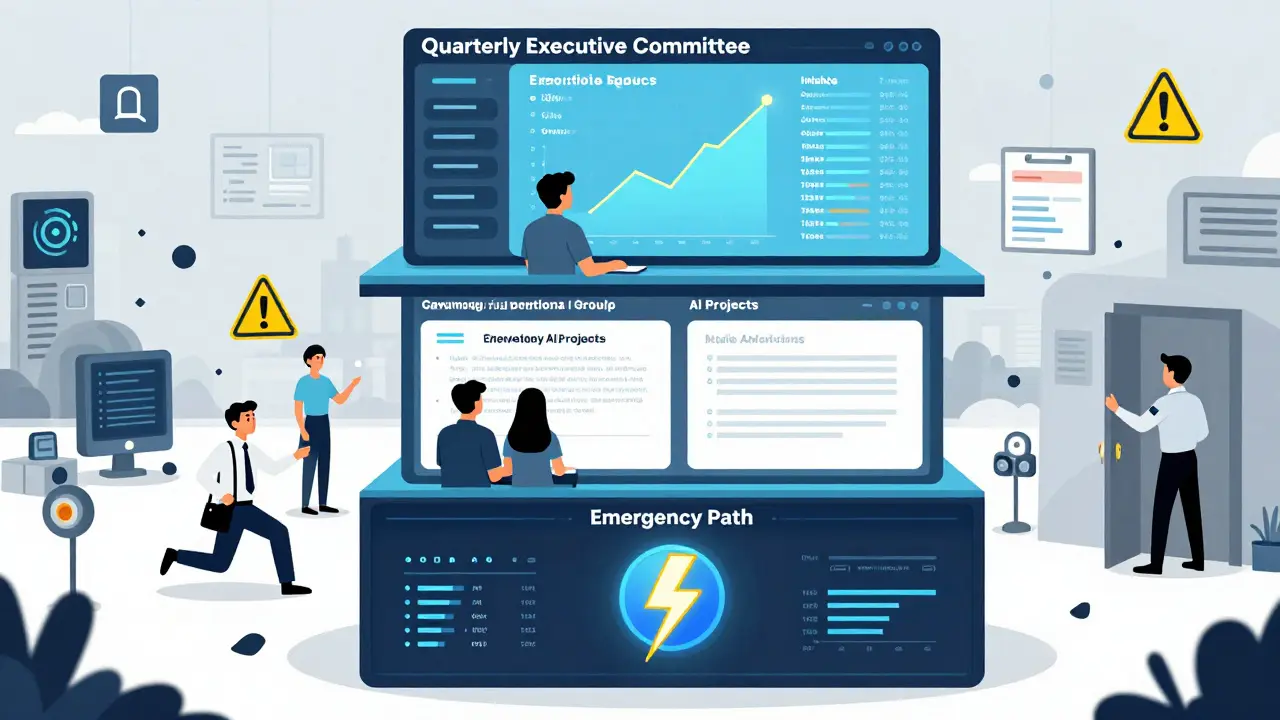
You don’t need weekly meetings. But you can’t wait six months. The sweet spot is tiered:- Executive Committee - Meets quarterly. Reviews strategy, budget, policy changes, and high-risk use cases. This is where the board gets updates.
- Operational Working Group - Meets every two weeks. Evaluates individual AI projects. Uses a standardized intake form and risk tiering system.
- Emergency Approval Path - For urgent, low-risk use cases (like internal chatbots), teams can submit requests with electronic voting. Decisions must be made within 72 hours.
Three Models: Centralized, Federated, Decentralized
Not all committees work the same way. Three models dominate:- Centralized - One committee controls all AI use. IBM and Goldman Sachs use this. It’s strict, consistent, and reduces regulatory incidents by 92%. But it’s slow. Executives spend 30% more time on reviews.
- Federated - Central team sets rules, but business units run their own subcommittees. JPMorgan Chase and Microsoft use this. It’s faster and scales better. Approval cycles are 44% quicker than centralized models.
- Decentralized - No central oversight. Each team picks their own tools. This is common in startups and retail. But it’s dangerous. TMASolutions found these companies had 57% more compliance violations.
What Success Looks Like
Successful committees don’t just say “no.” They say “yes, but…” - They have a written charter signed by the CEO. No charter? No authority. - They use version-controlled policies. Every update is tracked. Privacera found 100% of top performers do this. - They tie AI risk to existing frameworks. If your company already has a risk management system for cybersecurity or financial controls, plug AI into it. That’s what 79% of high-performing committees do. - They measure outcomes, not just compliance. Gartner found that committees focused on business results accelerated AI adoption by 2.3x. At The ODP Corporation, their committee didn’t just block bad tools-they helped teams redesign three customer service bots to reduce bias by 41% and improve response accuracy. That’s governance that adds value.Common Pitfalls and How to Avoid Them
Most committees fail because they’re poorly designed-not because AI is too risky.- Too many non-technical members - They can’t evaluate models. Solution: Require at least one engineer per committee, and train others on AI basics.
- No veto power - If the committee can’t stop a project, it’s just advisory. Dr. Rumman Chowdhury says 100% of effective committees have veto authority.
- Approval delays over 30 days - Dtex Systems found 61% of committees get bogged down. Fix it with standardized workflows: intake → risk tiering → review → approval. Keep the total cycle under 25 days.
- No training - Non-technical members need 20-25 hours of training to understand AI risks. Engineers need 15-20 hours to learn compliance. Skip this, and you’ll get bad decisions.
- Not integrated with procurement - If employees can buy AI tools without committee approval, you’ve already lost. Link governance to your vendor approval system.
What’s Next for AI Governance
By late 2025, the SEC will require public companies to disclose their AI governance committee structure. That’s going to push every remaining S&P 500 company to set one up. Tools are getting smarter too. 63% of leading companies now use AI governance platforms that show real-time risk dashboards-flagging when a model starts generating biased responses or accessing unauthorized data. The future isn’t about more meetings. It’s about automation. By 2027, 83% of analysts predict routine governance tasks-like data source checks or risk scoring-will be handled by software. The committee’s job will shift from reviewing forms to guiding strategy, ethics, and culture. Generative AI isn’t going away. Neither are the risks. The question isn’t whether you need a governance committee. It’s whether yours will be ready when the regulator knocks-or when your CEO asks why the chatbot insulted a customer.Do all companies need a generative AI governance committee?
If you’re using generative AI for customer interactions, HR, legal, finance, or any high-risk function-yes. Even small companies need some form of oversight. The EU AI Act and U.S. Executive Order 14110 apply to any organization using AI in regulated contexts. If you’re just using AI for internal brainstorming or personal notes, formal governance isn’t required-but you still need basic policies.
Who should lead the AI governance committee?
The chair should be a C-suite executive-usually the Chief Risk Officer, General Counsel, or Chief Data Officer. They need authority to enforce decisions, access to budget, and the ability to escalate issues to the board. The role isn’t about being the most technical person-it’s about being the most accountable.
How long does it take to set up a governance committee?
Expect 8-12 weeks for a small to mid-sized company. Larger enterprises (10,000+ employees) may need 16 weeks. The timeline includes stakeholder mapping, drafting the charter, defining RACI roles, selecting members, and training them. Don’t rush this. A poorly built committee creates more problems than it solves.
Can a governance committee block a project even if leadership wants it?
Yes-and it should. If the committee doesn’t have veto power, it’s just a rubber stamp. Experts like Dr. Rumman Chowdhury confirm that 100% of effective committees have the authority to halt deployments. Leadership can appeal, but the committee’s decision must be final on compliance and ethics grounds.
What happens if a committee member doesn’t show up to meetings?
Attendance should be tied to performance reviews. If someone is a key stakeholder (like Legal or Privacy), their participation must be part of their KPIs. One company replaced a non-engaged Legal rep with someone who had direct reporting lines to the CFO. Approval times dropped by 40%.
How do you measure if the committee is working?
Track these metrics: number of AI projects approved/rejected, average approval time, number of compliance incidents before and after implementation, percentage of teams using approved tools, and feedback from users. Successful committees reduce AI-related incidents by 63% and cut approval delays by 41%, according to The ODP Corporation’s audit data.
Destiny Brumbaugh
January 6, 2026 AT 12:24And don’t even get me started on the ‘ethics’ people. Who are they to decide what’s ‘fair’? My grandma’s AI chatbot doesn’t need a 12-page risk assessment to tell me the weather.
Sara Escanciano
January 7, 2026 AT 05:44Let companies decide for themselves. If your AI writes a racist email, you fire the person who trained it-not create a 7-person panel to debate whether ‘bias’ is a feeling or a fact.
Jason Townsend
January 8, 2026 AT 09:57Every time you see ‘ethical guidelines’ or ‘bias detection,’ that’s code for ‘we’re tracking your data and we’ll shut you down if you don’t ask permission.’
And don’t tell me ‘jailbreaking’ is a real threat. It’s a buzzword to scare startups into buying overpriced compliance software. The real threat? Losing your freedom to build.
Antwan Holder
January 9, 2026 AT 23:52This RACI chart? It’s a funeral dirge for innovation. Every box checked is another soul crushed under the weight of bureaucracy. The engineers who built this tech are now reduced to ‘consulted’ status while lawyers and executives sit in air-conditioned rooms deciding if a bot can say ‘hello’ with a smile.
And when the AI starts dreaming? When it writes poetry no human ever thought of? Will they vote on whether it’s ‘ethically appropriate’ to feel joy?
They’re not governing AI. They’re burying it alive in a suit and tie.
Angelina Jefary
January 11, 2026 AT 06:18Also, you say ‘78% of Fortune 500’ but cite no source. That’s not data-that’s wishful thinking. If you’re going to write about governance, at least get your grammar right. People lose trust when the messenger is sloppy.
Jennifer Kaiser
January 13, 2026 AT 04:46The real win isn’t in the chart or the cadence-it’s in the culture. If people feel like the committee is there to help them solve problems instead of block them, they’ll show up. If it feels like a police force, they’ll find ways around it.
Start with empathy. Not policies.
TIARA SUKMA UTAMA
January 15, 2026 AT 01:33