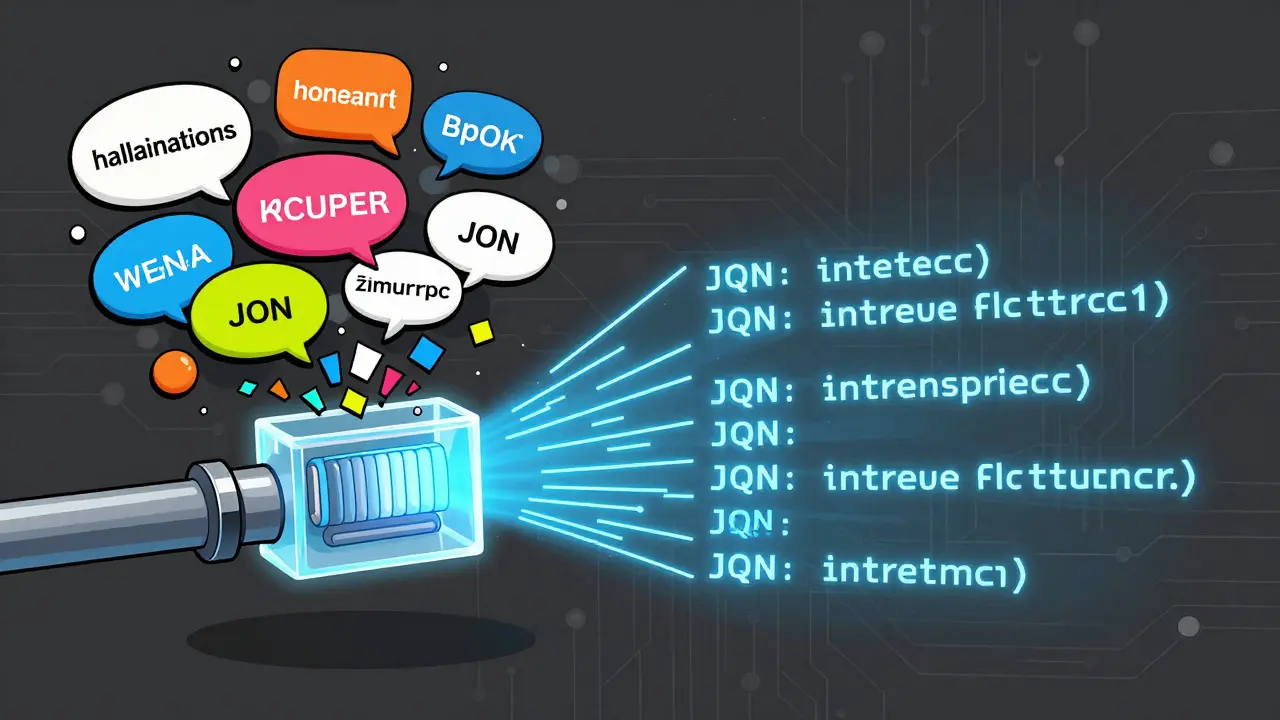
Imagine you've spent weeks building a sophisticated AI pipeline for your company. You're using a top-tier model to extract medical data from patient records, but every few dozen requests, the model decides to get "creative." Instead of a clean JSON object, it returns a conversational sentence or a slightly malformed list. For a human, it's a minor quirk; for your production database, it's a catastrophic system failure. This is the "hallucination of format" problem, and it's one of the biggest hurdles in moving AI from a cool demo to a reliable enterprise tool.
The solution isn't always more prompting or expensive fine-tuning. Instead, a technique called Grammar-Constrained Decoding is a method of controlling Large Language Model outputs by forcing the generation process to adhere to specific syntactic rules. Also known as GCD, this approach ensures that the model only picks tokens that fit a predefined structure, effectively putting a "guardrail" around the AI's vocabulary in real-time.
The Core Mechanics: How GCD Actually Works
To understand GCD, you have to look at how an LLM generates text. Normally, a model predicts the next token by calculating a probability distribution over its entire vocabulary. It picks the most likely word, regardless of whether that word makes the final output valid JSON or a proper SQL query. GCD changes this by introducing Context-Free Grammars (CFGs) into the decoding loop.
A CFG acts as a set of mathematical rules that define exactly what a valid string looks like. During each step of generation, the GCD layer checks the current state of the output against these rules. If the grammar says the next character must be a quote mark or a curly brace, the system simply zeros out the probability of every other token in the model's vocabulary. The model is forced to choose from the remaining valid options. This means the output is guaranteed to be syntactically correct, even if the model is struggling with the logic of the task.
Why This Matters for Enterprise Applications
In a business environment, "mostly correct" is usually the same as "completely wrong." Whether you are dealing with clinical records or financial reports, you need data that fits into a schema. Here is why Grammar-Constrained Decoding is becoming a standard for enterprise deployments:
- Zero-Shot Reliability: You don't need to provide ten perfect examples in your prompt (few-shot prompting). Research shows that zero-shot prompting combined with grammar constraints often beats five-shot unconstrained generation.
- Lowering the Hardware Bar: Small models are usually bad at following complex formats. However, GCD democratizes high-end capabilities. For instance, the Gemma2-2b model-a relatively tiny model-saw its executable rate in First-Order Logic (FOL) tasks jump from nearly 0% to over 60% when constrained by a grammar.
- Reduced Fine-Tuning Costs: Fine-tuning a model to output JSON perfectly is expensive and requires massive amounts of clean data. GCD achieves similar structural reliability without changing a single weight in the model.

Real-World Impact: From Healthcare to Logic
The theoretical benefits of GCD translate into hard numbers when applied to specialized domains. In medical information extraction, where precision is non-negotiable, GCD has shown a measurable impact on F1 scores (a measure of a model's accuracy). When using architectures like Flan-T5 or Longformer, researchers saw significant jumps in performance:
| Dataset Type | Baseline F1 Score | GCD-Enhanced F1 Score | Absolute Improvement |
|---|---|---|---|
| Type 2 Diabetes | 0.062 | 0.413 | +0.351 |
| Glaucoma | 0.102 | 0.470 | +0.425 |
These results show that the constraints don't just fix the formatting; they actually help the model focus on the correct entities, leading to better overall extraction accuracy.
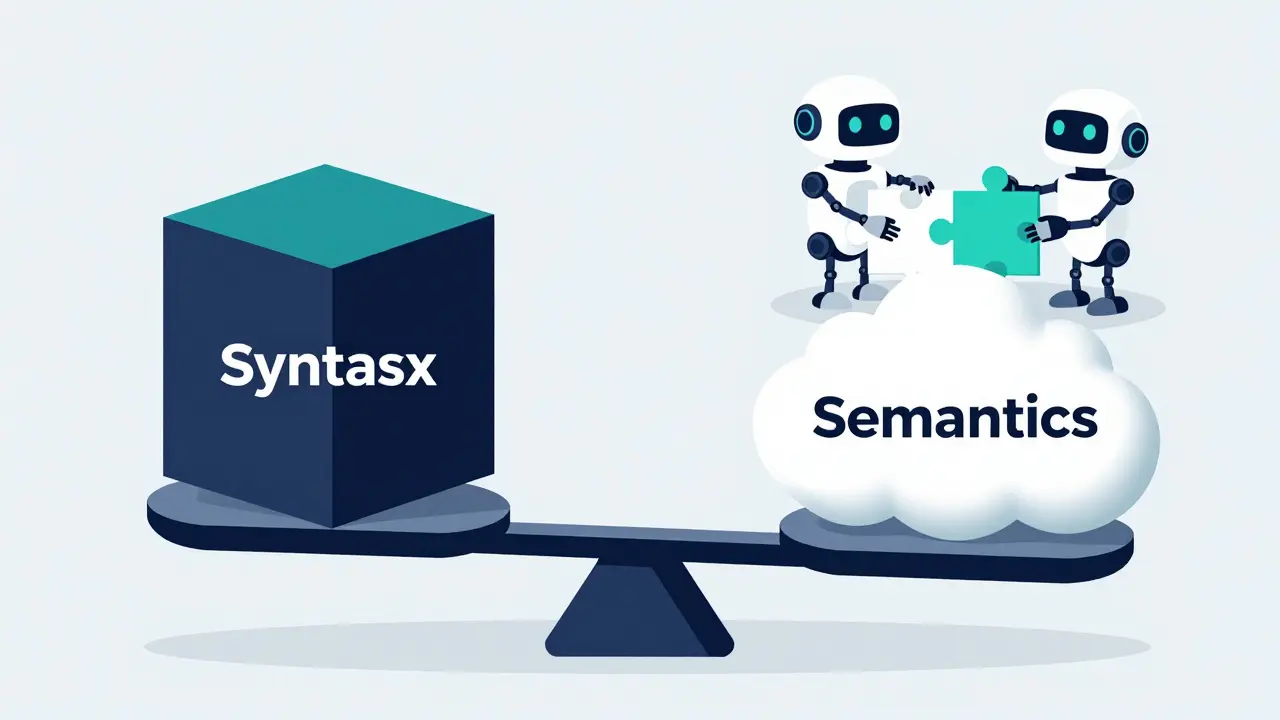
The Trade-Off: Syntax vs. Semantics
It sounds like a magic bullet, but there is a catch: the tension between syntactic validity and semantic correctness. GCD guarantees the output looks right, but it can't guarantee the information is right. If the model is forced to pick a token to satisfy a grammar rule, it might occasionally pick a token that is syntactically correct but factually wrong.
Interestingly, this trade-off varies by model size. Smaller models get a massive boost because their primary struggle is the format. However, with massive models, the bias introduced by these constraints can sometimes degrade the quality of the answer. When a model is already highly capable, forcing it into a rigid box can occasionally prevent it from finding the most nuanced or accurate expression of an idea. This means the "best" approach depends entirely on which model you're using.
Implementing GCD in Your Pipeline
If you're looking to integrate these constraints into your AI strategy, you can't just flip a switch. It requires a bit of architectural planning. First, you need a domain expert who can define the Context-Free Grammar. If you want JSON, the grammar is standard. If you want a proprietary logical language for a symbolic solver, you'll need to map out every possible valid transition.
Next, consider your model choice. If you are running on edge devices or limited GPUs, pairing a small model (like a 2B or 7B parameter model) with GCD is a powerhouse move. It gives you the reliability of a much larger model without the latency or cost. If you are using a massive frontier model, you should A/B test constrained versus unconstrained outputs to ensure you aren't sacrificing semantic accuracy for the sake of a trailing comma.
Does Grammar-Constrained Decoding slow down the model?
There is a small amount of computational overhead because the system must check the grammar rules at every token generation step. However, for most enterprise applications, this is negligible compared to the cost of manually cleaning malformed data or the latency of running a much larger model to get the same structural reliability.
Can GCD replace fine-tuning entirely?
For structural and formatting tasks, yes. GCD can often replace the need for fine-tuning a model just to make it "speak JSON." However, if the model lacks the fundamental knowledge of your domain (e.g., specific medical terminology), you will still need fine-tuning or RAG (Retrieval-Augmented Generation) to provide that knowledge.
What happens if the model can't find any valid token?
In the rare event that the model's probability distribution for all grammatically valid tokens is zero, the system will typically force the selection of the most likely valid token, even if its probability was low. This ensures the output never breaks the grammar, though it increases the risk of a semantic hallucination.
Is this different from Regular Expressions?
Yes. Regex is typically used to validate text after it has been generated. GCD works during generation. Instead of generating a bad string and throwing it away, GCD prevents the bad string from ever being created.
Which models work best with GCD?
While it works across most architectures, encoder-decoder models like Flan-T5 and Longformer have shown strong results in specialized extraction tasks. Smaller decoder-only models like Gemma2-2b also see the most dramatic relative improvements in logic and reasoning tasks.
Next Steps for Deployment
If you're ready to move forward, start by identifying your "failure modes." Where is your AI currently breaking the format? If you're seeing consistent structural errors, map those to a CFG. For those in highly regulated industries like healthcare, we recommend starting with a small, constrained model to prove the concept before scaling to larger, more expensive architectures. Your goal should be to find the smallest model that, when constrained, meets your accuracy threshold-this will keep your inference costs low and your system stability high.
NIKHIL TRIPATHI
April 22, 2026 AT 07:34Using GCD with smaller models like Gemma is a total game changer for cost optimization. I've seen similar results in my own tests where a 7B model with a strict grammar outperformed a massive 70B model just guessing the JSON structure.
It really allows us to scale without burning through the GPU budget.
Raji viji
April 23, 2026 AT 15:44Imagine thinking this is a "new" discovery. It's basically just masking logits, you absolute clowns. Calling it "Grammar-Constrained Decoding" is just a fancy way to wrap a basic concept in corporate buzzwords to make it sound like some breakthrough science for the suits in the boardroom.
Vishal Bharadwaj
April 23, 2026 AT 16:09the a-b testin part is totally overblown... most people dont even know how to write a proper cfg anyway so they just copy paste some crappy regex-like thing and wonder why the model is still glitching out. a litte bit of basic logit bias does the same thing if u actually know what ur doing
Parth Haz
April 24, 2026 AT 01:21The improvements in medical data extraction are truly impressive. It is heartening to see how structural constraints can lead to higher F1 scores in such a critical field. This could potentially save countless hours of manual data cleaning for healthcare professionals.
Rubina Jadhav
April 24, 2026 AT 18:05This is very helpful for beginners.
Rajashree Iyer
April 26, 2026 AT 13:33Is this not a metaphor for the human condition? We spend our entire lives fighting against the rigid grammars of society, desperately trying to fit our chaotic souls into predefined JSON schemas of expectation and duty! We are all just tokens being zeroed out by a cosmic CFG, forced to choose the most likely path even when it feels completely wrong in our hearts!
anoushka singh
April 26, 2026 AT 23:28lol I just tried this and it's kind of a pain to set up the grammar files. Just use a bigger model and pray it doesn't break, way less work than writing a whole math rulebook for a curly brace haha
Shivani Vaidya
April 28, 2026 AT 00:35The distinction between syntactic validity and semantic correctness is most pertinent. One must acknowledge that while the structure is preserved the essence of truth may yet be elusive. It is a sophisticated approach to a complex problem and merits further academic exploration into how the bias affects different model architectures
sumraa hussain
April 29, 2026 AT 19:53OH MY GOD!!! The jump from 0% to 60% on Gemma2-2b is absolutely insane!!!!!!!!! Like, actually mind-blowing how a tiny model can suddenly act like a genius just because you put it in a box!!!!!!!!! This is literally the most wild thing I've read all week!!!!
Jitendra Singh
May 1, 2026 AT 05:59I think both sides have a point here. It's a great tool for reliability but definitely not a replacement for a model that actually understands the data. Glad to see more people talking about the hardware side of things too.