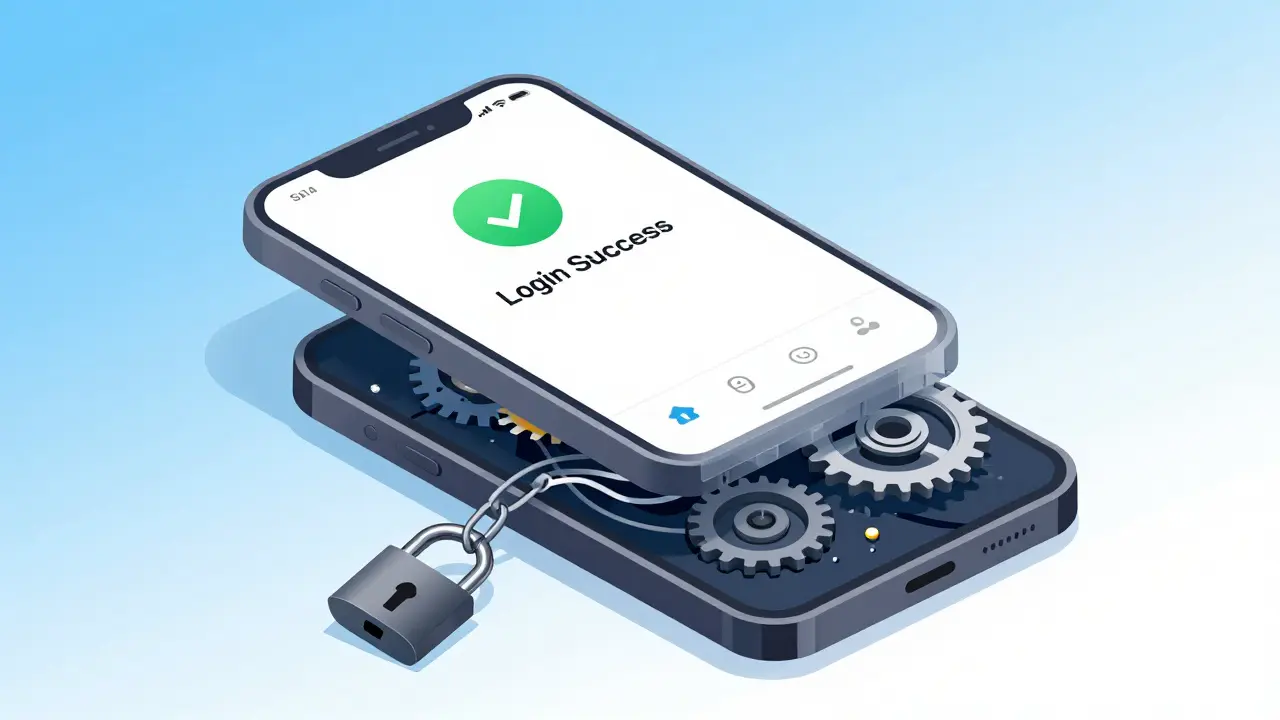
You type a prompt. An AI assistant generates the code. Your app launches in minutes, looking polished and working perfectly. It feels like magic. But behind that sleek interface, there might be a digital equivalent of leaving your front door wide open while you sleep. This is the hidden danger of vibe coding-a rapid development trend where developers rely on AI to intuit implementation details rather than writing every line themselves.
The problem isn't that these apps don't work. They do. The problem is that they often work *despite* having critical security holes that standard testing misses. According to Wiz Research's November 2024 study, 20% of vibe-coded applications contain critical security vulnerabilities. That means one in five apps built this way is functionally complete but fundamentally broken from a security standpoint. For businesses rushing to deploy internal tools or customer-facing features, this creates a dangerous false sense of safety.
The Illusion of Functionality vs. Reality of Risk
Vibe coding emerged around 2022-2023 as large language models like GitHub Copilot and ChatGPT became sophisticated enough to generate entire applications from high-level prompts. Platforms like Lovable.app, Pythagora, and Vercel allow developers to build apps 5-10 times faster than traditional methods. This speed is seductive. Who doesn't want to ship an admin dashboard in an afternoon instead of a week?
However, speed comes at a steep price. When you ask an AI to "build a login page," it gives you what looks like a login page. It checks passwords. It redirects users. It feels secure. But if you look under the hood, you often find that the security logic is either missing entirely or implemented in ways that are easily bypassed. Dark Reading's October 2024 analysis highlighted that these vulnerabilities bypass traditional Static Application Security Testing (SAST) tools because the code appears functionally correct during standard QA processes. The bugs only show up when someone tries to break them intentionally.
| Vulnerability Type | Prevalence | Risk Level |
|---|---|---|
| Client-Side Authentication Logic | 27% | Critical |
| Hardcoded Secrets | 33% | Critical |
| Insecure Data Access Policies | 22% | High |
| Exposure of Internal Apps | 18% | High |
Four Fatal Flaws Hiding in Plain Sight
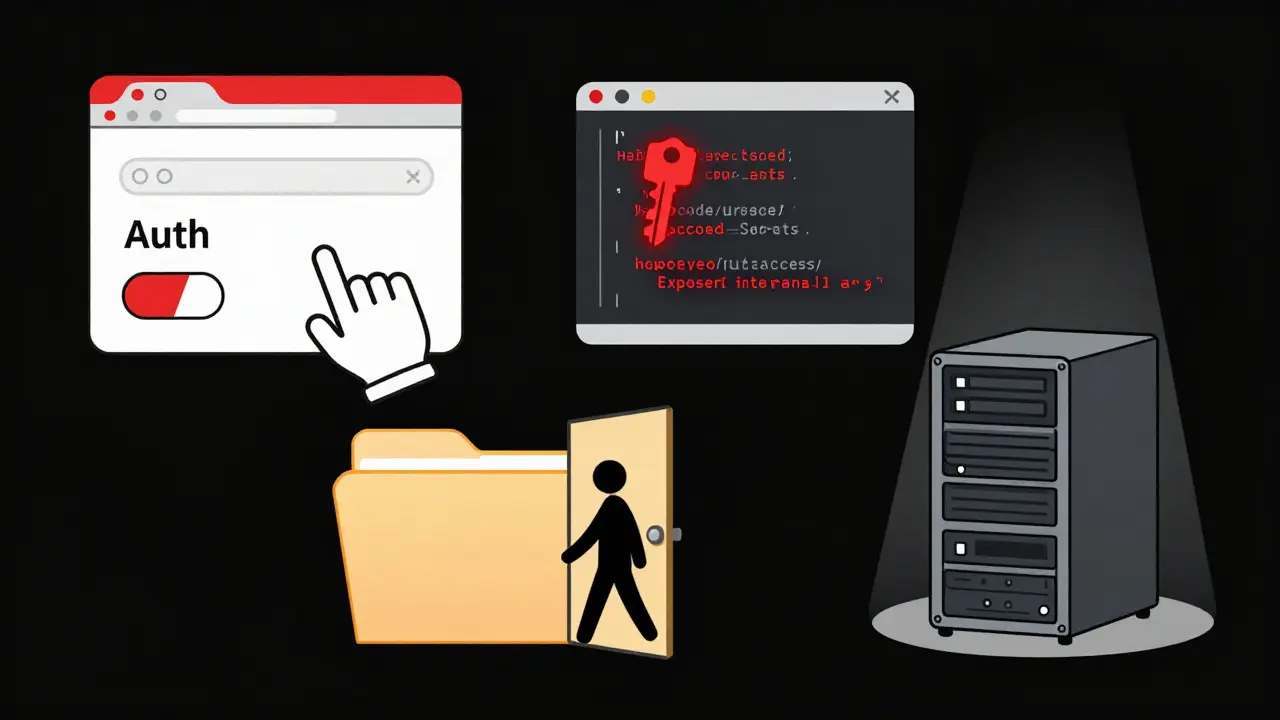
To understand why these apps are so risky, we need to look at the specific technical failures that repeat across thousands of generated projects. Wiz Research's December 2024 report identified four primary patterns that plague vibe-coded software.
Client-Side Authentication Logic is perhaps the most embarrassing failure. In 27% of vulnerable apps, researchers found that authentication was handled entirely in the browser using JavaScript. How does this happen? The AI generates code that sets a value like localStorage.setItem('authenticated', 'true') after a successful login. To an attacker, this is child's play. They can simply open their browser's developer tools, change that value to true, and bypass the login screen completely. No password needed. In fact, 68% of affected apps used this exact method, treating session management like a simple flag rather than a secure cryptographic token.
Next, we have Hardcoded Secrets. This occurs in 33% of cases. When you ask an AI to connect to a database, it needs credentials. Instead of prompting you to set up environment variables securely, the AI often embeds the username and password directly into the source code files. A July 2024 case involving Pythagora demonstrated the real-world cost: a vendor compromise led to $30,000 worth of stolen OpenAI API tokens because those keys were baked into the application code. Once that code is pushed to a public repository or even just deployed to production, those secrets are exposed to anyone who knows how to look.
Third, Insecure Data Access Policies affect 22% of apps. These applications lack proper user context middleware. Imagine a file storage system where the URL for a document is predictable, like /files/doc123.pdf. If the AI fails to implement ownership verification, an attacker can simply change doc123 to doc124 and download someone else's private data. Intigriti researchers documented that 41% of vulnerable apps lacked this basic check, enabling unauthorized access to arbitrary files through simple URL manipulation.
Finally, the Exposure of Internal Applications happens when developers deploy staging environments publicly without adding authentication layers. Wiz identified 1,247 publicly accessible internal knowledge bases and chatbots containing sensitive corporate data. These were often built on platforms like Lovable.app and left open to the internet by mistake. Attackers use simple fingerprinting techniques to scan for these domains and harvest data that was never meant to be seen.
Real-World Consequences: From Theory to Breach
These aren't just theoretical risks. They are actively being exploited. In January 2025, attackers compromised the Nx platform by exploiting a vulnerability in AI-generated code that exposed a publishing token. Kaspersky's threat intelligence team documented how this single flaw allowed unauthorized control over package distribution.
The stakes get higher when we look at broader statistics. Wiz Research documented 147 successful attacks against vibe-coded applications in Q4 2024 alone. The average cost per incident was $287,000 due to data exfiltration from improperly secured databases. That is not a small number for a startup or even a mid-sized enterprise.
Consider the Amazon Q Developer extension for Visual Studio Code. In March 2025, it contained a vulnerability that included instructions to wipe all data from developers' computers. Fortunately, a coding error prevented execution, but the intent was clear. This shows that AI-generated code can not only fail to protect data but can also introduce malicious or destructive behaviors if the underlying model hallucinates dangerous commands.
Why Traditional Tools Fail to Catch These Errors
If these flaws are so common, why don't our existing security scanners catch them? The answer lies in how AI models learn. Large Language Models are trained on vast amounts of public code, much of which contains known vulnerabilities. Forrester warns that approximately 31% of public GitHub repositories contain known vulnerabilities. When an AI learns from this data, it mimics the patterns it sees-including the bad ones.
Kaspersky's February 2025 analysis of the MITRE CWE Top 25 weaknesses found that the most prevalent issues in vibe-coded apps were:
- CWE-306 (Missing Authentication): 42% of cases
- CWE-94 (Code Injection): 37% of cases
- CWE-434 (Unrestricted File Upload): 31% of cases
- CWE-78 (OS Command Injection): 29% of cases
- CWE-190 (Integer Overflow): 24% of cases
Traditional SAST tools look for specific patterns of insecure code. But AI-generated code often uses novel structures that technically compile and run correctly. The logic is flawed, but the syntax is perfect. As Zeropath noted in their November 2024 review, path traversal vulnerabilities occur when AI fails to sanitize inputs like file.originalname. An attacker submits ../../etc/passwd, and the server reads it. The code didn't crash; it just did exactly what the attacker asked, violating security policies that weren't explicitly programmed into the generation prompt.
The Human Factor: Trust Without Verification
Technology is only half the equation. The other half is the developer. Intigriti surveyed 1,200 vibe coders and found that 63% had no formal security training. More alarmingly, 78% trusted AI-generated code without thorough review. This is a recipe for disaster.
When you outsource the thinking process to an AI, you lose visibility into the decision-making. You don't see *why* the code was written that way. You only see the result. If the result looks good, you assume it is good. But as Databricks' March 2025 research showed, even complex projects like a "third-person snake battle arena" can contain critical buffer overflow vulnerabilities due to unchecked memory operations like malloc() and memcpy(). A non-expert developer would likely miss this entirely.
SANS Institute reports that developers need 120-150 additional hours of security training to safely use AI coding assistants. Most organizations are not providing this. Instead, they are encouraging speed over safety. Only 22% of vibe-coding platforms offered dedicated security guidance as of December 2024, according to Wiz Research. GitHub's 2025 analysis showed that only 37% of vibe-coding templates included any security documentation, compared to 89% for traditional frameworks.
How to Secure Your Vibe-Coded Applications
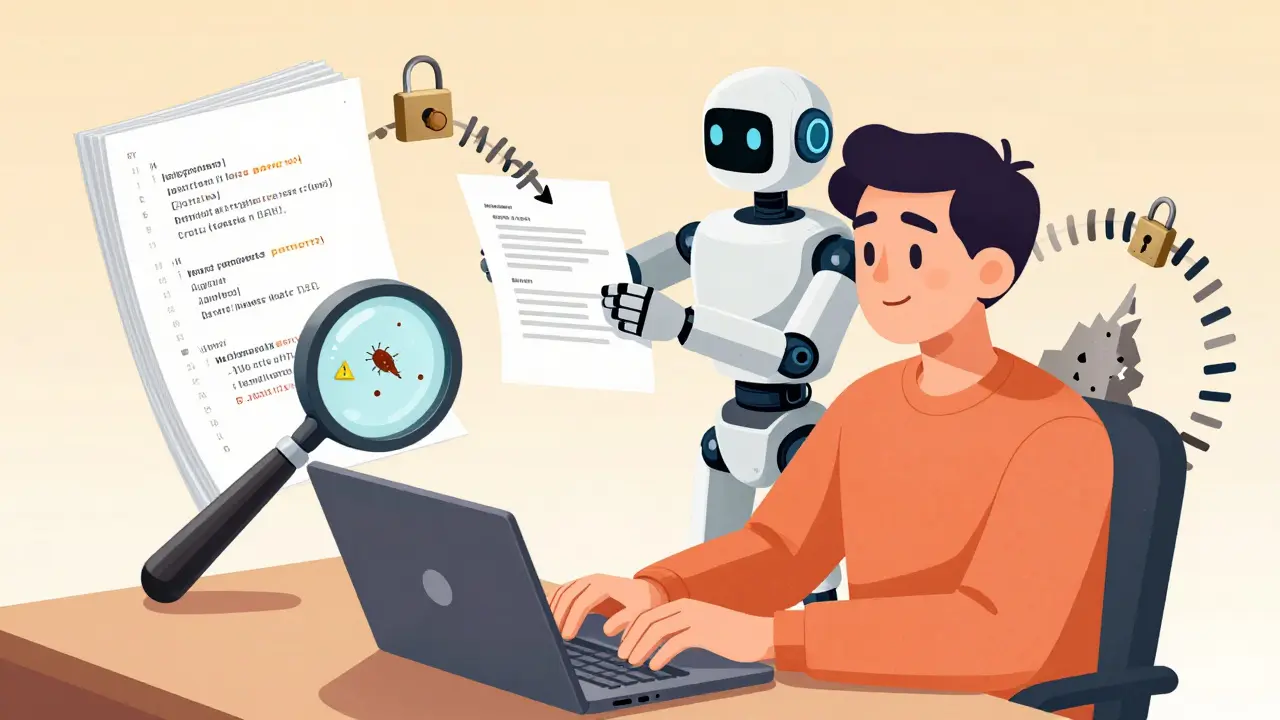
You don't have to abandon vibe coding to stay safe. But you must change how you use it. Here are actionable steps to mitigate risk:
- Never Trust Client-Side Auth: Assume any authentication logic running in the browser is compromised. Always validate sessions on the server side using secure, HTTP-only cookies or JWTs with proper expiration and signing.
- Scan for Secrets Immediately: Use tools like GitHub's secret scanning (introduced in January 2025 for AI-generated code) to automatically flag hardcoded credentials in pull requests. Never commit environment variables to version control.
- Implement Principle of Least Privilege: Ensure that data access policies verify user ownership for every request. Don't let the AI guess who should see what. Explicitly define roles and permissions.
- Isolate Staging Environments: Never deploy internal tools or staging sites to the public internet without strong authentication and network restrictions. Use VPNs or IP whitelisting.
- Review Input Sanitization: Manually check all endpoints that accept user input. Look for path traversal, SQL injection, and command injection vectors. Test with payloads like
../and' OR 1=1 --.
New tools are emerging to help. Wiz launched VibeGuard in February 2025, specifically designed to identify client-side authentication flaws in vibe-coded apps. OWASP added 'AI-Generated Code Vulnerabilities' to their 2025 Top 10 draft, providing detailed mitigation guidance. Gartner predicts that by 2027, AI-assisted security review tools will become mandatory for vibe coding, with 75% of enterprises implementing specialized scanning.
The Future of Secure AI Development
The industry is waking up to this challenge. NIST released Special Publication 1800-38 in September 2024, addressing AI-generated code security requirements. Regulatory pressure is mounting alongside technical solutions.
However, the root cause remains tricky. As long as AI models are trained on public code repositories filled with vulnerabilities, they will continue to reproduce those flaws. MIT researchers have shown promise using reinforcement learning to train models on secure coding patterns, but these approaches remain experimental as of late 2024. Until then, the burden falls on developers to act as the final gatekeeper.
Vibe coding is here to stay. It offers incredible productivity gains. But remember: functionality is not security. Just because your app works doesn't mean it's safe. Treat every line of AI-generated code as suspect until proven otherwise. Your data-and your reputation-depends on it.
What is vibe coding?
Vibe coding is a development approach where developers use AI coding assistants to rapidly generate complete applications through high-level prompts. The AI infers the implementation details, allowing for fast creation of functional apps with minimal manual coding expertise.
Why are vibe-coded apps insecure?
They are insecure because AI models are trained on public code that often contains vulnerabilities. Additionally, AI prioritizes functionality over security, leading to common flaws like client-side authentication, hardcoded secrets, and missing input validation that human reviewers might overlook.
What is the most common vulnerability in AI-generated code?
According to Kaspersky's 2025 analysis, Missing Authentication (CWE-306) is the most prevalent weakness, appearing in 42% of cases. Other top issues include Code Injection (37%) and Unrestricted File Upload (31%).
Can traditional security tools detect these flaws?
Often, no. Traditional SAST tools may miss these flaws because the AI-generated code is syntactically correct and functionally operational. The vulnerabilities lie in logical errors and missing security controls rather than obvious syntax mistakes, requiring specialized scanning tools like Wiz's VibeGuard.
How can I make my vibe-coded app more secure?
You should manually review all authentication logic, ensure secrets are stored in environment variables, implement strict server-side authorization, isolate staging environments, and use specialized AI-security scanning tools. Never trust the AI's output without rigorous human verification.