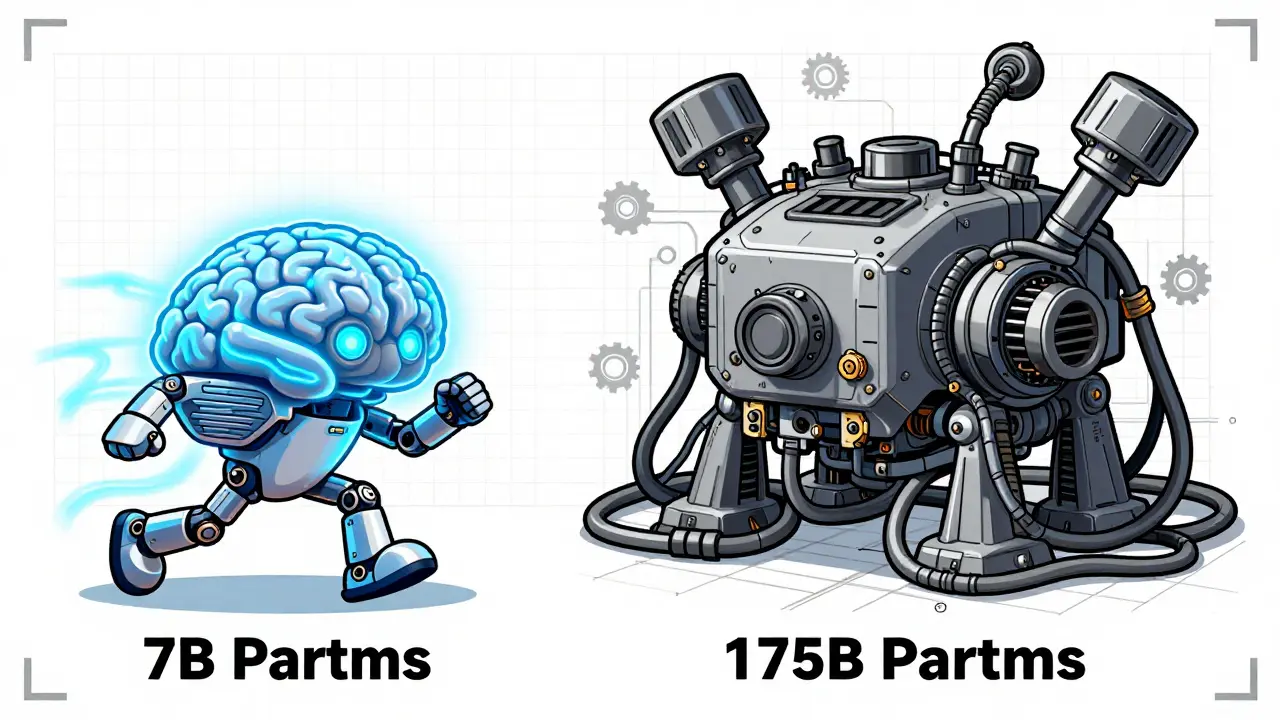
Have you ever wondered why one AI chatbot feels like a genius while another stumbles over basic logic? The answer often lies hidden in a single number: the parameter count. It is the secret metric that defines the brain size of Large Language Models (neural network-based AI systems trained on massive datasets to generate human-like text). But here is the twist-bigger isn't always better, and sometimes, it’s just more expensive.
In this guide, we are going to strip away the marketing hype and look at what parameters actually do. We will explore how models scale, why some tiny models outperform giants, and what this means for your hardware or budget in late 2025 and beyond.
The Quick Takeaways
- Parameters are memory: They store the weights and biases that allow an LLM to understand language patterns and relationships.
- Density matters more than raw size: A well-trained smaller model can beat a poorly trained larger one (the Chinchilla Scaling Laws).
- Mixture-of-Experts (MoE) changes the game: You can have trillions of total parameters but only activate billions during use, saving huge amounts of compute cost.
- Quantization shrinks the footprint: Reducing precision from 16-bit to 4-bit can cut memory needs by 75% with minimal quality loss for most tasks.
- Diminishing returns are real: Beyond certain sizes, adding parameters yields negligible accuracy gains compared to the cost increase.
What Exactly Is a Parameter?
Think of a neural network as a giant spreadsheet with millions of cells. Each cell holds a number-a weight or bias-that adjusts how the model processes information. These numbers are the parameters. When you train a model, you are essentially tweaking these numbers until the model predicts the next word in a sentence accurately.
The concept dates back to Google's Transformer architecture in 2017, but the term "Large Language Model" really took off with OpenAI's GPT-1 in 2018, which had a modest 117 million parameters. Fast forward to December 2025, and we are talking about models with trillions of parameters. That is not just a bigger spreadsheet; it is a library containing near-infinite knowledge and reasoning pathways.
Why does this matter? Because every parameter represents a potential connection in the model's "brain." More parameters mean the model can memorize more facts, understand more nuanced contexts, and perform complex reasoning tasks without hallucinating as much. However, each parameter also demands computational power. Training requires roughly 6 FLOPs (floating-point operations) per parameter per token, while inference (using the model) costs 1-2 FLOPs per parameter. This math dictates everything from electricity bills to response speeds.
The Evolution of Scale: From Millions to Trillions
To understand where we are, let's look at how far we've come. The jump from GPT-1 (117 million) to GPT-3 (175 billion) in 2020 was explosive. Today, the landscape is split between cloud behemoths and local champions.
| Model | Total Parameters | Active Parameters (Inference) | Architecture Type |
|---|---|---|---|
| GPT-5 (Rumored) | ~2.1 Trillion | ~2.1 Trillion | Dense |
| Google Gemini 2.5 Pro | ~1.8 Trillion | ~1.2 Trillion (optimized) | Hybrid/MoE |
| DeepSeek-V3 | 671 Billion | 37 Billion | Mixture-of-Experts (MoE) |
| Mixtral 8x22B | 141 Billion | 39 Billion | Mixture-of-Experts (MoE) |
| Llama 4 Maverick | 17 Billion | 17 Billion | Dense |
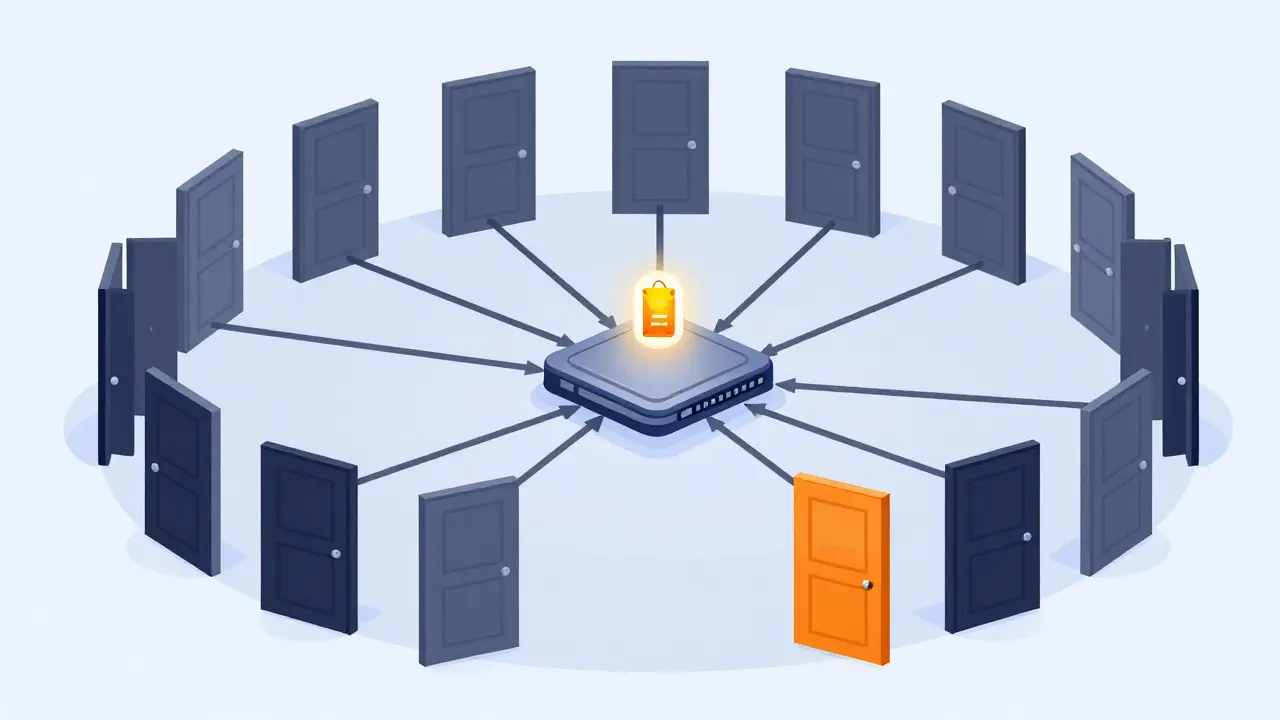
Notice the difference between "Total" and "Active" parameters? This is the key to modern efficiency. In a dense model like early GPTs, every single parameter is used for every single word generated. In a Mixture-of-Experts (MoE) model, the system routes each input to specific "experts" within the network. DeepSeek-V3 has 671 billion parameters, but only activates 37 billion per step. This allows it to rival much larger dense models while using significantly less energy and time during inference.
Why Bigger Isn't Always Better: The Efficiency Trap
You might assume that if Model A has twice the parameters of Model B, it should be twice as smart. Reality is messier. The Chinchilla Scaling Laws, published by DeepMind in 2022, showed that there is an optimal ratio between the number of parameters and the amount of training data. If you add more parameters without adding more high-quality data, the model doesn't get smarter-it gets worse. It starts overfitting, memorizing noise instead of learning generalizable rules.
Consider Mistral 7B versus Llama 2 13B. Mistral, with fewer parameters, outperformed Llama 2 on multiple benchmarks. How? Better architectural design and higher-quality training data. Similarly, Google's Gemma 3 highlights reporting quirks. Marketed as a 4-billion-parameter model, its technical docs listed 5.44 billion because Google sometimes excludes embedding parameters from their marketing counts. This inconsistency makes direct comparisons tricky. Always check the technical whitepaper, not just the press release.
There is also the issue of diminishing returns. Forrester's January 2025 report notes that beyond certain thresholds, each additional billion parameters yields less than 0.5% improvement in accuracy on standard benchmarks. Meanwhile, the cost to run those models skyrockets. An enterprise customer reported that deploying Gemini 1.5 Pro (estimated 1.2T parameters) cost 3.2 times more per million tokens than GPT-4, yet only delivered 1.8 times better accuracy for legal document analysis. Was that extra spend worth it? For some, yes. For others, no.
Running LLMs Locally: The Hardware Reality Check
If you are a developer or hobbyist trying to run these models on your own machine, parameter count directly dictates your hardware needs. Let's talk RAM and VRAM.
A 7-billion-parameter model in full 16-bit precision requires about 14GB of RAM. That fits comfortably on many consumer GPUs, like the NVIDIA RTX 3060 (12GB) or RTX 3080 (10-12GB). But what if you want to run a 13-billion or 70-billion-parameter model? You need quantization.
Quantization reduces the precision of the parameters. Instead of storing a weight as a precise 16-bit float, you store it as a rougher 4-bit integer. This cuts memory usage by up to 75%. A 9-billion-parameter model at 4-bit quantization might only need 3.5GB to 4GB of VRAM. According to Gary Explains (January 2025), a 9B model at 4-bit often performs better than a 2B model at full precision because the sheer volume of retained knowledge outweighs the slight loss in numerical precision.
Here is what users are seeing in practice:
- RTX 3080 User: Runs Mistral 7B at 4-bit quantization at 28 tokens per second. Switching to a 13B model causes the system to choke, dropping below usable speeds.
- RTX 4090 User: Can handle Qwen-14B at 4-bit quantization, requiring 8.2GB VRAM and processing 12.3 tokens per second. Running the same model at 16-bit requires 26GB VRAM (often exceeding single-GPU limits) and slows down to 4.7 tokens per second.
Tools like Ollama and LMStudio have made this easier. LMStudio's November 2024 metrics show that 85% of new users successfully run 7B models within 15 minutes using their GUI. The barrier to entry has dropped, but the ceiling remains defined by your GPU's VRAM.

The Future: Hybrid Architectures and Smart Scaling
We are moving past the era of brute-force scaling. By Q4 2026, Gartner predicts that 75% of enterprise LLM deployments will use MoE architectures with fewer than 50 billion active parameters, despite having hundreds of billions of total parameters. This shift is driven by economics. Cloud providers like OpenAI and Google are optimizing for throughput and cost-per-token, not just raw intelligence.
Meta's Llama 4 introduced Grouped-Query Attention, improving parameter efficiency by 22% compared to Llama 3. Google's Gemini 2.5 Pro focused on advanced routing algorithms to achieve comparable performance to rumored 1.8T parameter models using only 1.2T parameters. The focus is shifting from "how big can we make it" to "how efficiently can we use what we have."
MIT's December 2024 study suggests that beyond 2 trillion parameters, non-parameter innovations-better training data curation, novel architectures, and algorithmic improvements-will drive 80% of future capability gains. The race is changing. It is no longer just about building the biggest brain; it is about building the smartest, most efficient one.
How to Choose the Right Model Size
So, which one should you pick? It depends on your job-to-be-done.
- For simple text classification or summarization: Stick to small models (under 3 billion parameters). They are fast, cheap, and sufficient for straightforward tasks. Llama 3.2 1B/3B variants excel here.
- For coding assistance or creative writing: Mid-sized models (7B to 13B) offer the best balance. Run them locally with 4-bit quantization for privacy and speed.
- For complex reasoning, legal analysis, or medical queries: You need the heavy hitters. Use cloud APIs for models with 100B+ parameters. The accuracy gain is critical when mistakes are costly.
- For high-volume enterprise automation: Look for MoE models. They provide high capability at lower inference costs because they don't activate all parameters for every request.
Don't fall for "parameter inflation." Just because a model claims to have more parameters doesn't mean it's better. Look at benchmark scores (like MMLU or HumanEval), latency reports, and real-world user reviews. Sometimes, a smaller, cleaner model is the right tool for the job.
What is the difference between total parameters and active parameters?
Total parameters refer to the entire set of weights stored in the model's architecture. Active parameters are the subset of those weights that are actually used during inference (generating a response). In Dense models, all parameters are active. In Mixture-of-Experts (MoE) models, only a fraction (e.g., 37 billion out of 671 billion in DeepSeek-V3) are activated per token, reducing compute costs.
Does a higher parameter count always mean a smarter model?
Not necessarily. While larger models generally have higher capacity, their performance depends heavily on the quality of training data and architectural efficiency. The Chinchilla Scaling Laws show that adding parameters without corresponding increases in high-quality data leads to diminishing returns or even overfitting. A well-designed 7B model can outperform a poorly trained 13B model.
How much VRAM do I need to run a 7B parameter model?
It depends on quantization. A 7B model in full 16-bit precision requires approximately 14GB of VRAM. Using 4-bit quantization reduces this to around 3.5GB to 4GB, making it runnable on consumer GPUs like the NVIDIA RTX 3060 (12GB) or even integrated graphics with sufficient system RAM, though speed will vary.
What is quantization and why is it important?
Quantization is a technique that reduces the precision of the numbers (weights) used in the model, typically from 16-bit floats to 4-bit or 8-bit integers. This drastically reduces memory usage (VRAM/RAM) and can improve inference speed with minimal loss in model quality. It is essential for running large models on consumer hardware.
Are Mixture-of-Experts (MoE) models better than dense models?
MoE models offer better efficiency for their size. They contain many more total parameters than dense models but activate only a small subset during inference. This allows them to match or exceed the performance of larger dense models while requiring less computational power and energy per token generated. They are increasingly preferred for enterprise deployments due to cost savings.