
Remember when paying $30 for a million tokens felt like a steal? That was 2023. Fast forward to late 2026, and getting GPT-4 equivalent quality now costs less than a dollar per million tokens. We are watching one of the fastest deflationary events in tech history, driven by brutal competition and architectural breakthroughs. If you're still budgeting for AI based on last year's invoices, you're likely overpaying or misallocating resources.
The market isn't just getting cheaper; it's splitting in two. On one side, we have commodity models doing basic tasks for pennies. On the other, premium reasoning engines charging premiums for complex logic. Understanding this bifurcation is the only way to predict your future AI spend accurately. This guide breaks down where prices are heading, why they're dropping, and how to structure your contracts so you aren't left holding the bag when the next price cut hits.
The Great Deflation: Why Token Costs Are Crashing
You might think providers are being generous, but they're actually fighting for survival. The Large Language Model (LLM) market has seen inference costs drop by nearly 98% since their peak. This isn't magic; it's engineering efficiency meeting market saturation. When every provider from OpenAI to Meta to DeepSeek offers similar capabilities, price becomes the primary differentiator for general-purpose tasks.
Consider the trajectory. In 2023, high-quality generation cost around $60 per million tokens. Today, comparable performance sits at roughly $0.75. That’s a massive shift in unit economics. Providers achieve this through better hardware utilization and smarter architectures. They aren't just selling raw compute anymore; they're selling optimized outcomes. For businesses, this means the barrier to entry for deploying AI agents has collapsed. You can run thousands of queries for the price of a single coffee.
| Model Type | Input Cost ($/1M Tokens) | Output Cost ($/1M Tokens) | Primary Use Case |
|---|---|---|---|
| Meta Llama 4 Maverick | $0.27 (Median) | $0.85 (Median) | General summarization, chatbots |
| DeepSeek R1 | $0.60 (Median) | $2.34 (Median) | Cost-effective reasoning |
| Anthropic Claude Sonnet 4 | $3.00 | $15.00 | Balanced professional tasks |
| OpenAI GPT-5.2 Pro | $21.00 | $168.00 | Complex multi-step reasoning |
Commoditization vs. Premium Reasoning
Here is the critical insight most CFOs miss: not all AI workloads are created equal. Simple tasks like summarizing an email or extracting data from a receipt are becoming commodities. These require less specialized computation, so providers race to the bottom on price. If you are using a premium model for these tasks, you are burning cash unnecessarily.
Conversely, advanced reasoning commands a sustained premium. Models that perform deep chain-of-thought analysis, such as GPT-o1 or Claude Opus 4, require significantly more compute power. They don't just predict the next word; they plan, critique, and refine their answers. This internal processing generates "hidden" tokens that inflate bills. A legal review workflow using a reasoning model might cost ten times more than a standard Q&A bot, but the accuracy gain justifies the expense. The market is stabilizing into two distinct tiers: cheap, fast, and good enough for routine work; and expensive, slow, and precise for high-stakes decisions.

The Hidden Costs Beyond Per-Token Billing
Looking only at input and output token rates gives you a false sense of security. Real-world costs include several invisible layers that can double your bill if you aren't careful. First, there are reasoning tokens. When a model thinks silently before answering, those internal steps are billed. For long analytical tasks, this overhead is substantial.
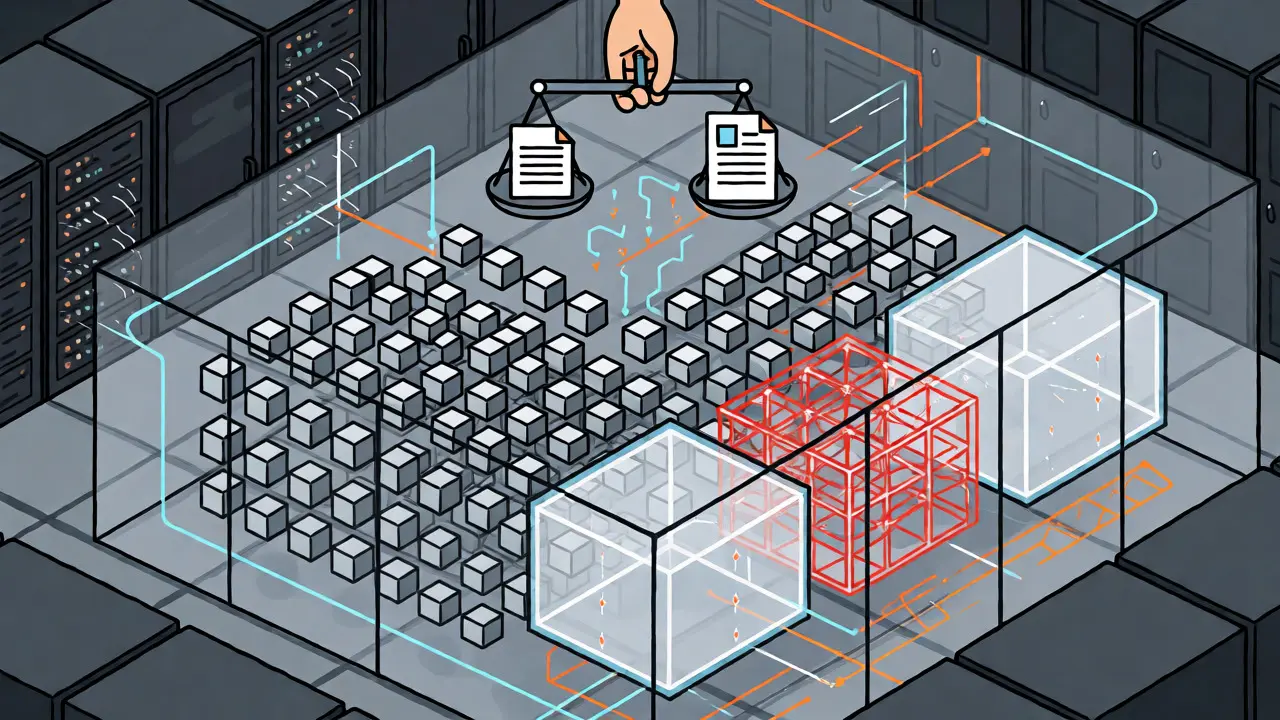
Then there is the infrastructure stack. Your application likely uses vector databases like Pinecone or Weaviate for retrieval-augmented generation (RAG). Each query incurs storage and read fees. Add reranking models that filter results before sending them to the LLM, and you have a complex cost web. Don't forget embeddings. Generating vectors for your knowledge base is a one-time cost, but querying them repeatedly adds up. Budgeting must account for this full ecosystem, not just the LLM API endpoint.
Predicting 2027: The Shift to Outcome-Based Pricing
Per-token billing is clumsy for business users. Nobody wants to calculate how many tokens a contract review consumes. As a result, we are seeing a rapid shift toward per-action pricing. Instead of paying for tokens, you pay a fixed fee for a completed task, like "summarize this document" or "extract invoice data." This trend, predicted to accelerate through 2027, aligns vendor incentives with customer value. It simplifies budgeting for non-technical teams who care about deliverables, not computational units.
Expect Service Level Agreements (SLAs) to become standard. Enterprise plans will offer guaranteed latency and uptime for a higher tier price. While consumer-grade APIs remain volatile and cheap, enterprise-grade reliability will carry a premium. This mirrors the cloud computing evolution, where basic storage became free-ish, but managed services remained profitable. If you need 99.99% uptime for your customer-facing chatbot, be prepared to sign a custom enterprise contract rather than relying on the public API rate card.
Strategic Moves for Your AI Budget
How do you navigate this shifting landscape? Start by auditing your current usage. Identify which workflows are truly commodity tasks. Can you swap your premium model for a mid-tier option like Llama 4 without losing quality? Run A/B tests. Often, users cannot distinguish between a $0.27 model and a $3.00 model for simple queries.
- Mix and Match: Use cheap models for routing and classification, reserving expensive reasoning models for final synthesis.
- Cache Aggressively: Store frequent responses to avoid re-processing identical queries.
- Negotiate Volume Discounts: With competition fierce, providers are eager to lock in enterprise customers. Ask for committed-use discounts.
- Monitor Open Source: Keep an eye on open-weight models. They often drive commercial prices down within months of release.
The era of blindly trusting one provider's pricing sheet is over. Flexibility is your best hedge against volatility. By diversifying your model stack and understanding the true cost drivers, you turn AI from a unpredictable expense into a controlled strategic asset.
Why are LLM prices dropping so rapidly?
Prices are falling due to intense competition among providers and significant improvements in model architecture, such as Mixture-of-Experts (MoE) and quantization. These technologies allow providers to serve requests with less compute power, passing savings to customers to capture market share.
What is the difference between commodity and premium LLM pricing?
Commodity models handle routine tasks like summarization and basic chat at very low costs (under $1 per million tokens). Premium models offer advanced reasoning, multimodal capabilities, and higher accuracy for complex workflows, commanding prices 10x to 100x higher due to greater computational requirements.
Will per-token pricing disappear completely?
Not entirely, but its dominance is waning. We expect a hybrid model where per-token billing remains for developers building custom apps, while enterprise clients increasingly adopt per-action or outcome-based pricing for predictable budgeting and simplified procurement.
How do hidden costs affect my total AI bill?
Hidden costs include reasoning tokens generated during internal chain-of-thought processes, vector database storage and query fees, and reranking model expenses. These can increase total cost of ownership by 20-50% compared to raw token counts alone.
Is open-source really cheaper than commercial APIs?
Open-source models like Llama 4 have lower per-token API costs via third-party hosts. However, self-hosting requires significant upfront investment in GPU infrastructure and maintenance. For small-to-medium businesses, managed APIs are usually cheaper overall until scale exceeds hundreds of millions of tokens monthly.