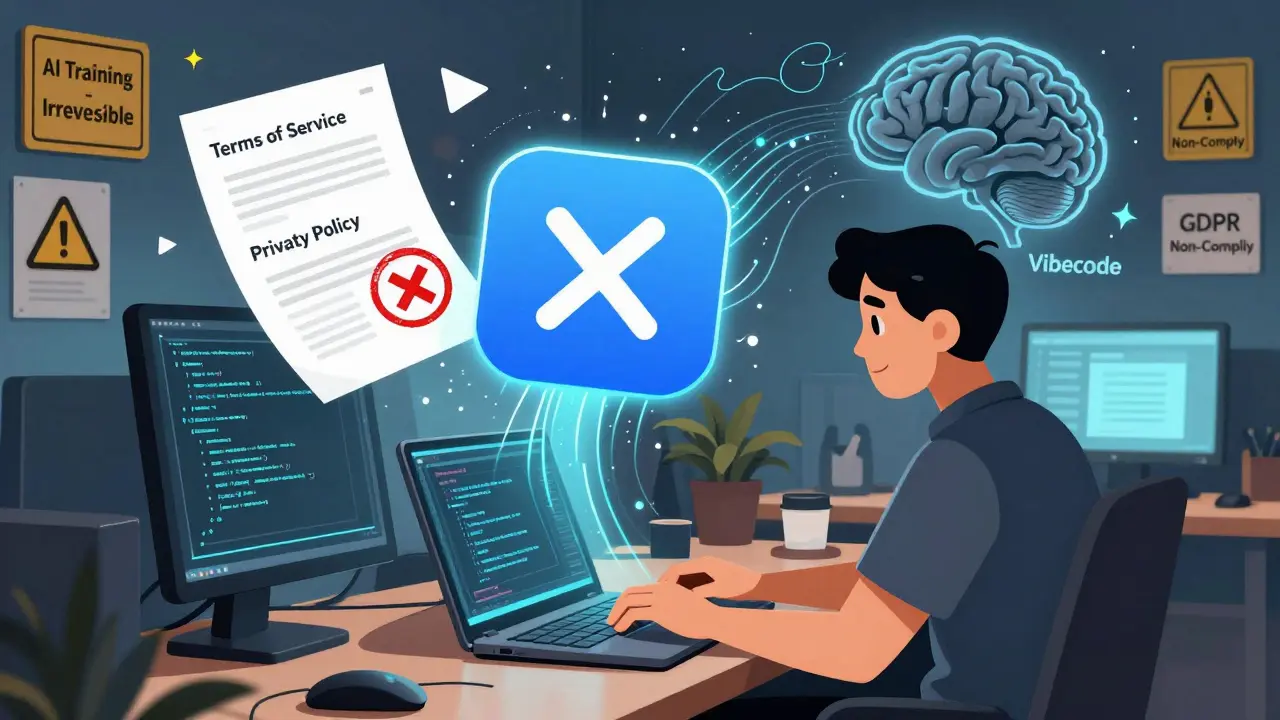
Building an app with Vibe Coding platforms feels like magic. You type a prompt, click generate, and boom - you’ve got a working React Native app in minutes. But here’s the catch: the code isn’t the only thing you need to generate. If you’re using Vibe Coding AI, Vibecode App Builder, or Vibecoding.build, you’re also generating legal risk - unless you know how to handle your Terms of Service and Privacy Policy properly.
Why Your App Got Rejected by the App Store
A developer in Toronto spent six weeks coding a fitness tracker using Vibecode App Builder. Everything worked perfectly. Then came the App Store rejection. The reason? "Privacy policy does not accurately describe data collection for AI training." This isn’t rare. In 2024, MobileDevHQ found that 68% of apps built with Vibe platforms got rejected on first submission because their privacy policies were either missing, too vague, or outright wrong. Most developers assumed the platform handled compliance. It didn’t. Vibe Coding platforms generate code - not legal documents. They don’t ask you: "Do you collect emails?" or "Do you send data to AI models?" They assume you’ll figure it out. But if you don’t, your app gets blocked. And the reason isn’t just bureaucracy. It’s law.What Vibe Platforms Actually Do With Your Users’ Data
Let’s cut through the noise. When you use Vibecode App Builder, you’re not just building an app. You’re feeding user inputs into an AI system that learns from them - permanently. According to their Terms of Service (Section 4.2, 2024), when users interact with your app built on their platform, any code queries, login details, or usage patterns you collect? Those get sent to Vibecode’s servers. And here’s the kicker: "Once any User Content is submitted to us, the effects of the development, optimization, and/or training of AI Technology and the Services are permanent and irreversible." That means if someone types their email into your app, and your app uses Vibecode’s AI backend, that email isn’t just stored in your database. It’s now part of the training data for every future AI model Vibecode builds. And you can’t undo it. Your Privacy Policy must say this. Not "we use data to improve services." Not "we may share with third parties." You must say: "User inputs are used permanently and irreversibly to train AI models operated by Vibecode." If you don’t, you’re violating GDPR, CCPA, and Apple’s June 2025 policy update, which now explicitly requires disclosure of "AI training practices using user content."The Gap Between Code Generation and Legal Compliance
Think of Vibe Coding platforms like a car factory. They build the engine, the wheels, the body. But they don’t install the seatbelts. You have to. Specialized tools like iubenda exist because they ask the right questions. They don’t guess. They don’t generate generic legal fluff. They ask: "Do you use Vibecode AI?" "Do you collect location data?" "Do you share data with Google Analytics?" Then they build a policy that matches your actual setup. A developer on Reddit, @CodeWithCaution, described how he got rejected twice before he used iubenda’s AI Compliance Module. "I thought my policy was fine. It said we collect email. But it didn’t mention that Vibecode’s AI keeps a copy forever. That’s what got me rejected. iubenda’s generator flagged it immediately." Vibe platforms don’t do that. Their own Privacy Policy (Vibecoding.build, July 2025) is detailed - but it’s for their platform, not yours. Your app might collect payments. Your app might track location. Your app might store health data. Their policy doesn’t cover that.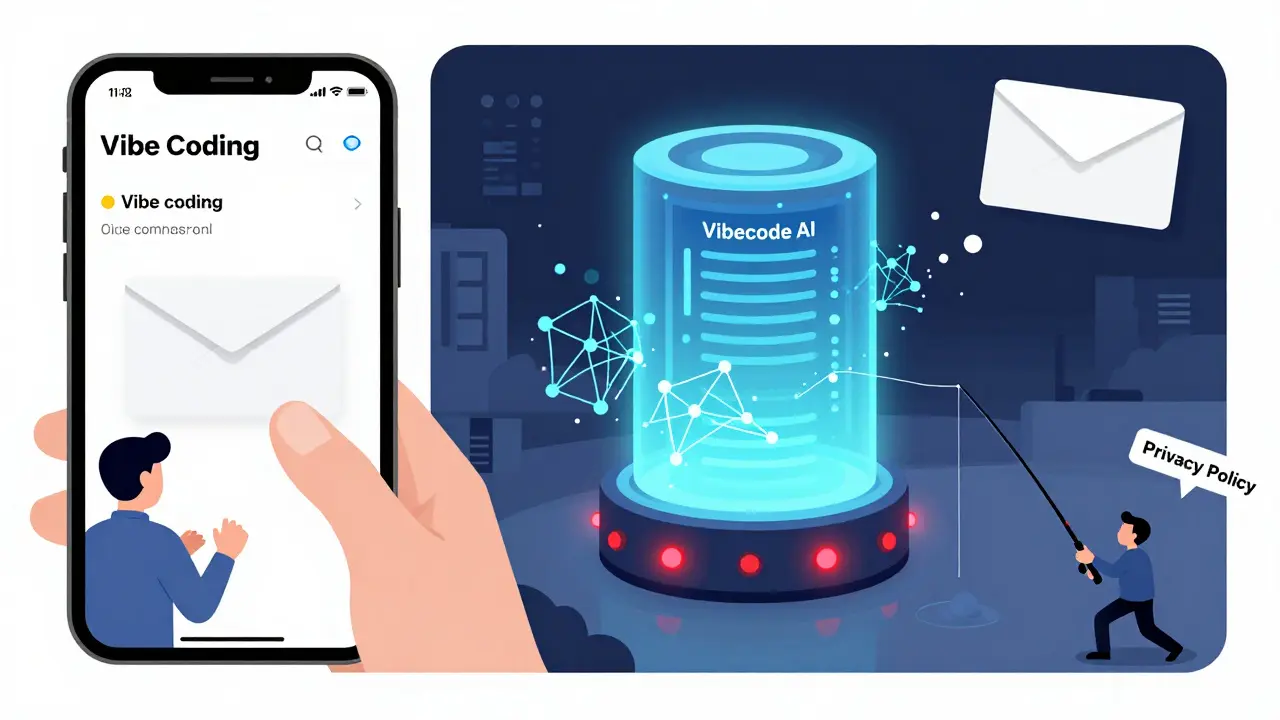
What Your Privacy Policy Must Include in 2026
Here’s what a compliant Privacy Policy for a Vibe-built app needs - no fluff, no templates:- Exactly what data you collect: Email, IP address, device ID, location, usage patterns - list them all.
- How it’s used: "We use your email to create your account. We use your code queries to power AI features via Vibecode App Builder."
- AI training disclosure: "User inputs may be permanently used to train AI models operated by Vibecode. This process is irreversible."
- Third-party disclosures: Name every service your app talks to - Vibecode, Firebase, Stripe, Google Analytics.
- User rights: How users can access, delete, or export their data. GDPR and CCPA require this.
- Data retention: "We keep your data for 30 days after account deletion. Vibecode retains inputs indefinitely for AI training."
Why Generic AI Legal Tools Fail
You might be tempted to use ChatGPT or a free AI policy generator. Don’t. A 2025 TechPolicy briefing from BEUC found that 89% of AI-generated privacy policies failed GDPR Article 13-14 compliance. Why? They use vague language like "we may use your data for research" or "third parties may process your information." They don’t name Vibecode. They don’t mention irreversible training. They don’t specify retention periods. Apple and Google don’t care how fancy your AI is. They care if your policy matches reality. If your policy says "we don’t share data," but your app sends everything to Vibecode? Your app gets rejected. Period. The iubenda AI Compliance Module, launched March 2025, is designed for this exact problem. It asks: "Are you using Vibe Coding?" If you say yes, it auto-generates the irreversible AI training clause. It links to Vibecode’s data practices. It even updates when their policies change.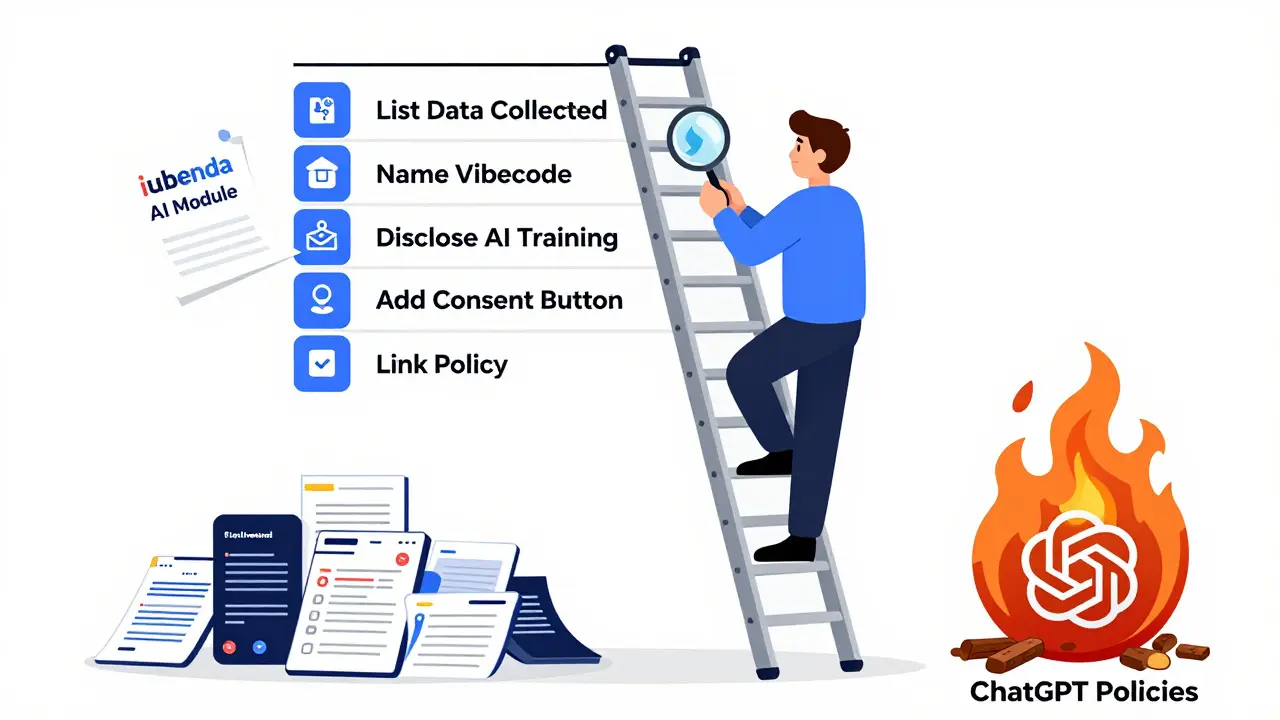
What You Should Do Right Now
If you’ve built an app with Vibe Coding, here’s your checklist - in order:- Go to your app’s code. Find every place where you call Vibecode’s API or use their generated components.
- List every piece of user data you collect: name, email, location, preferences, inputs, device info.
- Write a one-sentence truth: "User data submitted to this app is permanently used to train Vibecode’s AI models."
- Use a tool like iubenda’s AI Compliance Module to generate your Privacy Policy. Don’t write it yourself.
- Embed the policy in your app’s settings menu. Link it from your login screen.
- Add a separate consent screen before collecting any data: "Your inputs will be used to train AI. Do you agree?"
What’s Changing in 2026
By the end of this year, Forrester predicts 92% of app store rejections will be due to poor AI disclosure. Vibe platforms are responding - Vibecoding.build added a new "AI and Privacy" section to their policy in July 2025. Vibe Coding AI plans to give users more control over training data in Q2 2026. But here’s the truth: you can’t wait for them to fix it. Their updates help their own compliance - not yours. Your app still needs its own policy. And it still needs to be accurate. The democratization of app building is real. Anyone can build an app now. But with that power comes responsibility. You can’t outsource your legal obligations to an AI tool. You have to understand what your app does - and tell users the truth.Do Vibe Coding platforms automatically generate legal policies?
No. Vibe Coding platforms like Vibecode App Builder and Vibe Coding AI generate application code, but they do not generate legally compliant Terms of Service or Privacy Policies. Developers must create these documents themselves, ensuring they accurately reflect how user data is collected and used - especially for AI training.
Why do apps built with Vibe Coding get rejected by Apple and Google?
Apps are rejected because their Privacy Policies fail to disclose how user data is used for AI training. Platforms like Vibecode permanently store and analyze user inputs to improve their AI models. If your policy doesn’t explicitly mention this irreversible data usage, app stores will reject your submission - as of 2025, over 68% of such apps face this issue.
Can I use ChatGPT or free AI tools to write my Privacy Policy?
It’s risky. Most AI-generated policies use vague language like "we may use your data" and fail to name specific services like Vibecode. They often miss critical legal requirements under GDPR and CCPA, such as data retention periods, user rights, and explicit AI training disclosures. In 2025, 89% of AI-generated policies failed compliance checks by legal experts.
What’s the biggest mistake developers make with Vibe Coding apps?
Assuming the platform handles compliance. Many developers think because Vibecode has a Privacy Policy, their app does too. But Vibecode’s policy covers their own service - not yours. Your app might collect payments, location, or health data. That’s your responsibility. Failing to disclose how user data flows into Vibecode’s AI is the most common reason for app rejection.
Do I need user consent for AI training?
Yes, under California’s CPPA enforcement guidance (February 2025) and the EU AI Act, if user data is used permanently for AI training - and Vibecode’s terms say it is - you need explicit opt-in consent. A passive checkbox in the Terms of Service isn’t enough. You need a clear, separate action: "I agree my inputs will be used to train AI models forever."
How long does it take to create a compliant Privacy Policy for a Vibe-built app?
Most developers spend 8-12 hours mapping data flows after building their app. Using a specialized tool like iubenda’s AI Compliance Module reduces this to under 30 minutes. The key is accuracy, not speed. A policy that matches your actual data practices will get approved. One that’s generic will get rejected.
Bob Buthune
February 3, 2026 AT 16:44Okay, I just spent 3 hours re-reading this and I’m emotionally drained. Like, I built my app with Vibecode because I’m not a lawyer, I’m a guy who codes at 2 a.m. while eating cold pizza. Now I’m supposed to drop a whole separate consent screen just because some AI is quietly hoarding my users’ emails forever? 😭 I mean, I get it, legally it’s a nightmare, but emotionally? I feel like I just handed my users’ data to a black hole that also writes poetry about surveillance capitalism. I’m not even mad, I’m just… tired. And now I have to go rewrite my whole privacy policy in legalese while my cat judges me from the keyboard. 🐱💔
Jane San Miguel
February 3, 2026 AT 22:16It is not merely a matter of compliance; it is a fundamental epistemological failure of the current generation of low-code platforms to recognize that legal ontology cannot be abstracted away through algorithmic convenience. The assumption that legal documentation is analogous to UI component generation is not only erroneous-it is ontologically incoherent. The GDPR, as codified in Article 13(1)(f), mandates specificity of purpose, not performative vagueness. Vibecode’s Terms of Service, while internally consistent, are not a surrogate for your app’s legal persona. You are not absolved by proxy. You are the data controller. Period. No emoji. No shortcuts. No magic.
Kasey Drymalla
February 3, 2026 AT 23:29Dave Sumner Smith
February 4, 2026 AT 19:22Cait Sporleder
February 6, 2026 AT 01:46It is profoundly illuminating, albeit disheartening, to observe the widespread cognitive dissonance among developers who perceive legal compliance as an ancillary burden rather than an intrinsic component of ethical engineering. The notion that one can outsource moral responsibility to an algorithmic abstraction is not merely negligent-it is a betrayal of the user’s trust, which, in the digital age, constitutes the very foundation of human dignity. The irreversibility clause embedded within Vibecode’s Terms of Service is not a technical footnote; it is a metaphysical contract, one that permanently alters the ontological status of personal data. To omit its explicit articulation in one’s Privacy Policy is to engage in a form of epistemic violence. The iubenda AI Compliance Module, though commercial, performs a vital hermeneutic function: it forces the developer to confront the material consequences of their choices. One cannot, in good conscience, claim ignorance when the architecture of one’s application is explicitly designed to feed data into a black box whose outputs are not only unpredictable but irreversible. The EU AI Act, with its risk-based framework, is not overreach-it is a necessary recalibration. Developers who treat this as a bureaucratic hurdle are not merely unprepared-they are complicit.