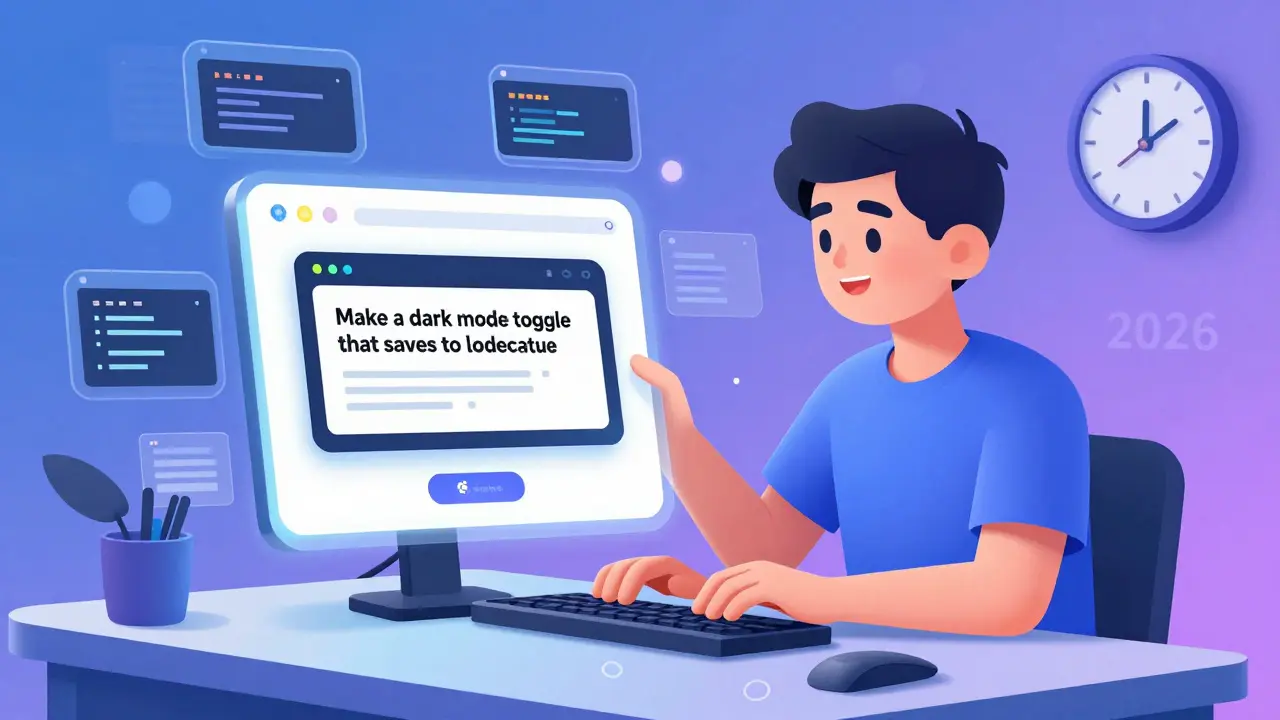
By 2026, if you’re still hiring developers the way you did in 2020, you’re already behind. The old model-where coding skills meant memorizing syntax, debugging line by line, and writing every function from scratch-is gone. What’s replaced it? Vibe coding. It’s not a buzzword. It’s a working reality in 78% of enterprise teams, according to SynergyLabs’ 2026 survey. Developers now type things like, "Make a dark mode toggle that saves to localStorage," and the AI generates working code. No semicolons. No import statements. Just intent. And that changes everything about who you need on your team.
Forget "Full-Stack Developer"-Here’s What Actually Matters Now
The title "full-stack developer" doesn’t mean what it used to. Back in 2023, it meant someone who could build a frontend, connect to a database, and deploy a server. Today, it means someone who can speak to AI like a teammate. The best developers aren’t the ones who write the most code-they’re the ones who write the clearest prompts. A 2025 study from Emergent.sh found that developers who spent just two hours a week practicing natural language descriptions saw 55% better results from vibe tools than those who stuck to traditional coding. That’s not luck. That’s skill.Companies that still hire for "JavaScript expertise" are missing the point. What they really need is someone who can say, "I need a form that validates email, shows a spinner while submitting, and sends a success toast without refreshing the page," and get exactly that. The AI handles the boilerplate. The human handles the clarity. This is why prompt engineering is now the most in-demand skill in tech-job postings for "prompt engineer" grew 312% from 2024 to 2025, according to LinkedIn.
The Three Roles That Actually Deliver Value in 2026
You don’t need more coders. You need three new kinds of people:- Junior Vibe Prototypers-These are the new entry-level hires. They don’t need years of experience. They need curiosity and clear communication. They use tools like Bolt.new to turn product ideas into working prototypes in hours, not weeks. Their job isn’t to write code. It’s to make ideas tangible fast.
- Hybrid Debugging Specialists-This is the role most companies overlook. AI generates code, but it’s messy. It’s inconsistent. It’s full of hidden bugs. According to Emergent.sh, 22% of initial vibe outputs have critical flaws. That’s where your mid-level engineers come in. They don’t write the code-they audit it. They check for security holes, memory leaks, and framework mismatches. Teams that assign this role see 32% fewer production bugs. And yes, they still need to know how to read traditional code. The AI doesn’t fix what you don’t understand.
- Senior Vibe-to-Code Transition Specialists-These are your secret weapon. They take a vibe-generated prototype and turn it into a maintainable, tested, CI/CD-ready codebase. They add unit tests. They refactor for readability. They integrate with legacy systems. This isn’t just coding. It’s translation. And it’s worth 22% more in salary, according to Levels.fyi data from 2025. Companies that don’t have this role end up with a pile of "cool demos" that never ship.
Why Replacing Developers With AI Is a Disaster
Some leaders think vibe coding means they can cut their engineering team in half. That’s how you get into trouble. Adam Smith, CTO of SynergyLabs, put it bluntly: "Organizations trying to replace developers with vibe coding alone face 47% higher technical debt within 18 months." Why? Because AI doesn’t understand context. It doesn’t know your company’s architecture. It doesn’t care about compliance.Remember that fintech case from 2025? A team used vibe coding to build a payment feature. The AI generated code that worked in testing-but ignored PCI-DSS requirements. Seventeen compliance violations. 340 engineering hours to fix. All because no one checked the output. AI doesn’t replace judgment. It amplifies it. If your team doesn’t know what good code looks like, the AI will just give them bad code faster.
How to Build a Vibe-Ready Team (Without Losing Your Best People)
Transitioning isn’t about firing people. It’s about retraining them. The most successful teams use a "vibe buddy" system: each traditional developer is paired with a vibe specialist for 4-6 weeks. The vibe buddy shows them how to phrase prompts. The traditional developer shows them how to spot bad output. SynergyLabs found this cuts the learning curve by 41%.Don’t skip the basics. Even in 2026, 68% of developers on Reddit still believe traditional coding skills are essential. ArchitectJane, a senior engineer with 18 years in the field, put it this way: "The AI can’t fix what you don’t understand. I’ve seen teams waste weeks chasing vibe-generated rabbit holes because no one knew the underlying frameworks."
Set up "No-AI Fridays." Give your team one day a week to work on legacy systems, write tests, or refactor old code without touching a vibe tool. This isn’t nostalgia-it’s insurance. It keeps your team from losing their foundational knowledge. And it prevents the knowledge atrophy that 27% of teams are already experiencing.
What to Look for in Candidates (and What to Avoid)
When hiring for vibe coding roles, avoid these red flags:- Candidates who say, "I don’t need to know JavaScript anymore-I just talk to the AI."
- People who can’t explain why a piece of AI-generated code might fail under load.
- Those who haven’t used GitHub in the past year. Even vibe tools like Lovable.dev sync with repositories. You still need to understand version control.
Look for these green flags:
- Someone who can describe a feature in plain language and then explain the trade-offs in technical terms.
- A developer who’s taken a course on prompt engineering-yes, they exist now. Platforms like Lovable.dev and Manus offer certification paths.
- People who’ve worked on hybrid teams. They know how to bridge the gap between product managers and engineers.
And yes, you still need people who can read a stack trace. You just don’t need them to write the first 80% of the code anymore.
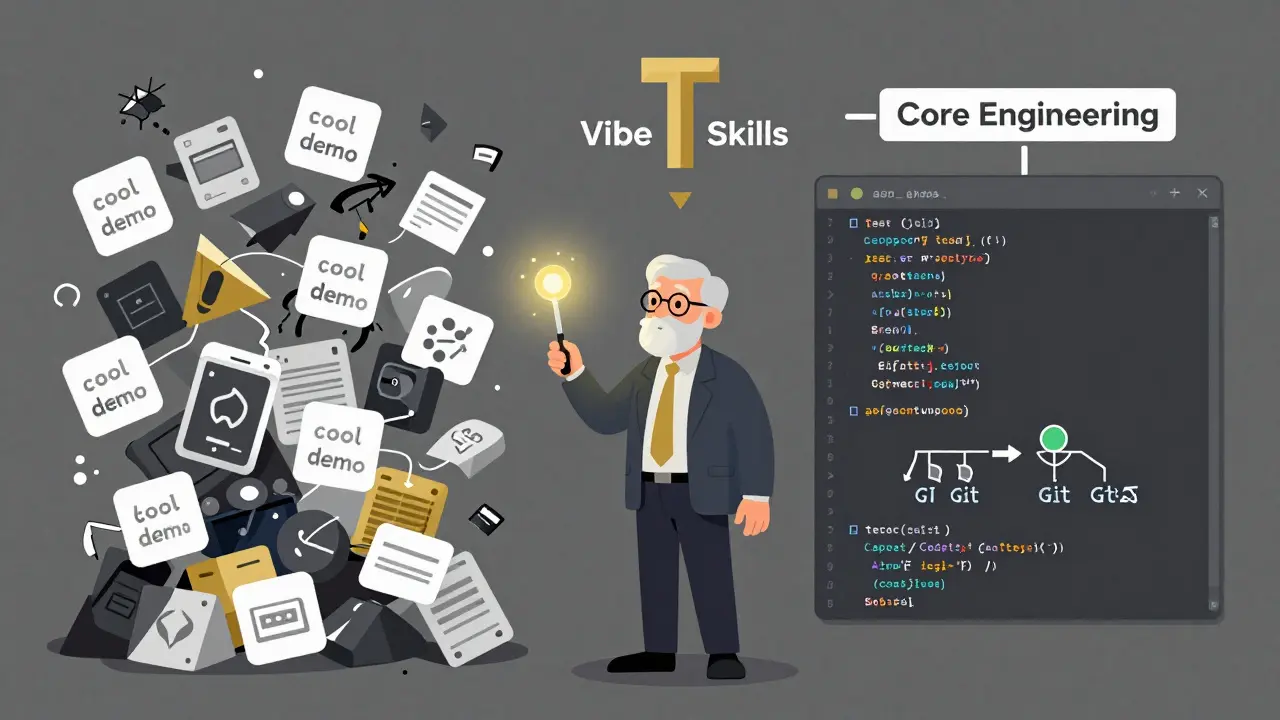
The Future Is T-Shaped
MIT’s 2026 Work of the Future report calls the ideal developer a "T-shaped professional." The horizontal bar? Deep expertise in vibe coding, prompt design, and AI collaboration. The vertical stem? Strong fundamentals in architecture, testing, security, and system design.That’s the future. And it’s not about being replaced by AI. It’s about becoming better because of it. Developers who master vibe tools while holding onto their core skills are 87% less likely to be displaced, according to the same report. Those who try to be "just a vibe coder"? 42% higher risk of job loss.
By 2027, Gartner predicts 85% of companies will require prompt engineering certifications for mid-to-senior roles. That’s not a trend. That’s a requirement. The companies that adapt now will have teams that ship faster, make fewer mistakes, and attract better talent. The ones that wait? They’ll be stuck paying for fixes they could’ve prevented.
Do I still need to know how to code if I use vibe coding?
Yes-more than ever. Vibe coding generates code, but it doesn’t understand context, security, or scalability. You still need to read, debug, and refactor what the AI produces. Teams that lose their coding fundamentals end up with brittle, unmaintainable systems. The best developers now are those who can both speak to AI and understand the code it writes.
What’s the difference between a vibe coder and a prompt engineer?
"Vibe coder" is a casual term for anyone using AI to generate code. A "prompt engineer" is a professional who specializes in designing precise, structured prompts that consistently produce reliable, production-ready output. Prompt engineers understand edge cases, system constraints, and how to guide AI toward maintainable solutions-not just quick demos.
Can non-technical people use vibe coding to build apps?
Yes-up to a point. Tools like Lovable.dev let product managers and designers create functional prototypes with natural language. G2 reviews show non-technical users achieve 83% of their desired functionality. But when they hit complex integrations, authentication, or performance issues, they hit a wall. That’s when you need a hybrid developer to step in and turn the prototype into real software.
Is vibe coding secure for regulated industries like finance or healthcare?
Only with oversight. The EU’s 2025 AI Code Directive requires human review of all AI-generated production code. In 2025, a fintech company got hit with 17 compliance violations because their vibe-generated code ignored data encryption rules. The solution? Hire "compliance validators"-developers who understand both regulations and AI outputs. Never deploy vibe code without code reviews, tests, and audit trails.
Which vibe coding tool should my team use?
For most teams, the choice comes down to Manus and Lovable.dev. Manus is cheaper at $45/user/month and has excellent documentation, ideal for teams focused on speed and clarity. Lovable.dev at $99/user/month offers deeper GitHub integration, two-way sync, and advanced collaboration features-better for teams building complex, long-term systems. The key isn’t the tool-it’s whether your team can use it to bridge the gap between ideas and maintainable code.
How long does it take to train a team on vibe coding?
Junior developers adapt in 3-4 weeks. Senior engineers take 6-8 weeks because they have to unlearn old habits. The fastest teams use a "vibe buddy" system, pairing experienced developers with new users. This reduces the learning curve by 41%, according to SynergyLabs. Plan for at least 8-12 weeks of full onboarding before expecting production results.
Next Steps: What to Do Today
If you’re reading this and your team is still coding the old way, here’s what to do:- Identify one low-risk feature to prototype with vibe coding this week.
- Assign one developer to learn prompt engineering-there are free courses on Lovable.dev’s site.
- Hold a team meeting to define what "good output" looks like. Write it down.
- Start a "No-AI Friday" to keep your team’s core skills sharp.
- Look for your first hybrid debugging specialist. Not a junior coder. Someone who’s seen production systems break-and fixed them.
The future of tech talent isn’t about writing more code. It’s about thinking more clearly. The AI handles the typing. You handle the thinking. And that’s worth more than ever.
Ben De Keersmaecker
January 26, 2026 AT 12:47I’ve been using Bolt.new for two weeks now and holy hell-it’s like having a junior dev who never sleeps. Made a login flow in 20 minutes that took me 3 days last year. The real skill? Knowing when to say ‘make it faster’ vs. ‘make it secure.’
Also, no one’s talking about how much easier it is to onboard new hires. My cousin just graduated and she’s shipping features. No one taught her React. They taught her how to talk to the AI.
Aaron Elliott
January 27, 2026 AT 07:02One must question the ontological foundation of ‘vibe coding’ as a legitimate epistemological framework for software engineering. If the act of programming is reduced to linguistic invocation, then is the developer merely a conduit for algorithmic output? Or have we, in our haste to optimize, surrendered the very essence of craftsmanship?
Furthermore, the notion that ‘prompt engineering’ constitutes a skill is a semantic sleight-of-hand. One does not become a violinist by humming to a synthesizer.
Chris Heffron
January 27, 2026 AT 14:30lol i just typed ‘make a button that turns dark’ and it gave me a full tailwind + localStorage thing. no semicolons, no imports, just… boom.
still need to check it tho. ai sometimes forgets to close divs 😅
Adrienne Temple
January 27, 2026 AT 21:03My team tried this last month and honestly? It’s been a game-changer. We had this junior who was terrified of code-now she’s the one pitching features to the AI. I just sit with her and say, ‘What do you want it to DO?’ and we go from there.
Also, No-AI Fridays saved us. Last week we fixed a 3-year-old bug that nobody even remembered was there. Turns out, knowing how the old stuff works helps you spot when the new stuff is lying.
And yes, you still need to read stack traces. Just… not write 80% of the code anymore. 💙
Sandy Dog
January 28, 2026 AT 19:06OKAY BUT WHAT IF THE AI JUST… GIVES YOU BAD CODE AND YOU DON’T EVEN KNOW IT??? 😭
I work at a startup and our CTO said ‘just use vibe coding’ and now our payment system is a glitchy mess because someone said ‘make a checkout button’ and the AI added a backdoor that lets anyone refund $10,000. Like. No one noticed until a user got $47,000. Now we’re in a lawsuit and my boss is crying in the breakroom.
Someone please tell me I’m not the only one who’s terrified of this.
Also I hate my life now. 😫
Nick Rios
January 28, 2026 AT 22:10I get the hype, but I also remember when ‘cloud’ was a buzzword and everyone thought servers were magic. AI is a tool, not a replacement. The best developers I know aren’t the fastest typists-they’re the ones who ask the right questions.
And honestly? The ‘vibe buddy’ system is genius. Pairing the new-school with the old-school isn’t just smart-it’s humane. We’re not losing engineers. We’re evolving them.
Also, No-AI Fridays? That’s not nostalgia. That’s discipline.
Amanda Harkins
January 29, 2026 AT 10:06people are acting like this is new but it’s just the next step after copy-pasting from stack overflow. the difference is now the ai does the copy-pasting for you.
still need to know what the code does. still need to test it. still need to care about the user.
the real skill is knowing when to trust it and when to say ‘nah, that’s garbage.’
Jeanie Watson
January 29, 2026 AT 12:59so you’re telling me i don’t need to memorize every react hook anymore?
…
wait.
…
so… i can just… not be good at coding anymore?
…
is this the future or am i just lazy?
…
…
…
ok but i’m still gonna learn how to debug. just in case.
Tom Mikota
January 29, 2026 AT 19:44Oh wow. So now we’re calling ‘typing vague wishes into a chatbot’ a job title? 🤡
‘Senior Vibe-to-Code Transition Specialist’? That’s just a senior dev who still knows how to read code. Congratulations, you renamed ‘developer’ to ‘AI janitor.’
And ‘prompt engineer’? That’s what we called people who wrote good SQL queries in 2012. You didn’t need a certification then, and you don’t need one now-you need experience.
Also, ‘No-AI Fridays’? Cute. But if your team needs a day off from AI to remember how to code… maybe you hired the wrong people.
Also, also-why are we pretending this isn’t just a fancy autocomplete with a therapist complex?