
In 2026, communities from Portland to Berlin are ditching cloud services for a new way to build software: running AI models directly on their own machines. This local-first coding movement keeps data private and avoids cloud costs-no more surprise bills from cloud providers. As Benjamin Life explained in his January 2024 Substack article, it's about "a different path-one where the people experiencing problems can directly create solutions tailored to their specific contexts."
What Exactly Is Local-First Vibe Coding?
Local-First Vibe Coding is a development approach that runs AI models directly on developer machines, prioritizing data sovereignty and community control. Unlike cloud-based tools, it doesn't send code or data to external servers, keeping everything local.
Think of it like building a house without relying on a contractor's blueprint. You have full control over every brick and beam. This method emerged in late 2023 when consumer hardware became capable of handling AI workloads locally. It's not just about AI-it's about how developers interact with tools to build software that serves real community needs.
How It Works on Your Machine
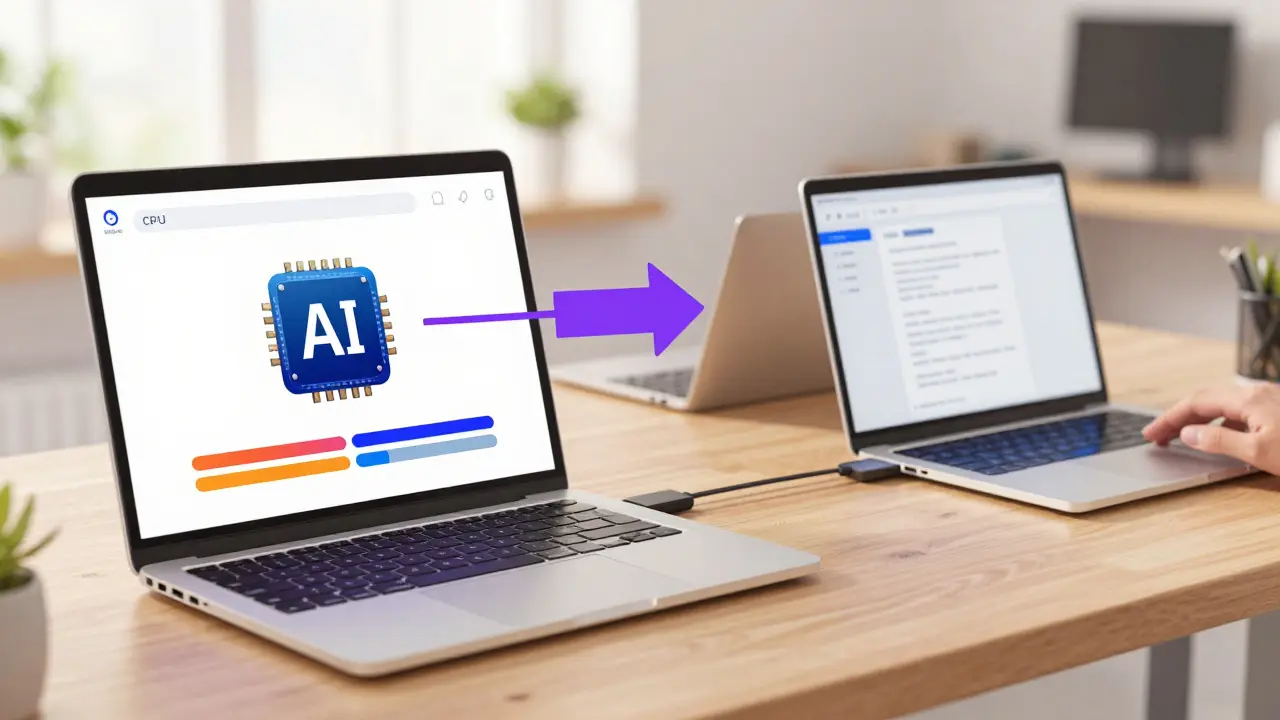
Running models locally requires specific hardware: at least 16GB RAM, an 8-core CPU, and a dedicated GPU for best results. Early adopters found that while local AI processing is 200-500ms slower than cloud services, it eliminates network latency (30-150ms), making overall performance comparable for most coding tasks.
For example, when you type code, the AI assistant processes it right there on your machine. No data leaves your computer. This means sensitive information-like citizen health data or municipal records-stays completely private. It's a trade-off: you give up raw processing power but gain control over your data.

Real Benefits and Hard Truths
The biggest win? Data sovereignty. Communities using local-first coding keep full ownership of their digital infrastructure. Reddit user 'civic_hacker42' noted in December 2024: "Using local-first vibe coding for our neighborhood composting app reduced our dependency on external platforms, but required 3 weeks of setup time." Positive reviews highlight "no surprise API cost increases" (42% of feedback) and "complete data control" (68%).
But there are trade-offs. Local implementations typically support 7B parameter models compared to cloud-based 70B+ models. Complex code generation tasks suffer. Collaboration also gets tricky-real-time co-editing isn't built-in, so teams must manually sync changes. As Forrester's Q3 2025 report warned: "The 37% slower iteration cycles in pilot implementations may prove prohibitive for time-sensitive projects."
Where It's Making a Difference Today
Portland's Municipal Maintenance Tracker is a success story. The neighborhood association built it using local-first coding and reported a 32% faster response to infrastructure issues-all while keeping citizen data on local servers. Similar projects in Berlin and Toronto use it for community health initiatives where privacy is non-negotiable.
Not all projects succeed. The "Community Health Connect" initiative in Austin abandoned its local-first approach after 4 months due to "unmanageable maintenance burden for volunteer developers," according to their post-mortem. The key? Only use this approach when data sovereignty is critical and your team has the technical resources to manage it.
The Setup Challenge
Getting started takes work. A December 2025 survey of 47 community projects found 2-4 weeks of setup time is typical. Developers need to master both traditional programming and local AI infrastructure. The open-source LocalVibe project has 87% complete documentation, but community forks often lack details.
Support is community-driven. The LocalVibe Discord server has 1,842 active members, but technical questions take an average of 14.2 hours to answer-compared to Salesforce's 2.1-hour enterprise SLA. Common issues include model version conflicts (41% of reports) and resource contention between tools and AI models (33%). New tools like the "Resource Governor" plugin now fix these in 78% of deployments.
What's Next for Local-First Coding
January 15, 2026 brought LocalVibe 2.0, which introduced "adaptive model loading" that dynamically adjusts AI model size based on available resources. This improved performance on lower-end hardware by up to 37%. The LocalVibe Foundation's Q2 2026 roadmap includes "secure peer-to-peer model synchronization" to enable communities to share improvements without central coordination.
Industry analysts are mixed. Gartner's 2026 Hype Cycle report placed local-first coding in the "Trough of Disillusionment" due to technical barriers. But MIT's Civic Design Lab projects it will reach 5% market penetration in community projects by 2028. With data privacy regulations like the EU's Data Governance Act requiring public sector data processing within jurisdictional boundaries by Q3 2026, this approach could become essential for government tech projects.
What hardware do I need for local-first vibe coding?
Minimum requirements are 16GB RAM, an 8-core CPU, and a dedicated GPU. For optimal performance, especially with larger AI models, more powerful hardware is recommended. Most developers find this achievable with modern consumer-grade machines, though older systems may struggle.
Is local-first coding secure?
Yes, because all data stays on your machine-no cloud transmission means no third-party access. However, security depends on proper local setup. If your machine is compromised, your data is at risk. Always use strong passwords and keep your OS updated.
Can I collaborate with others using local-first coding?
Real-time collaboration isn't built-in, but you can sync changes manually using version control tools like Git. Some communities use peer-to-peer networks to share updates, though this requires technical setup. For teams needing real-time co-editing, cloud-based tools still work better.
Why would a municipality choose local-first coding?
Municipalities use it to keep citizen data within jurisdictional boundaries, avoiding legal risks. With the EU's Data Governance Act requiring public sector data processing locally by Q3 2026, cities like Amsterdam are adopting it to stay compliant. It also eliminates ongoing cloud costs for government services.
How does LocalVibe 2.0 improve performance?
LocalVibe 2.0's "adaptive model loading" dynamically shrinks AI models to fit available memory and CPU. On older hardware, this cuts processing delays by up to 37%. It also reduces battery drain on laptops, making it practical for volunteer developers who work remotely.
Kelley Nelson
February 7, 2026 AT 20:45While the concept of local-first coding may appear appealing for data sovereignty, the practical implementation is fraught with challenges. Modern AI models typically require significantly more robust hardware than the stated minimums. Furthermore, the maintenance overhead for such systems often exceeds the capabilities of community-driven initiatives. It is imperative to recognize that true data sovereignty necessitates not just local processing, but also comprehensive security protocols and ongoing expert oversight. Without these elements, the purported benefits are largely theoretical.
Aryan Gupta
February 8, 2026 AT 18:51Terminology matters. 'Vibe coding' inaccurately describes the technical process. Hardware specifications are understated, and cloud costs still exist. This initiative appears to be a government plot to monitor citizens under the guise of privacy. Also, the EU's Data Governance Act is clearly a smokescreen for centralized control.
Fredda Freyer
February 9, 2026 AT 17:14Local-first coding presents a nuanced trade-off between data sovereignty and practicality. While keeping data on-premise is beneficial for privacy-sensitive applications, the technical demands-such as specialized hardware and maintenance expertise-are often overlooked. For instance, the post mentions 16GB RAM as sufficient, but real-world AI workloads typically require more. However, in contexts like municipal infrastructure tracking or community health initiatives where data privacy is paramount, this approach can be effective. The key is recognizing its niche applicability rather than universal adoption. It's a step toward decentralization, but not a panacea. Historically, similar movements have emerged when communities seek autonomy from centralized systems, yet they often struggle with scalability. The current iteration of local-first coding is promising but requires careful consideration of resource allocation. Developers must weigh the benefits of data control against the operational burdens. In some cases, hybrid models may offer a more sustainable solution. For example, using local processing for sensitive data while leveraging cloud resources for less critical tasks. The post's emphasis on 'no surprise bills' is somewhat simplistic; local infrastructure still incurs costs for maintenance and upgrades. Moreover, collaboration challenges persist, as real-time co-editing isn't built-in, necessitating manual synchronization. Despite these hurdles, the movement highlights the growing demand for data sovereignty in an increasingly interconnected world. Ultimately, success depends on tailored implementation rather than one-size-fits-all solutions.
Gareth Hobbs
February 9, 2026 AT 21:34Local-first coding is a JOKE!! The EU is forcing this on everyone-total nonsense! The gubermint is behind this to control data, mark my words! Also, 'vibe coding'-what a stupid term. Should be 'proper coding'! And the hardware specs? Pathetic! My laptop's got 32GB RAM, and it's still struggling!!
Zelda Breach
February 11, 2026 AT 07:1816GB RAM is woefully inadequate for meaningful AI tasks.