Why Your LLM Project Is Failing (It’s Not the Tech)
You bought the best GPU clusters. You hired data scientists who’ve published papers on transformer architectures. You integrated OpenAI’s latest model into your customer service chatbot. And yet-your LLM keeps hallucinating answers, leaking sensitive data, or just plain ignoring user prompts. The problem isn’t the model. It’s the operating model.
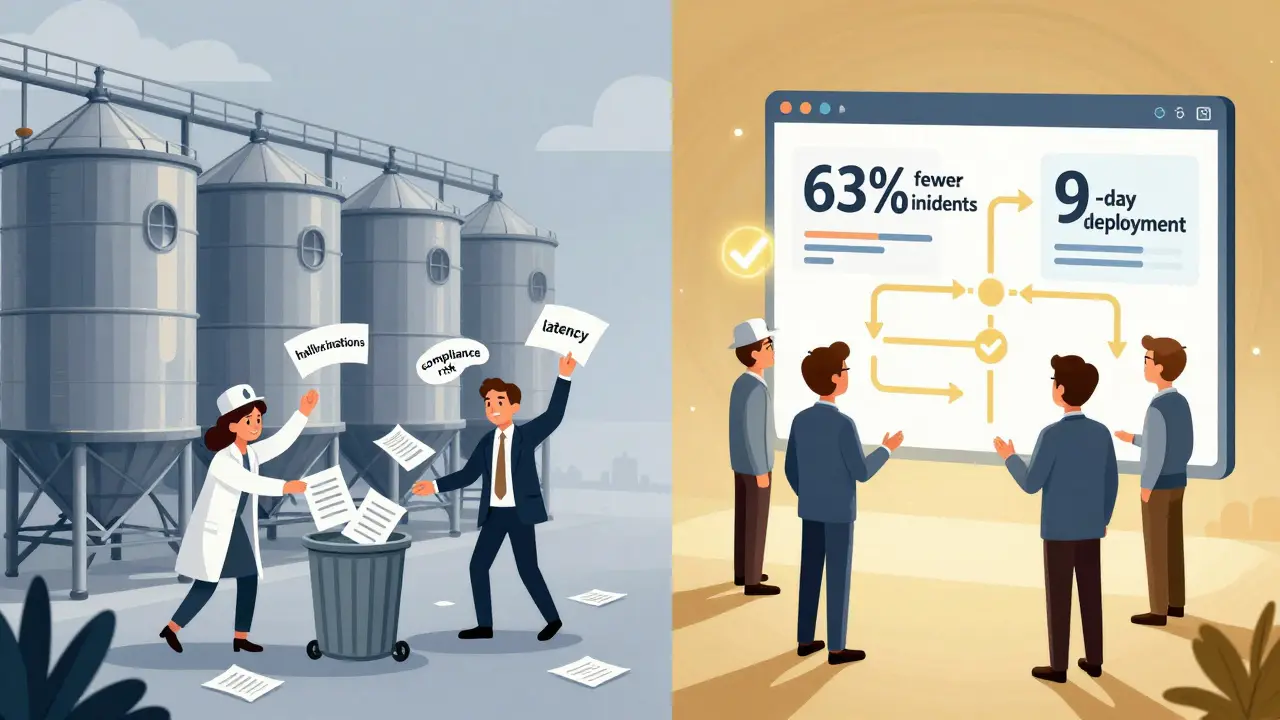
Organizations that treat LLM adoption like a software upgrade-slap it on top of existing workflows and hope for the best-are losing millions. According to Forrester’s 2024 benchmark study, companies without a structured LLM operating model saw deployment cycles stretch to 28 days and production incidents triple compared to those with clear teams and roles. The real differentiator? How you organize people.
What an LLM Operating Model Actually Is
An LLM operating model isn’t a tool. It’s a blueprint for who does what, when, and why. It answers questions like: Who owns the prompt that causes a legal violation? Who tests whether the model is biased? Who decides when to shut it down? This framework emerged in 2023 as enterprises moved past proof-of-concept demos and needed to scale responsibly. Unlike traditional machine learning, LLMs don’t just predict outcomes-they generate human-like text, which introduces new risks: prompt injection attacks, copyright violations, and opaque decision-making.
IBM defined this as LLMOps-the specialized practices for developing, deploying, and managing LLMs across their lifecycle. It’s not just MLOps with a new name. It’s a fundamentally different structure because LLMs require constant human feedback, dynamic prompting, and real-time monitoring for hallucinations and misuse. Wandb’s 2023 analysis showed that teams using full LLMOps frameworks cut deployment time from 28 days to 9 days and reduced incidents by 63%. That’s not luck. That’s structure.
The Core Teams You Need (And Who’s Missing)
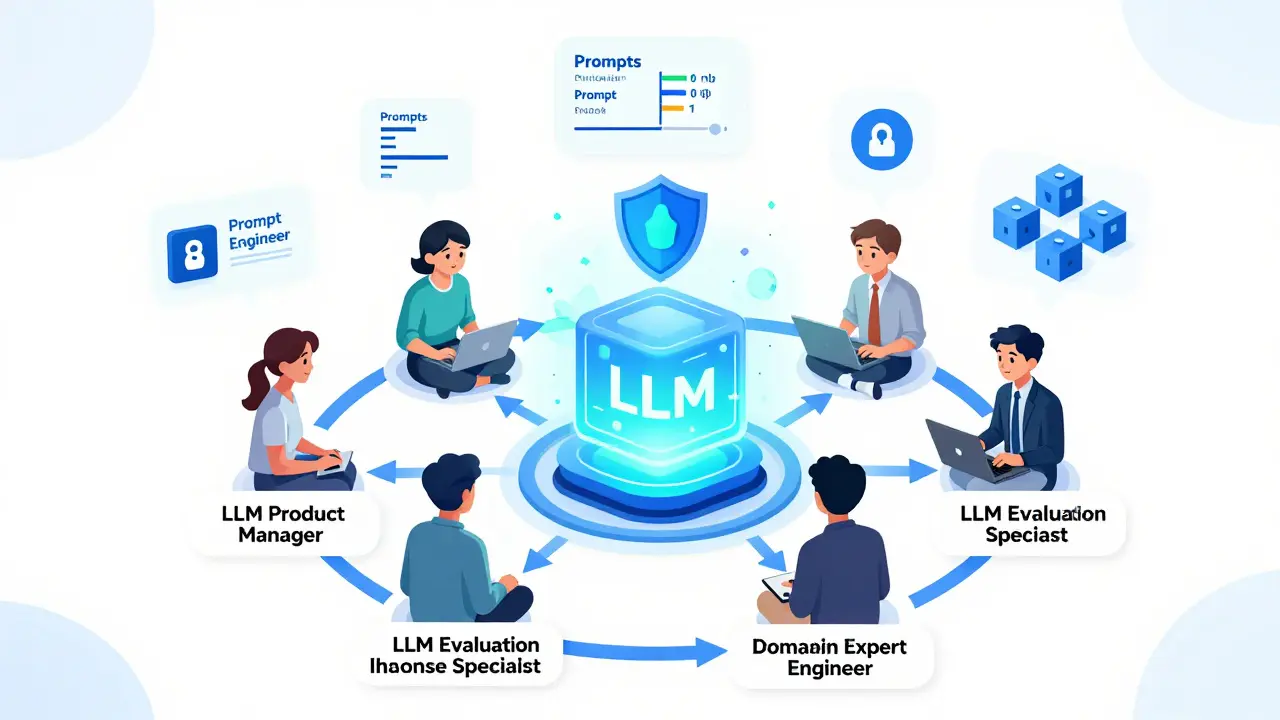
Most failed LLM projects have one thing in common: silos. Data scientists talk to engineers, but no one talks to legal. Product managers demand faster outputs, but no one’s tracking accuracy. Here’s what a working team looks like in 2025:
- LLM Product Manager: Bridges business goals with technical execution. Owns the roadmap, prioritizes use cases, and translates vague requests like “make it better” into measurable prompts. McKinsey found teams with this role achieved 2.8x higher ROI.
- Prompt Engineers: Not just writers. They design, test, and optimize prompts systematically. One Reddit user summed it up: “I spend 70% of my time explaining why ‘make it better’ isn’t a valid prompt.” These roles are now essential-89% of enterprises say they’re critical.
- LLM Evaluation Specialists: They don’t just check accuracy. They measure hallucination rates, toxicity, bias, and consistency across variations. Teams without formal evaluation processes scored 2.8/5 in user satisfaction. Those with them scored 4.2/5.
- Security & Compliance Officers: LLMs are attack surfaces. Prompt injection, data leakage, and model theft are real. Stanford HAI found 68% of LLM security flaws came from skipping security input early in design. This role must be involved from day one.
- Infrastructure Engineers: Run the models on Kubernetes clusters with NVIDIA A100s. Monitor latency, token efficiency, and cost per query. 82% of enterprises use Kubernetes for orchestration.
- Domain Experts: Doctors for healthcare LLMs, lawyers for contract review bots, customer service leads for support tools. They know what “good” looks like in context. Without them, the model generates technically correct but useless answers.
Many companies try to fold these into existing roles. That’s how you end up with a data scientist doing prompt engineering, compliance, and monitoring-all while missing deadlines. The result? Confusion, duplication, and blame-shifting.
Who Owns What? A Clear Responsibility Matrix
Without clear ownership, nothing moves. Here’s how responsibilities break down across teams:
| Function | Key Responsibilities | Tools Used |
|---|---|---|
| LLM Product Manager | Defines use cases, prioritizes features, aligns with business KPIs, manages stakeholder expectations | Jira, Confluence, OKR software |
| Prompt Engineers | Design, A/B test, and refine prompts; document prompt patterns; train other teams on effective prompting | LangChain, PromptLayer, Weights & Biases |
| LLM Evaluation Specialists | Build evaluation datasets; measure hallucination, bias, and consistency; report metrics weekly | OpenAI Evals, LLM-as-a-Judge, custom test suites |
| Security & Compliance | Implement OWASP Top 10 for LLMs; audit data pipelines; ensure GDPR/CCPA compliance; respond to breaches | TruEra, Arize, IBM Guardium |
| Infrastructure Engineers | Deploy models on GPU clusters; monitor resource usage; optimize token efficiency; manage Kubernetes scaling | Kubernetes, Prometheus, NVIDIA Triton |
| Domain Experts | Validate outputs against real-world standards; flag inaccuracies; provide feedback loops for fine-tuning | Internal documentation, feedback forms, annotation tools |
Notice anything? No one owns “model training.” That’s because most enterprises don’t train their own LLMs-they fine-tune or prompt-tune existing ones. The real work is in evaluation, safety, and alignment. That’s where most teams fail.
How to Build This Without Starting From Scratch
You don’t need to hire 12 new people tomorrow. Start small. EY’s four-step framework works for most organizations:
- Define your first use case. Pick one high-impact, low-risk task-like summarizing internal meeting notes or answering HR policy questions.
- Assess your AI readiness. Do you have clean data? Do teams know what LLMs can and can’t do? Are legal and compliance aware?
- Assign your first three roles: A product lead, a prompt engineer, and a security rep. That’s it. Start with a cross-functional task force, not a new department.
- Measure and iterate. Track output quality, user satisfaction, and incident rates. Use those metrics to justify expanding the team.
Capital One’s LLM Center of Excellence took 8 months to scale from 3 people to 12 roles. Their key move? They didn’t build a new org chart-they embedded LLM owners into existing teams. That’s how you avoid silos.
The Big Mistake: Trying to Force LLMs Into Old Systems
Many companies try to plug LLMs into their existing MLOps pipelines. Bad idea. Gartner’s 2024 analysis found that forcing LLMs into legacy ML frameworks led to 47% longer deployment times and 3.2x more failures. Why? Because MLOps was built for static models that predict outcomes. LLMs are dynamic, conversational, and require constant human feedback.
Traditional MLOps tracks accuracy and AUC scores. LLMs need to track prompt injection attempts, output coherence over time, and user trust metrics. You can’t measure those with old tools. Wandb’s data shows specialized LLMOps frameworks reduced operational costs by 29% and improved reliability by 38% compared to adapted MLOps.
But here’s the catch: LLMOps is still immature. Only 32% of enterprises have fully integrated it, according to MIT Technology Review. So don’t buy into hype. Start with what works: clear roles, tight feedback loops, and security baked in from the start.
What’s Next? The Future of LLM Teams
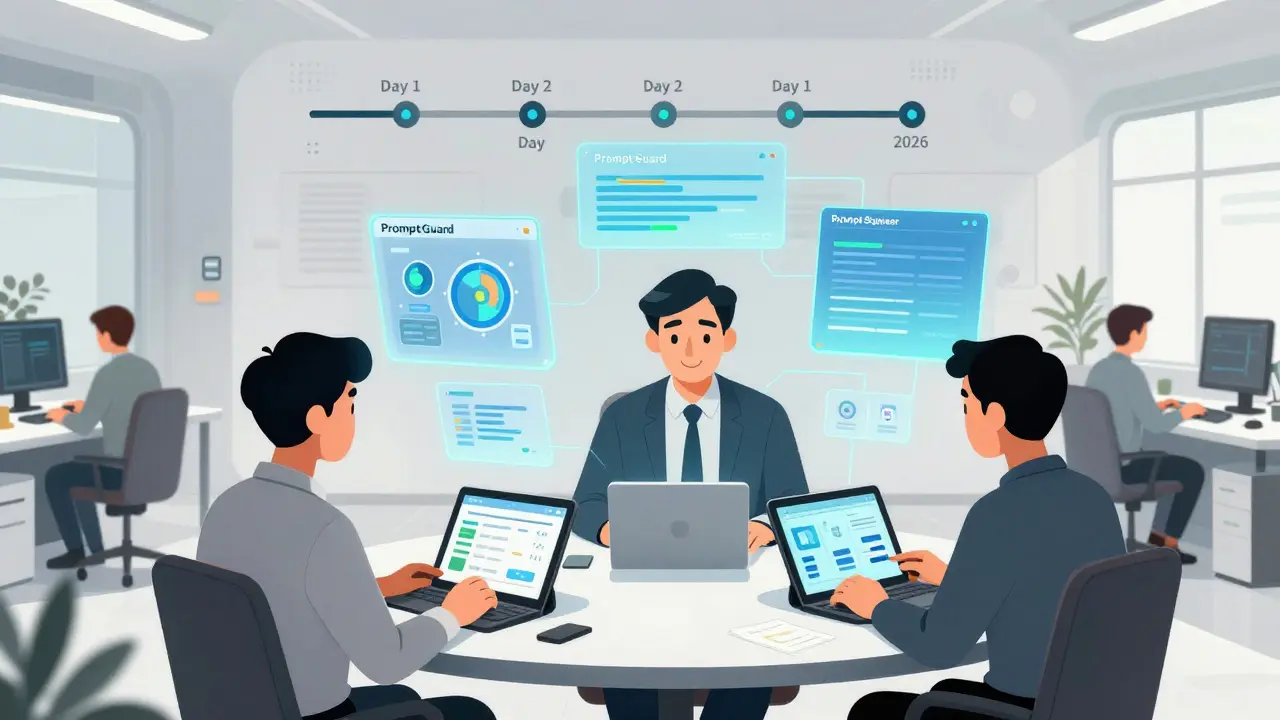
By 2026, Gartner predicts 75% of enterprises will have a dedicated LLM Center of Excellence. But that’s not the endgame. Experts like Dr. Percy Liang from Stanford warn that over-specialization creates new silos. The real goal? Convergence.
As tools get better-automated prompt testing, built-in safety filters, easier fine-tuning-the need for hyper-specialized roles will shrink. NIST’s AI Risk Management Framework 2.0, released in April 2025, is already pushing companies to integrate LLM governance into broader AI ethics programs. The LLMOps Consortium, formed in January 2025 by Google, Microsoft, and Anthropic, is standardizing roles across the industry.
By 2030, you might not need a “prompt engineer” title. But you’ll still need someone who understands how to test, validate, and secure AI outputs. The role evolves. The responsibility doesn’t.
Real Stories: What Worked and What Blew Up
Capital One’s success? They created a 12-person LLM Center of Excellence with clear ownership. They reduced time-to-value by 57% and never had a compliance violation.
A major retail chain? They gave LLM access to customer data without defining who was accountable. The model started generating fake return policies. After 11 months of duplicated work between marketing and data teams, they lost $8.2 million.
One hospital system in China used LLMs to triage patient questions. But because no one owned evaluation, staff didn’t trust the outputs. 63% refused to use the tool. They didn’t lack tech-they lacked trust.
Start Here: Your First 30 Days
If you’re reading this, you’re probably overwhelmed. Here’s your action plan:
- Identify your first LLM use case. Make it small. Make it safe.
- Find three people: one who understands the business, one who can write and test prompts, and one who cares about risk.
- Set up a weekly 30-minute sync. No slides. Just: What worked? What broke? What’s next?
You don’t need a fancy tool. You don’t need a budget. You just need clarity on who’s responsible for what. That’s the operating model. Everything else follows.