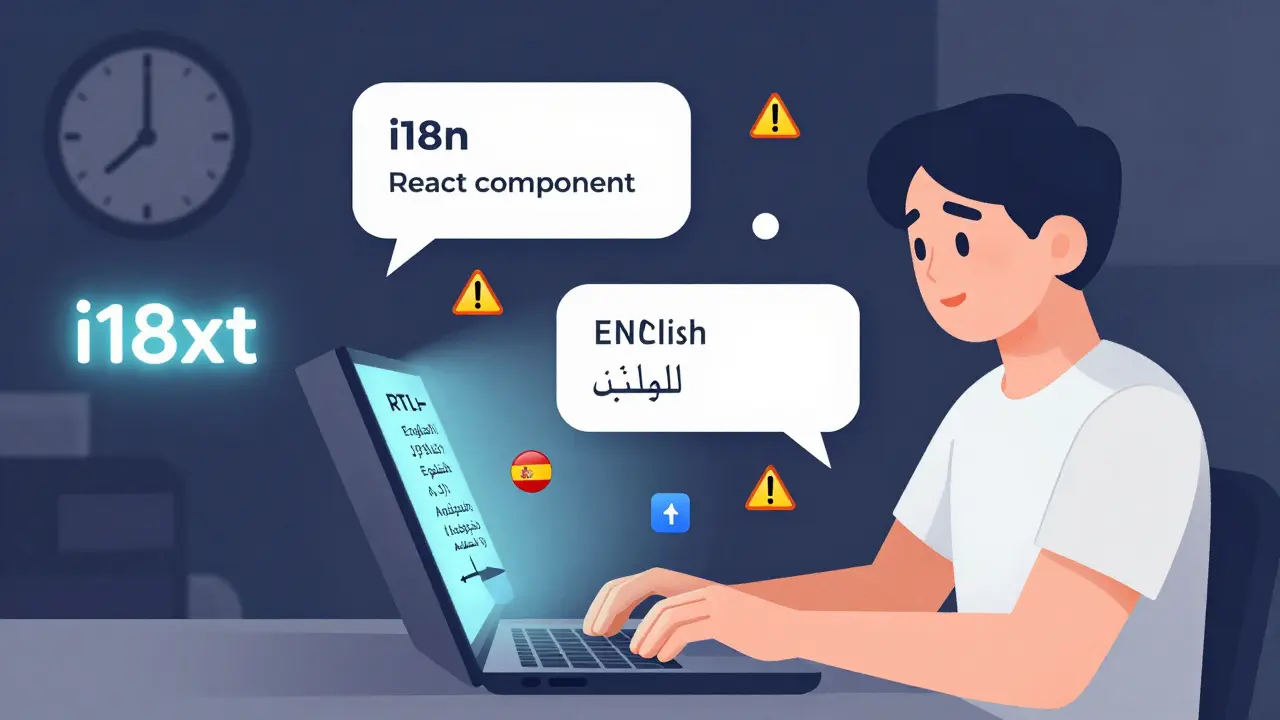
Building a frontend that works in Spanish, Arabic, and Japanese isn’t just about swapping words. It’s about structure, context, and culture. Traditional i18n setups used to take weeks-writing translation files by hand, managing plural forms, fixing RTL layouts, testing every button. Now, developers are using natural language prompts with LLMs to generate most of that code in minutes. This is vibe coding for internationalization: faster, but riskier.
What Is Vibe Coding for i18n?
Vibe coding isn’t magic. It’s a workflow where you describe what you want in plain language, and an LLM generates the code. For i18n, that means typing prompts like:"Generate a React component with i18next that displays a button labeled 'Download File' in English, Spanish, and Arabic. Handle pluralization for '1 file' vs '5 files'. Make sure Arabic text flows right-to-left. Use JSON files in /public/locales."The LLM spits out working code-React hooks, folder structure, JSON translation files, even CSS for RTL. According to a February 2025 DEV Community case study, developers cut initial i18n setup time by 40-60%. For startups racing to launch globally, that’s a game-changer.
How It Works Under the Hood
Most vibe-coded i18n setups rely on two tools: i18next is a JavaScript library that handles translation loading, pluralization, and language detection and vue-i18n is a Vue 3 plugin that integrates i18n into component state. Both support 200+ languages, including complex ones like Russian (which has six plural forms) and Arabic (which reverses layout). Translation files are stored as JSON:public/locales/en/translation.jsonpublic/locales/es/translation.jsonpublic/locales/ar/translation.json
{"downloadFile": "Download File"}
The LLM generates these files, sets up the library initialization code, and even writes the React or Vue component that uses useTranslation() or $t() to pull translations. The Intl API is a browser-native standard for formatting dates, numbers, and currencies based on locale handles the rest-like turning "1,000" into "1.000" for German users.
The Speed Advantage
A January 2026 benchmark by Worldline Tech compared four i18n methods:| Method | Average Time | Success Rate |
|---|---|---|
| Manual Coding | 6.5 hours | 92% |
| Standard Libraries (no LLM) | 4.1 hours | 89% |
| Vibe Coding (LLM) | 2.1 hours | 78% |
| Professional Localization | 12 hours | 99% |

Where It Breaks Down
The biggest problem? LLMs don’t understand context. They treat "file" as a noun, but in Spanish, "archivo" (file) and "archivar" (to file) are different. In Russian, "документ" can mean document or file depending on usage. A 2025 GitHub study of 1,200 pull requests found LLMs misinterpreted gender-specific pronouns in 18.7% of cases-especially in languages like Spanish with formal/informal "you" (usted vs tú). Pluralization is worse. English has two forms: "1 file", "2 files". Russian has six. Slavic, Arabic, and Celtic languages have complex rules. A December 2025 i18next GitHub issue tracker showed 27% of auto-generated plural rules were wrong. One developer reported:"LLM generated '1 document, 2 documents, 5 documents' for Russian. It should be '1 dokument, 2 dokumenta, 5 dokumentov'. I spent three days fixing it."RTL layout is another trap. The LLM might generate the right HTML, but forget to set
dir="rtl" on the root element. A European SaaS company shipped an Arabic interface with left-to-right text in January 2026. Users couldn’t read it. They had to patch it within 72 hours.
Expert Warnings
Julia Diez, Senior Internationalization Specialist at Meta, says: "Vibe coding creates dangerous illusions of completeness. LLMs can generate syntactically correct code that fails linguistically." Her analysis of 300 vibe-coded projects found 63% had no context for ambiguous terms like "file," "button," or "settings." Evan You, creator of Vue.js, adds: "True localization isn’t string replacement. It’s cultural adaptation. LLMs don’t know that in Japanese, you never say 'thank you' to a customer-you say 'we appreciate your patience.'" Gartner’s February 2026 Hype Cycle puts vibe coding for i18n at the "Peak of Inflated Expectations." 78% of companies are experimenting. Only 22% have production-ready apps.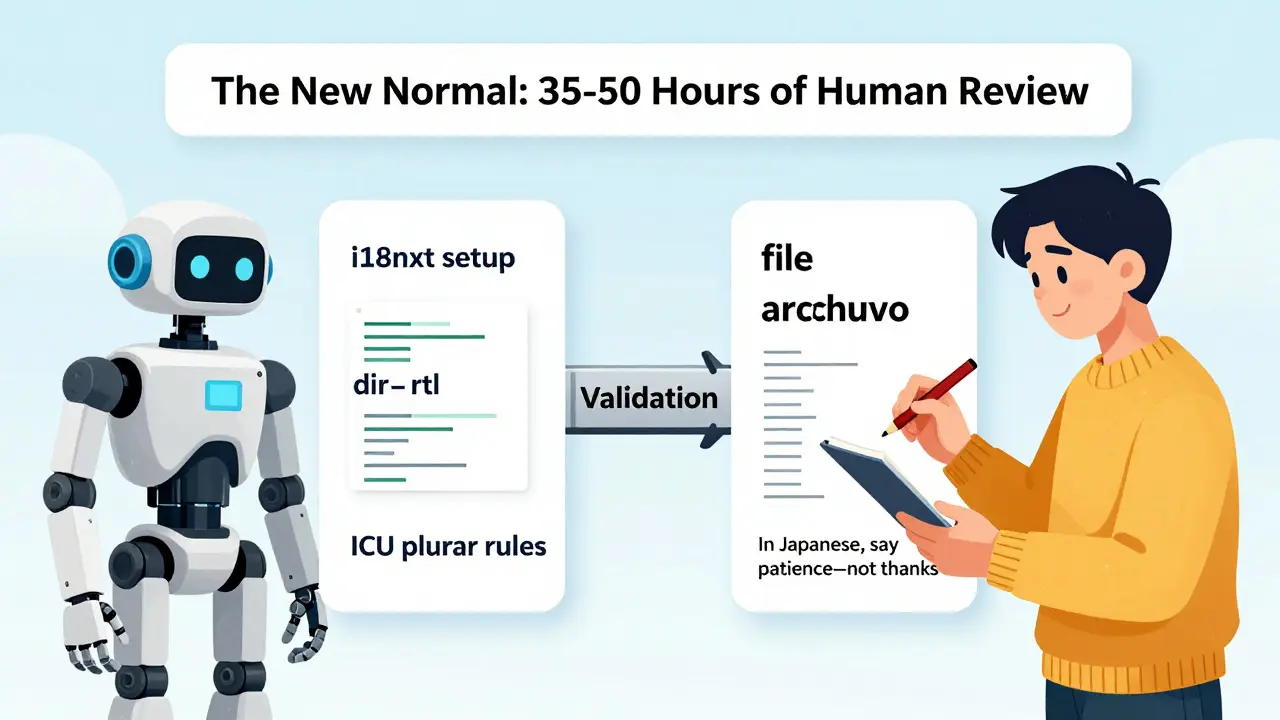
How to Do It Right
Vibe coding works-but only if you treat it as a starting point, not the final product. Here’s how:- Use structured prompts. Don’t just say "make it multilingual." Say: "Generate i18next setup for React 18.2.0. Use 'en-US', 'es-ES', 'ar-SA'. Include pluralization for 'file' and 'document'. Use ICU message syntax. Add dir='rtl' for Arabic. Store files in /public/locales/"
- Validate with Zod. Use schema validation on translation JSON files. i18next 24.0 (released Jan 2026) now has "prompt-aware" loading that checks structure against a Zod schema before loading.
- Test with real users. Run translations through native speakers before launch. Even a 30-minute review cuts errors by 60%.
- Separate structure from content. Use vibe coding for code: component structure, file layout, library setup. Use human translators for the actual text.
The Future: Hybrid Workflow
The market is shifting. Forrester predicts 87% of companies will use vibe coding for i18n structure by 2028-but only if paired with human linguists. Companies like Airbnb and Spotify now hire "i18n prompt engineers"-people who bridge code and culture. Their job? Write prompts that force LLMs to consider context, then hand off to native speakers. New tools are emerging. Vue.js announced vite-plugin-i18n is a real-time feedback tool that highlights missing translations during vibe coding sessions at Vue.js Amsterdam in January 2026. It shows you which keys are missing before you even build. The bottom line? Vibe coding isn’t replacing localization specialists. It’s creating a new role: the person who knows how to talk to machines so they don’t break languages.What You Need to Know
- i18next is the most adopted library (18,400 GitHub stars) and handles 200+ languages.
- Intl API is built into browsers and handles formatting-use it for dates, numbers, currencies.
- RTL support requires
dir="rtl"on the root element and CSS overrides. - Pluralization is the #1 failure point. Slavic, Arabic, and Celtic languages need special rules.
- Context matters. "File" isn’t just a word. It’s a verb, a noun, a concept. LLMs miss that.
- Validation is non-negotiable. Never ship vibe-coded i18n without native speaker review.
Can I use vibe coding for i18n in production?
Yes-but only if you treat it as a scaffolding tool, not the final product. Use LLMs to generate code structure, folder layouts, and basic translation files. Then validate every translation with native speakers. Never skip human review.
Which i18n library should I use with vibe coding?
Use i18next for React and general JavaScript apps. It’s the most mature, supports 200+ languages, has excellent documentation, and integrates with Zod validation. For Vue 3 apps, use vue-i18n-it’s optimized for Vue’s reactivity system and has better tooling for component-level translations.
Why do LLMs mess up pluralization?
LLMs are trained on English-dominant data. Most have no internal model for languages like Russian (6 plural forms), Polish (3), or Arabic (2+ complex rules). They guess based on patterns they’ve seen, not linguistic rules. For example, they might output "1 file, 2 files, 5 files" for Russian, when it should be "1 dokument, 2 dokumenta, 5 dokumentov." Always test pluralization manually.
How do I handle right-to-left (RTL) languages?
Set dir="rtl" on the root HTML element. Use i18next’s i18n.dir() method to dynamically set it based on the active locale. Override CSS properties like text-align, margin-left, and float for RTL. Many LLMs forget this. Always test with real Arabic or Hebrew text.
Is vibe coding cheaper than hiring translators?
It’s cheaper upfront, but more expensive long-term. Vibe coding cuts initial setup time by 60%, but you’ll spend 2-3x longer fixing translation errors. Professional services cost more but deliver accurate, culturally adapted content. The best approach: use vibe coding for code structure, then hire native speakers for translation validation. It’s a hybrid model now used by 38% of Fortune 500 companies.
Indi s
February 11, 2026 AT 23:26I've been using vibe coding for small projects and it's saved me so much time. But I learned the hard way that you can't just trust the LLM to get plural forms right in Hindi. Had to redo three translation files after users complained about broken grammar.
Now I always run the output through a native speaker. Even 15 minutes helps.
Rohit Sen
February 13, 2026 AT 00:21LLMs don’t understand culture. They just shuffle words. Real localization needs humans. Case closed.
Vimal Kumar
February 14, 2026 AT 20:19Hey, I think vibe coding is awesome if you use it right. It’s not about replacing humans-it’s about letting them focus on the hard parts.
I use it to generate the structure, then hand off the JSON files to our local team. They tweak the tone, fix the idioms, and make it feel natural. It’s a team effort now, not a magic button.
Amit Umarani
February 16, 2026 AT 12:21You say 'vibe coding' like it's a real term. It's not. It's just lazy development dressed up with buzzwords. And calling it 'faster' ignores the massive cleanup cost.
Also, you misspelled 'i18n' in the second paragraph. It's not 'i18n'-it's 'i18n'. Fix it.
Noel Dhiraj
February 17, 2026 AT 11:30Just started using i18next with LLM prompts and it’s been a game changer for our startup. We cut setup time from days to hours. But yeah, we still have our Indian and Arabic reviewers check every string.
Speed is great, but accuracy is everything. Don’t skip the human step.
vidhi patel
February 18, 2026 AT 02:35The author clearly has no understanding of linguistic complexity. To claim that LLMs can handle Arabic pluralization or Russian cases is not just inaccurate-it is dangerously misleading. The grammatical gender in Spanish alone requires contextual awareness that no current model possesses. This article is irresponsible.
Priti Yadav
February 18, 2026 AT 05:38LLMs are trained on data from Western tech companies. That’s why they fail at Arabic and Slavic languages. I bet the 'case study' they cited was written by someone who only speaks English. They’re not fixing localization-they’re erasing it.
And who owns the translation files? The company? The LLM? The user? Who’s liable when the app breaks in Egypt?
Ajit Kumar
February 18, 2026 AT 11:58It is a fundamental misconception to believe that natural language prompts can adequately convey the nuances of linguistic structure. The human brain processes syntax, morphology, and pragmatics in tandem; LLMs, by contrast, rely on statistical correlation without semantic grounding. Consequently, the generated code may appear functional on the surface, but it is structurally unsound.
For instance, in Arabic, the verb conjugation must align with the subject’s gender, number, and person-something no prompt can reliably specify without explicit linguistic rules. The notion that this can be automated via vague instructions is not only naïve-it is linguistically indefensible.
Diwakar Pandey
February 18, 2026 AT 23:07I’ve been doing this for years. I let the LLM write the initial code, the folder structure, the i18next init. Then I take over. I fix the plural forms. I check the RTL. I make sure the tone isn’t too direct in Japanese. It’s not magic. It’s just a really fast way to get started.
And honestly? The best part is that now I have more time to actually talk to native speakers. That’s where the real work happens.
Geet Ramchandani
February 20, 2026 AT 19:22Let’s be real. This whole vibe coding trend is just corporate laziness with a fancy name. You think you’re saving time? You’re just kicking the can down the road. Every time you ship a vibe-coded translation, you’re setting up a tech debt bomb that’ll explode during QA, during user complaints, during your 3am emergency patch.
And don’t even get me started on the fact that most of these 'case studies' are written by the same people who sell the LLM tools. It’s a feedback loop of nonsense. You’re not innovating-you’re outsourcing your responsibility to a bot that doesn’t know the difference between 'file' and 'archivar'.