
You spent weeks training a massive language model, only to find it too heavy for your server. So you prune the weights or squeeze them into 4-bit integers. Suddenly, the model gets faster and smaller, but it starts hallucinating facts it used to know cold. The perplexity spikes, and your benchmarks tank. This is the classic pain point of model compression: trading accuracy for efficiency. But here is the good news-you don't always need to retrain from scratch to fix it. In fact, some of the most effective ways to restore lost accuracy are surprisingly cheap, fast, and sometimes require zero gradient calculations.
The Real Cost of Naive Compression
When you compress a Large Language Model (LLM), you aren't just shrinking file size; you're altering the mathematical function that defines how the model thinks. Whether you use weight pruning to remove parameters or low-bit quantization to reduce numerical precision, you introduce noise. If you apply these techniques naively, the model's performance on downstream tasks-like question answering or code generation-can degrade significantly. A 2025 study by Apple Machine Learning Research investigated this exact phenomenon, asking whether compressed models actually "forget" knowledge or if the knowledge is just displaced internally. Their findings suggest that much of what we think is lost can be recovered, often without touching the core weights again.
The problem isn't uniform. Pruning tends to hurt structured reasoning, while aggressive quantization (below 4 bits) introduces significant noise in activation distributions. However, recent research has shifted the paradigm. We are moving away from the idea that compression requires expensive, full-model fine-tuning. Instead, we are seeing a toolkit of targeted recovery methods that range from local reconstruction to prompt-based redirection.
Local Reconstruction: The Free Lunch in Pruning
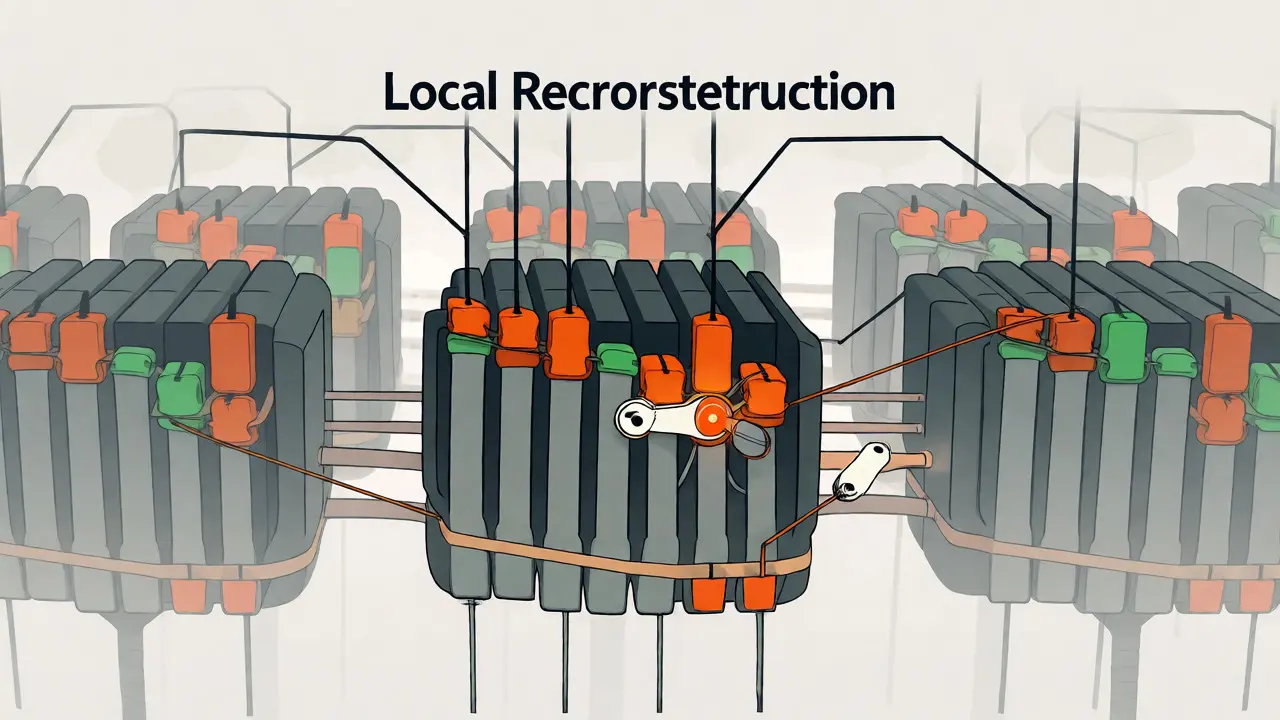
For years, the standard advice after pruning was simple: fine-tune the whole model. It worked, but it was slow and memory-intensive. A 2025 paper titled "A Free Lunch in LLM Compression: Revisiting Retraining after Pruning" challenged this norm. The authors discovered that you don't need to update every parameter globally. Instead, they focused on local reconstruction, which involves adjusting only the remaining weights within specific transformer blocks (like attention heads or MLP layers) after pruning.
This approach turns out to be incredibly efficient. By reconstructing components locally rather than globally, the method matches or even exceeds the performance of full end-to-end retraining. It’s called a "free lunch" because it achieves high accuracy with a fraction of the compute cost. For practitioners using criteria like Wanda (Weight and Activation Aware pruning), this means you can get better results with simpler pruning algorithms if you pair them with smart post-pruning reconstruction. You avoid the heavy lifting of backpropagating through the entire network, making it feasible to run on constrained hardware.
Fixing Quantization Noise: Calibration and Fine-Tuning
If you’re dealing with quantization, especially sub-4-bit formats like INT3 or INT2, calibration is your first line of defense. Post-training quantization (PTQ) methods like GPTQ or AWQ rely heavily on the quality of their calibration dataset. If your calibration data doesn't match the statistical properties of your actual workload, the model will struggle, regardless of how sophisticated the algorithm is.
But what if calibration isn't enough? That’s where short-duration fine-tuning comes in. Unlike full Quantization-Aware Training (QAT), which inserts quantization operators during the main training phase and is computationally expensive, post-quantization fine-tuning is a lightweight adjustment. You take the already quantized model and train it for just a few hundred to a few thousand steps on representative data. This allows the model to adapt to the quantization noise. For very aggressive compression (≤3 bits), QAT remains the gold standard, but for most 4-bit deployments, this short fine-tuning phase offers a sweet spot between cost and performance.
| Method | Compute Cost | Accuracy Recovery | Best Use Case |
|---|---|---|---|
| Full Retraining | Very High | High | Small models or critical applications |
| Local Reconstruction | Low | High | Pruned transformers |
| Post-Quantization FT | Moderate | Moderate-High | 4-bit quantized models |
| EoRA (Low-Rank) | Minimal | Moderate | Rapid deployment, no gradients |
| IDP Prompting | None (Inference) | Task-Dependent | Knowledge-intensive tasks |
EoRA: Compensation Without Gradients
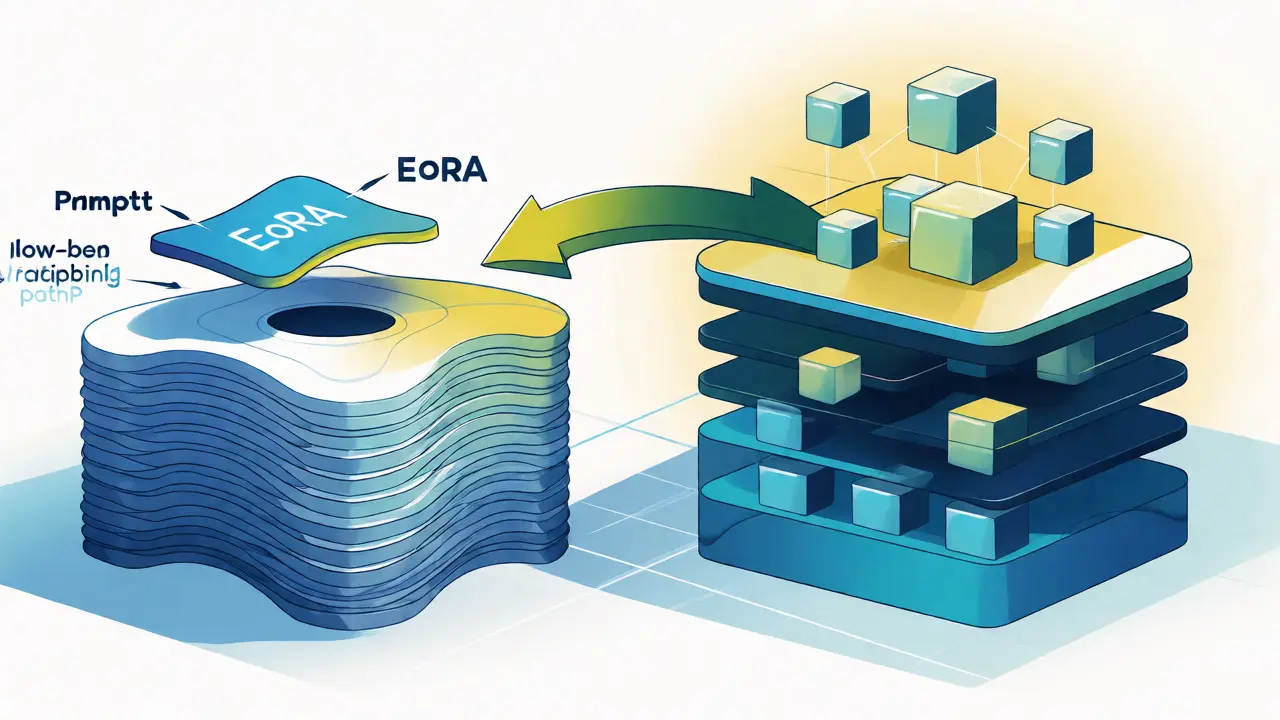
Sometimes, you don’t want to touch the weights at all. Enter EoRA (Eigenspace Low-Rank Approximation), introduced by NVIDIA Research in 2024. EoRA reframes compression as a compensation problem. Instead of modifying the compressed weights, it adds residual low-rank paths that approximate the error introduced by compression. These paths operate in eigenspace and effectively correct the output without requiring gradient-based training.
The appeal of EoRA is its speed. It completes in minutes using minimal calibration data and no backpropagation. This makes it ideal for production environments where retraining loops are too slow or operationally complex. Because it works independently of the specific compression format, you can combine it with both pruning and quantization. It consistently outperforms older SVD-based compensation methods, particularly on heavily compressed models. If you need to deploy a compressed LLM quickly and can’t afford a fine-tuning cycle, EoRA is a powerful tool to keep in your arsenal.
Prompting Over Parameters: The IDP Approach
Apple’s research takes a different angle. Their study on knowledge displacement suggests that compressed models often retain information but lose the ability to access it easily. Rather than adding new parameters via techniques like LoRA (Low-Rank Adaptation), they propose IDP (Input-Dependent Prompting). This method uses sophisticated prompting strategies to redirect the model’s internal state, essentially guiding it to retrieve the "displaced" knowledge.
In their experiments, IDP matched or surpassed LoRA-based retraining in restoring performance on knowledge-intensive tasks. The benefits are stark: IDP saves 21x in extra parameter size and reduces inference latency by 60% compared to LoRA. This implies that for certain tasks, engineering the input is more efficient than engineering the weights. While this might not solve all accuracy issues, it challenges the assumption that you must add trainable parameters to recover performance.
Choosing Your Recovery Strategy
So, which method should you pick? It depends on your constraints. If you have limited compute but need high accuracy after pruning, go with local reconstruction. If you’re struggling with quantization noise in a 4-bit model, try improved calibration first, then short fine-tuning. For rapid deployment scenarios where you can’t wait for training, EoRA is your best bet. And if your primary concern is factual recall on a knowledge-heavy task, experiment with advanced prompting before committing to parameter-efficient fine-tuning.
The era of treating compression as a destructive act that requires massive rebuilding is over. Today, it’s a surgical process. By combining these modular recovery techniques, you can maintain near-baseline performance while enjoying the speed and cost benefits of compressed LLMs.
Does compression permanently destroy knowledge in LLMs?
Not necessarily. Recent studies, including work from Apple, suggest that compression often displaces knowledge rather than erasing it. This means the information is still present in the model's weights but becomes harder to access. Techniques like prompt engineering or minor fine-tuning can often reactivate this knowledge without extensive retraining.
Is Quantization-Aware Training (QAT) always better than post-training quantization?
QAT generally yields higher accuracy, especially for very low bit-widths (≤3 bits), because it accounts for quantization noise during training. However, it is computationally expensive. For moderate compression (e.g., 4-bit), post-training quantization combined with short fine-tuning often provides a better cost-performance trade-off.
What is the main advantage of EoRA over traditional fine-tuning?
EoRA requires no gradient computation and completes in minutes using minimal data. Traditional fine-tuning requires backpropagation and significant computational resources. EoRA adds low-rank correction paths to compensate for compression errors, making it ideal for rapid deployment scenarios.
Can I use multiple recovery methods together?
Yes, hybrid strategies are becoming common. For example, you might use local reconstruction after pruning, followed by a short period of post-quantization fine-tuning. Combining methods allows you to tailor the recovery process to the specific weaknesses of your compressed model.
How important is calibration data for quantized models?
Extremely important. Poorly chosen calibration data can lead to significant accuracy drops, even if the quantization algorithm is robust. The data should represent the statistical distribution of your actual target workloads, not just generic text.