Imagine trying to fit a 175-billion-parameter GPT-3 model onto a single NVIDIA A100 GPU. It’s physically impossible. The model requires roughly 320GB of memory just for training states, but that GPU only has 80GB. So, how do tech giants train models with hundreds of billions of parameters? They don’t just buy bigger GPUs; they split the model itself across multiple devices. This is where model parallelism and specifically pipeline parallelism come into play. These techniques allow us to shard neural networks across clusters, turning memory constraints into manageable engineering problems rather than hard stops.
If you’ve ever wondered why your local LLM runs fine on one card but fails to load on another, or if you’re an engineer struggling to scale training jobs beyond a single node, understanding these parallelization strategies is non-negotiable. We’ll break down exactly how pipeline parallelism works, why it’s different from data parallelism, and how to avoid the common pitfalls like "pipeline bubbles" that waste expensive compute time.
The Memory Wall: Why Data Parallelism Isn't Enough
For years, data parallelism was the go-to strategy for scaling deep learning. In this setup, every GPU holds a full copy of the model. You split the batch of data among them, each GPU computes gradients independently, and then they sync up. It’s efficient-often hitting 90-95% scaling efficiency-but it hits a hard ceiling. If the model doesn’t fit in the VRAM of a single device, data parallelism fails immediately. You can’t replicate what you can’t store.
This limitation became critical as transformer architectures exploded in size. GPT-3, PaLM, and Llama models pushed parameter counts into the tens and hundreds of billions. Suddenly, we needed a way to train models larger than any single chip’s memory capacity. Enter model parallelism, which partitions the model itself rather than the data. Unlike data parallelism, where GPUs work on different batches simultaneously, model parallelism splits the network layers across devices. Each GPU handles a specific chunk of the architecture, passing intermediate results to the next device in line.
Pipeline Parallelism: The Assembly Line Approach
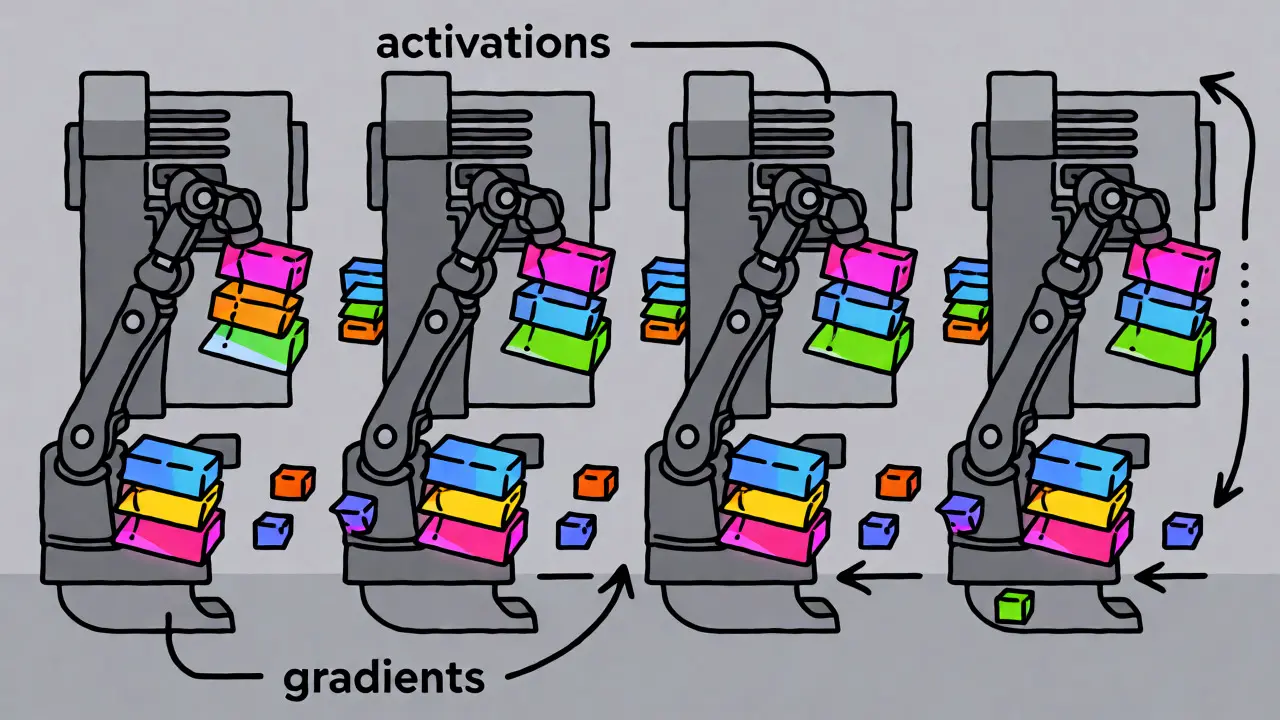
Pipeline parallelism is a specific type of model parallelism pioneered around 2019 by Google’s GPipe. Think of it like a factory assembly line. Instead of one worker building the entire car (the model) alone, you have stations. Station A installs the engine, passes the chassis to Station B, which installs the wheels, and so on. In neural network terms, the model is split by layer into sequential stages. Device 1 processes the first few layers, sends the output (activations) to Device 2, which processes the next set of layers, and so forth.
The magic lies in how this flow is managed. During the forward pass, activations move downstream. During the backward pass, gradients flow upstream. But here’s the catch: if you process one batch at a time, most of your GPUs sit idle while waiting for the previous stage to finish. This idle time is known as the "pipeline bubble." Early implementations suffered from massive inefficiencies because of this. Modern frameworks solve this using micro-batching, where a large batch is split into smaller chunks. While Micro-batch 1 is being processed by Stage 2, Stage 1 can start processing Micro-batch 2. This keeps all stages busy, drastically reducing idle time.
Bubbles, Scheduling, and Efficiency
The core challenge in pipeline parallelism is minimizing those bubbles. The original GPipe paper showed that naive scheduling could leave GPUs idle for nearly half the time. By optimizing the schedule, researchers reduced bubble time significantly. For example, interleaved scheduling allows multiple micro-batches to be in flight simultaneously, pushing GPU utilization from ~50% to over 90% in optimized configurations.
There are two main scheduling schemes you’ll encounter:
- Grouped Schemes: All forward passes happen, then all backward passes. This reduces communication frequency but requires more memory to hold activations for all micro-batches.
- Interleaved Schemes: Forward and backward passes are mixed. This uses less memory but increases communication overhead and complexity.
Most modern systems, including NVIDIA Megatron-LM and ColossalAI, use sophisticated schedulers to balance these trade-offs. The goal is always the same: keep every GPU computing something useful at every millisecond.
Hybrid Strategies: Combining Forces
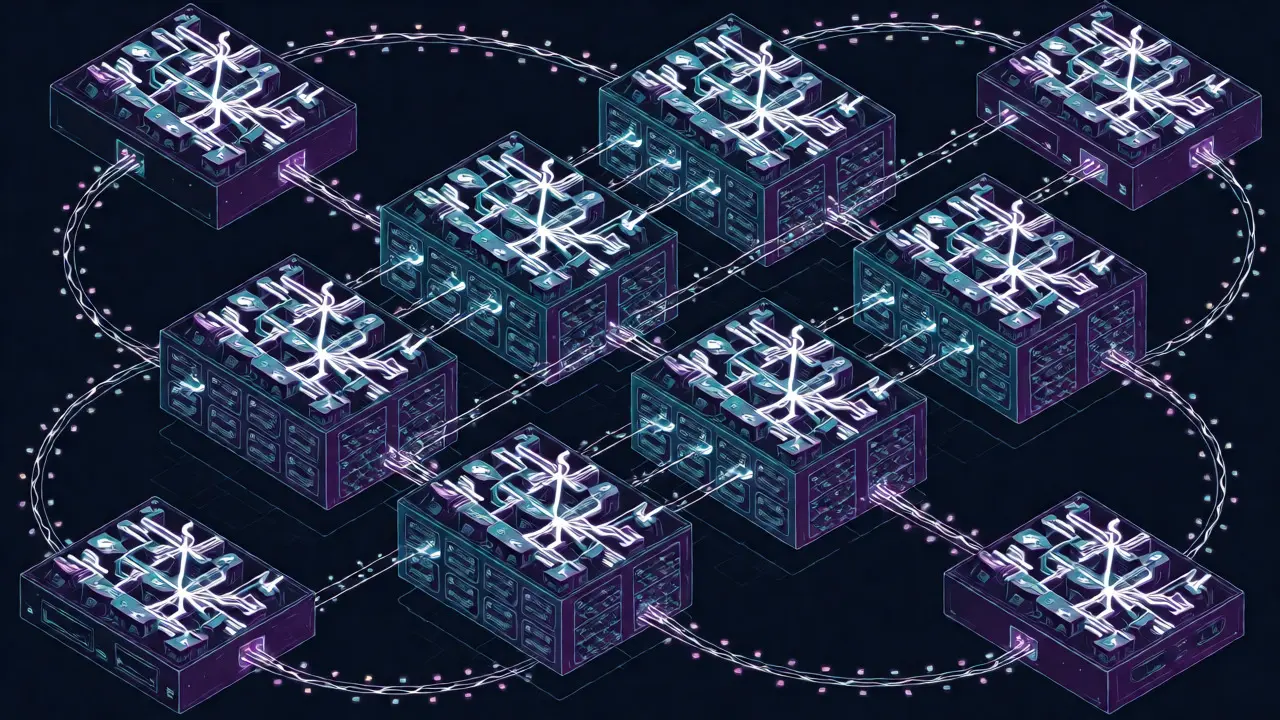
In practice, you rarely use pipeline parallelism alone. Large-scale training usually combines it with other forms of parallelism. This is called hybrid parallelism. A typical setup might use tensor parallelism within a single node to split individual layers across GPUs connected by high-speed NVLink, and pipeline parallelism across nodes to split the model depth. Finally, data parallelism replicates these groups across many nodes to handle larger batch sizes.
For instance, training a 530-billion parameter model might involve 8-way tensor parallelism, 128-way pipeline parallelism, and multiple data parallel groups. This layered approach allows scaling to thousands of GPUs. AWS SageMaker and Google Cloud Vertex AI offer managed services that automate much of this orchestration, though custom implementations in PyTorch give you finer control over memory usage.
| Strategy | Primary Goal | Memory Impact | Communication Overhead | Best Use Case |
|---|---|---|---|---|
| Data Parallelism | Speed up training via batch size | No reduction per GPU | High (all-reduce) | Models fitting on single GPU |
| Tensor Parallelism | Split matrix operations | Reduces layer size | Very High (within node) | Large layers on fast interconnects |
| Pipeline Parallelism | Split model depth | Linear reduction | Low (stage boundaries) | Models exceeding single-node memory |
Practical Challenges and Debugging Nightmares
While powerful, pipeline parallelism isn’t plug-and-play. Engineers often report that debugging takes three times longer than with data parallel code. Why? Because errors aren’t localized to one device. A gradient mismatch might originate in Stage 1 but manifest as a loss spike in Stage 4. Tracking this requires robust logging across the entire pipeline.
Another common issue is load imbalance. Not all layers are created equal. Attention layers are computationally heavy compared to simple feed-forward layers. If you split the model evenly by number of layers, some stages will bottleneck the whole pipeline. Smart frameworks use heuristics to group heavier layers together, ensuring each stage takes roughly the same amount of time to complete its work.
Mixed precision training adds another layer of complexity. Some attention implementations interact poorly with pipeline schedules, causing unexpected spikes in bubble time. Always profile your specific hardware setup before committing to a long training run.
The Future: Dynamic Reconfiguration and Zero-Bubble Pipelines
The field is moving fast. Recent updates to Megatron-Core introduced dynamic pipeline reconfiguration, allowing users to change parallelism degrees mid-training without restarting from scratch. This is huge for long-running jobs where you might want to adjust resources based on availability or performance metrics.
Researchers are also working on "zero-bubble" pipelines, where computation and communication overlap perfectly. Microsoft’s recent work demonstrated near-perfect scaling efficiency by decoupling synchronization points. As GPU memory grows slower than model sizes (1.5x annually vs. 10x for parameters), these optimizations will become standard. If you’re building infrastructure today, design for flexibility. Static pipelines are becoming obsolete.
What is the difference between model parallelism and data parallelism?
Data parallelism splits the dataset, requiring each GPU to hold a full copy of the model. Model parallelism splits the model itself across GPUs, allowing training of models larger than a single GPU's memory. Data parallelism is faster for small models; model parallelism is necessary for huge ones.
What is a pipeline bubble in training?
A pipeline bubble is idle time during training when a GPU waits for data from the previous stage or for the next stage to accept its output. Minimizing bubbles through micro-batching and smart scheduling is critical for maintaining high GPU utilization in pipeline parallelism.
Can I combine pipeline parallelism with other methods?
Yes, hybrid parallelism is standard practice. Most large-scale training jobs combine pipeline parallelism (across nodes) with tensor parallelism (within nodes) and data parallelism (across groups) to maximize both memory efficiency and computational speed.
Which frameworks support pipeline parallelism?
Major frameworks include NVIDIA Megatron-LM, ColossalAI, DeepSpeed, and PyTorch FSDP. Cloud providers like AWS SageMaker and Google Cloud Vertex AI also offer managed services that abstract away much of the implementation complexity.
Why is debugging harder with pipeline parallelism?
Errors are distributed across multiple devices and stages. A bug in early layers can cause symptoms in later stages, making root cause analysis difficult. Additionally, timing issues and race conditions between stages add complexity not present in single-device training.