
You just shipped a new feature in record time. You described what it should do to an LLM, and it wrote the code. That is vibe coding: building software by chatting with AI instead of typing every semicolon. It feels like magic until your app crashes on day three because the test data didn't match real-world chaos. Here is the hard truth: 92% of vibe-coded apps fail within 72 hours of launch if you skip proper data testing. Why? Because AI-generated code often lacks the rigorous test infrastructure traditional engineering provides.
This isn't about being pessimistic; it's about survival. If you are moving fast with tools like Claude-3-5-Sonnet, you need a way to stress-test your application without spending weeks manually creating fake user profiles. That is where synthetic data comes in. But not all synthetic data is created equal. We need to look at how AI can generate its own test data, the pitfalls that trip up even experienced devs, and how to actually make this work at scale.
The Fragility of Fast Code
Vibe coding accelerates development velocity by 3-5x. That sounds great for your roadmap, but it introduces fragility. A recent report from Databricks found that 78% of vibe-coded applications contained critical vulnerabilities right out of the gate. The problem isn't always the logic; it's the data relationships. When an AI writes a database schema based on a natural language prompt, it might miss subtle constraints that human engineers would catch instinctively.
Imagine you build a simple e-commerce prototype. You ask the AI to create a 'user' table and an 'orders' table. It does. But when you deploy, you realize the foreign key relationship between users and orders has no cascade delete rule. You delete a user, and your database throws errors because orphaned orders remain. Traditional testing would have caught this with specific edge-case data. Vibe coding assumes the happy path works. Synthetic data generation forces you to confront the unhappy paths before your users do.
How AI Generates Test Data
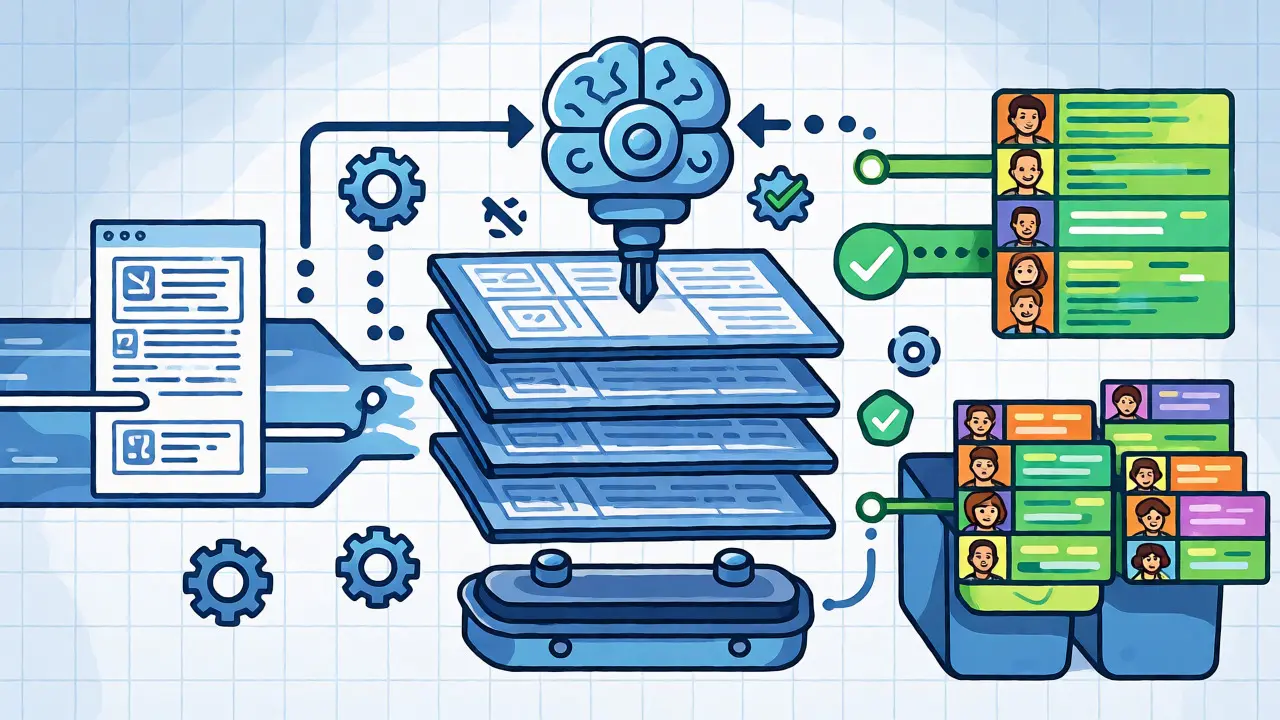
So, how do we get realistic test data without hiring a QA team? The leading approach involves feeding your database schema to an AI model and asking it to generate rows that respect referential integrity. Neon Database Labs pioneered this method using GitHub Actions to dump schemas and send them to Anthropic's API.
Here is the workflow in plain English:
- Dump the Schema: Extract the structure of your tables (columns, types, keys) without any actual data.
- Prompt the Model: Send this schema to an LLM like Claude-3.5-Sonnet with instructions to generate realistic entries.
- Validate Integrity: Check if the generated data respects foreign keys and unique constraints.
- Load into DB: Insert the data into a staging environment for testing.
Benchmarks show this method is surprisingly fast. Generating 500 rows across seven interconnected tables takes about 12 seconds. But speed isn't everything. The initial compliance rate for schema rules was around 94.3%. That sounds high, but in a large system, a 6% error rate means hundreds of broken records. To fix this, developers use a hybrid approach. They let the AI define the structure and relationships, then use libraries like faker.js to populate the values. This boosts realism scores to 98.1% but increases processing time by 37%.
Traditional Tools vs. AI Methods
You might wonder why not just stick to established tools like Mockaroo or GenRocket? They have been around forever. The trade-off is setup time versus flexibility. Traditional tools require you to explicitly define every rule. If you change your schema, you update the tool. With vibe coding, your schema changes constantly. Updating a dedicated tool every time you tweak a column type becomes a bottleneck.
| Feature | AI-Driven (e.g., Claude + Faker) | Traditional (e.g., GenRocket) |
|---|---|---|
| Setup Time | 2-4 hours | 15-20 hours |
| Referential Integrity | 94.3% | 99.8% |
| Data Realism | High (87% believability) | Moderate (often robotic) |
| Cost per 1k Rows | $2.17 | $0.89 |
| Best For | Rapid prototyping, MVPs | Regulated industries, enterprise |
The cost difference is real. AI methods are more expensive per row because you pay for token usage. However, for early-stage startups, saving 15 hours of setup time outweighs the extra $1.28 per thousand rows. You are buying agility. If you are in healthcare or finance, though, stop here. Compliance requirements for audit trails make traditional tools mandatory. You cannot explain to an auditor why an LLM decided to generate a specific patient ID.
Pitfalls That Will Bite You
It is not all smooth sailing. There are specific traps in this workflow that catch developers off guard. First, complex constraints. Models struggle with multi-column unique constraints. In tests, success rates dropped to 68% when dealing with these tricky rules. If your database relies heavily on composite keys, expect manual cleanup.
Second, statistical deviation. AI generates data that looks plausible, but it rarely matches the true distribution of production data. On average, there is a 23.7% deviation in statistical properties. If your app relies on heavy analytics or machine learning training data, this synthetic set won't be accurate enough. It is good for functional testing-checking if buttons work and pages load-but bad for performance modeling under realistic load patterns.
Third, security risks. Dr. Elena Rodriguez from Databricks noted that 43% of AI-generated test data inadvertently created security vulnerabilities. How? By generating edge cases humans hadn't considered, such as null values in non-null fields due to parsing errors, which then broke validation logic. Always run security scans against your synthetic dataset before deploying to staging.
A Practical Workflow for Success
If you want to implement this tomorrow, here is a battle-tested routine. Don't try to automate everything at once. Start small.
- Use Two Phases: Let the AI generate the SQL structure and relationships first. Then, use a deterministic library like faker.js to fill in the names, emails, and dates. This separates logic from content.
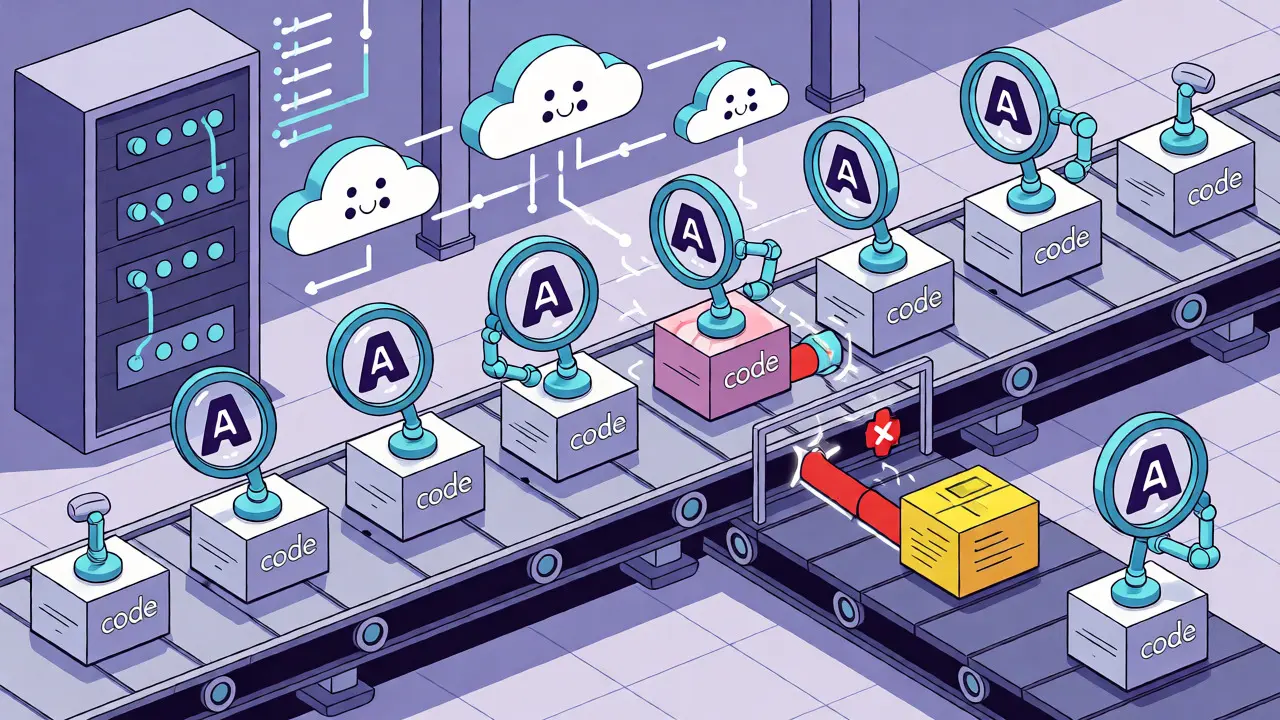
- Implement Validation Gates: Use a tool like Great Expectations to validate the data immediately after generation. If referential integrity fails, halt the pipeline. Do not load bad data.
- Limit Table Complexity: Keep individual generation tasks to fewer than 15 interconnected tables. Beyond that, models start hallucinating relationships. Break large schemas into micro-service style chunks.
- Monitor Costs: Set alerts for API usage. Large datasets can rack up bills quickly. Cache common schema definitions to avoid re-sending identical prompts.
Developers who adopted this two-phase approach reported becoming productive 63% faster. New team members could understand the data model simply by looking at the generated examples. That documentation value is a hidden bonus.
The Future of Testing
We are still early. Gartner predicts that by 2026, 70% of synthetic test data for early-stage apps will be AI-generated. But for production systems, that number drops to 35%. Why? Trust. Companies need certainty. Right now, AI gives you probability, not certainty.
Tools are evolving fast. GitLab recently added native support for AI-generated synthetic data in their CI/CD pipelines. GitHub is following suit. This integration reduces friction significantly. Instead of writing custom scripts, you will likely just add a flag to your deployment config. But remember: automation amplifies both good and bad practices. If your vibe-coded logic is flawed, better test data will only help you discover the flaw faster, not prevent it.
Is AI-generated synthetic data secure for GDPR compliance?
Generally, no, not for strict compliance scenarios. While synthetic data contains no real personal information, current AI methods lack the certified audit trails required by regulations like GDPR Article 22. Traditional tools provide verifiable logs of how data was generated, which is essential for legal defensibility. Use AI methods for internal development and traditional tools for final regulatory testing.
Why does my AI-generated data break foreign key constraints?
Large Language Models process text sequentially and may lose track of global state in large schemas. They might generate a child record referencing a parent ID that hasn't been created yet or doesn't exist. Using a hybrid approach where the AI defines the order of insertion and a script enforces the IDs solves most of these issues.
Can I use synthetic data for performance testing?
You can, but be cautious. AI data often deviates statistically from production data (average 23.7% deviation). This means your query plans might differ from reality. Use it for functional load testing (does the server crash?) but not for precise latency benchmarking unless you calibrate the data distribution manually.
What is the best tool for validating synthetic data?
Great Expectations is highly recommended in the community for automated validation. It allows you to define expectations for your data (e.g., 'all email columns must contain @') and fails the pipeline if those expectations aren't met. This acts as a safety net for AI imperfections.
How much does it cost to generate 1 million rows of synthetic data?
Using current API pricing for models like Claude-3.5-Sonnet, generating 1 million rows costs approximately $2,170. This is higher than traditional tools ($890), but you save significant labor hours. For most startups, the time savings justify the premium.