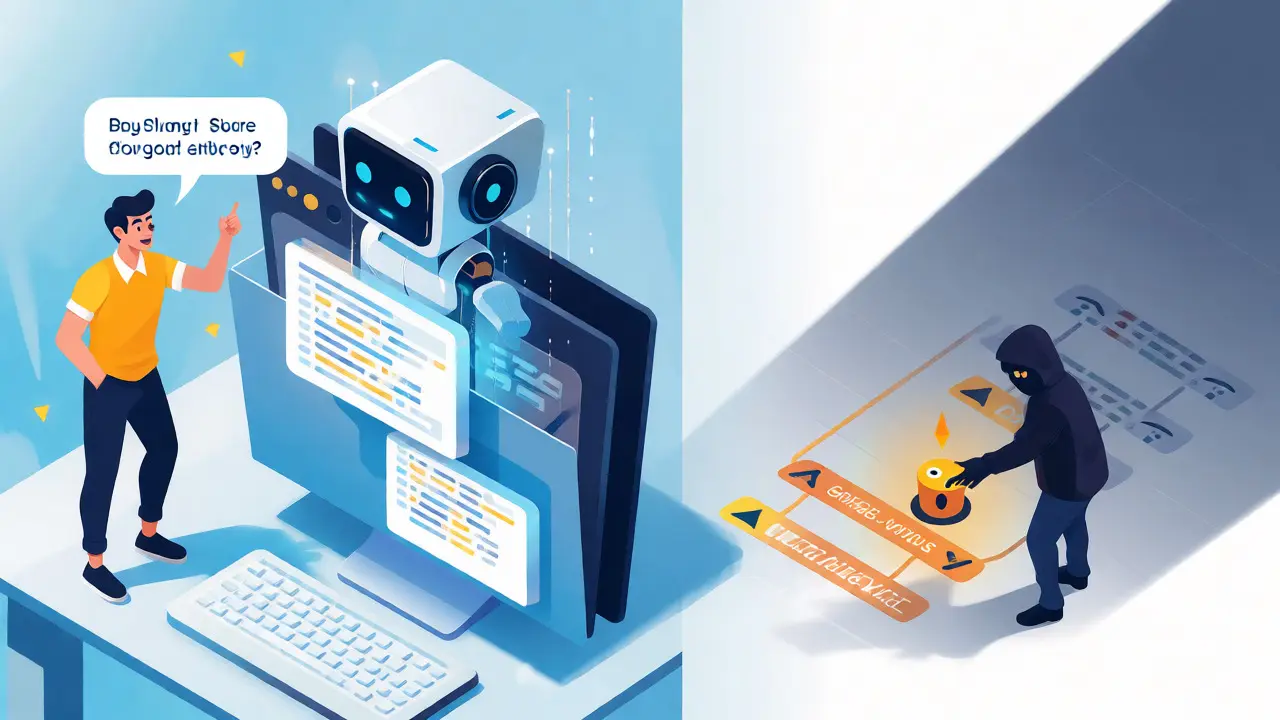
You just asked your AI assistant to build a login system. It spat out clean-looking JavaScript in seconds. You merged it into main. Two days later, you discover the AI hallucinated a package name that didn't exist, so an attacker had already registered it with malicious code inside. This isn't a hypothetical nightmare; it's Tuesday for teams adopting vibe coding is a development practice where engineers use conversational AI prompts to generate large chunks of application code rapidly.
The speed of AI-assisted development breaks traditional security assumptions. When humans write code, they usually understand the context and the risks. When AI writes code, it optimizes for syntax correctness and prompt adherence, often ignoring security headers, access controls, or dependency safety. That’s why standard code reviews aren’t enough anymore. You need automated gatekeepers. Branch protection is a set of rules enforced on specific repository branches (like main) that prevent merges unless certain conditions are met, such as passing security scans acts as this gatekeeper. If you’re shipping AI-generated code without robust branch protection, you’re essentially deploying untested prototypes straight to production.
Why Traditional Reviews Fail AI Code
Let’s be honest: reviewing 500 lines of AI-generated boilerplate is tedious. Developers often skim it, trusting the AI because "it looks right." But AI models have blind spots. They frequently introduce what researchers call "hallucinated bypasses"-accidentally removing authentication checks or deleting critical keywords like auth during refactoring. Worse, they tend to suggest libraries that sound plausible but don’t exist, or they pick outdated versions with known vulnerabilities.
Human review catches logic errors. Automated branch protection catches structural and security flaws before they ever touch your shared codebase. According to industry data from 2025-2026, catching a vulnerability during the pull request phase is exponentially cheaper than fixing it after deployment. For vibe-coded repos, this cost differential is even steeper because AI can introduce subtle supply chain attacks at scale. If one prompt installs a compromised npm package, and you have ten microservices using that same prompt pattern, you’ve got a systemic issue, not a local bug.
The Four Pillars of Secure Merging
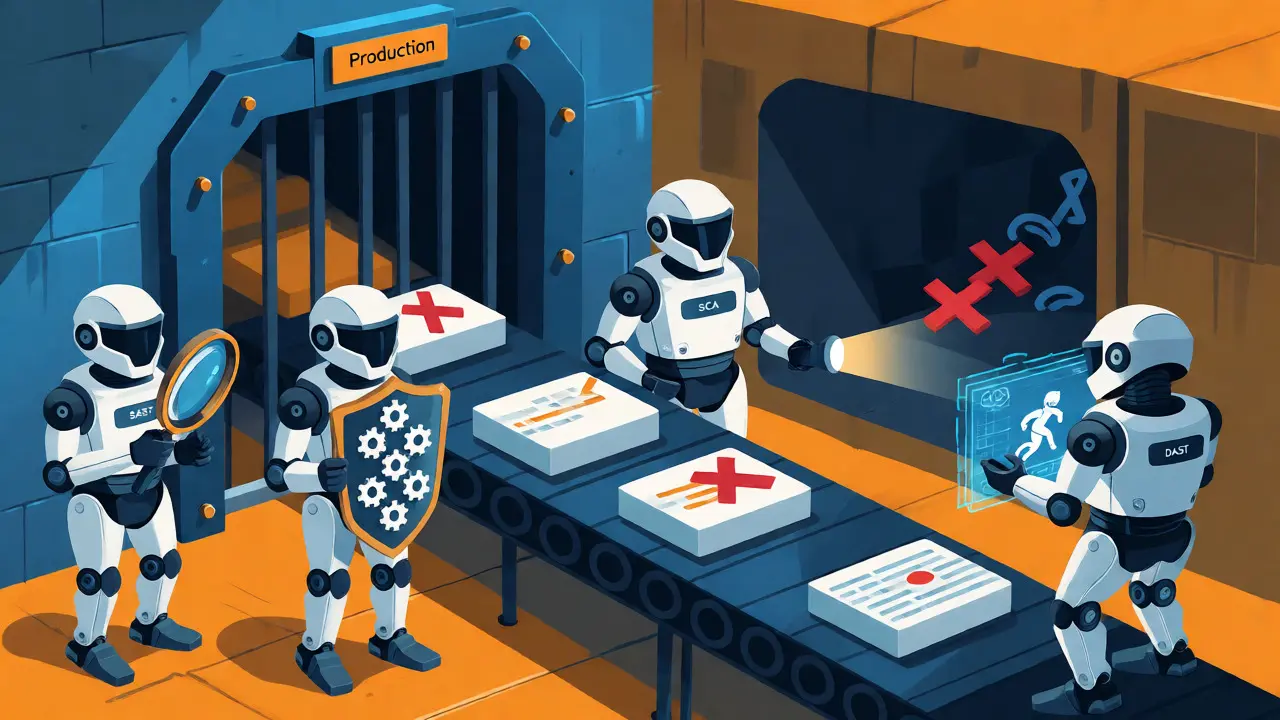
To protect your repositories, your branch protection rules must enforce four distinct types of scanning. Think of these as layers of defense. If any layer fails, the merge is blocked.
- SAST (Static Application Security Testing): This scans the source code itself for insecure patterns. Tools like Semgrep is an open-source static analysis tool that uses pattern matching to find bugs and security issues or CodeQL is a semantic code analysis engine developed by GitHub check for SQL injection, XSS, and path traversal. AI often forgets to sanitize inputs, leading directly to injection flaws.
- SCA (Software Composition Analysis): This checks your dependencies. AI loves to grab the latest version of a library, which might contain new vulnerabilities. Tools like Snyk is a developer-first security platform that helps teams find and fix vulnerabilities in their code and dependencies or Trivy is a comprehensive and lightweight scanner for container images and filesystems ensure no vulnerable packages slip through.
- Secrets Scanning: AI sometimes pastes example API keys directly into the code. Tools like Gitleaks is a tool for detecting secrets such as passwords and API tokens in git repositories scan every commit to ensure no credentials are hardcoded.
- DAST (Dynamic Application Security Testing): While harder to integrate into pre-merge checks, running basic DAST on staging deployments triggered by the PR ensures runtime vulnerabilities like CORS misconfigurations are caught early.
| Tool Type | Primary Purpose | Common AI-Specific Risk Caught | Recommended Tools |
|---|---|---|---|
| SAST | Analyze source code structure | Missing input validation, insecure crypto | Semgrep, CodeQL, Snyk Code |
| SCA | Analyze third-party dependencies | Typosquatting, outdated libraries | Snyk, Trivy, npm audit |
| Secrets | Detect hardcoded credentials | Example API keys left in comments/code | Gitleaks, GitGuardian |
| IaC Scan | Analyze infrastructure config | Overly permissive IAM roles | Checkov, Terraform Plan |
Combating Hallucinations and Typosquatting
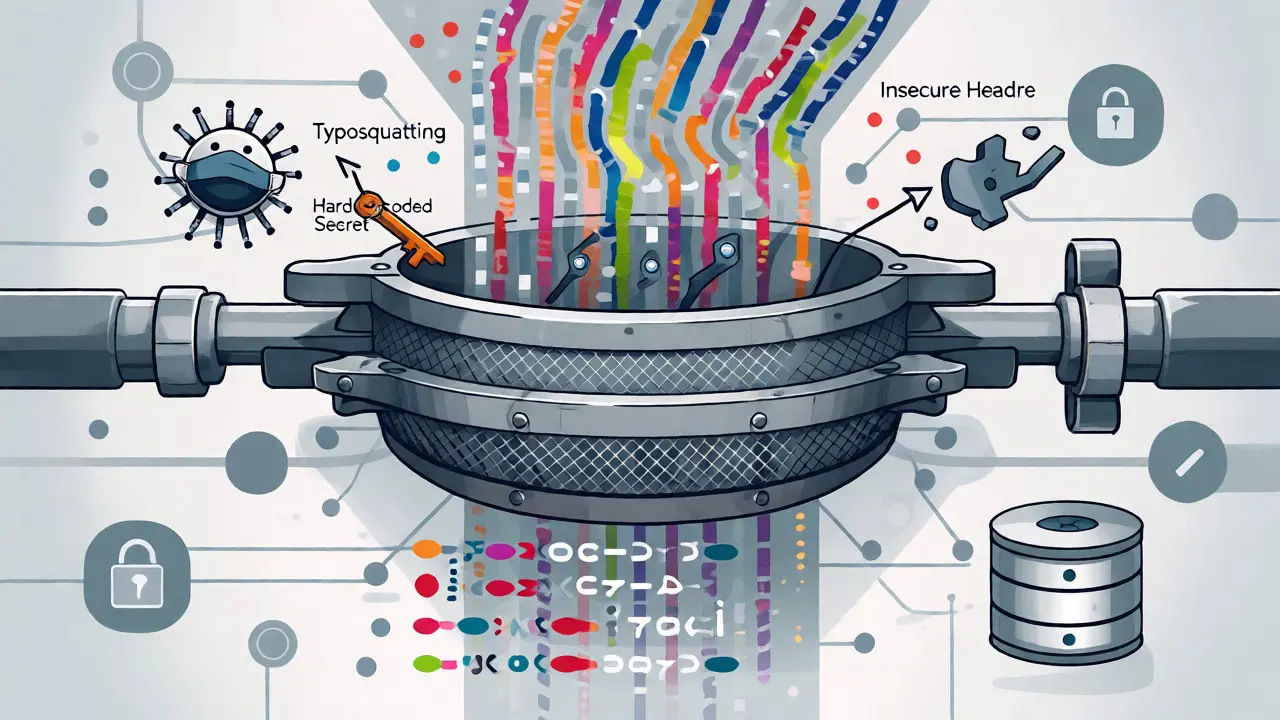
One of the most dangerous aspects of vibe coding is package hallucination. An AI model might suggest importing react-native-auth-helper, a library that doesn’t actually exist. In a vacuum, this causes a build error. But attackers monitor these trends. If they see developers frequently asking AI for similar functionality, they register those fake names with malicious code. This is typosquatting.
Your branch protection needs to verify dependency pinning strictly. Do not allow wildcard versions like ^1.0.0 if you can avoid it. Enforce exact version locking in your package-lock.json or yarn.lock files. Furthermore, implement cooldown policies for newly published packages. If a package was published less than 48 hours ago, block its installation automatically. Most supply chain attacks exploit fresh packages before the community has had time to review them. Platforms like StepSecurity offer org-wide package search capabilities that let you instantly identify if a suspicious package has been introduced across all your repositories.
Enforcing Infrastructure and Access Controls
AI-generated database configurations are notoriously lazy. They often ship with overly permissive defaults. For instance, an AI might set up a Supabase or Postgres connection without enabling Row Level Security (RLS). Without RLS, any user can read another user’s data simply by changing an ID in the URL. Your branch protection rules should include custom scripts that verify RLS policies are present on all tables touched by the migration.
Similarly, check for security headers. AI almost never adds HTTP security headers unless explicitly prompted. You need to enforce the presence of headers like X-Content-Type-Options: nosniff, X-Frame-Options: DENY, and Strict-Transport-Security. A simple linting rule in your CI pipeline can fail the build if these headers are missing from your Express or Next.js configuration. This is low-hanging fruit that prevents clickjacking and MIME-sniffing attacks.
Implementing the Workflow
So, how do you actually set this up? Start small. Don’t try to secure everything at once. Pick your highest-risk repository-the one handling payments or user data-and apply these rules:
- Require Status Checks: Configure your GitHub/GitLab settings to require successful completion of specific CI jobs before merging. Name these jobs clearly, e.g., "Security Scan - SAST," "Dependency Audit."
- Add Required Reviewers: Require approval from a senior engineer or security champion. Never rely solely on the AI author (if you track bot commits) or the junior dev who prompted it.
- Block Force Pushes: Prevent force pushes to protected branches. This ensures history integrity and makes auditing easier.
- Integrate Pre-Commit Hooks: Catch obvious errors locally before they even hit the server. Use tools like Husky to run Gitleaks and basic linters on commit.
Remember, branch protection is about friction. It slows down the merge process slightly, but that friction is intentional. It forces a pause for reflection. When a developer sees a red "X" next to their PR because Semgrep found a potential SQL injection, they have to stop and think: "Did I trust the AI too much here?" That moment of doubt is where security lives.
Balancing Velocity and Rigor
Critics will argue that strict branch protection kills the speed advantage of vibe coding. And they’re partially right. If every minor typo triggers a full security scan, developers will get frustrated. The key is tuning. Use incremental scanning where possible. Only scan changed files for SAST if the tool supports it. Cache dependency checks to avoid redundant work.
Also, distinguish between blocking and warning errors. A missing comment shouldn’t block a merge. A hardcoded AWS secret key definitely should. Establish a clear policy matrix: Critical vulnerabilities block the merge; medium warnings require acknowledgment; low-severity issues are logged for tech debt cleanup. This keeps the workflow moving while ensuring the worst offenders never reach production.
Ultimately, securing vibe-coded repositories isn’t about distrusting AI. It’s about acknowledging that AI is a powerful but naive collaborator. It writes code fast, but it doesn’t care about your threat model. Branch protection injects that care back into the pipeline, turning raw generation into reliable software.
Can AI self-review replace human code review?
No. While AI can perform multi-stage security prompting to review its own output, it lacks contextual awareness of business logic and organizational standards. Human review remains essential for verifying intent and architectural fit, while automated branch protection handles mechanical security checks.
What is the biggest risk of vibe coding?
The biggest risks are hallucinated dependencies (typosquatting), missing security headers, and overly permissive database access controls. AI tends to optimize for functionality over security, often skipping necessary safeguards like Row Level Security or input sanitization.
How does branch protection help with supply chain attacks?
Branch protection enforces Software Composition Analysis (SCA) on every pull request. This detects vulnerable or suspicious dependencies immediately. Features like cooldown policies can also block newly published packages, preventing the introduction of malware that hasn't yet been flagged by community scanners.
Should I block merges for low-severity security findings?
It depends on your team's velocity goals. Generally, critical and high-severity findings should block merges. Medium findings might require a ticket or acknowledgment, while low-severity findings can be logged as technical debt to avoid slowing down development excessively.
What tools are best for secrets detection in AI code?
Gitleaks and GitGuardian are highly effective. They detect patterns resembling API keys, passwords, and tokens. Integrating these into both pre-commit hooks and CI pipelines ensures that accidental credential leaks are caught before they enter the repository history.
Lauren Martin
October 2, 2026 AT 21:49Look, this entire premise is fundamentally flawed because you're treating vibe coding like it's a legitimate engineering discipline rather than just lazy prompt injection with extra steps. You talk about SAST and SCA as if they are silver bullets, but any competent security analyst knows that static analysis tools have massive false positive rates when dealing with LLM-generated boilerplate, which means your developers will spend more time whitelisting noise than actually fixing the underlying architectural rot caused by hallucinated dependencies. The idea that 'branch protection' solves the supply chain issue is naive at best; if an attacker registers a typosquatted package that passes basic heuristic checks, your CI pipeline is just going to green-light malware into production while everyone pats themselves on the back for having 'robust' controls. You need semantic understanding of intent, not just pattern matching, and until AI can explain its threat model reasoning in a way that survives adversarial probing, these automated gatekeepers are just theater for management who don't want to hire actual senior engineers to review the garbage output.
Ian Mason-Laurence
October 4, 2026 AT 08:37The assertion that traditional reviews fail AI code due to volume is accurate, but the proposed solution overlooks the necessity of deterministic verification. While SAST and SCA provide structural integrity, they do not address logical consistency or business rule adherence, which remains the primary domain of human oversight. Furthermore, enforcing exact version locking in package managers often leads to dependency hell scenarios where transitive conflicts become unresolvable without manual intervention, thereby negating the velocity benefits cited in the introduction. A balanced approach requires integrating dynamic analysis earlier in the lifecycle, perhaps through ephemeral environments spun up per pull request, to catch runtime behaviors that static scanners miss. Without such measures, the friction introduced by branch protection rules may indeed degrade developer experience significantly, leading to workaround behaviors that ultimately weaken the security posture.
Sundaraiah Kollipara
October 5, 2026 AT 22:56this feels like we are trying to put seatbelts on a rocket ship before checking if the engine even works 🚀
the real question isn't about tools or pipelines but about our relationship with abstraction layers
if we accept that ai generates code based on probability distributions rather than logical deduction then every line is essentially a guess that happened to compile
we are building castles on sand and calling it innovation
maybe the friction mentioned is actually a feature not a bug because it forces us to confront the fact that we don't understand what we are shipping anymore
i wonder if the next step is ai reviewing ai creating a closed loop of validation that never touches human reality
evelyn starcher
October 6, 2026 AT 01:47Finally someone said it! 🇺🇸 We shouldn't be relying on some fancy newfangled AI nonsense to keep our data safe. It’s all just cheap tricks from overseas tech companies trying to sell us snake oil. 😤 I bet half those tools are just wrappers around open-source stuff anyway. We need good old-fashioned American ingenuity and hard work, not prompts! 💪
jyotshna Senapati
October 7, 2026 AT 16:11I see so many people here missing the point entirely, which is honestly disappointing. 😒 You’re all focusing on the technical implementation details while completely ignoring the cultural shift happening right now. If you think adding a few linters fixes the problem, you’re living in a bubble. The real issue is that junior developers are losing their ability to reason about systems because they’ve outsourced their thinking to a chatbot.
It’s not just about security headers or RLS policies; it’s about the erosion of fundamental engineering skills. When the AI makes a mistake, nobody knows how to fix it because nobody understands why it was written that way in the first place. This creates a fragile system that looks robust on paper but collapses under pressure.
And let’s be real, most of these 'security champions' are just middle managers trying to justify their existence. They love the idea of automated gates because it lets them feel in control without actually doing the hard work of mentoring. Until we address the skill gap and the over-reliance on automation, no amount of Semgrep or CodeQL will save us from ourselves. We are sleepwalking into a crisis of competence, and you’re all arguing about tool configurations. 🙄