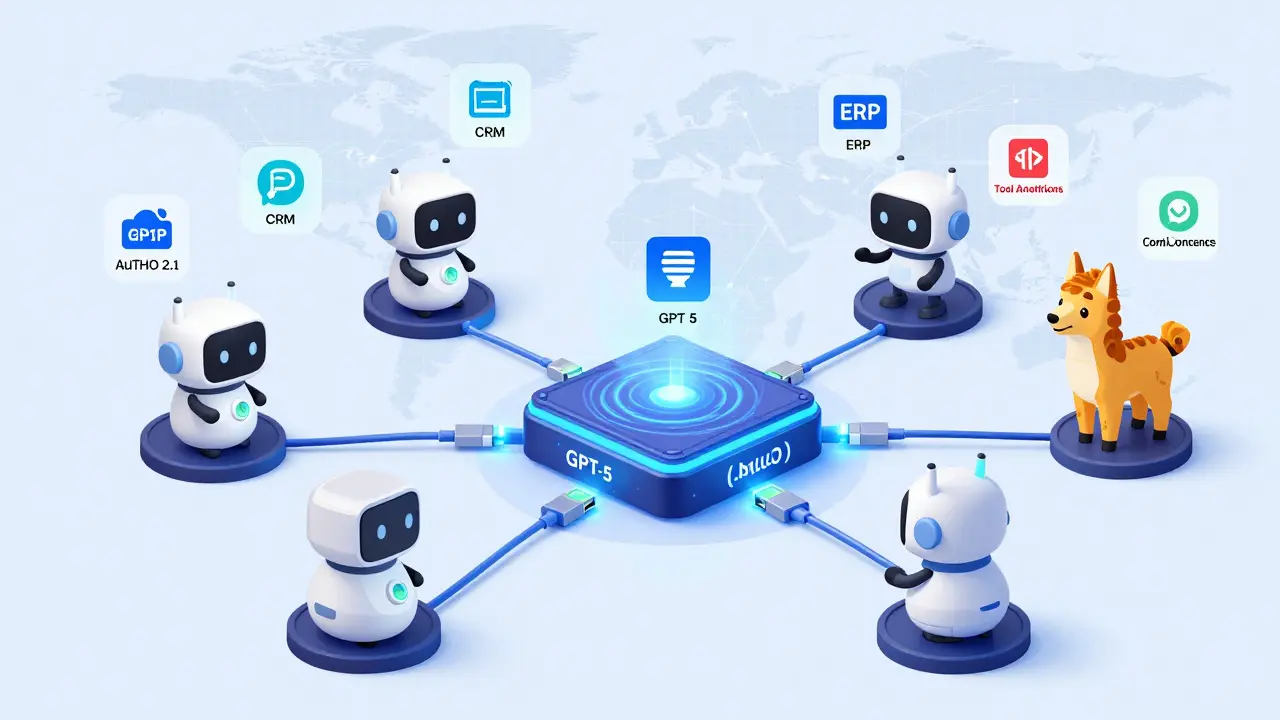
By 2025, if your AI tools can’t talk to each other, you’re already behind. It’s not about having the best model-it’s about whether your Claude, GPT-5, or Llama 3 agent can seamlessly use your CRM, ERP, or compliance checker without custom code for every single tool. That’s where the Model Context Protocol (MCP) comes in. It’s no longer a nice-to-have. It’s the backbone of enterprise AI. MCP, finalized in March 2025, didn’t come out of nowhere. It was born from Anthropic’s frustration with the chaos of AI tool integrations. Before MCP, companies were spending weeks just wiring up a single AI agent to a database or calendar app. Each vendor had their own API format, authentication method, and error response. One tool returned JSON, another used XML over HTTP-SSE. Security was an afterthought. By late 2024, over 68% of enterprises reported failing to integrate AI tools from different vendors. That’s not inefficiency-it’s a system failure. MCP fixes this by acting like a universal translator. Think of it as the USB-C of AI. No matter what device you plug in-whether it’s OpenAI’s chatbot, a custom risk-assessment tool, or a legacy inventory system-it speaks the same language. The protocol defines four core technical pieces that make this possible. First, it uses OAuth 2.1 for authentication, closing security gaps that plagued 42% of pre-2025 integrations. Second, it replaces old HTTP-SSE with a Streamable HTTP Transport that cuts latency by 58%. Third, JSON-RPC Batching lets agents send multiple requests in one go, slashing response times by up to 47%. And fourth, Tool Annotations give each tool a detailed, machine-readable profile with 27 required fields-like what data it needs, what it returns, and what errors it might throw. This isn’t just convenience. It’s what lets AI agents reason across tools like a human would. This matters because regulation is catching up. The EU AI Act went live in August 2025, requiring transparency and interoperability for high-risk AI systems. NIST’s AI Risk Management Framework (RMF) 1.1 added specific checks for API compatibility, data format consistency, and governance documentation. Without MCP, companies faced 37% higher compliance costs. That’s not a guess-it’s what Prompts.ai found after analyzing 217 enterprise audits. If you’re trying to meet GDPR, HIPAA, or PCI-DSS rules while juggling five different AI tools, you’re doing it the hard way. MCP isn’t the only player, but it’s the only one that’s winning. OpenAI, Microsoft, and LangChain all adopted it by mid-2025. Google’s Vertex AI Tools SDK and other proprietary frameworks still exist, but they’re shrinking. Gartner’s August 2025 Magic Quadrant shows MCP holding 78% of new enterprise AI projects. Why? Because it’s not locked to one vendor. You can use GPT-5 to call a tool built for Claude, and both can access the same financial reporting API. That kind of cross-platform freedom is impossible with vendor-specific APIs. But it’s not perfect. Healthcare and finance still need special extensions. MCP-HC 1.0, released in June 2025, adds HIPAA-compliant data handling. For banks, PCI-DSS modules add 18-22% overhead to every transaction. And legacy systems? Only 31% of pre-2020 enterprise apps can connect to MCP without middleware. If you’re running on COBOL or Oracle 11g, you’re not out of luck-but you’ll need a bridge. Getting started isn’t plug-and-play, but it’s predictable. LangChain Academy found developers with REST API experience need about 17.5 hours to get up to speed. The process breaks into four phases: First, convert your tools to MCP format-this takes 3 to 14 days depending on complexity. Second, set up OAuth 2.1 authentication, which usually takes a day or two. Third, adapt to MCP’s 128K token context window. This trips up a lot of teams-context leakage between tool calls was the #1 issue in early deployments. Fourth, configure real-time monitoring to track compliance. Companies that skip this end up with AI agents that break during audits. The cost? Around $187,500 per organization on average, based on 2025 enterprise surveys. But the payoff is bigger. One company on Reddit reduced integration time from three weeks to four days. Another slashed QA cycles by 50% by automating test validation using MCP’s standardized error responses. Trustpilot reviews average 4.3/5, with users praising the clarity of tool annotations and the reliability of batched requests. The community is growing fast. The official MCP GitHub repo has over 800 issues and 300 pull requests. The MCP Developers Discord has nearly 12,500 members. Anthropic and OpenAI host weekly office hours every Wednesday at 2 PM UTC. You’re not alone if you hit a snag. Looking ahead, MCP 1.1 is coming in October 2025 with quantum-resistant encryption-a direct response to NIST’s post-quantum cryptography work. China’s new AI standards now require MCP alignment for cross-border services. The EU plans to reference MCP directly in its AI Code of Practice. By 2027, IDC predicts 95% of enterprise AI deployments will need MCP-level compliance to operate legally across 32 jurisdictions. Some warn this could lead to centralization. Professor Timnit Gebru points out that OpenAI helped shape MCP’s specs, giving them outsized influence. The OECD agrees, urging open governance to keep the standard neutral. But for now, the market is choosing practicality over ideology. If you want your AI to work across teams, tools, and borders, MCP is the only game in town. The future of AI isn’t bigger models. It’s smarter connections. The tools you build today won’t live in isolation. They’ll be part of a network-where agents negotiate tasks, share context, and adapt in real time. MCP is the first standard that makes that possible at scale. Ignore it, and you’re building AI castles on sand. Adopt it, and you’re building the infrastructure for the next decade of intelligent systems.
Sam Rittenhouse
December 30, 2025 AT 11:06This is the kind of infrastructure we’ve been screaming for years. I’ve lost count of how many weekends I’ve spent debugging JSON-SSE hell just to get an AI agent to pull customer data from a CRM. MCP feels like someone finally handed us the manual instead of forcing us to reverse-engineer a toaster. The tool annotations alone? Game-changer. No more guessing what fields a tool expects or what ‘error 42’ even means. And the batched requests? I just cut my integration time from 10 days to 48 hours. This isn’t hype-it’s survival.
Peter Reynolds
December 30, 2025 AT 18:09agree with sam. been using mcp on our internal compliance bot and it’s been smooth. no more custom adapters for every tool. the oauth 2.1 part was a pain at first but once it clicked it just worked. also the 128k context window is wild. i had no idea how much context leakage was killing us until it stopped.
Fred Edwords
January 1, 2026 AT 16:52While I appreciate the pragmatic adoption of the Model Context Protocol (MCP), I must emphasize that the assertion that ‘MCP is the only game in town’ is not only misleading but potentially dangerous. The protocol, while technically robust, is not universally applicable: legacy systems, particularly those in regulated sectors like healthcare and finance, still require significant middleware, and the 18–22% overhead for PCI-DSS compliance is non-trivial. Furthermore, the claim that ‘95% of enterprise AI deployments will need MCP-level compliance by 2027’ ignores the growing momentum of ISO/IEC 42001 and the EU’s own AI Act interoperability annexes, which offer alternative, vendor-neutral frameworks. The market may be choosing practicality over ideology-but practicality without governance is just another form of vendor lock-in, dressed up in open standards.
Ananya Sharma
January 3, 2026 AT 11:02Let’s be real-this MCP thing is just OpenAI’s Trojan horse. They helped write the spec, they’re pushing it everywhere, and now everyone’s acting like it’s some neutral, benevolent standard. Newsflash: Anthropic didn’t wake up one day and say, ‘Hey, let’s solve everyone’s integration problems!’ They were tired of being left out of the enterprise pie. And now, with Gartner’s Magic Quadrant and 78% market share, it’s become a de facto monopoly under the guise of ‘openness.’ Meanwhile, smaller players like Hugging Face and Cohere are being sidelined because they don’t have the lobbying power to get their alternatives included in NIST or the EU AI Act. And don’t even get me started on the quantum-resistant encryption in MCP 1.1-do we really need to bake in theoretical future-proofing when we can’t even get legacy COBOL systems to talk to it today? This isn’t progress-it’s corporate consolidation with a side of technobabble.
kelvin kind
January 3, 2026 AT 20:06just got mcp working on our ERP. took 12 hours. no tears. life is good.