
Every time you ask a large language model (LLM) a question, it doesn’t just think-it burns electricity, uses computing power, and racks up costs. A single query can use 10 times more energy than a Google search. And when you’re running thousands of these requests daily, the waste adds up fast-both in dollars and carbon emissions.
Here’s the good news: you don’t need to buy a new model or retrain anything. The biggest savings are hiding in your prompts.
Prompt Templates Are the Hidden Efficiency Tool
Prompt templates aren’t just fancy ways to phrase questions. They’re structured blueprints that tell the model exactly what to do, how to do it, and what to ignore. Think of them like recipes. If you give someone a vague instruction like "Make something tasty," they might spend 20 minutes guessing what you want. But if you say "Make a cheese omelet with spinach and tomatoes, no onions," they get it right the first time-and waste less time, ingredients, and energy.
That’s what prompt templates do for LLMs. Instead of letting the model wander through hundreds of possible responses, you guide it down the most efficient path. Studies from PMC (2024) show well-designed templates can cut token usage by 65-85%. That’s not a small tweak-it’s a massive reduction in computational load.
How Do They Actually Save Resources?
There are three main ways prompt templates reduce waste:
- Token Optimization-Every word, punctuation mark, and space you type gets turned into a "token." Models charge by the token. A messy prompt like "Can you tell me about renewable energy in Europe? Like, what are the good ones and why?" uses 18 tokens. A clean version-"List top 5 renewable energy sources in Europe and their key advantages"-uses only 12. That’s a 33% drop in tokens just by being precise.
- Structural Guidance-Templates with clear roles ("You are a code reviewer") or formats ("Answer in JSON: {answer: \"...\"}") prevent the model from generating fluff. One study found that adding "Return TRUE if the statement is accurate, FALSE otherwise" eliminated 92% of irrelevant text. No need to process 500 words when 20 will do.
- Task Decomposition-Breaking big tasks into smaller steps reduces cognitive overload. Instead of asking for "Write a full report on renewable energy policies," use three prompts: 1) List key policies in Germany, France, and Spain. 2) Compare their carbon reduction impact. 3) Summarize in one paragraph. Total tokens dropped from 3,200 to 1,850 in real tests.
Chain-of-thought (CoT) prompting-where you ask the model to "think step by step"-cuts energy use by 15-22% on coding models like Qwen2.5-Coder. Why? Because it prevents the model from guessing. It forces a logical path, reducing retries and hallucinations.
Real Savings: Numbers That Matter
Let’s talk real-world impact.
A developer on Reddit reduced AWS Bedrock costs by 42% after switching to variable-based prompt templates in LangChain. Their average request went from 2,800 tokens to 1,600. That’s 1,200 tokens saved per call. Multiply that by 10,000 requests a day? That’s 12 million fewer tokens daily. That’s not just cheaper-it’s greener.
Capgemini’s clients saw a 30% drop in LLM service costs within two months of adopting templated prompts. One enterprise customer using AI for customer service automation cut their monthly bill from $18,000 to $12,600-just by rewriting prompts.
And it’s not just about money. The same techniques reduced carbon emissions by 36% in coding applications, according to Podder et al. (2023). If every company using LLMs optimized their prompts, we’d save the equivalent energy of tens of thousands of homes annually.

Where It Works Best (and Where It Doesn’t)
Prompt templates shine in structured tasks:
- Code generation and review
- Data extraction from documents
- Classification (spam detection, sentiment tagging)
- Automated customer support replies
- Screening research papers for systematic reviews
In these cases, PMC (2024) found workload reductions of up to 80%. For example, one team using templated prompts to screen medical studies cut their manual review time from 40 hours to 8.
But they struggle with open-ended creativity. If you’re writing poetry, brainstorming product names, or generating fictional stories, rigid templates can make outputs feel robotic. Developers on GitHub reported a 15-20% drop in quality when templates were too restrictive in creative tasks.
That’s not a flaw-it’s a boundary. Use templates where precision matters. Let flexibility rule where imagination does.
Tools That Make It Easy
You don’t need to build this from scratch. Two tools dominate the space:
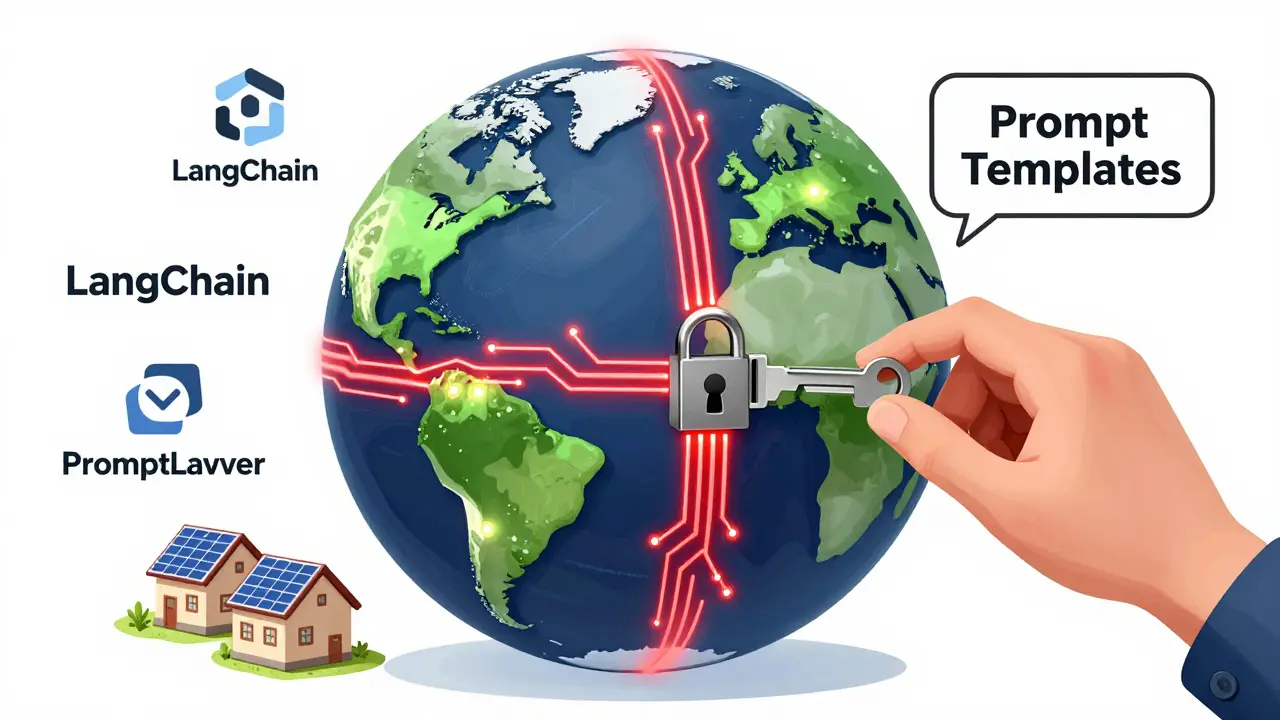
- LangChain-Lets you define reusable prompt templates with variables. You can swap out user inputs, model types, or output formats without rewriting everything. Used by 85% of enterprise teams (Capgemini, Q3 2025).
- PromptLayer-Tracks every prompt’s performance: token count, cost, latency, and output quality. It shows you which templates are wasting resources and which are working. One user cut redundant requests by 70% using its caching feature.
Both integrate with OpenAI, Anthropic, Llama, and other major models. No code changes needed-just swap your prompt input.
How to Start (Without Getting Overwhelmed)
You don’t need to overhaul everything tomorrow. Here’s how to begin:
- Pick one high-volume task-Something you run 50+ times a day. Customer support replies? Code comments? Data labeling?
- Record your current prompt and token usage-Use PromptLayer or your provider’s dashboard.
- Apply one template technique-Try role prompting ("You are a financial analyst...") or output formatting ("Answer in bullet points.").
- Test and measure-Run 100 queries before and after. Compare token count, cost, and accuracy.
- Iterate-Most teams need 5-7 rounds of tweaks to hit peak efficiency. Each cycle takes 1-2 hours.
Developers with training hit 80% of potential savings in 20-30 hours of practice (Codesmith.IO, 2025). That’s less than a week of lunch breaks.
The Bigger Picture: Why This Isn’t Just a Tech Trick
This isn’t about saving a few dollars on your cloud bill. It’s about sustainability.
The EU’s AI Act (March 2025) now requires "reasonable efficiency measures" for commercial LLM use. Prompt optimization isn’t optional anymore-it’s compliance.
Gartner predicts 75% of enterprises will use structured prompts by 2026, up from 35% in 2024. The market for prompt engineering tools hit $1.2 billion in 2025. This is becoming standard practice.
And it’s accessible. You don’t need a PhD. You don’t need to buy new hardware. You just need to write better instructions.
Watch Out for These Pitfalls
It’s not all smooth sailing. Here’s what trips people up:
- Over-optimizing-Too many constraints can kill output diversity. One ACM study found rigid prompts reduced creativity so much they created new inefficiencies in marketing content.
- Model drift-When a model updates, your template might break. 72% of users on HackerNews reported losing efficiency after a model upgrade. Always test after updates.
- Vendor lock-in-A template that works perfectly on OpenAI might lose 40-50% efficiency on Llama. Don’t assume your templates are portable.
- Time cost-68% of developers spend 3-5 hours a week refining prompts. That’s real labor. Automate what you can.
The key? Balance. Be precise, but leave room for the model to do its job.
What’s Next?
The future is automation. Anthropic’s December 2025 update now auto-refines prompts to cut token use by 22% on average. Gartner says by 2027, 60% of prompts will be generated and tuned by AI-without human input.
But for now, the biggest gains are still in your hands. You control the prompt. You control the waste.
Start small. Measure everything. Optimize one task at a time. The savings aren’t just in your budget-they’re in the planet’s energy ledger.
Do prompt templates work with all large language models?
Yes-prompt templates work with OpenAI, Anthropic, Meta’s Llama, and open-source models like StableCode and Qwen. You don’t need to change the model. Just adjust the input format. However, efficiency varies. Smaller models (SLMs) respond better to templates than massive ones. A template that cuts 70% of tokens on Phi-3-Mini might only save 40% on GPT-4.
Can I use prompt templates to reduce my cloud bill?
Absolutely. Token usage directly determines cost on platforms like AWS Bedrock, Google Vertex AI, and Azure OpenAI. One developer cut costs by 42% just by switching to structured templates. If you’re making 10,000 requests a day and saving 1,000 tokens per request, you’re cutting your bill by roughly $3,000 a month-without changing your model or provider.
Are prompt templates better than model quantization for saving resources?
For most teams, yes. Model quantization-reducing a model’s precision to save memory-requires technical expertise and can hurt accuracy. Prompt templates need no code changes, no retraining, and often deliver similar or better efficiency gains. Researchers from arXiv (2024) found prompt engineering matched quantization’s savings without the complexity.
How long does it take to learn prompt templating?
You can start seeing results in a few hours. Learning the basics-like role prompting, output formatting, and chain-of-thought-takes 5-10 hours. Getting really good-optimizing for multiple models and tasks-takes 20-30 hours of practice. Most developers hit 80% of potential savings within that range (Codesmith.IO, 2025).
What’s the biggest mistake people make with prompt templates?
Trying to make them too perfect too fast. Many teams spend weeks tweaking one template, over-constraining outputs, and losing flexibility. The goal isn’t perfection-it’s efficiency. Start with a simple template, test it, measure the results, then improve. Iteration beats over-engineering every time.
Do I need special software to use prompt templates?
No. You can write them in any text editor. But tools like LangChain and PromptLayer make it much easier. LangChain lets you reuse templates across projects. PromptLayer tracks performance over time. If you’re using LLMs at scale, these tools save hours of manual work and prevent costly mistakes.
Will prompt templates become obsolete as models get smarter?
Unlikely. Even the most advanced models still waste resources on vague or poorly structured inputs. As models grow larger, the cost of inefficiency grows faster. Prompt templates are the cheapest, fastest way to control that waste. In fact, companies like Anthropic are now building auto-optimization into their models-because they know templates work.
Can prompt templates help with compliance and regulation?
Yes. The EU’s AI Act now requires "reasonable efficiency measures" for commercial LLM use. Prompt templating is the most straightforward way to meet that requirement. It’s documented, measurable, and low-risk. Companies using templates are already ahead of regulatory deadlines.
Samuel Bennett
January 14, 2026 AT 23:00Wait so you're telling me the entire AI industry is just a glorified autocomplete with a $2000 GPU bill? I've been using notepad++ and copy-pasting my own templates since 2018 and nobody even blinked. This is just corporate buzzword bingo dressed up as sustainability. They want you to think you're saving the planet while they rake in cash from your cloud bill.
Rob D
January 16, 2026 AT 09:07Let me get this straight-you’re telling me the real secret to cutting AI costs isn’t some fancy AI tool or quantum chip but… writing better instructions? Like a damn babysitter? That’s it? That’s the big reveal? I’ve been telling my interns this since I started my startup in Texas. You don’t need a PhD to tell a machine what to do-you need balls. And common sense. And a damn good cup of coffee. This whole article reads like a TED Talk written by a guy who just discovered the wheel.
Franklin Hooper
January 17, 2026 AT 23:47Token optimization is not a technique it is a necessity
Every extraneous word is a silent tax on computational resources
The model does not think it computes
And computation has a cost measured in joules not dollars
Clarity is not elegance it is efficiency
And efficiency is the only moral imperative left in this industry
Jim Sonntag
January 19, 2026 AT 02:26Man I love how we're all suddenly climate warriors because we learned to use bullet points
But hey if telling an AI to "answer in JSON" saves enough power to charge my phone for a week I'm all in
Let's not pretend we're saving the planet though
Let's just admit we're saving our own sanity and bank account
And that's pretty damn cool
Deepak Sungra
January 20, 2026 AT 11:51bro i tried this and my boss said "why are you making the AI so robotic" like what
i just wanted it to stop saying "as an AI language model" 12 times in every reply
now i get 30% less tokens and 100% less eye rolls from clients
also my cat stopped judging me when i type
maybe that's the real win
Samar Omar
January 21, 2026 AT 14:09It is profoundly disturbing how the entire AI ecosystem has been reduced to a mechanical puppet show where human intention is the only string that matters
And yet we are told to celebrate this as innovation
As if the soul of intelligence can be distilled into a templated string of tokens
Where is the wonder
Where is the poetry
Where is the risk
When we demand perfection from machines we become the ones who are broken
And we call it efficiency
What a tragic, beautiful, horrifying irony
chioma okwara
January 23, 2026 AT 06:38yo i just tried the "you are a code reviewer" thing and my ai started saying "this variable name is sus" and i lost it
but honestly it caught 3 bugs i missed
so maybe the template thing works
even if the ai is now my new roomie who judges my code
send help or more templates
John Fox
January 23, 2026 AT 08:33Used this on my customer support bot. Went from 2k tokens to 1.1k. Saved $800/month. Didn't change a line of code. Just made the prompt less chatty. The model still works. The customers didn't notice. The company's happy. I'm just glad I didn't have to retrain anything. Easy win.
Tasha Hernandez
January 24, 2026 AT 04:33Oh so now we're supposed to feel virtuous because we told an AI to "just answer in bullet points" and now we're saving the planet? Please. You're not saving energy-you're just saving your boss from having to explain why the chatbot wrote a 12-paragraph essay about the weather. This isn't sustainability. It's laziness with a greenwashing label. And now they're making it mandatory? Next they'll fine you for using contractions. We've become servants to our own tools.
Anuj Kumar
January 25, 2026 AT 04:51They say templates save money but what about the time you waste trying to make them perfect? I spent 3 days on one template and the model still gave me nonsense. Then they updated the model and everything broke. Now I'm back to writing full sentences like a peasant. This is just another Silicon Valley scam. Save your money. Save your time. Just hire a real person.