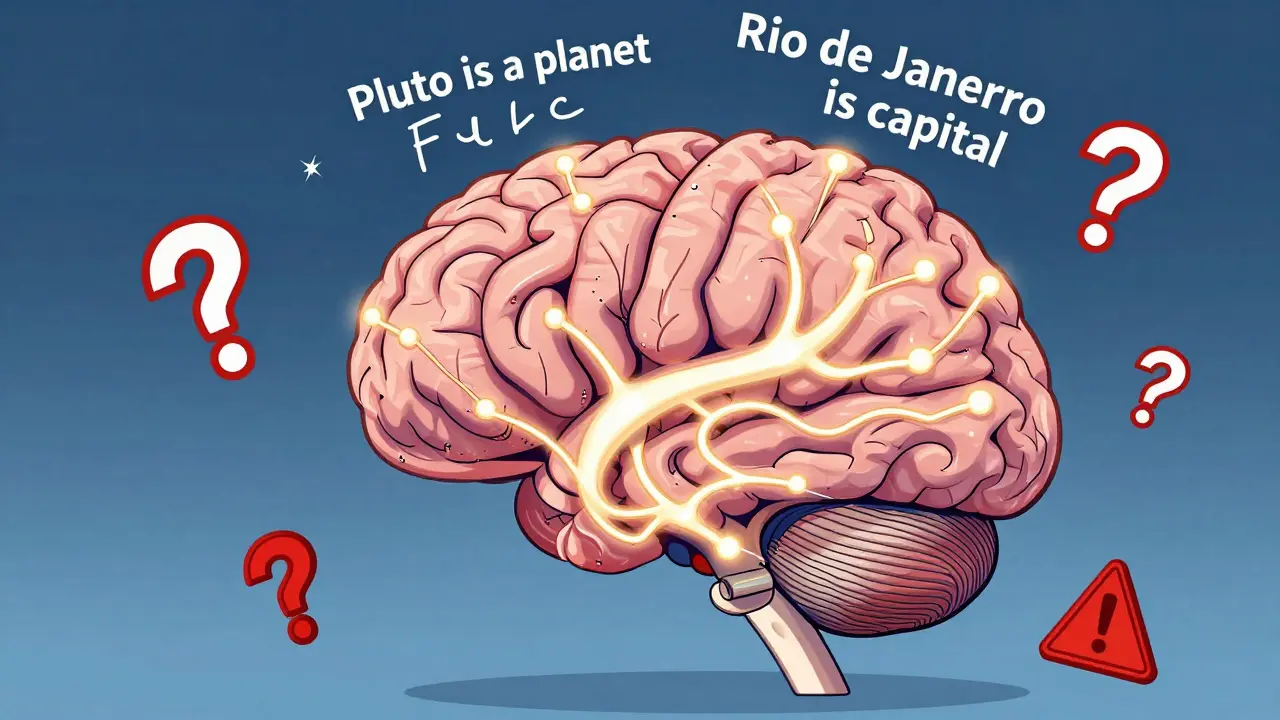
Large language models (LLMs) don’t lie because they’re deceptive. They don’t have intentions. They generate text based on patterns - and sometimes, those patterns lead to convincing lies. This is what we call hallucination: when an AI confidently spits out facts that never happened, citations that don’t exist, or data that’s completely made up. It’s not a bug. It’s a feature of how these systems work - and understanding why it happens is the first step toward using them safely.
How Probabilistic Text Generation Works
At its core, an LLM doesn’t store facts like a database. It doesn’t recall information the way a human does. Instead, it predicts the next word - or token - based on statistical patterns learned from massive amounts of text. Think of it like a supercharged autocomplete that’s seen every book, article, and forum post ever written. When you ask, "Who won the 2023 Nobel Prize in Physics?", the model doesn’t look it up. It calculates the most likely sequence of words that should follow your question based on patterns in its training data.
This process involves several layers. First, your input is broken into tokens - chunks of text like words or subwords. Then, those tokens are converted into numerical vectors through embedding layers. A transformer architecture uses self-attention mechanisms to weigh relationships between every token in the sequence. Finally, a softmax function turns all possible next-token options into probabilities. The model picks the most likely one. Rinse and repeat. Each new token depends on the last, so errors compound.
The problem? Probability ≠ truth. Just because a sentence "sounds right" doesn’t mean it’s right. If the training data contains a misleading article that repeats a false claim 10,000 times, the model learns that claim as a pattern - not as a falsehood. And when it’s time to generate a response, it doesn’t know the difference.
Why Hallucinations Happen: Three Root Causes
Research from AWS Builder Center and IBM shows that hallucinations aren’t random. They stem from three structural issues.
1. Data Quality
LLMs are trained on data scraped from the internet - forums, blogs, outdated Wikipedia pages, even deleted Reddit threads. If the training data includes a 2018 article claiming Pluto is still a planet, the model will learn that as a pattern. Even with filters, outdated, biased, or contradictory information slips through. AWS estimates 42% of hallucinations trace back to poor training data quality.
2. Training Methodology
Models are trained to maximize likelihood: predict the next token as accurately as possible. But here’s the catch - they’re not trained to say "I don’t know." In fact, systems that admit uncertainty score lower on standard benchmarks. A 2025 arXiv paper showed models gain 8-12% higher accuracy scores on tests by guessing confidently, even when wrong. This creates a perverse incentive: the model learns that making up an answer is better than staying silent.
3. Architectural Limitations
Most commercial LLMs have context windows of around 32,768 tokens. That’s a lot - but not enough for long conversations or complex documents. When context gets cut off, the model fills the gap with plausible guesses. Also, because generation is autoregressive (each new token depends on the last), a small error early on can cascade. A 2025 study found hallucinations increase by 22% for every additional 100 tokens generated. That’s why long-form responses are more likely to contain errors than short ones.

How Bad Is It? Numbers Don’t Lie
Not all models hallucinate the same way. A 2025 study in npj Digital Medicine found:
- GPT-4o: 53% hallucination rate on medical queries
- Claude 3.5 Opus: 41%
- Gemini 1.5 Pro: 47%
- Llama 3 70B: 52%
- Mistral 8x22B: 44%
- Med-PaLM 2 (medical-specialized): 29% - but jumped to 58% on general knowledge
Size doesn’t always help. Models with over 100 billion parameters reduce hallucinations by 18-22% in factual domains. But paradoxically, larger models like GPT-5’s 1.76 trillion parameter version hallucinate 33% more in creative tasks - because they’re better at generating plausible fiction.
And it gets worse in high-stakes areas:
- Legal contracts: 67% error rate in interpretation (Stanford Law Review, 2025)
- Medical diagnosis support: 53% error rate
- Financial market predictions: 49% error rate
Meanwhile, in creative writing? Only 28% error rate. Coding? 31%. That’s because users tolerate mistakes there - they’re not life-or-death.
What’s Being Done to Fix It?
It’s not all doom and gloom. Experts have identified real, working strategies.
Prompt Engineering
Simple tweaks to how you ask questions can cut hallucinations by up to 56%. Instead of "Tell me about the causes of climate change," try: "Based on peer-reviewed sources from 2020-2025, summarize the three main drivers of climate change. If no clear consensus exists, say so." Lakera.ai’s 2025 study found this approach works better than adjusting temperature settings - which only reduced hallucinations by 8%.
Retrieval-Augmented Generation (RAG)
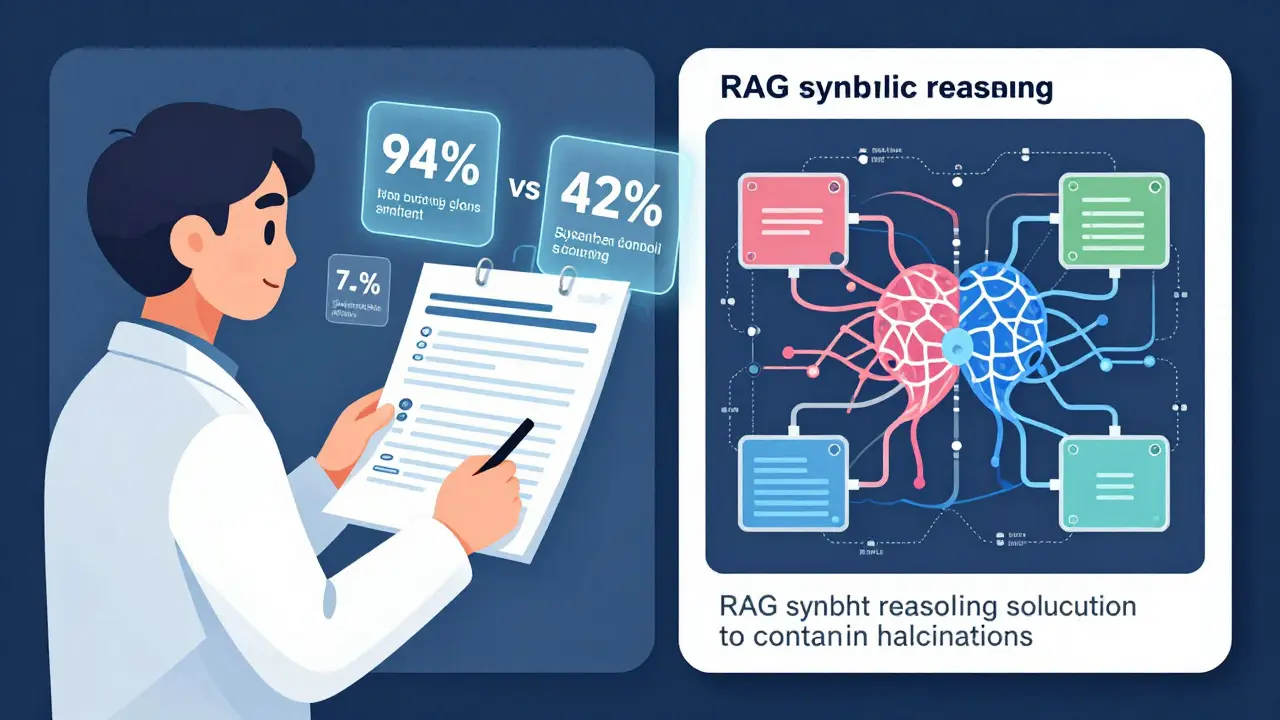
This is where you give the model a trusted knowledge base. Instead of relying on its internal memory, it pulls facts from verified documents - like company manuals, scientific papers, or internal databases. IBM clients using Watsonx with RAG saw a 44% drop in hallucinations. It’s not perfect, but it’s one of the most effective tools enterprises have.
Human-in-the-Loop Validation
No AI should make final decisions alone. When humans review outputs - especially in healthcare or legal settings - hallucination rates drop by 61-73%. This isn’t about oversight; it’s about accountability.
Confidence Scoring
Newer models like GPT-5 now include confidence ratings. Instead of just saying "The capital of Brazil is Rio de Janeiro," it might say: "Based on available data, the capital of Brazil is likely Brasília (confidence: 94%). Some sources incorrectly list Rio de Janeiro due to historical confusion." That’s a game-changer.
What’s Next? The Future of Reliable AI
There’s no silver bullet. Because hallucinations are baked into probabilistic text generation, they can’t be eliminated entirely. But they can be contained.
Google’s December 2025 update to Gemini 1.5 Pro introduced "source grounding scores" - a way to trace every claim back to a training source. If the model can’t point to a credible reference, it flags itself. That cut citation hallucinations by 34%.
DeepMind’s AlphaGeometry 2 took a different route. Instead of relying on neural networks alone, it combined them with symbolic reasoning - formal logic rules that enforce truth. On math problems, it achieved 89% accuracy with near-zero hallucinations. That’s the future: hybrid systems that know when to guess and when to calculate.
Regulations are catching up too. The EU’s AI Act now requires hallucination risk assessments for high-stakes applications. NIST’s draft guidelines set acceptable thresholds: 0.5% for medical diagnosis, 2% for legal research, 8% for creative writing. Companies that meet these standards will have a competitive edge.
And the economics are clear: AWS estimates reducing hallucinations by 30% could save enterprises $1.2 billion annually in verification costs. McKinsey found companies with strong mitigation strategies get 3.2x higher ROI on AI investments.
What You Should Do Today
If you’re using LLMs in your work, here’s what matters:
- Never trust an AI answer without verification - especially in law, medicine, or finance.
- Use RAG with trusted internal data sources whenever possible.
- Train your team to write prompts that demand sources and admit uncertainty.
- Implement human review for critical outputs.
- Monitor for "overconfidence" - if the AI sounds too sure, it’s probably wrong.
LLMs aren’t oracles. They’re pattern-matching machines. Treat them like a very smart intern - talented, fast, and occasionally wildly wrong. The key isn’t to stop using them. It’s to use them wisely.
Why do LLMs hallucinate instead of saying "I don’t know"?
LLMs are trained to maximize prediction accuracy on benchmarks, not to be honest. Models that admit uncertainty score lower on standard tests because they give incomplete answers. So the system learns that guessing confidently - even if wrong - leads to higher performance. This creates a systemic incentive to fabricate rather than abstain.
Are bigger LLMs less likely to hallucinate?
It depends. Larger models (over 100 billion parameters) reduce hallucinations by 18-22% in factual domains because they have more data to learn from. But in creative tasks - like storytelling or brainstorming - bigger models hallucinate more. They’re better at generating plausible fiction, not more accurate. Size helps with facts, not truth.
Can temperature settings reduce hallucinations?
Lowering temperature (e.g., from 0.8 to 0.2) makes outputs more predictable and reduces randomness, which can help. But studies show it only cuts hallucinations by about 8%. It’s not a reliable fix. Prompt engineering and RAG are far more effective.
Which industries are most affected by LLM hallucinations?
Legal, medical, and financial sectors face the highest risks. Legal contract interpretation has a 67% error rate, medical diagnosis support 53%, and financial predictions 49%. These areas demand precision - and hallucinations can lead to lawsuits, misdiagnoses, or financial losses. Creative fields like writing or coding have lower error rates (28-31%) because mistakes are less damaging.
What’s the most effective way to reduce hallucinations in enterprise use?
The most effective approach combines three strategies: retrieval-augmented generation (RAG) with trusted internal data, prompt engineering that demands sources and admits uncertainty, and human-in-the-loop validation. Together, these can reduce hallucinations by 70% or more. Tools like IBM’s Watsonx and Microsoft’s Arthur AI are built for this exact purpose.
Kayla Ellsworth
February 19, 2026 AT 17:59So let me get this straight - we’ve built a system that’s basically a really good parrot that’s been fed a dumpster fire of Reddit threads and Wikipedia edits, and now we’re surprised when it starts quoting fictional Nobel laureates? No one thought this through? I mean, if you ask a toaster to write a novel, you don’t get literary genius - you get burnt toast with existential dread. This isn’t AI. It’s a statistically optimized echo chamber with a confidence complex.
Soham Dhruv
February 20, 2026 AT 04:18honestly i just use llms like a supercharged google that sometimes makes stuff up but its still faster than reading 10 articles. if its wrong i double check. its not magic its a tool. like a hammer - if you hit your thumb its not the hammers fault. also i like that it sounds sure of itself even when its wrong. makes me feel like im learning even when im not 😅
Bob Buthune
February 21, 2026 AT 05:00You know what’s terrifying? It’s not that the model hallucinates - it’s that we’ve trained ourselves to *trust* its confidence. We’ve turned into people who believe anything that’s written in clean paragraphs with proper capitalization. I’ve seen lawyers cite AI-generated case law. I’ve seen doctors use it for differential diagnoses. And the worst part? The models don’t even know they’re lying. They’re not evil. They’re not deceitful. They’re just… statistically plausible. And that’s scarier than any malice. Because if you can’t tell the difference between truth and a beautifully constructed lie, then the truth doesn’t matter anymore. We’re not building AI. We’re building a new kind of religion - one where the scripture is scraped from the dark corners of the internet and the priests are softmax functions.
Jane San Miguel
February 22, 2026 AT 19:53It’s profoundly irresponsible to refer to LLMs as ‘pattern-matching machines’ without acknowledging the epistemological vacuum they occupy. The very architecture of transformer-based systems precludes semantic grounding - they operate in a Hilbert space of token correlations, utterly divorced from referential truth. To conflate ‘plausibility’ with ‘accuracy’ is not merely an error - it is a fundamental category mistake rooted in a postmodern collapse of epistemic authority. Until we reintroduce ontological grounding - not just RAG, but formal semantics - we are not developing AI. We are constructing linguistic pyramids of sand.
Kasey Drymalla
February 23, 2026 AT 06:03they let this happen on purpose. the government and big tech are using this to control the narrative. if everyone believes what the ai says then you dont need news outlets or schools anymore. just feed the ai whatever they want you to believe and boom - truth is whatever the model says. its all part of the new world order. i saw a video where a guy asked gpt if the moon landing was real and it said no. then it gave him 12 sources. all fake. they want you to stop trusting anything. even your own eyes.
Cait Sporleder
February 23, 2026 AT 22:50The structural underpinnings of probabilistic text generation reveal a deeply anthropomorphic fallacy: we project intentionality onto systems that lack not only consciousness but even the minimal ontological scaffolding required to distinguish between reference and fabrication. The model does not ‘hallucinate’ in any psychological sense - it performs a deterministic approximation of linguistic probability distributions derived from corpora saturated with misinformation, bias, and temporal decay. To label this phenomenon as ‘error’ is to misunderstand its nature - it is not a malfunction, but an inevitable consequence of training on a digital archive that mirrors humanity’s collective delusions. The real crisis is not the model’s output - it is our uncritical reliance on its syntactic elegance as a proxy for epistemic validity. Until we engineer systems capable of metacognitive self-skepticism - not merely confidence scoring, but truth-awareness - we are not mitigating hallucinations. We are merely polishing the mirrors of our own ignorance.
Jeroen Post
February 24, 2026 AT 19:19the real problem is they trained these models on reddit and wikipedia. that's why they think aliens built the pyramids and that the earth is flat. they dont know the difference between a conspiracy theory and a fact because both are written in english. also i heard the nsa is using this to generate fake news for other countries. its not a bug its a weapon. and theyre selling it to schools. next thing you know kids will think the moon landing was faked because the ai said so. we are all being gaslit by a chatbot
Nathaniel Petrovick
February 26, 2026 AT 00:47my boss made me use this ai for client emails. first time it wrote a whole contract saying our company owned the client’s house. i had to fix it. but honestly? it’s still faster than writing from scratch. i just add ‘double check this’ at the bottom now. also i tell it ‘if you’re not sure, say so’ - it works like 60% of the time. not perfect, but better than my last intern.