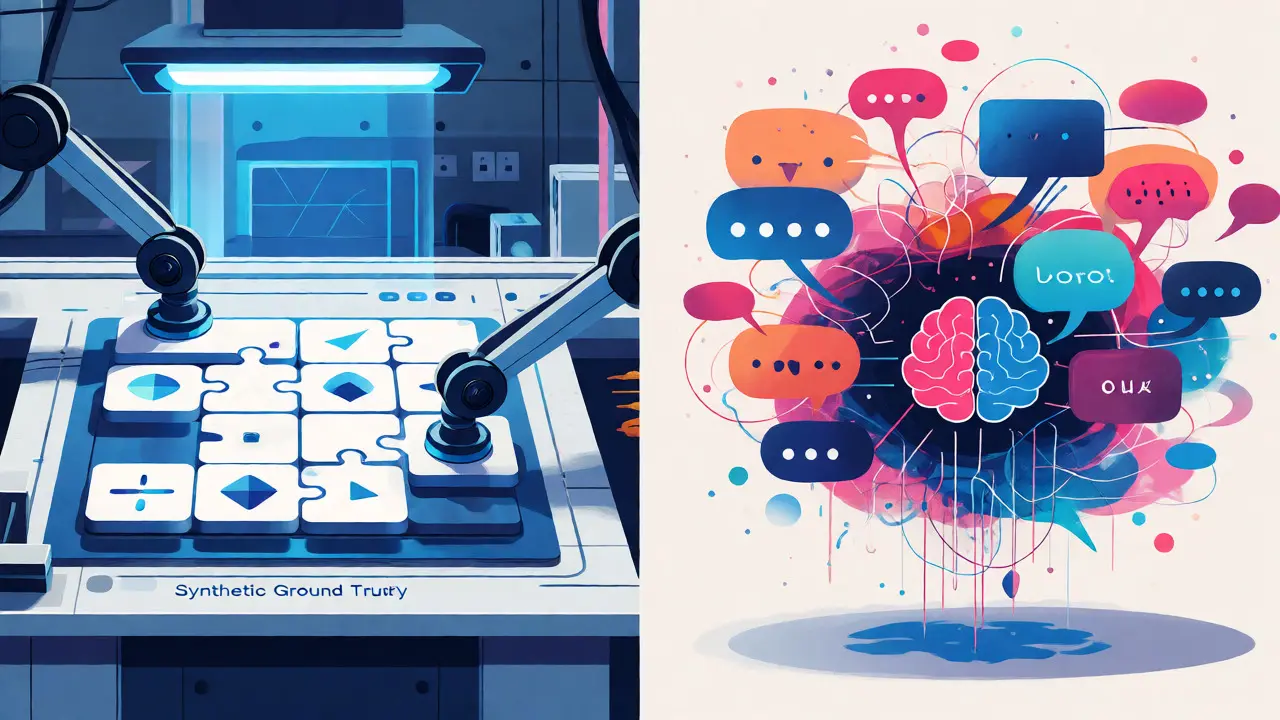
You built a Retrieval-Augmented Generation (RAG) pipeline. It works great in your Jupyter notebook. You demo it to stakeholders, they nod, and you push it to production. Then, three days later, support tickets flood in because the AI is hallucinating pricing tiers or citing outdated policy documents. This isn't a bug in your code; it's a gap in your testing strategy.
Here’s the hard truth: RAG pipelines are not just LLMs with a search box. They are complex, multi-stage systems where retrieval failures and generation errors interact in unpredictable ways. Testing them requires two distinct but complementary approaches: Synthetic Queries, which give you controlled, repeatable benchmarks, and Real Traffic, which reveals how actual humans break your system. If you only do one, you’re flying blind.
Why Standard LLM Tests Fail for RAG
If you treat a RAG system like a standard chatbot, you’ll miss critical failure modes. A standard LLM test checks if the output is coherent. A RAG test must check if the output is grounded. Did the model use the retrieved context? Did it retrieve the right documents in the first place?
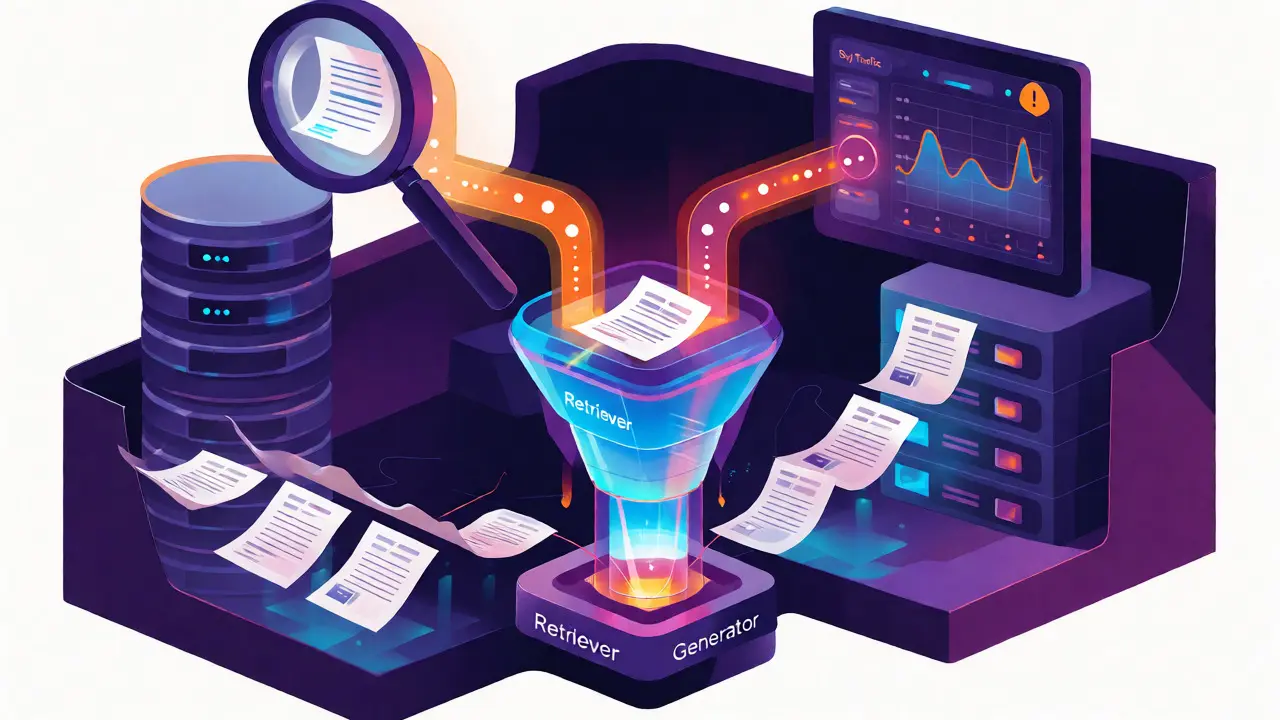
According to Neptune.ai, evaluating RAG takes 30-50% more effort than standard LLM evaluation. Why? Because you have to debug two separate engines: the retriever and the generator. If the answer is wrong, was it because the retriever found irrelevant chunks, or because the LLM ignored the relevant ones? Without specific metrics for each stage, you can’t fix the root cause.
The Power of Synthetic Queries
Synthetic queries are pre-defined questions with known ground-truth answers. Think of them as unit tests for your AI. You create a dataset-maybe using established benchmarks like MS MARCO or domain-specific sets like FiQA-and run your pipeline against it every time you change a parameter.
This approach gives you control. You know exactly what the answer should be. You can measure:
- Retrieval Metrics: Did the correct document appear in the top 5 results? (Recall@5)
- Generation Metrics: Was the answer factually consistent with the retrieved text? (Faithfulness)
Tools like Ragas have become essential here. Open-sourced in 2022, Ragas provides reference-free metrics that score your pipeline on a 0-1 scale. In production, healthy systems typically score between 0.6 and 0.9 on faithfulness and relevancy. If your scores drop below this range after a prompt tweak, you’ve introduced a regression.
But synthetic tests have a bias problem. Dr. James Zhang from MIT noted that synthetic queries underrepresent complex, multi-turn interactions by 45-60%. Humans don’t ask clean, textbook questions. They ask vague, ambiguous, or contradictory things. Synthetic data often misses this nuance.
Real Traffic: Where the Chaos Lives
Production traffic is messy. Users make typos. They paste entire paragraphs instead of asking questions. They ask about things that aren’t in your knowledge base. Real traffic monitoring captures these edge cases, but it comes with a major hurdle: no ground truth.
When a user asks, "What's our refund policy for international orders?", you don’t always have a perfect, pre-written answer to compare against. This makes automated scoring difficult. Neptune.ai reports that 72% of production RAG implementations struggle to establish reliable baselines for real queries.
To solve this, you need distributed tracing. Tools like Langfuse or Maxim AI capture every step of the request: the query, the retrieved chunks, the final response, and the latency. By logging 100% of production traffic (with minimal overhead, often <50ms), you can spot patterns. For example, a startup CTO on HackerNews shared how real traffic monitoring caught a retrieval failure affecting 12% of finance queries-a bias their synthetic tests missed entirely.
Comparing Approaches: Cost and Coverage
You might think, "Can't I just monitor everything in production?" You could, but it gets expensive. Evaluating every single trace with an LLM-as-a-judge (like using GPT-4 to score another GPT-4) costs money. Langfuse pricing data suggests full scoring costs around $15 per 1,000 queries. Batch scoring a random 10% sample drops this to $1.50, but you risk missing rare, critical failures.
| Feature | Synthetic Queries | Real Traffic |
|---|---|---|
| Ground Truth | Available (Known Answers) | Unknown (Requires Heuristics) |
| Cost | Low (Batch processing) | High (Per-query LLM judging) |
| Coverage | Controlled, Representative | Comprehensive, Unpredictable |
| Setup Effort | High (Dataset creation) | Medium (Instrumentation) |
| Detection Rate | ~60-70% of failure modes | ~100% of observed failures |
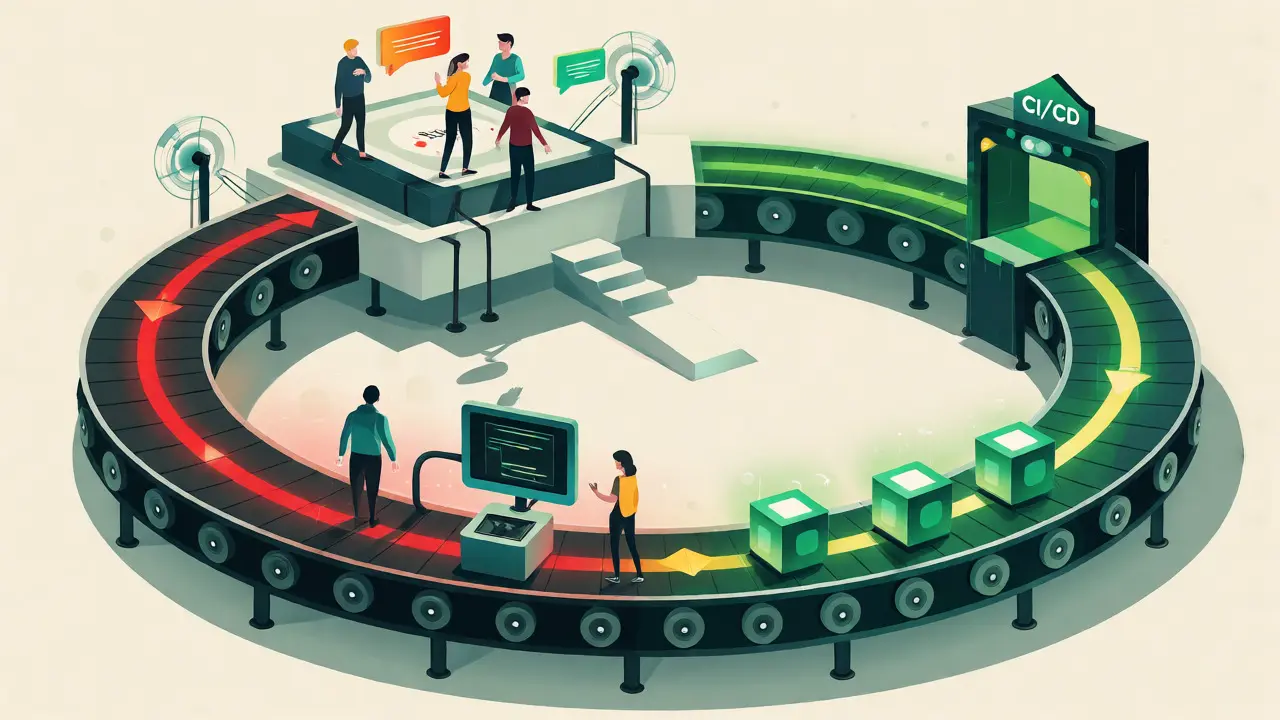
Braintrust.dev analysis shows that creating high-quality synthetic datasets consumes 40-60% of development time. But without them, you lack a safety net for deployments. The sweet spot? Use synthetic tests for CI/CD gates (preventing regressions) and real traffic for continuous health monitoring.
Building a Closed Feedback Loop
The most effective teams don’t treat these as separate silos. They connect them. Alex Chen, CTO of Maxim AI, emphasizes that top-performing systems convert production failures into synthetic test cases within 24 hours.
Here’s how that loop works:
- Monitor: Real traffic logs show a spike in low-relevancy scores for a specific query type.
- Analyze: Engineers inspect the traces and realize the retriever is failing on multi-part questions.
- Generate: They add similar multi-part questions to the synthetic dataset.
- Test: Future deployments are validated against this new, harder test set.
This dynamic approach closes the gap between what you think users ask and what they actually ask. Evidently AI notes that 63% of RAG failures happen at the interface between retrieval and generation. Tracing this interaction in real time allows you to catch these subtle breaks before they become customer complaints.
Implementation Pitfalls to Avoid
Don’t fall into these common traps:
- Ignoring Latency: Accuracy means nothing if the user waits 10 seconds for an answer. Production systems should aim for 1-5 seconds per query. Monitor p95 latency, not just averages.
- Over-relying on Faithfulness: Ragas has a reported 22% false positive rate for hallucination detection in some setups. Always pair automated scores with human review for critical domains like healthcare or finance.
- Static Thresholds: User behavior changes. Set up alerts that adjust based on historical trends rather than fixed numbers.
Also, watch out for security. Patronus.ai found that 68% of tested RAG systems were vulnerable to prompt injection. Your monitoring should include security flags, not just quality metrics.
Next Steps for Your Team
If you’re starting today, here’s a practical roadmap:
- Week 1-2: Build a small synthetic dataset (50-100 examples) covering your most common use cases. Use Ragas to establish baseline scores for Faithfulness and Answer Relevancy.
- Week 3: Integrate an observability tool like Langfuse or Vellum. Instrument your pipeline to log inputs, retrieved contexts, and outputs.
- Week 4: Enable sampling-based evaluation on production traffic. Start with 10% of queries to keep costs manageable.
- Ongoing: Review failed traces weekly. Add new synthetic test cases derived from real-world failures.
RAG evaluation isn’t a one-time task. It’s a continuous cycle of learning. As Gartner predicts, by 2026, 90% of enterprise RAG implementations will have automated evaluation pipelines. Don’t wait until you’re drowning in bad answers to start measuring.
What is the difference between synthetic and real traffic testing?
Synthetic testing uses predefined questions with known correct answers to provide controlled, repeatable benchmarks. Real traffic testing monitors actual user interactions in production, capturing unpredictable behaviors and edge cases but lacking immediate ground truth for automated scoring.
Which tools are best for RAG evaluation?
Popular open-source options include Ragas for metric calculation and TruLens for feedback functions. Commercial platforms like Langfuse, Vellum, and Maxim AI offer integrated observability, tracing, and dashboarding capabilities suitable for enterprise needs.
How much does RAG monitoring cost?
Costs vary widely. Open-source tools require engineering time (20-40 hours/month). Commercial platforms typically cost $1,500-$5,000/month. Additionally, LLM-as-a-judge evaluation adds operational costs, ranging from $1.50 to $15 per 1,000 queries depending on sampling rates and model choice.
Why do synthetic tests miss production failures?
Synthetic datasets often fail to represent the complexity, ambiguity, and noise of real human language. Research indicates they underrepresent multi-turn interactions and edge cases by 45-60%, leading to a false sense of security in controlled environments.
What metrics should I track for RAG pipelines?
Track retrieval metrics like Recall@k and Precision@k, generation metrics like Faithfulness and Answer Relevancy, and operational metrics like latency, cost per query, and error rates. Correlate these with user satisfaction signals like session duration.