Here is the hard truth about AI watermarking: it is not a silver bullet. If you are looking for a perfect, unbreakable seal that guarantees a piece of content is human-made or machine-generated, you won't find it in today's technology. Instead, what we have is a complex, evolving toolkit designed to make synthetic content traceable, detectable, and accountable. As we move through 2026, the landscape has shifted from theoretical research to messy, real-world implementation.
The core problem is simple but high-stakes. Generative AI can now create text, images, audio, and video that looks and sounds indistinguishable from reality. This capability threatens trust in everything from news reporting to legal evidence. To fight back, the industry developed two main approaches: embedding invisible signals directly into the data (watermarking) and attaching cryptographic proof of origin (provenance metadata). Both have strengths, but both also have glaring weaknesses.
How AI Watermarking Actually Works
At its simplest, AI content watermarking is the practice of embedding imperceptible but algorithmically detectable signals into generative AI outputs so they can later be identified as synthetic. Think of it like a digital fingerprint that only a specific scanner can read. It doesn't change how the image looks to your eye or how the text reads to your brain, but it changes the underlying math just enough to leave a trail.
Technically, this involves a pair of algorithms sharing a secret key. The first algorithm, the embedder, modifies the output during generation. The second, the detector, scans the final product to see if that specific pattern exists. The goal is to balance three competing needs:
- Quality: The watermark must not degrade the output. In blind tests, humans should not be able to tell the difference between watermarked and non-watermarked content.
- Detectability: The statistical test must reliably separate watermarked content from natural content with high true-positive rates (often >95%) and very low false-positive rates (e.g., <0.1%).
- Robustness: The signal must survive common transformations like cropping, compression, paraphrasing, or re-encoding.
This balance is tricky. Make the watermark too strong, and it ruins the quality. Make it too weak, and it breaks when someone saves the file as a JPEG or runs the text through a summarizer.
Text Watermarking: The Statistical Game
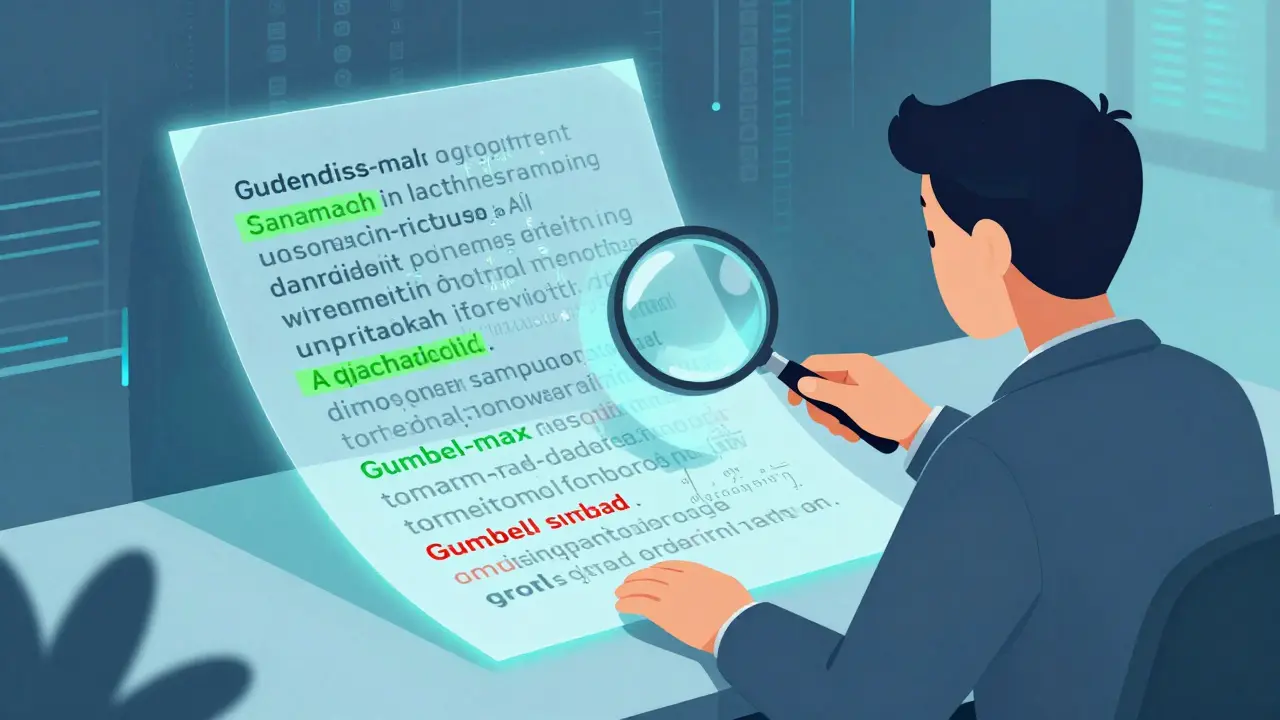
For large language models (LLMs), watermarking works by manipulating how the model chooses words. One of the most cited methods, pioneered by Scott Aaronson at OpenAI around 2022, uses a technique called Gumbel-max sampling. Essentially, the model generates a probability distribution for the next word, but then adds a tiny, keyed bias. Another popular approach, introduced by Kirchenbauer et al. in 2023, splits the vocabulary into "green" and "red" lists based on a secret key. The model is biased to pick words from the green list more often than chance would allow.
Detection is purely statistical. A detector counts how many "green" words appear in a passage. If the number is statistically unlikely for random human writing, it flags the text as AI-generated. For long texts (800-1000 tokens), these methods can achieve detection accuracy exceeding 99%.
However, text watermarking has major limitations. It relies heavily on length. Short tweets or brief prompts don't provide enough data points for the statistics to work, leading to unreliable results. More critically, it is fragile against editing. If a user copies a watermarked paragraph and asks another LLM to "rewrite this," the new version loses the original statistical pattern. Research from 2023 showed that automated paraphrasing could reduce detection accuracy close to chance levels for some schemes. Because of these robustness issues, OpenAI ultimately decided not to deploy their initial text watermark in ChatGPT for public use.
Image Watermarking: Holographic Signals
Images present different challenges. Traditional digital watermarks date back to the 1990s, using techniques like Discrete Cosine Transform (DCT) to hide signals in frequency domains. But generative AI requires something smarter. Google DeepMind’s SynthID is a post-hoc neural encoder/decoder system that embeds multi-bit watermarks into images generated by models like Imagen.
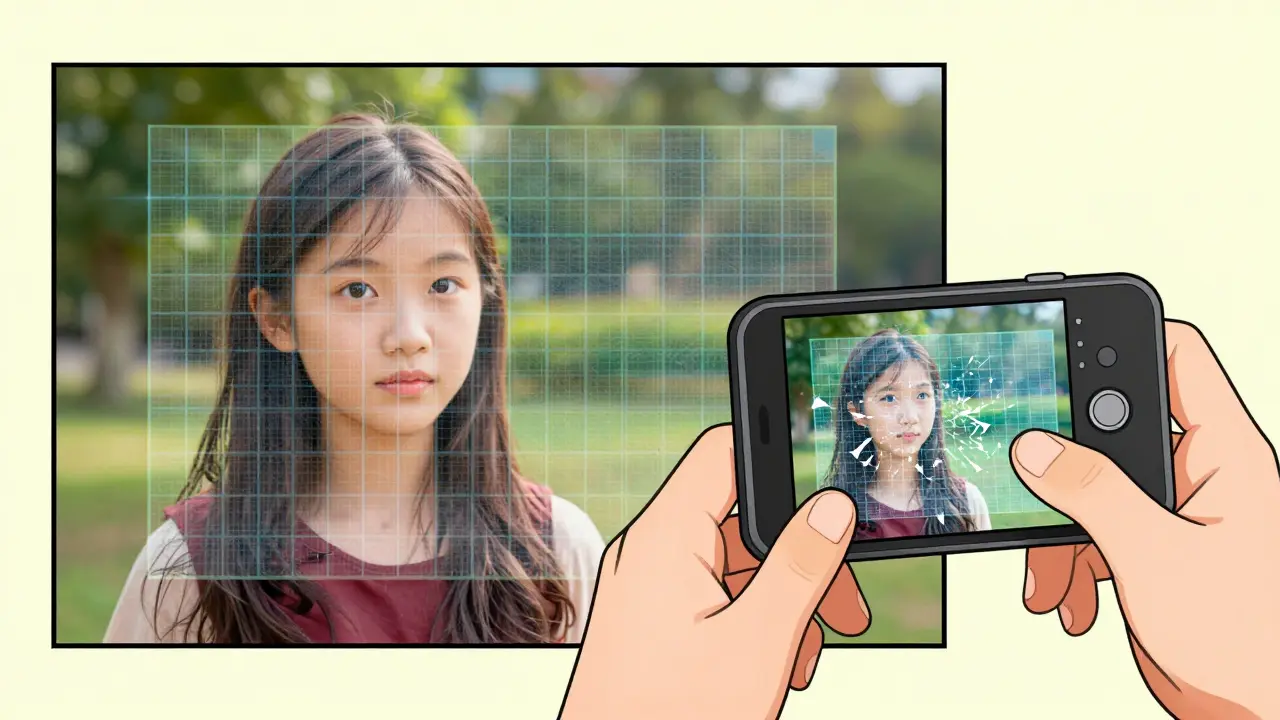
SynthID is described as "holographic." This means the information is distributed across the entire image rather than concentrated in one spot. Even if you crop out 50% of the picture, the remaining pixels still contain enough signal for the decoder to identify the source. DeepMind reported high detection reliability (>90% true positive rate) under common transformations like resizing and JPEG compression.
Another approach is model-integrated watermarking, such as Stable Signature. This method fine-tunes the Variational Autoencoder (VAE) decoder of latent diffusion models (like Stable Diffusion) to ensure every decoded image contains a fixed binary signature. While effective in controlled environments, these watermarks can still be degraded by heavy editing pipelines, such as exporting an image to social media platforms that aggressively re-compress and resize files.
| Approach | Best For | Key Strength | Major Weakness |
|---|---|---|---|
| Statistical Text Watermarking | Long-form LLM output | High accuracy on unedited text | Fails after paraphrasing or shortening |
| Holographic Image Watermarking (e.g., SynthID) | Generated images | Survives cropping and compression | Vulnerable to analog capture (screenshots) |
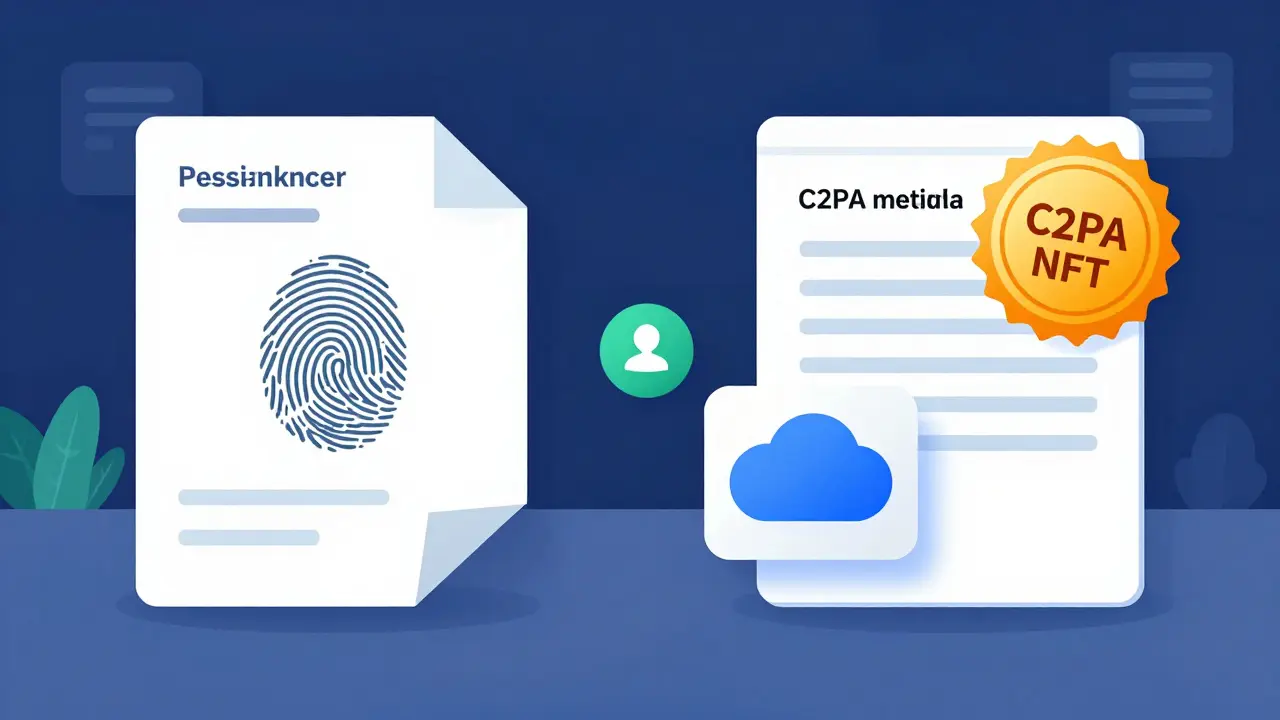
| C2PA Metadata | Professional workflows | Cryptographically verifiable provenance | Easily stripped by saving/exporting |
The Role of Provenance Metadata (C2PA)
Watermarking isn't the only tool in the box. Often, it is discussed alongside C2PA is a technical specification for cryptographically signed provenance assertions attached as metadata to images, video, and other assets. Developed by the Coalition for Content Provenance and Authenticity (including Adobe, Microsoft, Intel, and others), C2PA creates a digital chain of custody. Instead of altering pixels, it attaches a signed JSON file to the image container (like XMP in a JPEG).
Adobe’s Content Credentials, used in Photoshop and Firefly, rely on this standard. It tells you exactly which software created or edited the file and when. The advantage? Cryptographic verification can have effectively 0% false positives. If the signature is valid, the history is authentic. The disadvantage? It is brittle. If you take a screenshot of an image, or save it via WhatsApp, the metadata is often stripped away. Watermarking survives these actions; metadata does not. That is why experts recommend using both.
Limitations and Attacks: Why It Isn't Perfect
We need to be realistic about what these tools cannot do. There are several fundamental gaps that adversaries exploit.
The Analog Hole: Once content leaves the digital realm-displayed on a screen or played through a speaker-it can be captured by a camera or microphone. A smartphone photo of a TV screen showing a deepfake video will likely destroy any embedded watermark while preserving the visual content perfectly. This remains the biggest vulnerability for all modalities.
Model Proliferation: Open-source models like Stable Diffusion or LLaMA can be run locally without any watermarks. Therefore, the absence of a watermark does not prove content is human-made. It only proves it wasn't made by a provider who implemented that specific watermark. Conversely, the presence of a watermark confirms it came from a specific source, but doesn't guarantee it hasn't been manipulated since.
Collusion and Mixing: If an attacker combines watermarked content with non-watermarked content, or mixes outputs from multiple models, detection becomes ambiguous. Detectors may return scores that fall into a gray area, making it difficult to draw a clear line.
Privacy Concerns: Multi-bit watermarks can encode user IDs or timestamps. While useful for tracing abuse, this raises significant privacy questions. Could this be used to track individuals' AI usage across platforms? Regulators like the EU are aware of this. Article 50 of the EU AI Act requires AI-generated content to be marked in a machine-readable format, but explicitly states that methods must respect fundamental rights, avoiding unjustified surveillance.
Regulatory Landscape and Industry Status
As of 2026, the regulatory pressure is mounting. The EU AI Act, fully adopted in 2024, mandates transparency for generative AI systems. Providers must ensure outputs are marked as artificially generated. In the United States, the 2023 Executive Order on Safe, Secure, and Trustworthy AI directed agencies like NIST to develop guidance for authenticating digital content, though concrete technical requirements remain voluntary for most companies.
Industry adoption is mixed. Google has integrated SynthID into Vertex AI offerings. Meta announced that images from its tools include invisible watermarks and support C2PA standards. However, many smaller providers lack the resources to implement robust watermarking systems. Meanwhile, heuristic AI detectors (classifiers that guess if content is AI based on patterns) have largely fallen out of favor due to high false-positive rates, particularly when misclassifying non-native English writing or creative styles as AI-generated.
Practical Advice for Users and Organizations
If you are building with AI or consuming AI content, here is how to navigate this imperfect world:
- Treat Watermarks as Probabilistic Signals: Do not treat a watermark detection score as definitive proof. Use it as one piece of evidence alongside context and other checks.
- Combine Tools: Rely on a portfolio of authenticity measures. Use C2PA metadata where available for provenance, and look for watermarks for synthetic detection. Neither is sufficient alone.
- Be Aware of False Positives: Especially in text, short samples can trigger false alarms. Always verify suspicious detections with manual review or additional context.
- Protect Your Own Content: If you generate AI content for commercial use, consider implementing C2PA metadata to establish ownership and provenance, even if you aren't worried about detection.
- Stay Updated: The technology evolves rapidly. What was robust in 2024 might be bypassed in 2026. Keep an eye on updates from standards bodies like C2PA and ITU.
Watermarking is a critical step toward responsible AI, but it is not a finish line. It is a tool for accountability, not a magic shield against misinformation. By understanding its methods and limitations, we can use it wisely without over-relying on it.
Can AI watermarks be removed easily?
It depends on the modality and the attack. For text, paraphrasing or rewriting can often remove statistical watermarks. For images, basic compression usually preserves holographic watermarks like SynthID, but heavy editing, re-generation through another model, or analog capture (taking a photo of the screen) can destroy them. No current watermark is completely unremovable by a determined adversary.
What is the difference between AI watermarking and C2PA metadata?
Watermarking embeds a signal directly into the content pixels or text structure, allowing it to survive metadata stripping but potentially degrading under heavy editing. C2PA metadata attaches a cryptographic signature to the file's header, providing strong proof of origin and edit history, but this data is easily lost if the file is saved as a screenshot or shared via messaging apps.
Is AI watermarking required by law?
In the European Union, yes. The EU AI Act (Article 50) requires providers of certain generative AI systems to mark outputs in a machine-readable format. In the US, there are no federal laws mandating specific watermarking technologies yet, though executive orders encourage voluntary compliance and development of standards.
Why did OpenAI stop using text watermarks in ChatGPT?
OpenAI experimented with text watermarking in 2022-2023 but found that the robustness was insufficient for high-stakes use. Paraphrasing and editing could easily defeat the detection, leading to a false sense of security. They focused instead on other safety measures and detection tools, which also faced accuracy challenges.
Can I detect if an image is AI-generated without a watermark?
Not reliably. Heuristic AI detectors that claim to identify AI images without watermarks have high false-positive rates and often struggle with diverse artistic styles or non-native languages. Without a specific watermark or provenance metadata, distinguishing high-quality synthetic media from human-created content is increasingly difficult for automated tools.
Amanda Ablan
May 21, 2026 AT 11:45It's actually pretty wild how we went from thinking watermarks were just for copyright to realizing they're our only line of defense against total epistemological collapse. I've been testing some of the new C2PA implementations and honestly, the friction is real but necessary. We can't just rely on detection algorithms because adversarial attacks will always outpace them. The key is making the provenance chain unbreakable at the source rather than trying to scan everything downstream. It feels like we are building a digital immune system that has to evolve faster than the virus.
Yashwanth Gouravajjula
May 22, 2026 AT 14:51In India we see this daily with deepfake scams targeting families. Technology must serve society not destroy trust.
Kendall Storey
May 22, 2026 AT 22:43Dude, you nailed it with the immune system analogy. Most people don't realize that watermarking is basically steganography on steroids. The embedder tweaks the latent space vectors during diffusion so subtly that human eyes miss it, but the detector sees a statistical anomaly in the noise distribution. It’s not magic, it’s just high-dimensional math doing heavy lifting while we argue about ethics. Keep pushing for open standards though, proprietary watermarks are a dead end.
Meredith Howard
May 23, 2026 AT 16:55i find the reliance on cryptographic metadata fascinating yet deeply flawed in practice because most users simply delete headers or copy paste content which strips the signature entirely. the technical elegance does not survive contact with the messy reality of social media sharing habits where context is lost instantly
Richard H
May 24, 2026 AT 06:49This whole industry is a scam designed to keep us dependent on big tech solutions. They create the problem and sell the cure. Real Americans know that truth doesn't need a digital seal. We used to have honor and integrity before these silicon valley grifters started messing with our heads. Now they want to tax our thoughts and label our creativity as 'synthetic' if it doesn't come from their approved list of generators. It's authoritarianism disguised as security. We should be banning these tools entirely instead of putting band-aids on bullet holes. Our sovereignty is being eroded by code written by people who have never worked a day in their lives.
Janiss McCamish
May 24, 2026 AT 19:28Richard, your anger is misplaced. The technology isn't the enemy, the lack of regulation is. Watermarking is a tool, not a ideology. Stop crying about sovereignty and look at the data. False positives are dropping.
Dylan Rodriquez
May 26, 2026 AT 12:57There is a profound philosophical shift happening here that we often overlook in the technical debates. By embedding a 'truth' signal into the content itself, we are essentially arguing that authenticity is an intrinsic property of the data rather than a contextual interpretation by the viewer. This moves us away from postmodern relativism towards a deterministic view of information. If we accept that AI content is inherently different because of its generative process, then the watermark becomes a moral marker, not just a technical one. It forces us to confront what we value about human creation. Is it the effort? The intent? Or the biological origin? The watermark says 'this was not born of a mind,' which carries a weight that goes beyond simple detection. We are redefining the soul of art through algorithmic fingerprints.
Ashton Strong
May 27, 2026 AT 17:55I appreciate the nuanced perspective provided here. It is encouraging to see such thoughtful analysis on a topic that is often reduced to soundbites. The distinction between watermarking and provenance is crucial for future policy discussions. Let us continue to support initiatives that promote transparency and accountability in AI development. Together, we can build a more trustworthy digital ecosystem.