
Imagine building a fully working internal tool in under two hours-no prior coding experience needed. That’s not science fiction anymore. It’s vibe coding, and it’s changing how teams build software. Instead of writing line after line of code, you describe what you want in plain language: "Create a form that collects employee feedback and sends it to HR with a dashboard showing trends." The AI does the rest. No syntax errors. No debugging nightmares. Just results.
But here’s the catch: vibe coding isn’t magic. It’s a tool. And like any tool, it works best when you use it the right way. Jumping straight into company-wide rollout without a plan? That’s how you end up with a mess of AI-generated scripts no one can maintain. The real win comes from starting small, learning fast, and scaling smart.
What Vibe Coding Actually Does (And Doesn’t Do)
Vibe coding isn’t about replacing developers. It’s about removing the friction between ideas and working software. Platforms like Google’s Vibe Code, Replit’s AI assistant, and Knack’s low-code builder let non-programmers turn natural language into functional apps. According to Replit’s 2024 data, teams using vibe coding build prototypes 5.8 times faster than traditional methods. Tanium’s case study showed a 68% drop in prototyping time-for simple tools, that means going from 40 hours down to under 2.
But it’s not perfect. Vibe coding hits 95% accuracy on basic CRUD apps-think forms, dashboards, data entry tools. That’s great for HR onboarding portals or marketing campaign trackers. But when you need complex algorithms, real-time data processing, or tight security controls? Accuracy drops to 65%. That’s why IBM warns: without proper oversight, vibe coding can create a maintenance nightmare.
Users love it. On G2 Crowd, 89% of reviewers say it slashed their time to prototype. One Reddit user built a client portal in 3 hours that would’ve taken 2 weeks. But complaints are real too. Forty-two percent of negative reviews mention debugging headaches. Thirty-one percent report "hallucinated" features-code that looks right but does the wrong thing. The AI doesn’t understand context like a human. If your prompt is vague, the output will be too.
Why Pilot Projects Are Non-Negotiable
Most companies that fail with vibe coding skip the pilot phase. They see a demo, get excited, and tell their entire marketing team to start building apps. That’s how you end up with ten different versions of the same form, all written differently, scattered across Slack and Google Drive.
A successful pilot has three rules:
- Start with a single, well-defined problem. Pick something repetitive, low-risk, and high-friction. Example: "Automate the weekly sales report that takes Sarah 4 hours every Monday."
- Use a cross-functional team. Include the person who does the task, a manager who cares about the outcome, and one developer who can help with refinement. This isn’t just about tech-it’s about workflow.
- Set clear success metrics. Not "we built an app." But: "Reduced report generation time from 4 hours to 15 minutes, with zero manual corrections needed."
Deloitte’s 2024 survey found that 78% of enterprises start with departmental pilots-usually in HR, marketing, or operations. That’s not an accident. These teams have clear, repetitive tasks. They’re also less likely to break critical systems if things go wrong.
The Iterative Refinement Process
Vibe coding doesn’t work with a "type it and forget it" mindset. Google Cloud calls it a "low-level iterative loop." Think of it like writing an email draft-you don’t send the first version. You tweak it. Same here.
Here’s how it works in practice:
- Start with a clear prompt. Instead of "Make a dashboard," say: "Create a dashboard showing monthly customer support tickets by category, with a filter for priority level and export to CSV."
- Generate the first version. The AI gives you code-maybe it’s messy, maybe it’s missing a filter.
- Refine with feedback. Say: "The chart doesn’t show the top 5 categories. Fix that." Or: "Add a date range picker."
- Test with real users. Give it to the person who uses the old version. Watch them use it. Where do they get stuck?
- Repeat until it’s solid.
Dr. Sarah Chen from MIT says this human-AI collaboration is the key. "It’s not about the AI writing perfect code. It’s about the human guiding it to understand the real need."
Replit’s 2024 update added something called a "vibe score"-a metric that rates code quality based on structure, clarity, and completeness. It’s not perfect, but it helps teams know when to stop refining.
Scaling Up Without Losing Control
Once your pilot works, you’ll want to roll it out. But scaling too fast is the #1 reason vibe coding initiatives fail.
Wasp’s 2024 research found that teams who succeed at scale use something called "vertical slicing." Instead of building all the front-end first, then the backend, then the database-you build one small feature end-to-end. Example: "Let users upload a receipt and auto-fill an expense form." You build the UI, the upload logic, the form filling, and the database save-all in one go. Then you repeat for the next feature.
Why does this matter? Because vibe coding works best when context stays tight. If you try to build a whole app in one prompt, the AI loses track. But if you build one small piece at a time, you keep quality high.
Documentation becomes critical too. Google’s 2024 guide says: "Don’t assume the AI will remember what it built last week." Use AI to help write docs. Ask: "Summarize how this form works in plain language for non-tech staff." Save it in your team’s wiki.
Training Your Team
You don’t need to train everyone to be developers. But you do need to train them to be effective partners with AI.
Business analysts and managers: 8-10 hours of training is enough. Focus on prompt writing: how to be specific, how to ask for constraints, how to describe data flow. IBM found that after a short session, non-tech users could build working prototypes in under 15 minutes.
Developers: They need 20-30 hours. Not to learn to code-but to learn to guide AI. This means mastering prompt engineering, reviewing generated code for logic errors, and setting up testing pipelines. A developer’s new job isn’t writing code. It’s auditing it.
One team at a financial services firm started with a 2-hour workshop. After three weeks, their operations team built their own expense approval workflow. The developer’s role? Just reviewing the final version and adding security checks.
Where Vibe Coding Falls Short (And What to Do About It)
Not every app should be built with vibe coding. Here’s when to say no:
- Security-critical systems: Banking, healthcare, or compliance tools. The AI doesn’t understand regulatory nuances. Use traditional development here.
- Legacy system integrations: If you’re connecting to a 20-year-old ERP system, vibe coding won’t handle the quirks.
- High-performance apps: Real-time trading platforms, video processing, or large-scale data pipelines need hand-tuned code.
Instead of forcing vibe coding everywhere, use it as a force multiplier. Let your team build internal tools, dashboards, and automation scripts with it. Let your developers focus on the hard stuff: security, scalability, integration.
Forrester predicts that by 2027, 80% of professional developers will use vibe coding for 30-50% of their work-mostly for boilerplate code and prototypes. That’s the sweet spot.
Governance: The Silent Success Factor
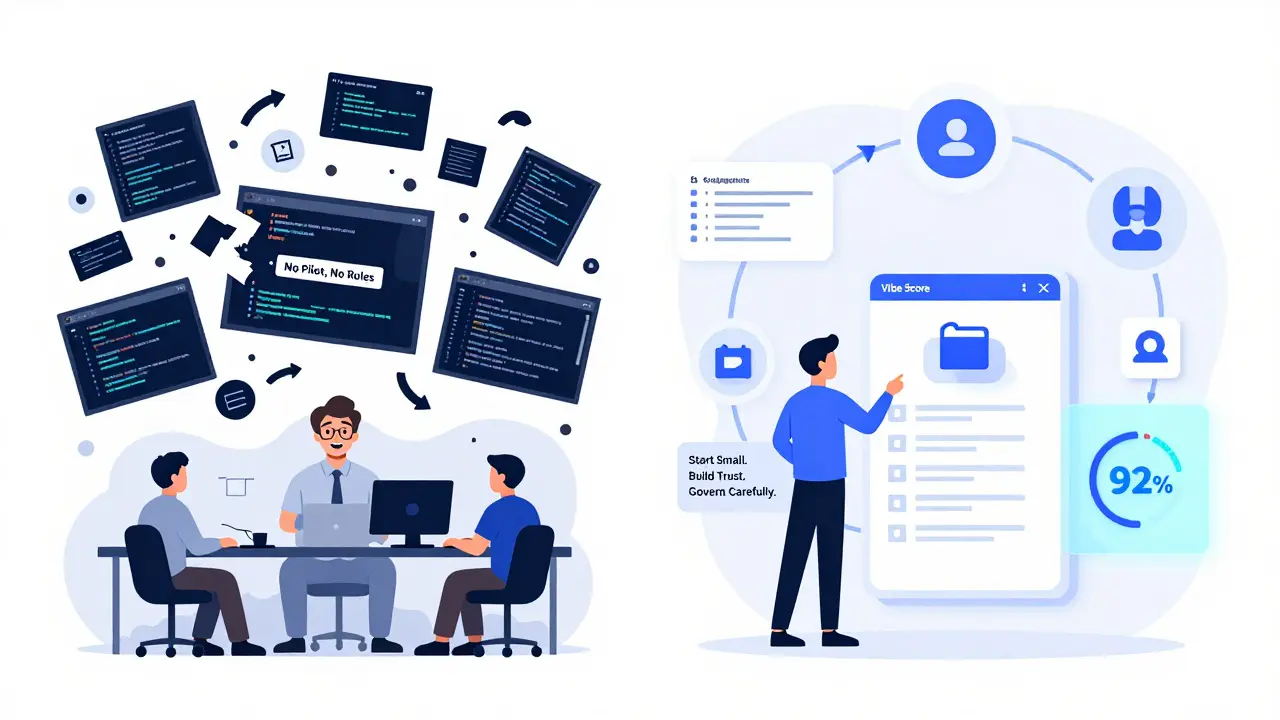
The biggest threat to vibe coding isn’t the tech. It’s chaos.
Without rules, you get:
- Twenty different versions of the same report
- Code nobody understands
- Security holes from unreviewed AI output
IBM’s 2024 "vibe coding compliance toolkit" is a step in the right direction. It includes templates for:
- Approval workflows for AI-generated apps
- Code review checklists
- Documentation standards
- Retention policies for AI-built tools
Start simple. Require every vibe-coded app to be reviewed by a developer before going live. Log every prompt and output in a shared folder. Assign an owner for each tool. These aren’t heavy processes. They’re guardrails.
The EU’s 2024 AI Act requires human oversight for AI-generated code in critical systems. Even if you’re not in Europe, this is a sign of what’s coming. Start preparing now.
The Roadmap: From Pilot to Rollout
Here’s the real plan, step by step:
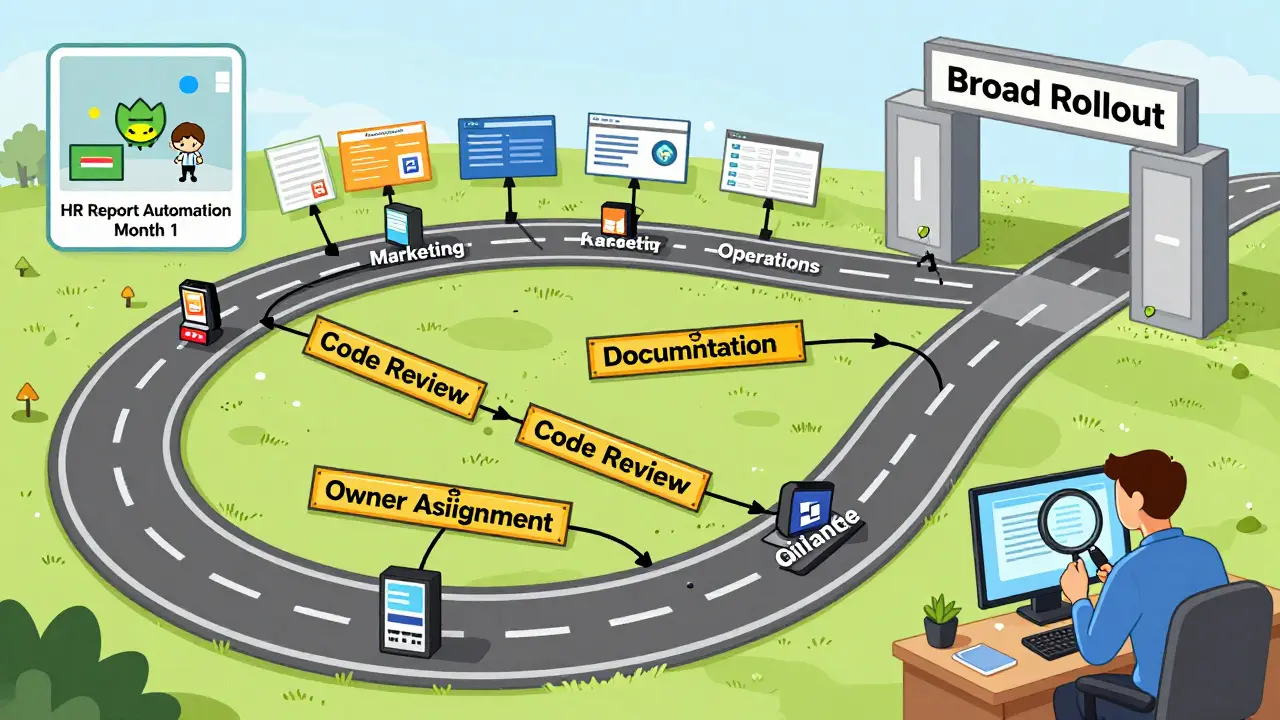
- Month 1-2: Pilot-Pick one team, one problem. Build, test, refine. Measure time saved.
- Month 3: Document & Share-Write a one-page case study. Show the before and after. Share it company-wide.
- Month 4-5: Train & Expand-Run 2-hour workshops for 3-5 departments. Start with HR, marketing, operations.
- Month 6-8: Set Guardrails-Launch your basic governance rules: review checklist, owner assignment, documentation standard.
- Month 9-12: Scale Vertically-Help teams build end-to-end features, not just pieces. Encourage vertical slicing.
- Month 13+: Broad Rollout-Now you have a system, not a trend. Support is built in. Governance is in place. Adoption grows organically.
Companies that follow this path see 45% cross-functional adoption within a year. Those that skip steps? Only 22% make it to full rollout.
What’s Next
Vibe coding isn’t going away. Gartner predicts 65% of app development will be low-code or no-code by 2026. The market for citizen development tools is on track to hit $32.6 billion by 2027.
But the winners won’t be the ones who adopt the tech fastest. They’ll be the ones who adopt it smartest.
Start small. Build trust. Document everything. Govern carefully. Let your team create-not just consume. That’s how you turn a buzzword into real value.
Is vibe coding the same as low-code or no-code platforms?
No. Low-code and no-code tools rely on drag-and-drop interfaces and pre-built components. Vibe coding uses natural language prompts to generate actual code. It’s more flexible-you’re not limited by what’s in the toolbox. But it also requires more oversight, because the output isn’t always predictable.
Can non-technical people really build production apps with vibe coding?
They can build functional prototypes and internal tools quickly-yes. But "production-grade" apps? Not without developer oversight. AI-generated code often lacks security checks, error handling, and scalability. The best approach is for non-technical users to create the initial version, then hand it off to a developer for hardening.
What’s the biggest mistake companies make when starting with vibe coding?
Skipping the pilot and going straight to company-wide rollout. Without testing on a small scale, you don’t learn how your team interacts with the tool. You also miss the chance to build internal support and create best practices before things get messy.
Does vibe coding reduce the need for developers?
No-it changes their role. Developers shift from writing code to reviewing, refining, and securing AI-generated code. They become quality gatekeepers and mentors. This frees them up to focus on complex problems that AI can’t solve, like system architecture, security, and integration.
How do I measure success with vibe coding?
Track time saved, number of apps built, and reduction in manual work. But also track quality: how many apps needed major fixes after launch? How many were abandoned? A good metric: 80% of vibe-coded apps should be used regularly after 90 days. If they’re not, the problem isn’t the tool-it’s the process.
Is vibe coding secure?
It can be-but only if you make it secure. AI doesn’t know your compliance rules. Always review generated code for data handling, API keys, and access controls. Never let AI-generated code touch sensitive systems without a human audit. Treat it like any third-party code: verify, test, restrict.
kelvin kind
December 24, 2025 AT 02:54Been using vibe coding for internal HR forms for months. Made a leave request tool in 45 minutes. No one died. No one cried. Just got work done.
Ian Cassidy
December 25, 2025 AT 00:48Let’s be real - vibe coding is just low-code with a fancy name and AI sprinkles. The real win isn’t the tool, it’s the cultural shift. Non-devs finally feel empowered to solve their own problems instead of waiting for IT. But yeah, the hallucinations? Still wild.
Zach Beggs
December 26, 2025 AT 15:10My team tried this last quarter. We built a vendor invoice tracker. It worked. Then Sarah from accounting tweaked it and now it sends emails to her cat. We’re fixing it. But honestly? Worth it.
Kenny Stockman
December 28, 2025 AT 00:37Biggest thing I’ve learned? Don’t treat the AI like a magic wand. It’s more like a really enthusiastic intern who doesn’t know when to stop. Give it clear boundaries, check its work, and celebrate the wins. We cut our reporting time by 70%. No drama. Just results.
Antonio Hunter
December 29, 2025 AT 22:03I’ve watched this trend evolve over the last year. What’s interesting isn’t the tech - it’s how it’s reshaping roles. Developers aren’t being replaced; they’re being elevated. Instead of writing boilerplate, they’re doing quality assurance, mentoring, and designing guardrails. That’s actually a better use of their time. The real challenge? Getting management to see it as a process, not a product.
Paritosh Bhagat
December 30, 2025 AT 03:49Oh wow, another ‘AI will save us’ fairy tale. Let me guess - you didn’t mention the fact that 60% of these ‘vibe-coded’ apps get abandoned after 30 days because they’re full of security holes and undocumented spaghetti logic? And now your CFO thinks you’re a genius because you ‘automated’ something that should’ve been a simple spreadsheet. I’ve seen this movie before. It ends with a $200k audit fine and a team that now hates tech.
Ben De Keersmaecker
December 30, 2025 AT 15:24Interesting how the term ‘vibe coding’ implies emotional intuition over logic - almost poetic. But the real innovation here isn’t the AI; it’s the democratization of problem-solving. Non-technical users are no longer passive consumers of software. They’re co-creators. That shift in power dynamics is what’ll define the next decade of enterprise tech. And yes, governance is non-negotiable. If you skip documentation, you’re not building tools - you’re building landmines.
Ananya Sharma
January 1, 2026 AT 12:41Let’s not pretend this is revolutionary. This is just Microsoft Access with a ChatGPT skin. You think you’re saving time? You’re just creating a new class of technical debt that’ll haunt your successors for years. And let’s talk about the ‘vibe score’ - a metric invented by someone who clearly never had to debug a 500-line AI-generated script that crashes when someone types a comma. This isn’t progress. It’s a corporate placebo wrapped in buzzwords and marketed to execs who don’t know SQL from a sandwich.
Sarah McWhirter
January 2, 2026 AT 06:02So… if AI writes the code, and I just say ‘make it better,’ does that mean I’m the new programmer? Or just the emotional support human for a machine that hallucinates tax forms? I’m not mad. I’m just… confused. Also, my boss thinks I’m a genius now. I didn’t even write a line. I just said ‘add a button’ five times. 🤷♀️
Aaron Elliott
January 2, 2026 AT 06:14While the superficial utility of this paradigm may appear nontrivial, a rigorous epistemological examination reveals a fundamental epistemic vulnerability: the delegation of cognitive labor to an opaque, non-intentional agent. The ontological status of AI-generated artifacts remains ungrounded in syntactic rigor, and their proliferation constitutes an emergent form of institutional epistemic corruption. One must ask: if the artifact is not authored, can it be owned? If it is not understood, can it be maintained? The answer, logically, is no. This is not innovation. It is the commodification of ignorance.