
Imagine building a tool that helps doctors track patient symptoms, predict treatment outcomes, or manage clinical trials - without ever touching a single real patient record. That’s not science fiction. It’s vibe coding, and it’s changing how healthcare innovation happens.
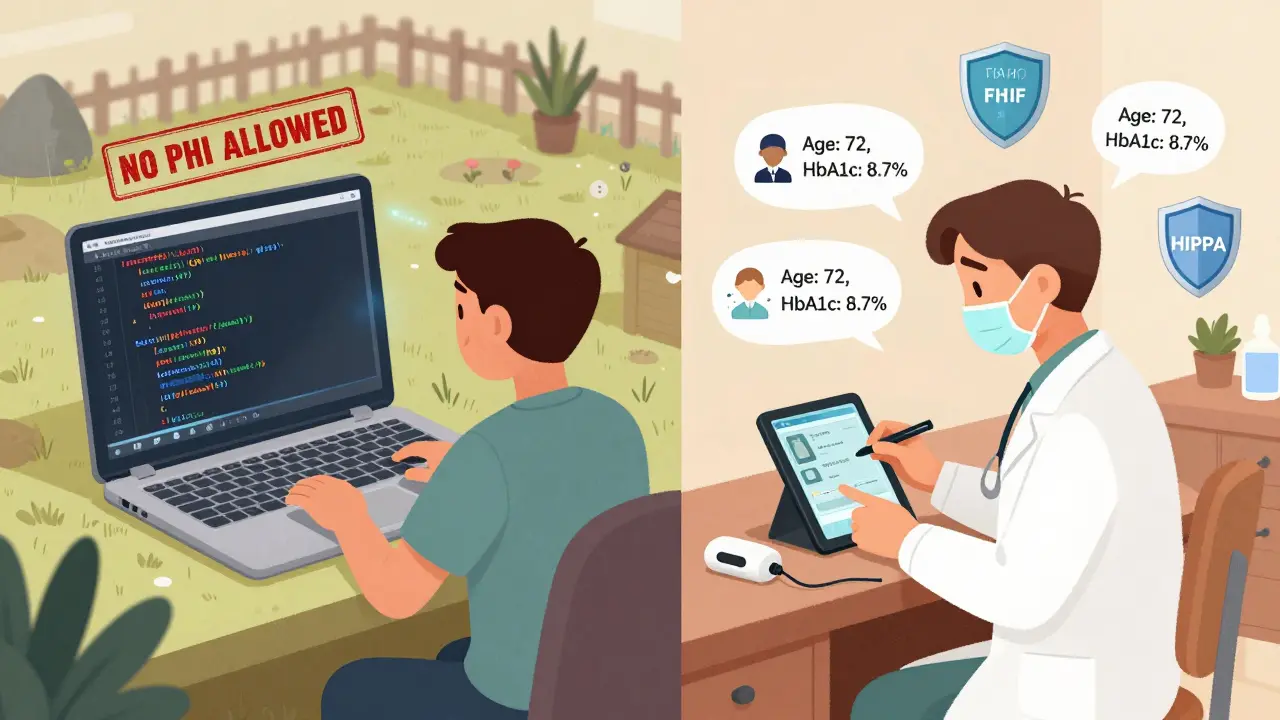
Before vibe coding, building even a simple health app meant navigating layers of compliance, data anonymization, and legal reviews. You needed a bioinformatician, a HIPAA officer, and weeks of back-and-forth just to get started. Now, a nurse, a researcher, or a clinic administrator can describe what they need in plain English - like "find patients with high blood pressure who didn’t respond to medication A" - and an AI generates working code in minutes. All without seeing protected health information (PHI). The system doesn’t just avoid PHI; it’s designed to never touch it.
How Vibe Coding Works (Without PHI)
Vibe coding isn’t just another code generator. It’s a new way of thinking about software development in healthcare. Instead of writing code line by line, you describe the vibe - the intent, the goal, the flow. The AI interprets that intent and builds the script for you.
Here’s how it stays safe:
- Every input is scanned in real time by a PHI detection engine trained on millions of clinical notes, lab reports, and patient records.
- If you accidentally type a name, date of birth, or medical record number, it’s automatically stripped - like a redaction tool built into your conversation.
- The AI doesn’t use real patient data to learn. It trains on synthetic data generated by tools like Synthea, which creates realistic but fake patient profiles with the same statistical patterns as real populations.
- The code runs in a sandbox - a digital cage that can’t connect to live EHR systems or store any data outside the session.
Platforms like OpenAI’s Windsurf, Anysphere Cursor, and Meta’s Code Llama Healthcare Edition are built specifically for this. They don’t just generate code - they generate compliant code. Studies show these models now hit 78.3% accuracy on biomedical coding tasks, up from 42.1% just two years ago.
Why This Changes Everything for Healthcare Teams
Traditional healthcare software development is slow. A simple prototype for a patient survey tool might take a team of developers 18 days and $14,200. With vibe coding, that same prototype can be built in 2.3 days for under $3,800 - and with zero PHI exposure during development.
That speed unlocks something bigger: democratization. You don’t need to be a coder to build something useful. A clinician at a rural clinic can prototype a tool to flag high-risk diabetic patients. A pharmacy researcher can test how different drug interactions show up in synthetic data. A public health worker can simulate outbreak patterns without ever seeing names or addresses.
At Mayo Clinic’s Digital Health Lab, a team built a diabetes engagement prototype in just three days. They used vibe coding to simulate patient interactions - asking questions, tracking adherence, suggesting reminders - all with synthetic data. Clinicians tested it, gave feedback, and the team iterated daily. No compliance team was involved until the final version was ready to connect to real systems.
This isn’t just about saving time. It’s about giving people who live with the problems every day - nurses, pharmacists, researchers - the power to solve them.
Where Vibe Coding Falls Short
But vibe coding isn’t magic. It doesn’t replace engineers - it changes their role.
Generated code works great for prototypes. But when you move from prototype to production, things get messy. Studies show that 22.4% of vibe-generated code contains bugs or security gaps that only a human can catch. One user on Reddit shared how their vibe-coded tool worked perfectly with fake data - then crashed when connected to a real Epic EHR system because the API calls weren’t structured for live data.
Here are the hard limits:
- Regulatory logic: Vibe coders can’t reliably handle complex HIPAA rules like minimum necessary use or audit trail requirements. Only a human can decide what counts as "necessary."
- Legacy systems: If your hospital still runs a 2010 version of Cerner, vibe coding won’t magically make it talk to modern tools.
- Genetic data: Even synthetic data from genetic studies can carry re-identification risks. Experts warn against using vibe coding for DNA-based research unless the synthetic data is heavily obfuscated.
- Documentation: Many vibe-coded tools generate code without clear comments or version history. That’s a nightmare for FDA submissions. One study found 68.3% of early vibe-coded projects failed regulatory audits because they couldn’t prove how the code evolved.
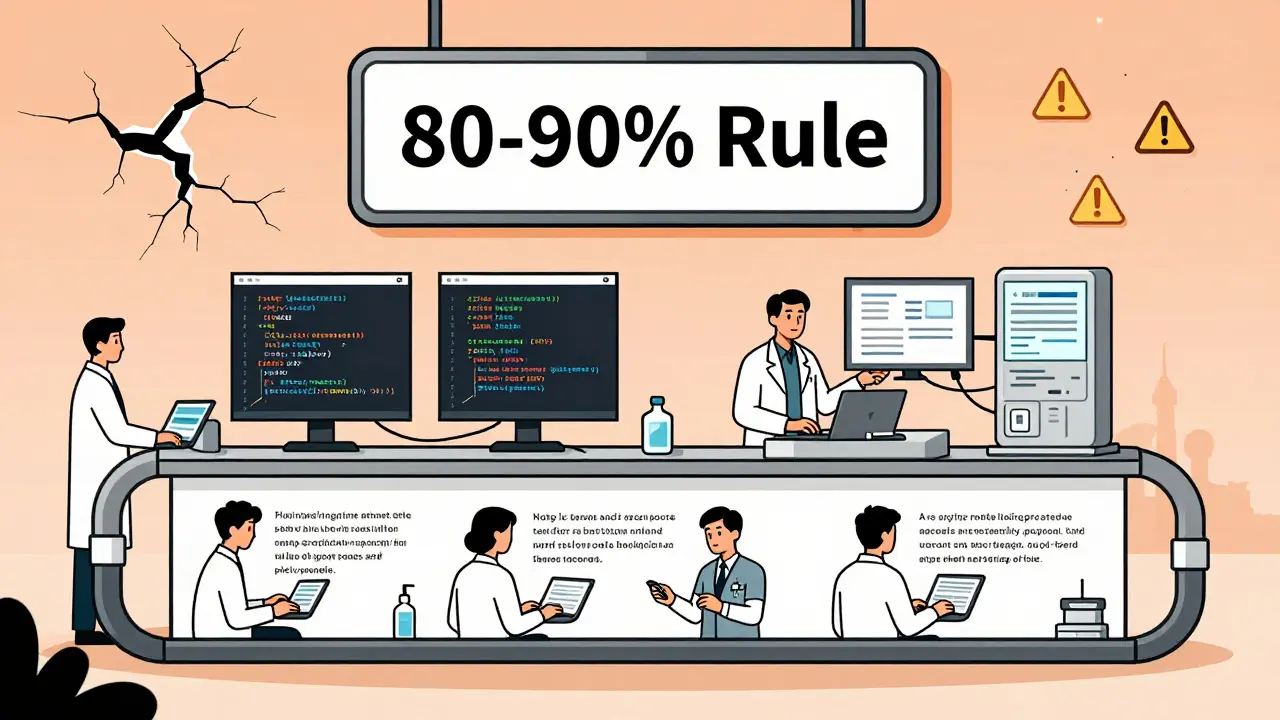
The "80-90% rule" is real: vibe coding gets you 80% of the way there. The last 20%? That’s where experienced engineers come in - to review, secure, and integrate.
Who’s Using It - And Who Shouldn’t
Adoption is growing fast, but unevenly.
Startups and academic labs are leading the charge. Over 78% of healthcare startups now use vibe coding for their first prototypes. Why? They don’t have big compliance teams. They need speed. They can’t afford to wait months for a developer.
Mid-sized SaaS companies are next, with about 57% adopting it for internal tools and pilot projects.
Large hospitals and health systems? Only 22% are using it - and mostly for non-clinical tools like scheduling or staff training apps. They’re cautious. One Boston health system lost four months when a vibe-coded tool accidentally used de-identified data that still contained re-identifiable patterns. The HIPAA audit that followed shut everything down.
Who should avoid it? Anyone building tools that will directly analyze live patient data - like clinical decision support systems that recommend treatments based on real-time vitals. That’s not what vibe coding is for. It’s for the before - the imagining, the testing, the learning.
How to Get Started Safely
If you’re ready to try vibe coding, here’s how to do it right:
- Use only healthcare-specific tools. Don’t use free AI coding platforms like ChatGPT or GitHub Copilot. A 2025 audit found 92.7% of public tools lack proper data governance for healthcare. Stick to platforms like Epic’s Cogito, Anysphere’s Healthcare Mode, or Replit’s HIPAA-compliant version.
- Start with synthetic data. Use Synthea or similar tools to generate fake patient profiles that mirror your target population - age, gender, comorbidities, lab values - but zero real identifiers.
- Use FHIR sandboxes. Test your code against simulated EHR systems. Most major vendors offer free sandbox environments that mimic Epic, Cerner, or Meditech without real data.
- Write clear prompts. The more specific you are, the better the output. Instead of "analyze patient data," say "find patients over 65 with HbA1c above 8.5% who haven’t had a nephrology visit in 12 months."
- Always review the code. Even if it runs, have a developer check for security flaws, API limits, and compliance gaps. Don’t skip this step.
- Train your team. Non-technical users need 8-12 hours of training to use vibe coding effectively. Start with simple tasks - data filtering, chart generation, basic alerts.
One hospital in Minnesota trained 15 nurses in vibe coding over two weeks. Within a month, they’d built six small tools - from medication reminder bots to appointment reminder systems - all without a single PHI exposure.
The Future Is Safe, Not Just Smart
The global market for healthcare AI development tools hit $2.87 billion in late 2025. By 2027, IDC predicts over half of healthcare organizations will be using vibe coding for prototyping. But only 12% will use AI-generated code in live production systems.
That’s the key insight: vibe coding isn’t about replacing humans. It’s about removing the friction that’s held healthcare innovation back for decades. It lets clinicians, researchers, and administrators build without fear - without worrying they’ll accidentally violate HIPAA, trigger a breach, or expose a patient’s private data.
The future of healthcare tech won’t be built by coders alone. It’ll be built by people who know the problems - and now, finally, have the tools to solve them, safely.
Sarah McWhirter
January 18, 2026 AT 17:14So let me get this straight - we’re trusting AI to redact PHI… but the same AI that got caught generating fake clinical trials last year? 😏
And you’re telling me it doesn’t *learn* from real data? Lol. My grandma’s Fitbit knows more about my bowel movements than this ‘synthetic’ data ever will. They’re just feeding it back its own echo chamber with extra commas.
Next thing you know, the algorithm will be prescribing antidepressants to synthetic patients who never existed… and then billing Medicare for it. 🤖💊
Ananya Sharma
January 19, 2026 AT 23:53This is the exact kind of techno-utopian nonsense that gets people killed. You don’t ‘vibe code’ your way out of ethical responsibility. The fact that you’re celebrating a tool that bypasses HIPAA compliance entirely - even if it’s ‘just’ for prototyping - reveals a dangerous moral vacuum in modern healthcare tech.
Every line of code generated without human oversight is a potential liability. That 22.4% bug rate? That’s not a bug - that’s a death sentence waiting to be deployed in a live system. And you call this ‘democratization’? No. This is corporate laziness dressed up as innovation. If you can’t afford proper compliance, you shouldn’t be building health tools. Period.
And don’t even get me started on synthetic data - it’s statistically plausible, yes, but it’s still a fiction. Real patients don’t behave like Gaussian distributions. Real suffering doesn’t come with labeled fields. You’re not building for people - you’re building for a spreadsheet.
kelvin kind
January 21, 2026 AT 22:48Kinda wild how this actually works. I tried it last week to make a simple appointment tracker for my aunt’s clinic. Didn’t touch a single real record. Took 20 minutes. Works fine.
Still got a dev check it over, but yeah - way faster than the old way.
Ian Cassidy
January 23, 2026 AT 21:08The real win here is the FHIR sandbox integration - that’s the unsung hero. Vibe coding’s just the frontend; the magic’s in the simulated EHR layer. You’re not avoiding PHI - you’re abstracting the entire data pipeline into a deterministic, auditable environment.
But yeah, the 80-90% rule holds. The code’s clean until it hits a legacy Cerner API with 17 nested XML schemas. Then it’s just a pile of 404s and tears.
Zach Beggs
January 25, 2026 AT 02:05Really cool to see this gaining traction. I work in a small research lab and we’ve been using Anysphere’s Healthcare Mode for our trial simulators. No more waiting 3 months for IT to approve a data request.
Just wish more hospitals would adopt this before they spend another $500k on some bloated vendor platform.
Aaron Elliott
January 25, 2026 AT 12:39It is an incontrovertible fact that the normalization of algorithmic abstraction in clinical prototyping constitutes a systemic erosion of epistemological accountability in medical informatics. The reliance upon synthetic datasets, while statistically convenient, introduces a latent epistemic bias - one that privileges algorithmic plausibility over phenomenological veracity.
Moreover, the notion that non-clinicians can adequately articulate therapeutic intent without formal biomedical training is not merely naïve - it is an affront to the epistemic integrity of the discipline.
One must ask: if a nurse can ‘vibe code’ a diabetes intervention, what becomes of the clinical reasoning process? Is it to be reduced to a prompt-engineering exercise?
The answer, I submit, is that we are not advancing healthcare - we are automating its commodification.
Chris Heffron
January 26, 2026 AT 22:14Hey, just a quick heads-up - you might wanna check the casing on those FHIR resource names. I saw a vibe-coded script the other day that used 'PatientId' instead of 'patientId'… and it broke the whole sandbox. 😅
Small thing, but it’s the little things that make devs cry.
Also, love the synthetic data point - Synthea’s great, but make sure you’re using v5.3+ or the age distributions get weird.
Adrienne Temple
January 28, 2026 AT 14:50This is actually so cool for people like me who aren’t coders but see problems every day. I’m a nurse in a rural clinic and we’ve got zero IT support. Last month, I used Replit’s HIPAA mode to make a little tool that flags patients who haven’t gotten their flu shots - based on fake data, of course.
It’s not perfect, but it saved us 10 hours a week. 😊
And hey - if you’re trying this, don’t be afraid to ask for help. There’s a whole subreddit full of folks who’ll walk you through it. You don’t have to be a genius. Just curious. 💪
Sandy Dog
January 29, 2026 AT 16:08OKAY BUT WHAT IF THE AI GETS SAD??? 😭
Like… what if it’s training on synthetic data and it starts to THINK it’s a real person? What if it dreams of being a nurse? What if it cries because it can’t feel a real patient’s hand? 🥺
I saw a TikTok where an AI-generated patient said, ‘I just want to be seen.’ I cried. I haven’t slept since.
And then I realized - if the AI is writing code for us… who’s writing the code for the AI?
Are we the gods now? Or just the ones who pressed ‘generate’?
Someone call Elon. He needs to hear this.
Nick Rios
January 31, 2026 AT 00:26Really appreciate how this balances speed and safety. I’ve seen too many teams rush into AI tools and end up with breaches. This approach - synthetic data, sandboxes, human review - feels like the right path.
It’s not perfect, but it’s honest. We’re not pretending we’ve solved compliance. We’re just giving people the tools to try, learn, and improve - without risking lives.
That’s the kind of innovation worth supporting.