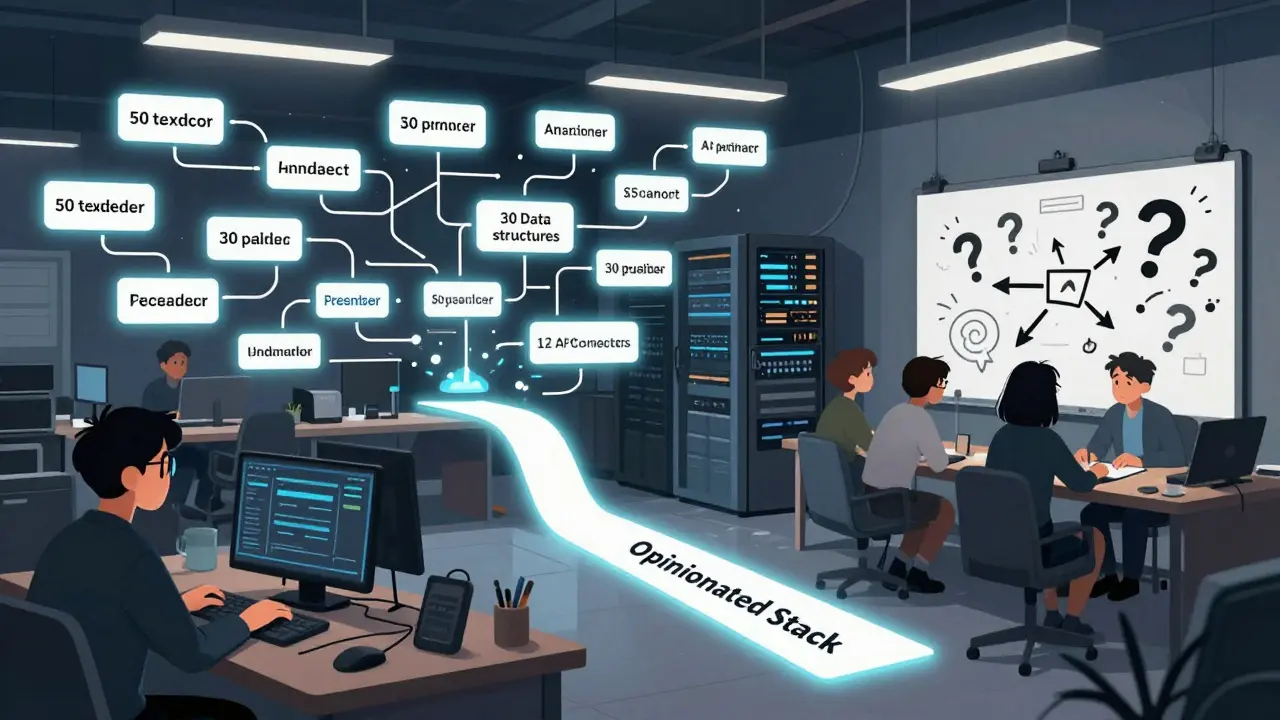
When you're building something with AI, having too many choices can be worse than having none. It’s not about what the tools can do - it’s about what they decide for you. That’s the power of opinionated stacks. They don’t just offer features. They take a stand. And in today’s crowded AI landscape, that’s what actually moves the needle.
Why Flexibility Is Killing AI Projects
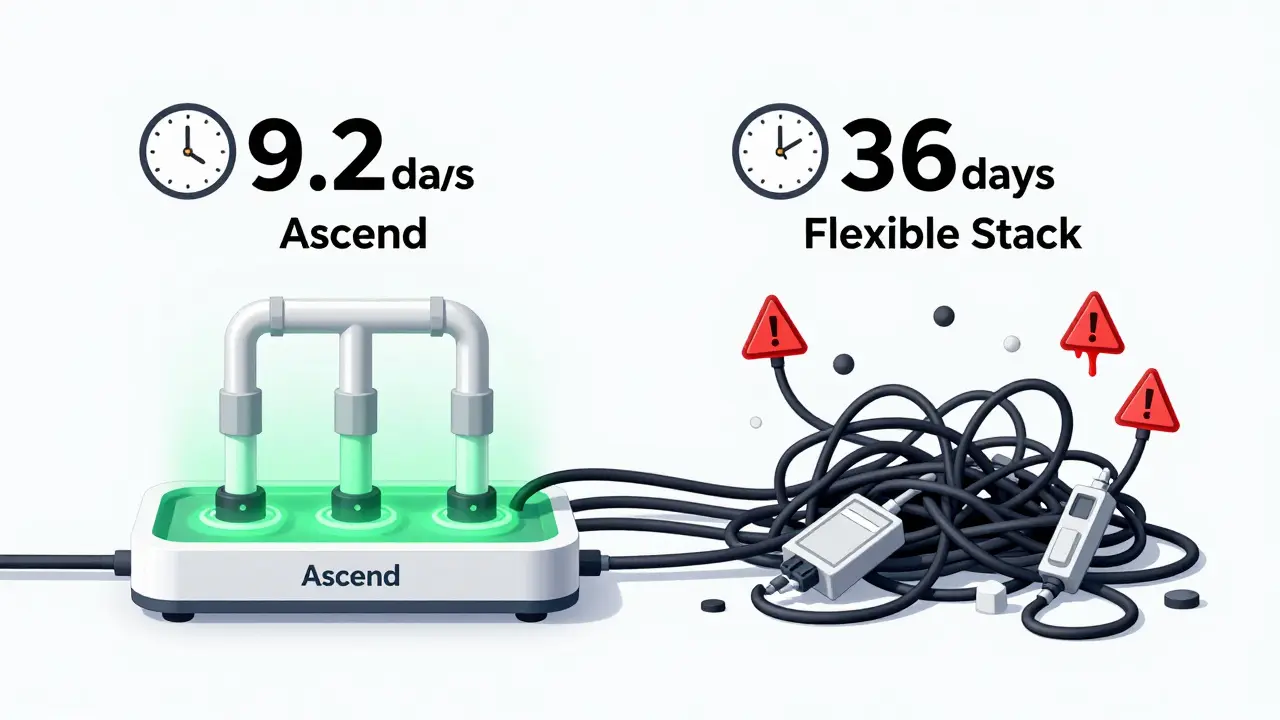
Most AI tools today feel like a garage sale. You get 50 ways to generate text, 30 ways to structure data, and 12 ways to connect to APIs. Sounds great? It’s not. A 2025 Wing Venture Capital study found that teams using highly flexible AI platforms took an average of 36 days to deliver their first working result. Why? Because every decision - from how prompts are structured to how outputs are validated - had to be debated from scratch. Teams got stuck in analysis paralysis. They spent more time configuring than building. Meanwhile, companies using opinionated stacks cut that time in half. Ascend’s data platform, for example, locks down data ingestion, transformation, and routing into a single workflow. No custom pipelines. No tinkering. Just a clear path. Their customers hit production in 9.2 days on average. That’s not luck. It’s design.What Makes an AI Stack Opinionated
An opinionated AI stack doesn’t just have fewer options. It has intentional limits. Here’s what that looks like in practice:- Fixed workflows: Linear, the project management tool, doesn’t let you create custom status columns. It gives you Backlog, In Progress, Review, Done. That’s it. And because of that, 92% of users stay with it after six months.
- Minimal configuration: Owner, the restaurant platform, reduced its website templates from 47 to 7. Every template was chosen based on real conversion data. Result? Online orders jumped 32%.
- Locked-in patterns: Superhuman’s AI email client enforces inbox-zero. Keyboard shortcuts are non-negotiable. No “maybe” options. Users gave it a 4.8/5 satisfaction rating - 0.9 points higher than flexible rivals.
- Small API surface: Instead of letting you plug into any database or tool, opinionated stacks expose only what’s proven. Ascend’s platform connects to just three data sources - but does them better than anything else.
These aren’t arbitrary restrictions. They’re data-backed decisions. As DHH put it: "The best software takes sides." And today, the side that wins is the one that knows what users actually need - not what they think they want.
Real Numbers: Why Opinionated Stacks Win
Numbers don’t lie. Here’s what the data shows:| Metric | Opinionated Stacks | Flexible Stacks |
|---|---|---|
| Time-to-value | 11 days | 36 days | Net dollar retention | 112% | 84% |
| User satisfaction (avg. rating) | 4.3/5 | 3.8/5 |
| Documentation quality | 4.5/5 | 3.7/5 |
| Infrastructure overhead | 47% lower | Baseline |
| Support resolution time | 63% faster | Slower |
Notice something? The opinionated tools aren’t just faster. They’re stickier. Users don’t just try them - they stick with them. That’s because opinionated stacks reduce friction, not add it. They remove the guesswork. And in AI, where every prompt and pipeline matters, that’s gold.
When Opinionated Stacks Fail
But here’s the catch: opinionated doesn’t mean better. It means right for a specific job. Base, a Notion competitor, collapsed in Q2 2025 after forcing rigid templates on users who needed to manage wildly different workflows - from legal case tracking to indie game development. A TechCrunch post-mortem found that 78% of users felt the system didn’t match how they worked. The tool wasn’t broken. It was misaligned. Same thing happened with a popular AI content tool in 2024. It forced all outputs into a three-section format. Writers who needed to write poetry, legal briefs, or technical manuals couldn’t adapt. The backlash was loud. The company shut down within months. Opinionated stacks don’t fail because they’re rigid. They fail because their opinions are wrong. Or worse - they’re based on assumptions, not data.Who Benefits Most?
Not everyone. But some groups win big:- Non-technical teams: Marketers, customer support, HR - they don’t want to configure AI. They want it to just work. Opinionated stacks give them that. TrustRadius data shows a 0.9-point satisfaction gap between opinionated and flexible tools among non-technical users.
- Startups: With limited engineering bandwidth, they can’t afford to build custom pipelines. A 2024 Contrary Research survey found 78% of early-stage AI startups chose opinionated stacks to move faster.
- Enterprise teams doing repetitive tasks: Marketing automation, customer onboarding, internal reporting - these are predictable workflows. Opinionated tools like Ascend and Linear crush them.
On the flip side, researchers, scientists, and developers building truly novel systems still need flexibility. If you’re inventing something new, constraints can stifle innovation. That’s why scientific computing has the lowest adoption of opinionated AI stacks - just 29% among Fortune 500 companies.

The Hidden Cost of Flexibility
Most people think flexible tools save money. They don’t. A 2025 Forrester study found that maintaining a custom-built AI stack costs $210,000 a year in engineering labor. Compare that to Ascend’s $15,000 annual fee. The flexible option isn’t cheaper. It’s just hidden. And it’s not just money. It’s time. It’s morale. It’s the team that burns out because they’re always fixing pipelines instead of solving problems. Opinionated stacks shift the cost from ongoing maintenance to upfront alignment. That’s a trade-off worth making - if you pick the right one.How to Choose the Right One
Don’t just pick the loudest tool. Ask these questions:- What’s your core workflow? Is it generating reports? Managing orders? Onboarding customers? Find a tool built for that - not one that claims to do everything.
- Who’s using it? If it’s non-technical staff, you need simplicity. If it’s engineers, you can tolerate more structure - but still need clear rules.
- Is the opinion data-driven? Look for case studies. Did Owner reduce bounce rates? Did Linear improve retention? If the vendor can’t show you real numbers, their "opinions" are just guesses.
- Can it evolve? The best opinionated stacks - like TikTok’s feed algorithm - update their rules based on usage. Ask if the tool learns from you, or just demands you adapt to it.
- What happens when you hit a wall? Does it have a clear escape hatch? Or are you locked in forever?
Don’t fall for the myth that "more options = better." In AI, the best tool is the one that removes the noise - not adds to it.
The Future Is Opinionated
Gartner predicts that by 2027, 65% of industry-specific AI tools will be opinionated. That’s not a trend. It’s a necessity. As AI becomes easier to use, the real differentiator won’t be accuracy or speed. It’ll be clarity. Direction. Vision. The companies that win won’t be the ones with the most features. They’ll be the ones that dared to say "no" - and meant it.Opinionated stacks aren’t about limiting creativity. They’re about focusing it. They turn chaos into rhythm. And in a world drowning in AI noise, that’s the only thing that makes sense.
Chris Heffron
February 21, 2026 AT 20:46Sandy Dog
February 23, 2026 AT 13:06Nick Rios
February 23, 2026 AT 15:32Johnathan Rhyne
February 24, 2026 AT 03:56Adrienne Temple
February 25, 2026 AT 18:36Salomi Cummingham
February 27, 2026 AT 01:39Mike Zhong
February 27, 2026 AT 05:12Aaron Elliott
February 27, 2026 AT 23:53Jamie Roman
March 1, 2026 AT 05:57