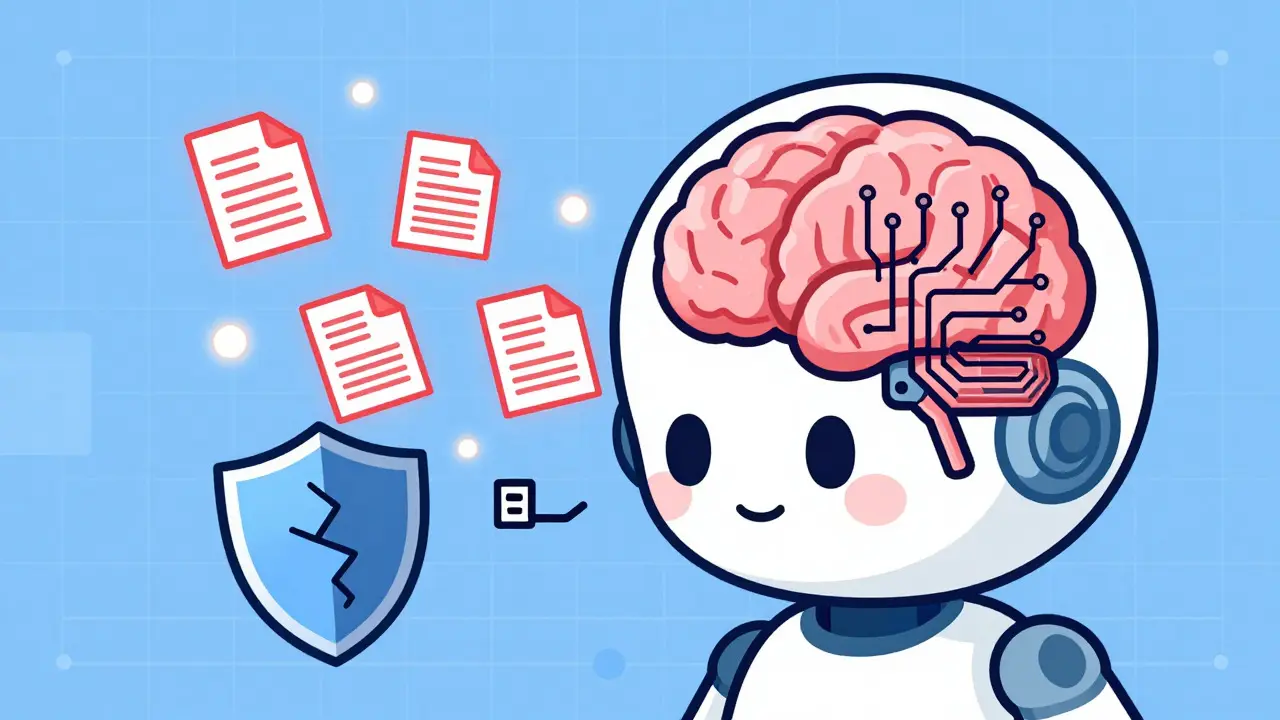
Imagine training a brilliant assistant on your company's most sensitive customer records, only to have it accidentally recite a client's medical history or bank account number during a routine query. This isn't just a hypothetical nightmare; it is the central challenge facing enterprises today as they integrate Large Language Models (LLMs) into their operations. The era of simply throwing raw data at an algorithm is over. With regulations like the EU's AI Act tightening its grip from August 2026 and fines reaching up to 4% of global revenue, protecting Personally Identifiable Information (PII) within your training pipeline is no longer optional-it is existential.
We are moving past the early days of foundational models like GPT-3, where data leakage was an afterthought. Today, organizations need robust, layered defenses that address both how data enters the model and how information leaves it. This guide breaks down the practical steps for implementing PII redaction and governance, balancing mathematical guarantees with real-world utility.
Understanding the Threat Landscape
Before you can fix the problem, you need to understand how data leaks occur. In LLMs, privacy risks manifest in two primary ways: memorization and inference-time extraction. Memorization happens when the model essentially "memorizes" specific training examples rather than learning general patterns. If a patient record appears frequently enough in your training set, the model might reproduce it verbatim when prompted.
Inference-time extraction is more subtle. Even if the model hasn't memorized exact text, adversarial prompts can coax out sensitive details. Stanford HAILab's research in September 2024 highlighted this vulnerability, showing that rare training examples-those occurring less than 0.001% of the time-remain vulnerable to extraction through thousands of carefully crafted prompts. This means that even with some protections, outliers in your dataset pose a significant risk.
The stakes are high. The Ponemon Institute reported a 217% year-over-year increase in LLM data leakage incidents in 2025. For financial services and healthcare sectors, where trust is currency, a single breach can destroy brand reputation and trigger massive regulatory penalties under GDPR and HIPAA.
Core Strategies for PII Redaction
To mitigate these risks, you need a multi-layered approach. Relying on a single tool is a recipe for failure. Here are the three dominant strategies currently shaping the industry:
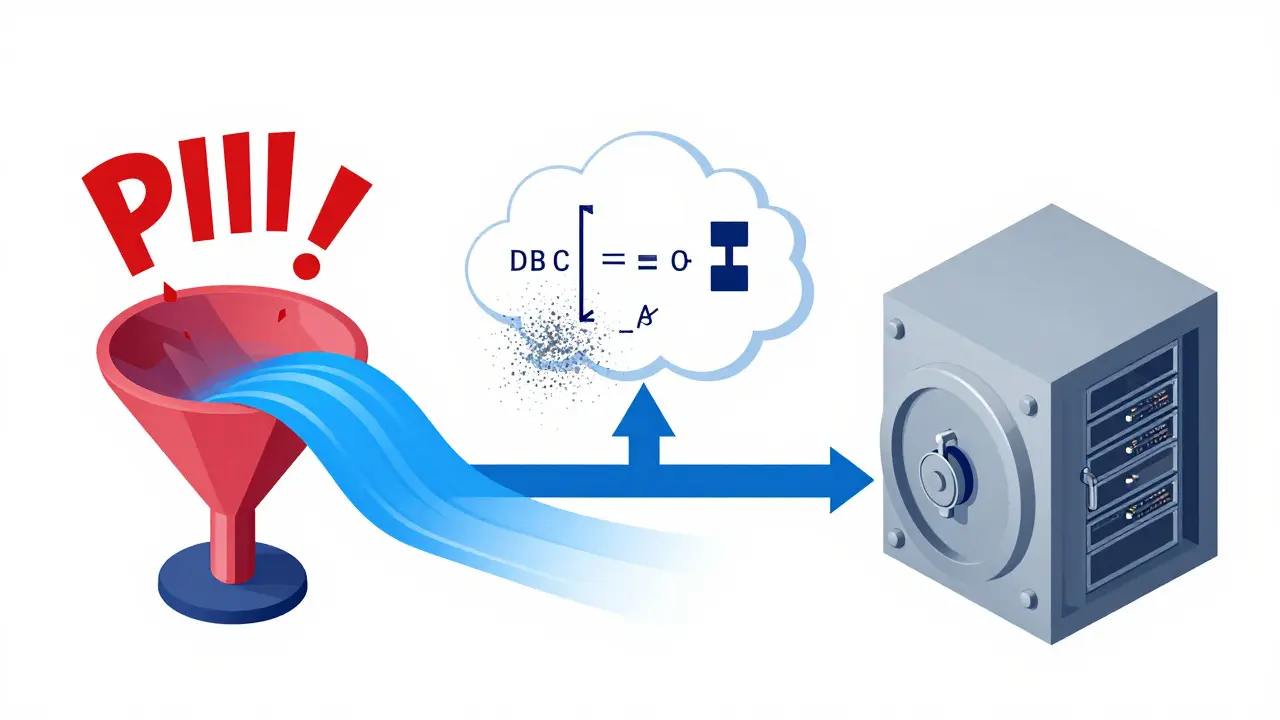
- Statistical Filtering: This involves using AI-driven detectors to identify and mask PII before it enters the training process. Anthropic's Clio system is a prime example. It uses a four-layer architecture to filter conversational data. While it doesn't offer formal mathematical guarantees, it achieves high precision (95-98% according to Sigma.ai benchmarks) with minimal impact on model accuracy (only 1-3% drop).
- Differential Privacy (DP): This adds mathematical noise to the training process to obscure individual data points. Using frameworks like Opacus for PyTorch, you can implement DP-SGD (Stochastic Gradient Descent). The key metric here is epsilon (ε). A lower ε means more privacy but less accuracy. At ε=2, accuracy drops by 15-20%, which is often unacceptable. At ε=8, the drop is manageable (3-5%), providing meaningful protection against extraction attacks as noted by Dr. Cynthia Dwork in her May 2025 NIST update.
- Confidential Computing: This protects data while it is being processed. Technologies like Intel SGX or AMD SEV-SNP create secure enclaves where data is encrypted even in memory. This prevents unauthorized access during the computation phase, adding a hardware-level layer of security.
Most successful enterprise implementations now use a hybrid approach. They combine statistical filtering for preprocessing with differential privacy during training. This balances the need for high model utility with rigorous privacy standards.
| Approach | Accuracy Impact | Privacy Guarantee | Complexity |
|---|---|---|---|
| Statistical Filtering (e.g., Clio) | Low (1-3%) | Heuristic / No formal guarantee | Medium |
| Differential Privacy (DP-SGD) | High (15-20% at ε=2; 3-5% at ε=8) | Mathematical guarantee | High |
| Confidential Computing | Negligible | Hardware-enforced isolation | Very High |
| Hybrid (Filtering + DP) | Moderate (3-5%) | Strong combined protection | High |
Building Your Data Inventory and Governance Framework
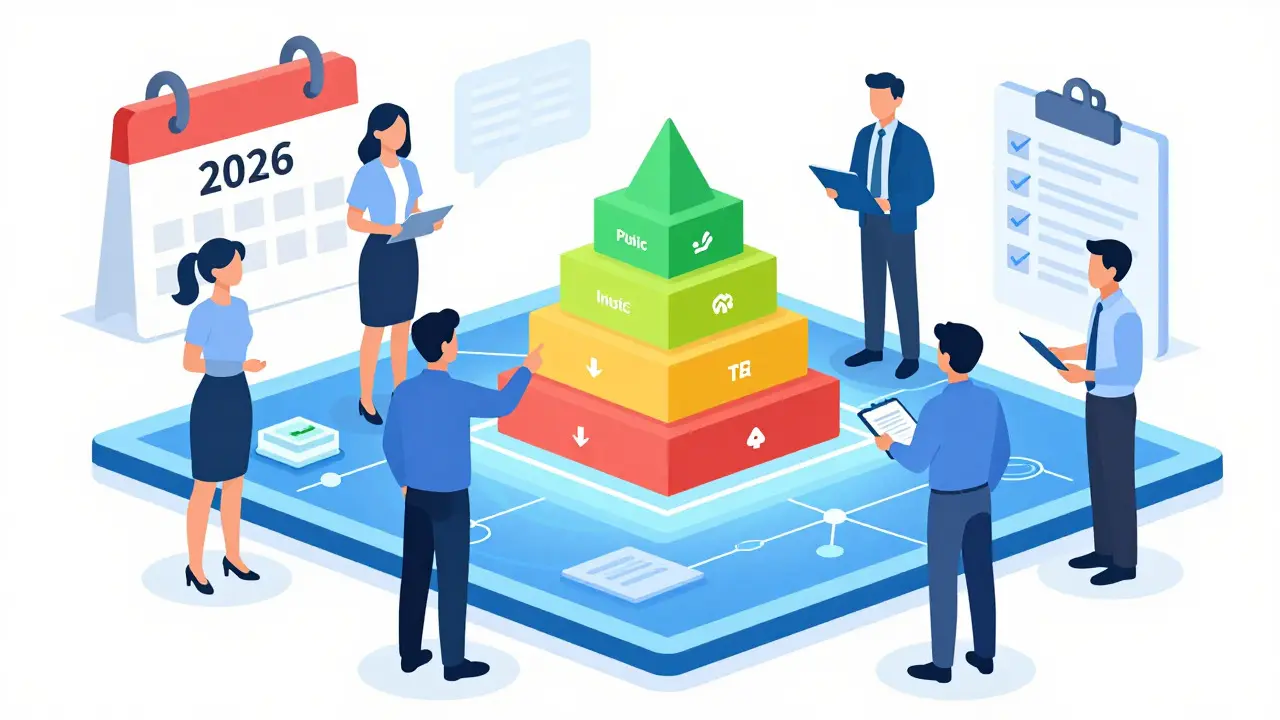
Technology alone won't save you. You need governance. The first step is building a comprehensive data inventory, as mandated by GDPR Article 30. This typically takes 4-8 weeks for medium-sized enterprises. You need to know exactly what data you have, where it lives, and who has access to it.
Classify your data into tiers based on sensitivity. Not all data requires the same level of protection. Publicly available news articles need different handling than internal employee performance reviews or patient health records. Once classified, apply appropriate controls. For highly sensitive data, consider pseudonymization with stable tokens. This allows you to perform longitudinal analysis without exposing identities, a technique that helped a manufacturing client achieve 99.2% redaction accuracy after three months of refinement, according to Lasso.security.
Documentation is critical. Keep detailed lineage tracking of your training data. The European Data Protection Board (EDPB) released updated guidance in December 2025 requiring this specifically to address the 'right to be forgotten.' Since information embedded in model weights cannot be easily removed without complete retraining, knowing exactly which data contributed to which model version is essential for compliance.
Tools and Implementation Realities
When selecting tools, you have options ranging from open-source libraries to expensive enterprise suites. Microsoft Presidio, open-sourced in February 2023, is a popular choice for PII detection. It offers highly customizable detectors but comes with a steep learning curve, requiring significant NLP expertise. Users on G2 praise its flexibility but note that it averages 4.2/5 stars due to implementation complexity.
For differential privacy, the Opacus library for PyTorch is the standard. As of December 2025, version 1.13.1 is widely used. However, integrating DP adds computational overhead. Expect your training times to increase by 20-30%. If you are using cloud infrastructure like AWS Lambda for aggregation pipelines, factor in this additional processing time and cost. AWS Clean Rooms, launched in Q2 2024, charges $0.45 per million tokens processed, which can add up quickly at scale.
Don't underestimate the human element. Data engineers typically require 3-6 months to become proficient in privacy-preserving techniques. LinkedIn Learning's 2025 report highlights that 87% of job postings in this space require NLP expertise alongside knowledge of privacy frameworks like k-anonymity and DP-SGD. Invest in training your team early.
Pitfalls to Avoid
Even with the best intentions, mistakes happen. One common failure mode is relying solely on synthetic data generation without proper validation. A healthcare provider documented in Sigma.ai's November 2024 case study experienced PHI leakage because their synthetic data contained re-identifiable patterns when cross-referenced with public datasets. Always maintain a "gold-standard PII canary set" to test your outputs against.
Another pitfall is ignoring the trade-off between privacy and utility. Dr. Dawn Song emphasized at NeurIPS in December 2025 that we cannot simultaneously maximize model accuracy and privacy. The art lies in finding the optimal balance for your specific use case. If your model needs near-perfect accuracy for medical diagnosis, a heavy-handed privacy filter might make it useless. Conversely, if you are using the model for general sentiment analysis, you can afford stricter privacy measures.
Finally, don't forget inference-time risks. Redacting data during training is only half the battle. You also need monitoring at serving time. Implement dynamic data masking and output filters to catch any residual PII that slips through. This creates a defense-in-depth strategy that covers the entire lifecycle.
Future Outlook and Compliance
The landscape is evolving rapidly. The EU's AI Act, effective August 2026, will require "appropriate technical and organizational measures" for high-risk AI systems. This includes LLMs trained on sensitive data. Non-compliance could mean significant fines and operational restrictions.
Looking ahead, NIST's AI Risk Management Framework 2.0, scheduled for release in Q2 2026, will introduce specific testing protocols for LLM privacy. Standardized metrics will help compare solutions objectively. Gartner places "privacy-preserving LLM training" on the "Slope of Enlightenment," predicting mainstream adoption by 2028. Companies that start building their governance frameworks now will have a significant competitive advantage.
The goal is not perfect privacy, which is impossible, but risk management. By combining statistical filtering, differential privacy, and strong governance, you can leverage the power of LLMs while keeping your customers' data safe and your business compliant.
What is the difference between statistical filtering and differential privacy in LLMs?
Statistical filtering uses AI detectors to identify and remove PII from training data before the model sees it. It is fast and preserves accuracy well but lacks mathematical guarantees. Differential privacy adds mathematical noise to the training process itself, providing a formal guarantee that individual data points cannot be reverse-engineered, but it often reduces model accuracy.
How much does implementing differential privacy affect model accuracy?
The impact depends on the epsilon (ε) value chosen. At a strict ε=2, accuracy can drop by 15-20%. At a more moderate ε=8, which is recommended for many enterprise applications, the accuracy drop is typically around 3-5%. This trade-off must be balanced against the required level of privacy protection.
Can I completely remove data from an already trained LLM?
Not easily. The EDPB notes that information embedded in model weights cannot be simply deleted. To fully satisfy the 'right to be forgotten,' you often need to retrain the model from scratch without that specific data point. This is why maintaining detailed data lineage and using techniques like differential privacy during training is crucial.
What are the best tools for PII redaction in 2026?
Popular tools include Microsoft Presidio for open-source PII detection, Anthropic's Clio for AI-driven filtering, and Opacus for implementing differential privacy in PyTorch. Enterprise solutions like AWS Clean Rooms also provide managed environments for private data collaboration. The best choice depends on your technical expertise and budget.
Is confidential computing necessary for LLM training?
It is not strictly necessary for all use cases but adds a valuable layer of security. Confidential computing uses hardware enclaves (like Intel SGX) to keep data encrypted while it is being processed. This protects against unauthorized access to the data in memory, complementing software-based privacy techniques like redaction and differential privacy.
Saranya M.L.
July 18, 2026 AT 22:01The notion that Western enterprises are suddenly discovering the gravity of data governance is laughable, given that our own digital infrastructure has been grappling with these exact nuances for years. The reliance on statistical filtering as a primary defense mechanism is intellectually lazy and fundamentally flawed because it lacks the rigorous mathematical underpinnings required for true privacy preservation in high-dimensional vector spaces. Differential Privacy, specifically when implemented via DP-SGD with carefully calibrated epsilon values, remains the only scientifically valid approach to ensuring that individual data points do not disproportionately influence the model's weight updates. It is disheartening to see organizations prioritize convenience over cryptographic certainty, especially when the cost of non-compliance under emerging regulatory frameworks like the EU AI Act could be catastrophic. One must question whether the so-called 'hybrid approaches' mentioned here are merely band-aids applied to a systemic failure of architectural foresight.
om gman
July 19, 2026 AT 09:46oh look another article telling us what we already know but written by someone who probably thinks they invented the wheel because they read a whitepaper last tuesday. honestly this is all just corporate fluff designed to sell more consulting hours from people who cant code their way out of a paper bag. nobody cares about your epsilon values if the model still spits out nonsense half the time anyway
Bineesh Mathew
July 20, 2026 AT 23:33You speak of utility as if it were a static commodity rather than a fragile illusion woven from the threads of human bias and algorithmic determinism. To reduce the profound ethical dilemma of surveillance capitalism to a mere trade-off between accuracy and privacy is to miss the forest for the trees entirely. We are building gods in silicon cages and complaining about the noise they make while forgetting that the cage itself is built on the bones of the forgotten. Is it truly privacy we seek or merely the comfort of believing our secrets are safe behind a firewall of differential noise? The soul of the machine does not care for your GDPR compliance certificates it only hungers for the patterns hidden within your deepest vulnerabilities.
Jeanne Abrahams
July 21, 2026 AT 07:02Charming really how you think adding some poetic flair makes your tech illiteracy any less apparent. Back in South Africa we have bigger problems than philosophical musings on silicon souls we have actual infrastructure issues that require practical solutions not existential dread. If you want to talk about real privacy threats maybe try looking at state-sponsored surveillance before you start lecturing us on the moral implications of gradient descent. Your drama queen antics are exhausting and frankly irrelevant to anyone trying to keep their customer data from leaking into a chatbot response.
Andrea Alonzo
July 22, 2026 AT 01:31I find myself reflecting deeply on the intricate dance between technological advancement and the fundamental human right to privacy which seems to be increasingly overshadowed by the relentless pursuit of efficiency and scale in modern enterprise environments. It is quite fascinating to observe how the implementation of tools like Microsoft Presidio requires such a steep learning curve which often leaves smaller organizations feeling alienated and overwhelmed by the sheer complexity of the requirements placed upon them to achieve even basic compliance standards. This creates a disparate landscape where only the most well-resourced entities can afford to maintain robust governance frameworks thereby exacerbating existing inequalities in the digital realm and potentially leaving vulnerable populations exposed to greater risks of data exploitation and identity theft. Furthermore the emphasis on synthetic data generation as a solution raises important questions about the provenance and quality of the underlying datasets used to train these synthetic generators which may inadvertently encode biases or inaccuracies that propagate through the entire pipeline. We must consider the long-term implications of relying on heuristic-based filters which offer no formal guarantees and may fail catastrophically when faced with novel adversarial attacks or previously unseen patterns of personally identifiable information. The human element cannot be overstated as data engineers need extensive training and support to navigate these complex systems effectively which suggests that investment in education and professional development should be prioritized alongside technological solutions. Ultimately the goal should be to create an inclusive ecosystem where privacy-preserving techniques are accessible and understandable to all stakeholders regardless of their technical expertise or organizational size.
Oskar Falkenberg
July 23, 2026 AT 17:24i totally agree with andrea here its so frustrating how hard it is to get started with stuff like opacus without having a PhD in math. i mean sure the table shows that hybrid approaches are best but actually setting that up takes forever and my team is already stretched thin trying to meet deadlines. also typos happen dont worry about it too much lol. seriously though who has time to build a full data inventory in 4 weeks thats insane unless you have like fifty data analysts just sitting around doing nothing. we tried using presidio and spent three months just tuning the detectors for our specific jargon which was painful but maybe worth it in the end. just wish there was a simpler button to press to make everything compliant instantly.
michael rome
July 24, 2026 AT 21:18It is imperative that we recognize the significant operational burden placed on engineering teams when implementing these rigorous privacy standards without adequate resources or clear strategic direction. While the theoretical benefits of differential privacy are undeniable, the practical reality of increased training times and computational costs often leads to stakeholder fatigue and resistance to adoption. Organizations must foster a culture of collaboration between legal, compliance, and technical departments to ensure that privacy initiatives are viewed as enablers of trust rather than impediments to innovation. By investing in comprehensive training programs and leveraging managed services like AWS Clean Rooms, companies can mitigate the complexity associated with privacy-preserving technologies while maintaining high levels of model utility. Let us strive to create an environment where data protection is seamlessly integrated into the development lifecycle, empowering teams to build responsible AI systems that benefit society as a whole.
Francis Laquerre
July 26, 2026 AT 08:27This entire discourse misses the point entirely.