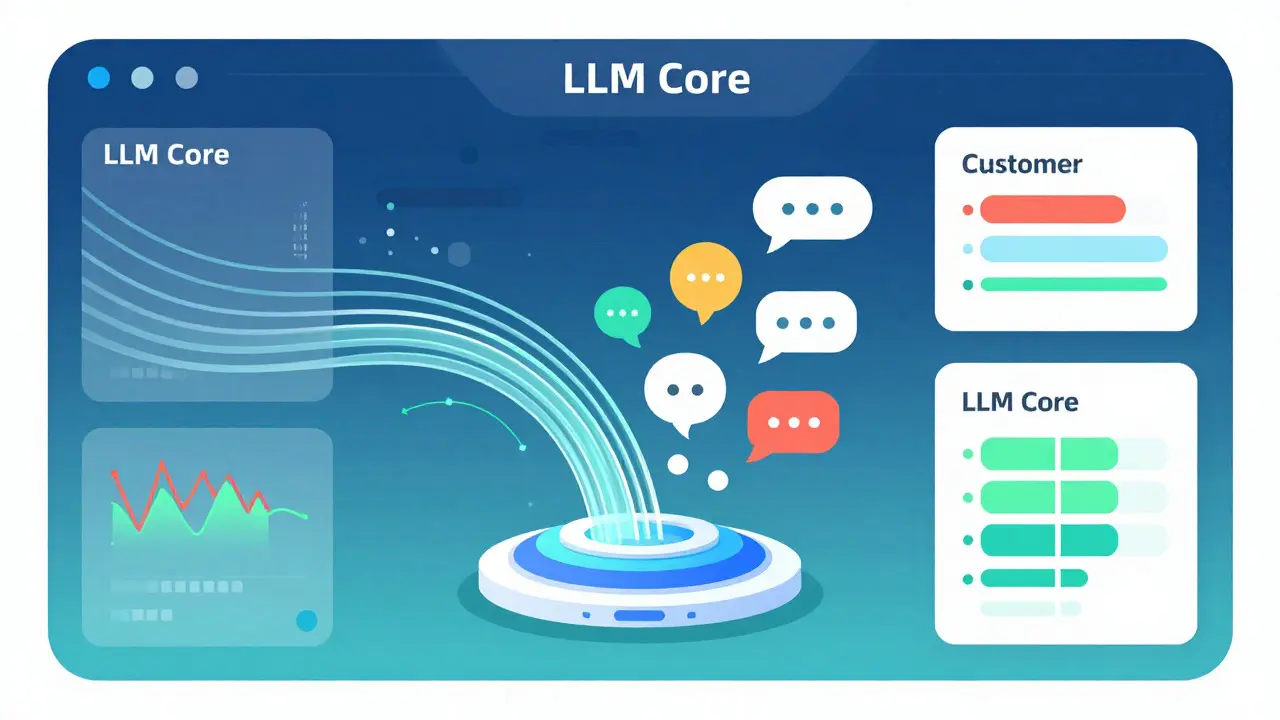
Imagine listening to a thousand customer calls at once. Not just hearing the words, but feeling the frustration in a voice crack or spotting the exact moment a buyer decides to stay loyal. That is the promise of modern Contact Center Analytics powered by Large Language Models (LLMs). For years, contact centers relied on keyword matching-flagging calls that mentioned "cancel" or "refund." It was blunt, often inaccurate, and missed the nuance of human conversation. Today, AI systems are moving beyond simple triggers to understand context, emotion, and underlying goals.
This shift isn't just about better technology; it's about survival. Customers expect seamless experiences across languages and channels. If your support team can't detect rising anger before it becomes a churn event, you lose revenue. If they can't identify why customers are calling in the first place, you're flying blind. LLMs bridge this gap by turning unstructured audio and text into structured, actionable intelligence.
How LLMs Transform Call Driver Analysis
The foundation of any analytics system is identifying the "call driver"-the primary reason a customer contacted you. Traditional systems struggled here. They used rigid topic modeling that created overlapping categories. One call might be tagged as both "billing issue" and "technical error," leaving agents confused about where to start.
Modern solutions use embeddings and clustering algorithms to solve this ambiguity. Instead of forcing data into pre-defined boxes, these systems analyze the semantic meaning of the conversation. A common approach involves using HDBSCAN (Hierarchical Density-Based Spatial Clustering of Applications with Noise). Unlike older methods like K-means, HDBSCAN doesn't require you to guess how many topics exist beforehand. It finds natural clusters in the data, even if those clusters vary in size and shape.
To make this work, the system preprocesses transcripts by removing stop words and lemmatizing terms (reducing words to their root form). Studies suggest optimal configurations involve analyzing the top 25 most frequent normalized drivers and extracting the top 3 unigrams for labeling. This precision ensures that when a trend emerges-like a spike in complaints about a specific software update-it gets flagged immediately rather than getting lost in generic noise.
Sentiment and Emotion Detection Beyond Binary Labels
Old-school analytics gave you a binary score: positive or negative. Human emotions aren't binary. A customer might be frustrated but still confident in your brand, or polite but deeply disappointed. Sentiment Analysis with LLMs captures these nuances.
Advanced models detect specific emotional states such as frustration, confidence, urgency, and empathy. They track the "sentiment trajectory" throughout the call. Did the customer start angry and leave calm? Or did they start neutral and become increasingly hostile as the agent failed to resolve the issue? This distinction matters. A call that ends positively despite starting negatively is a win for your training team. A call that sours midway is a warning sign for process failure.
Tone detection adds another layer. It analyzes communication style-affect states that influence outcomes. For example, an agent might be factually correct but deliver the news with a tone that feels dismissive. LLMs can flag this disconnect between content and delivery, helping managers coach agents on soft skills rather than just script adherence.
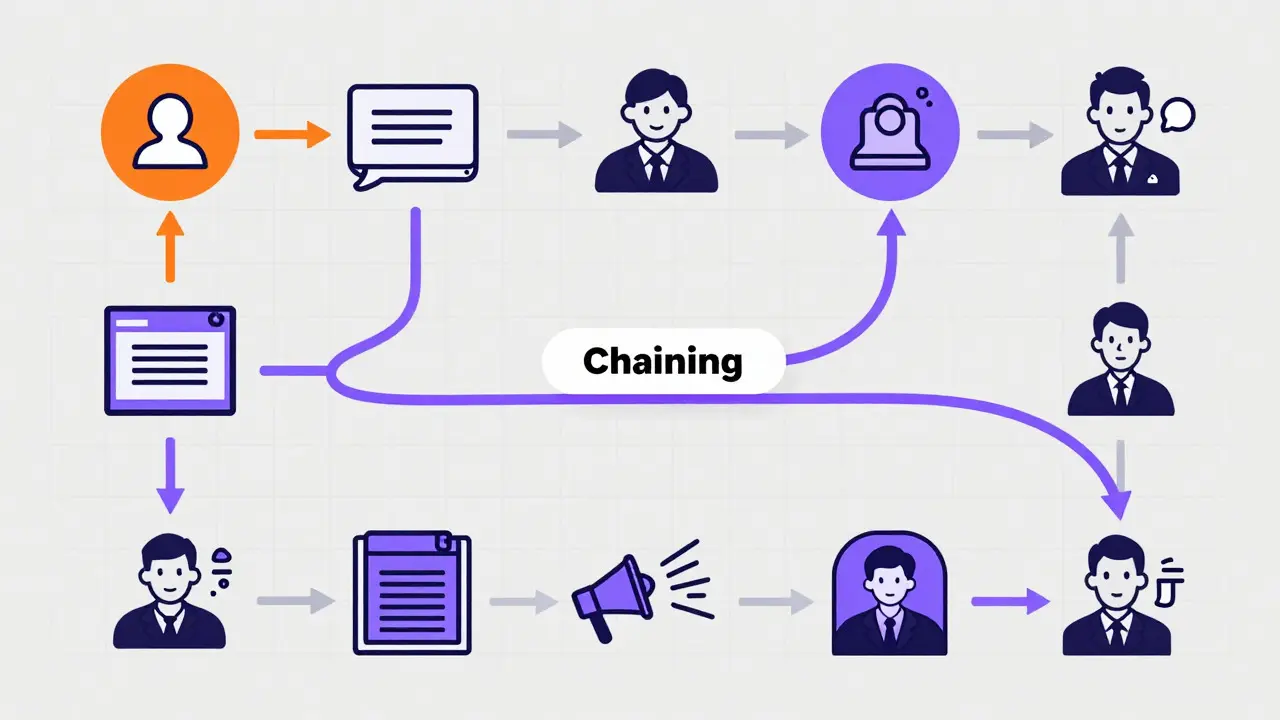
Intent Detection and Chaining in Multi-Turn Conversations
Knowing how a customer feels is useful. Knowing what they want is critical. Intent Detection identifies the underlying goal behind the words. But here’s the challenge: customers rarely state their intent clearly in the first sentence. They meander. They provide context. They change their minds.
Legacy systems could only catch the first intent. Modern LLMs enable "intent chaining." This means the system tracks how the customer's goal evolves over time. A caller might start by asking about a password reset (Intent A), realize they need to update their payment method (Intent B), and then ask about loyalty points (Intent C). The system captures all three, linking them to a single interaction.
This capability allows for simultaneous tracking of multiple intents within one conversation. It helps businesses understand complex customer journeys. If you see a high volume of calls where Intent A leads to Intent B, you might redesign your self-service portal to address both issues upfront, reducing call volume entirely.
Benchmarking Performance: Proprietary vs. General Models
Not all LLMs are created equal for contact centers. You might assume a general-purpose model like GPT-3.5 is sufficient. However, benchmarking studies tell a different story. Observe.AI conducted comparative analyses testing proprietary contact center-specific LLMs against general models.
The results showed that general-purpose models often miss the mark on specialized tasks. Contact center language has unique patterns, jargon, and structures. To fix this, companies test various model sizes-such as 7B, 13B, 20B, and 30B parameters-to find the sweet spot between accuracy and speed. These tests use real-world conversations with sensitive data redacted. Evaluators check if the model correctly identifies the call reason, resolution steps, and sequence of events.
Summarization is a key test case. A good summary isn't just an abstract; it must include the reason for the call, important actions taken, and opportunities presented by the agent. Specialized models trained on contact center terminology consistently outperform general models in these detailed extractions.
| Feature | General-Purpose LLMs (e.g., GPT-3.5) | Proprietary/Fine-Tuned LLMs |
|---|---|---|
| Domain Specificity | Low (Generic language patterns) | High (Trained on call center jargon) |
| Intent Chaining Accuracy | Moderate (Struggles with multi-turn evolution) | High (Optimized for conversational flow) |
| Cost Efficiency at Scale | Variable (Often higher API costs) | Predictable (On-premise or dedicated cloud) |
| Data Privacy Control | Lower (Data sent to third-party servers) | Higher (Can be hosted internally) |
Proactive Trend Detection and FAQ Generation
Reactive analysis tells you what happened. Proactive analysis tells you what will happen next. LLM-driven systems monitor outlier clusters in topic models. If a small cluster of calls starts growing rapidly, it signals an emerging issue. The system uses fast greedy clustering algorithms to re-cluster these outliers, identifying new trends before they become mainstream crises.
If a new call driver emerges that matches no existing category, it’s added as a single-element cluster in an outlier group. This creates an early warning system. Marketing teams can see product confusion spikes. IT teams can spot bug reports before they flood the queue.
These insights also automate knowledge base maintenance. Systems trace call drivers back to original utterances in transcripts using lexical overlap density scores. Then, LLMs like GPT-3.5 analyze samples of 5-20 similar questions to generate FAQ entries. This turns raw conversation data into structured help articles, saving administrators hours of manual curation.
Enhancing Agent Experience and Customer Outcomes
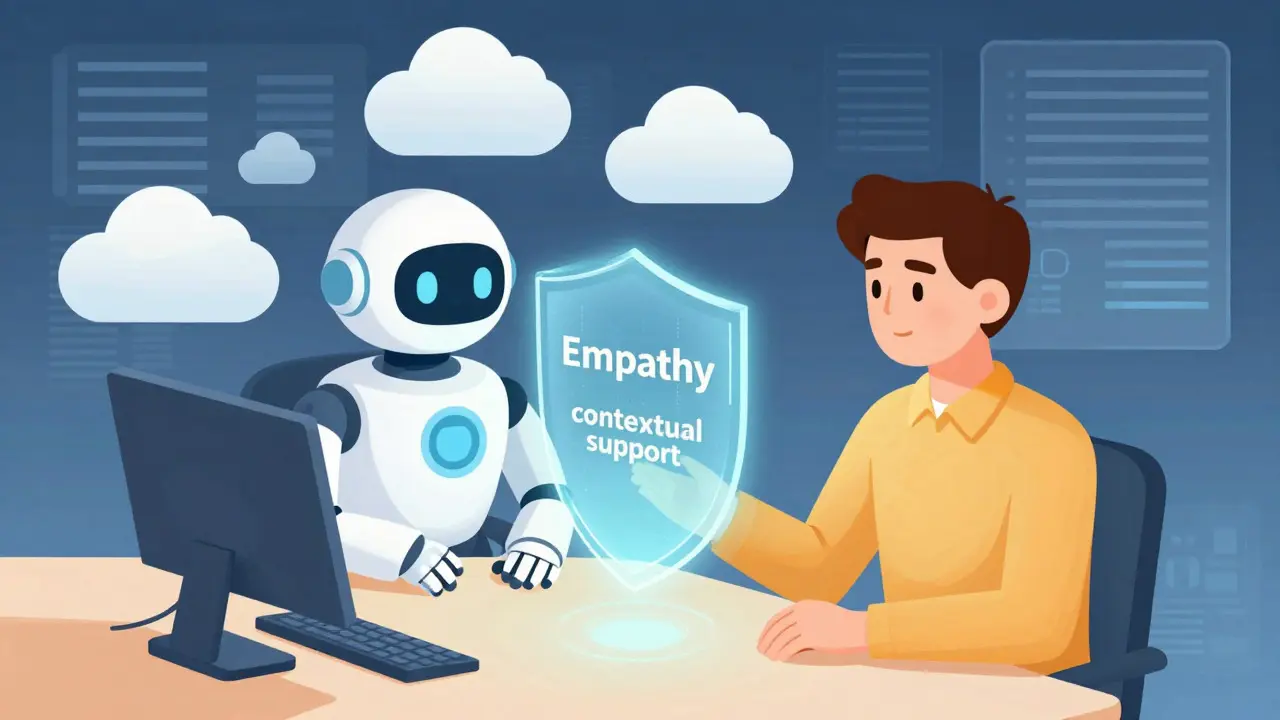
Technology should empower humans, not replace them. In production environments, LLMs act as co-pilots for agents. When a call connects, the system generates welcome responses and pulls up relevant dialog tasks alongside the agent’s desktop interface. It streamlines workflows from start to finish.
Empathy is hard to script. But LLMs excel at contextual empathy. If a customer says, "Things pile up and I can't get to this during the month," the system suggests a response that acknowledges their stress rather than offering a robotic solution. It integrates with knowledge bases to help virtual assistants locate accurate FAQs instantly.
At the end of the interaction, wrap-up notes are automatically summarized for CRM entry. This eliminates the manual documentation burden that causes agent burnout. Agents spend less time typing and more time connecting with customers.
Predictive Analytics and Future Capabilities
The next frontier is prediction. Current systems describe history. Future systems will predict friction. By analyzing sentiment trajectories and intent patterns, models can calculate the likelihood of call escalation or churn risk in real-time. If a customer’s frustration hits a critical threshold, the system can trigger proactive interventions-like offering a supervisor callback or a discount-before the customer hangs up in anger.
Root-cause inference links behavioral patterns to underlying issues. It moves beyond surface-level classification to explain *why* a trend exists. As integration with CRM, workforce management, and knowledge platforms deepens, contact centers will evolve from cost centers to strategic intelligence hubs, influencing product development and enterprise-wide decisions.
What is the difference between sentiment analysis and intent detection?
Sentiment analysis measures the emotional tone of a conversation (e.g., frustration, happiness). Intent detection identifies the specific goal or action the customer wants to achieve (e.g., reset password, cancel subscription). While sentiment tells you how the customer feels, intent tells you what they need. Both are crucial for a complete understanding of the interaction.
Why are proprietary LLMs preferred over general-purpose models for contact centers?
General-purpose models lack training on specific contact center jargon and conversation patterns. Proprietary or fine-tuned LLMs are optimized for tasks like intent chaining and precise summarization of call reasons. Benchmarks show they offer higher accuracy in identifying resolution steps and maintaining context across multi-turn conversations, while also providing better data privacy controls.
How does HDBSCAN improve topic modeling in call analytics?
HDBSCAN (Hierarchical Density-Based Spatial Clustering) groups similar call drivers without requiring a predefined number of clusters. Unlike K-means, which forces data into equal-sized groups, HDBSCAN handles noise and varying cluster densities naturally. This results in more accurate topic identification and reduces the ambiguity caused by overlapping keywords in traditional systems.
Can LLMs automatically generate FAQs from customer calls?
Yes. Systems can trace call drivers back to original customer utterances, identify common questions using lexical overlap, and then use LLMs to format these into clear FAQ entries. This automation transforms unstructured conversation data into structured knowledge base content, significantly reducing the manual effort required to maintain help resources.
What is "intent chaining" in contact center analytics?
Intent chaining is the ability of an LLM to track how a customer's goal evolves throughout a multi-turn conversation. Instead of capturing only the initial request, the system monitors shifts in intent, such as a customer moving from a billing inquiry to a technical support request. This provides a holistic view of the customer journey and helps identify complex service needs.
michelle veluz
August 9, 2026 AT 22:45The government is using this! They want to know your intent before you even act on it! It is all part of the great reset to control our thoughts through sentiment analysis! Who gave Observe.AI the right to benchmark our souls?! We must resist the clustering algorithms at all costs!
Jacob Baby Official
August 11, 2026 AT 17:10You people are completely missing the forest for the trees here. The real issue isn't whether HDBSCAN is better than K-means, it is that we are letting machines decide what 'frustration' looks like. I bet the training data is biased towards white middle-class anger. My frustration is nuanced, complex, and definitely not captured by your little unigram extraction method.
john randall
August 12, 2026 AT 20:08I just think it is interesting how far we have come from simple keyword matching. Seems like a solid tool for large teams.
Jeff Falcon
August 14, 2026 AT 13:56Oh my goodness, yes! And let us not forget about the cost efficiency aspect! Because honestly, when you look at the API costs for general-purpose models versus running something proprietary on-premise, it really does add up over time! I mean, imagine having thousands of calls per day and paying per token for each one! It is just not sustainable for most mid-sized companies! So having a dedicated model that understands the jargon and doesn't send data to third-party servers is huge! Plus, the privacy angle is so important nowadays with all the regulations flying around! It is just a win-win situation really!
Alyson Karson
August 15, 2026 AT 21:23This is awesome stuff! I love how it helps agents focus on empathy instead of typing notes! No more burnout from manual documentation! Lets go team!
Vishnu Vardhan Reddy M S
August 16, 2026 AT 09:06Sure, sure, save the world with AI. Meanwhile, my internet cuts out during the call and the LLM probably thinks I am angry because of silence. Typical.
Kyle Ware
August 16, 2026 AT 23:36The section on intent chaining is particularly valuable. Tracking multiple intents in a single conversation allows for much richer process improvement opportunities than single-label classification ever could
Iva Grekova
August 17, 2026 AT 12:07I really like the idea of proactive trend detection. Catching issues before they become crises sounds like a dream for anyone managing a support team. Hope it works as well in practice as it does on paper!
Onyinyechi Nwosu
August 18, 2026 AT 05:45It is nice to see technology trying to understand human emotion but I worry it will never truly capture the complexity of how we feel especially across different cultures and languages