
Imagine trying to drink from a firehose. That is what happens when you try to feed a petabyte-scale dataset into a large language model (LLM) without proper infrastructure. The GPU sits idle, waiting for data that never arrives fast enough. This bottleneck isn't just annoying; it wastes thousands of dollars in compute credits every hour. The solution lies in two critical components: efficient sharding and optimized data loading pipelines.
Sharding is the process of splitting massive datasets into smaller, manageable chunks called shards. These shards are then distributed across multiple storage nodes and compute devices. When done correctly, sharding ensures that your GPUs stay busy processing tokens instead of waiting for I/O operations. In this guide, we break down how to structure these shards, load them efficiently, and scale your training pipeline to handle petabytes of data.
The Core Problem: Why Raw Files Fail at Scale
You might think storing millions of JSON lines or image files in a standard folder is fine. It works for small projects. But when you hit the terabyte range, and especially the petabyte range, traditional file systems collapse under their own weight. The metadata overhead becomes unmanageable. Reading thousands of tiny files creates massive latency because each read operation requires a network round-trip and disk seek time.
This is where sharding changes the game. Instead of millions of individual files, you compress and serialize data into larger binary objects. Common formats include .tar, .tgz, or compressed variants like .tar.lz4. By grouping samples into shards, you reduce the number of open/close operations significantly. This approach allows storage systems to stream data continuously rather than jumping around randomly.
| Approach | File Count | I/O Latency | Scalability |
|---|---|---|---|
| Raw Individual Files | Millions | High (many seeks) | Poor |
| Sharded Archives (.tar/.lz4) | Thousands | Low (sequential reads) | Excellent |
| Lakehouse Formats (Iceberg/Delta) | Managed by Metadata | Medium (metadata lookup) | Good |
Architecture: Tiered Storage for Petabyte Workloads
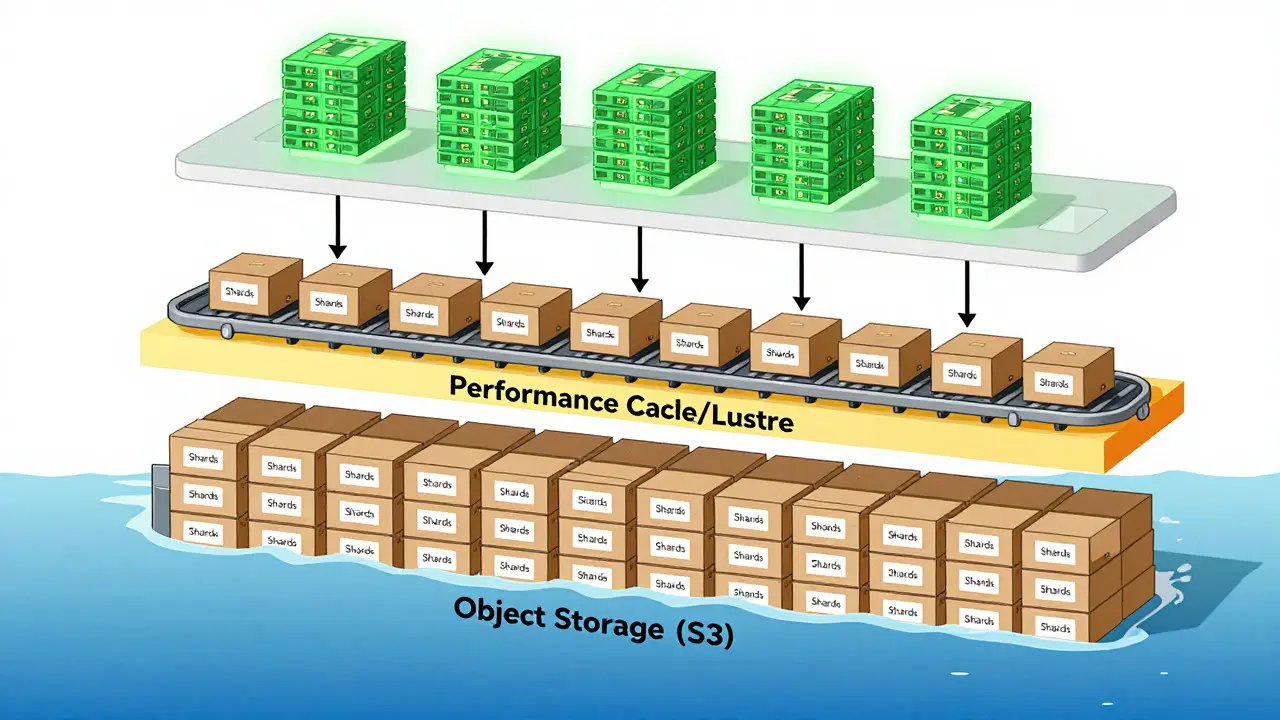
No single storage system can handle both cost-efficiency and high-speed access simultaneously. You need a tiered architecture. At the bottom layer, you have object storage like AWS S3, Google Cloud Storage, or Azure Blob Storage. This is your cold storage. It’s cheap, durable, and holds your entire petabyte dataset. However, reading directly from S3 during training is too slow for modern GPU clusters.
The middle layer is your performance cache. This could be a distributed file system like Lustre, GPFS, or WekaIO. Alternatively, many teams use high-performance caching layers closer to the compute nodes. The strategy here is simple: stage the active shards needed for the current training epoch into the fast layer. As the model progresses through epochs, new shards are pulled from object storage while old ones are evicted. This keeps the most frequently accessed data on low-latency media.
Data lakes and lakehouses add another layer of sophistication. Technologies like Apache Iceberg, Delta Lake, and Hudi sit on top of object storage. They provide transactional capabilities, schema evolution, and efficient metadata management. While they don’t replace the need for sharding, they help manage the lifecycle of your shards, ensuring that only clean, validated data enters the training pipeline.
Data Loading Frameworks: Keeping GPUs Busy
Having sharded data is only half the battle. You need a framework to coordinate which node reads which shard. If Node A reads Shard 1 and Node B also tries to read Shard 1, you create network contention. Efficient frameworks distribute shards evenly and prefetch data for upcoming batches.
Popular tools include PyTorch’s DistributedSampler combined with DataLoader, TensorFlow’s tf.data API, NVIDIA DALI, and WebDataset. WebDataset is particularly popular for vision-language models because it handles streaming tar files natively. It avoids decoding the entire archive, allowing you to jump to specific samples within a shard quickly.
One critical feature to look for is global shuffling. Simply randomizing shards locally on each node introduces bias. Your training data must be shuffled globally across all nodes. Some implementations achieve this by shuffling shard names centrally and using client-side buffers to mix samples further. This ensures that no two nodes see the same sequence of data, improving model generalization.
Sharded Data Parallelism vs. Tensor Parallelism
When training massive models, memory becomes the primary constraint. A single GPU cannot hold the parameters, gradients, and optimizer states for a 70-billion-parameter model. This is where parallelism strategies come in.
Standard data parallelism replicates the entire model on every GPU. Each GPU processes a different batch of data. Then, gradients are aggregated using an AllReduce operation. This works well for smaller models but fails when the model exceeds GPU memory.
Sharded Data Parallelism (SDP) solves this by splitting the optimizer states and gradients across GPUs. Each GPU only holds a fraction of the total state. This reduces memory usage dramatically. However, SDP alone doesn’t split the model weights themselves. For that, you need Tensor Parallelism (TP).
Tensor Parallelism splits the model’s matrix multiplications across multiple GPUs. Combining SDP and TP allows you to train enormous models on large clusters. For example, Amazon SageMaker supports configurations where you use degree-2 SDP with degree-64 TP. This hybrid approach lets you fit models like GPT-NeoX-65B onto clusters of 64 or more instances.
| Strategy | Memory Savings | Communication Overhead | Best Use Case |
|---|---|---|---|
| Data Parallelism | None | Low | Small models, single GPU fits |
| Sharded Data Parallelism | High (optimizer states) | Medium | Large models, limited VRAM |
| Tensor Parallelism | High (model weights) | High (all-to-all) | Massive models, multi-GPU nodes |
| Hybrid (SDP + TP) | Very High | Complex | Petabyte-scale training |
Optimizing Batch Size and Throughput
Batch size selection is not arbitrary. It directly impacts convergence speed and memory usage. In sharded environments, you start with a small batch size per GPU and increase it until you hit out-of-memory (OOM) errors. If even batch size 1 causes OOM, you need to increase the degree of sharding or tensor parallelism.
Consider a cluster of 1,536 GPUs. With sharded data parallelism degree 32 and batch size 1 per GPU, you get a global batch size of 1,536. If you combine this with tensor parallelism, the effective global batch size might drop to 768. You must balance these settings to maximize throughput without starving the GPUs.
Network bandwidth between storage and compute is often the hidden bottleneck. Ensure your storage network (InfiniBand or high-speed Ethernet) matches the aggregate bandwidth of your GPUs. If your GPUs can process 100 GB/s but your storage delivers only 50 GB/s, you’re wasting 50% of your compute power.

Practical Implementation Steps
- Serialize Data: Convert raw files into sharded archives using tools like
ishardor custom scripts. Aim for shard sizes that balance I/O efficiency and flexibility (e.g., 100MB-1GB per shard). - Set Up Tiered Storage: Store shards in object storage. Configure a caching layer or distributed file system for active training data.
- Choose a Loader: Implement WebDataset or PyTorch DataLoader with
DistributedSampler. Enable prefetching and multi-worker loading. - Configure Parallelism: Determine the optimal mix of SDP and TP based on your model size and GPU count. Start with SDP if memory is tight.
- Monitor Metrics: Track GPU utilization, data loading latency, and network throughput. Adjust shard sizes and buffer depths if GPUs idle frequently.
Common Pitfalls to Avoid
- Ignoring Shuffle Bias: Local shuffling leads to correlated batches across nodes. Always implement global shuffle logic.
- Over-Sharding: Too many small shards increase metadata overhead. Keep shards large enough to minimize open/close calls.
- Underestimating Network Costs: Cross-AZ or cross-region data transfers add latency and cost. Keep storage and compute in the same region.
- Static Configurations: Different models require different parallelism degrees. Don’t lock yourself into one setup.
Future Trends in Data Infrastructure
As models grow larger, the demand for efficient data handling increases. Recent research shows that domain adaptation can achieve competitive results with smaller, focused datasets. For instance, cybersecurity LLMs trained on 118.8 million tokens outperformed models trained on billions. This suggests that quality and relevance matter more than sheer volume.
However, pretraining still requires petabytes. The industry is moving toward smarter sharding strategies that prioritize high-quality samples. Techniques like curriculum learning, where easier samples are processed first, benefit from flexible shard organization. Tools like ishard allow you to group samples by category or difficulty, enabling dynamic data selection during training.
What is the ideal shard size for LLM training?
There is no one-size-fits-all answer, but shards between 100MB and 1GB are common. Smaller shards increase metadata overhead, while larger shards reduce flexibility. Test different sizes to find the sweet spot for your storage system and loader.
How does sharding improve GPU utilization?
Sharding enables sequential reads and reduces I/O latency. By distributing shards across nodes and prefetching data, you ensure that GPUs receive data as soon as they finish processing the previous batch, minimizing idle time.
Can I use standard file systems for petabyte datasets?
Not effectively. Standard file systems struggle with millions of small files due to metadata bottlenecks. Object storage with sharded archives or distributed file systems like Lustre are better suited for petabyte-scale workloads.
What is the difference between Sharded Data Parallelism and Tensor Parallelism?
Sharded Data Parallelism splits optimizer states and gradients across GPUs to save memory. Tensor Parallelism splits the model weights and computations across GPUs. Combining both allows training of very large models on limited hardware.
How do I handle data shuffling in a distributed environment?
Use global shuffling techniques. Shuffle shard names centrally before distribution, and use client-side buffers to mix samples further. This prevents bias caused by local shuffling and ensures diverse batches across all nodes.
Vishnu Vardhan Reddy M S
August 6, 2026 AT 11:55Oh look, another guide telling us that JSON lines are slow. Shocking. I mean, who didn't know that reading millions of tiny files is basically asking for a system crash? But thanks for the sarcasm-free reminder that we should probably use tar.lz4 instead of just throwing raw data at GPUs and hoping for the best.
Kyle Ware
August 8, 2026 AT 06:18webdataset is definitely the way to go if you are dealing with vision language models. it handles streaming tar files natively which saves so much headache compared to decoding entire archives. just make sure your loader supports global shuffling otherwise you might introduce bias into your training data
Iva Grekova
August 9, 2026 AT 08:40Iva here. Just wanted to say this breakdown on tiered storage is super helpful. It’s crazy how many teams still try to read directly from S3 during training without any caching layer. The latency alone must be killing their GPU utilization rates. Glad to see more people talking about Lustre or GPFS as middle layers.
Onyinyechi Nwosu
August 10, 2026 AT 05:38the part about ignoring shuffle bias really hit home. we had similar issues where local shuffling caused correlated batches across nodes and it took forever to realize why our model wasnt generalizing well. always implement global shuffle logic folks
Chandan Singh
August 10, 2026 AT 12:50Actually, the claim that standard file systems collapse under their own weight is a bit hyperbolic. Modern POSIX-compliant filesystems like XFS or ZFS can handle millions of small files quite efficiently if tuned correctly. The real issue is usually network I/O bottlenecks rather than metadata overhead per se. Also, suggesting .tar.lz4 as the only solution ignores the benefits of columnar formats like Parquet for certain types of structured LLM data preprocessing tasks before tokenization.
Brannen Hall
August 11, 2026 AT 08:23Who cares about sharding when the model architecture itself is flawed? Most of these petabyte-scale efforts are just burning cash on inefficient compute because the underlying algorithms haven't improved in years. You can optimize your data loading until you're blue in the face but if your attention mechanism is O(n^2) you're still screwed. Also, hybrid SDP+TP is overkill for most use cases unless you're literally training GPT-4 sized models which 99% of companies aren't doing.