
Have you ever wondered how an AI knows that the word "bank" in one sentence refers to a river edge, while in another it means a financial institution? Or how it remembers a character's name from the first chapter of a novel when discussing them in the last? The answer lies hidden inside the black box of Large Language Models, which are artificial intelligence systems designed to understand and generate human language by processing vast amounts of text data. These systems rely on a mechanism called attention to make sense of the chaos of human communication.
At its core, attention is not about paying focus in the human sense. It is a mathematical calculation that assigns weights to input tokens based on their importance. When a model processes a sequence of text, it calculates query, key, and value mappings. By multiplying the query and key, the model determines which elements in the input should receive focus. This allows the system to give greater emphasis to relevant tokens while ignoring the noise. Without this mechanism, words would just be isolated numbers floating in a void, devoid of context or connection.
The Foundation: Embeddings and Tokenization
Before attention can do its work, the text must be transformed. Large language models like ChatGPT-3 contain approximately 175 billion parameters and between 60 to 80 billion neurons. To process language, these models break down words or fragments of words-roughly 50,000 unique units-into numerical values called "tokens." This process is known as tokenization. Once tokenized, these inputs are fed into the embedding layer.
The embedding layer serves as the foundational component that creates vector embeddings from input text. In ChatGPT-3 specifically, this requires 12,228 dimensions to capture all the complex nuances of words and their relationships with one another. Think of this as placing every word in a massive multi-dimensional space where similar concepts cluster together. This mathematical representation captures both the semantic and syntactic meaning of the input, enabling the model to contextually understand words and their relationships before the attention mechanism even begins its calculations.
Syntax vs. Semantics: What LLMs Actually Understand
There is a common misconception that because an LLM writes grammatically correct sentences, it understands grammar rules. Syntax refers to the definite, unambiguous grammatical rules about how words fit together to convey meaning. Large language models guess the syntactic structure of a language by recognizing regularities and patterns from all the text in their training data. They operate similarly to a native English speaker who may never have studied formal English grammar in school but knows what kinds of words are likely to follow in a series given the context. Machine learning has automated much of the model-development process, allowing ML-driven models to perform as well as, if not better than, traditional counterparts in predicting word sequences.
Semantics, however, represents a deeper, more complex constraint on language beyond syntax. While syntax provides rules for how words fit together, semantics requires that words also make sense and communicate actual meaning. Semantics assumes a model of the world where logic, natural laws, and human perceptions play a significant role. Humans possess an almost innate knowledge of this world model-often called "common sense"-and apply it unconsciously in everyday speech. The question of whether ChatGPT-3, with its 175 billion parameters, has implicitly discovered a "Model of Language" or somehow deciphered the law of semantics remains incompletely answered. Despite its remarkable capabilities, ChatGPT has discovered some semblance of structure in human language in a statistical way rather than algorithmically replicating systematic human language.
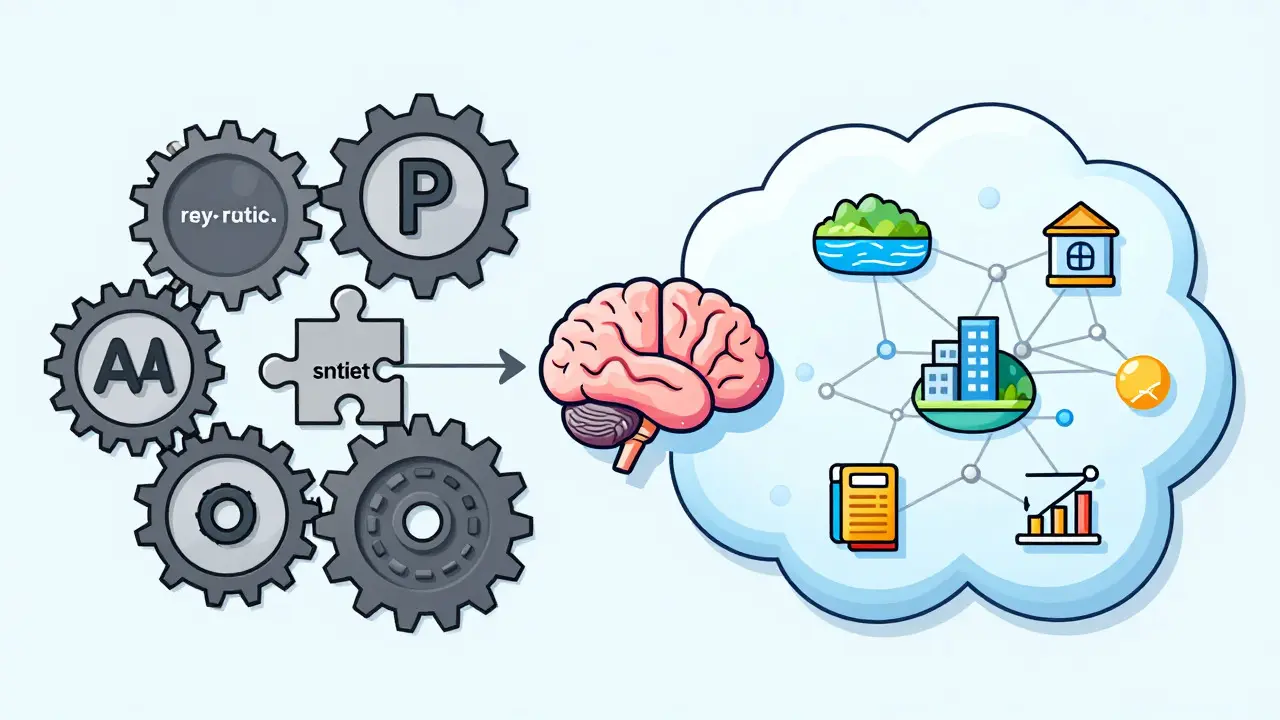
Capturing Long-Range Dependencies
One of the biggest hurdles in early AI was handling long-range dependencies. In older models like Long Short-Term Memory (LSTM) networks, information had to pass through a sequential chain, often leading to the loss of earlier details. Transformer models work with self-attention mechanisms, which enable these models to learn more quickly primarily by allowing parallel processing of information. Self-attention is what enables transformer models to capture relationships between words, even those far apart in a sentence, better than older models.
The attention heads in transformer architectures examine blocks of sequences of embedded vectors written so far. For each block, attention heads reweigh or "transform" them into a new vector that is then passed through the fully connected neural net layer. This process occurs continuously through the entire sequence of texts as new texts are added. The attention head transformation functions as a way of looking back at the sequences of words thus far, repackaging the past string of texts so that the model can anticipate what new text might be added. This mechanism enables ChatGPT to understand, for instance, that a verb and adjective appearing after a sequence modifies the noun from a few words back.

The Positional Problem and the Rise of PaTH Attention
Despite these capabilities, existing cutting-edge attention mechanisms within transformers have theoretical and empirical limitations when it comes to state changes and sequential reasoning. Most languages use word position and sentence structure to extract meaning-for example, "The cat sat on the box" is not the same as "The box was on the cat." Over long texts like financial documents or novels, the syntax of words likely evolves. A person might track variables in a piece of code or follow instructions with conditional actions, representing examples of state changes and sequential reasoning that state-of-the-art AI systems are expected to excel at. However, the existing attention mechanism alone does not inherently understand word order. While attention mechanisms allow an LLM to look back at earlier parts of a query or document, this mechanism sees all input words simultaneously and handles them in the order presented. Researchers developed techniques to encode position information to address this limitation, traditionally using methods like Rotary Position Embedding (RoPE).
Recent advances have challenged these static approaches. MIT and the MIT-IBM Watson AI Lab developed an encoding technique known as "PaTH Attention," released in December 2025. This method makes positional information adaptive and context-aware rather than static, as with RoPE. Instead of assigning every word a fixed rotation based on relative distance between tokens, as RoPE does, PaTH Attention is flexible. It treats the in-between words as a path made up of small, data-dependent transformations. Each transformation, based on a mathematical operation called a Householder reflection, acts like a tiny mirror that adjusts depending on the content of each token it passes. Each step in a sequence can influence how the model interprets information later on, and the cumulative effect allows the system to model how meaning changes along the path between words, not just how far apart they are.
Performance Improvements and Future Directions
Testing of PaTH Attention on synthetic and real-world tasks has demonstrated significant improvements. MIT-IBM researchers explored PaTH Attention's performance on reasoning, long-context benchmarks, and full LLM training to determine whether it improved the model's ability to track information over time. The team tested its ability to follow the most recent "write" command despite many distracting steps and multi-step recall tests, tasks that are difficult for standard positional encoding methods like RoPE. Results showed that PaTH Attention improved perplexity and outcompeted other methods on reasoning benchmarks it was not trained on. When researchers trained mid-size LLMs and compared them against other methods, PaTH Attention demonstrated superior performance. The researchers also evaluated retrieval, reasoning, and stability with inputs of tens of thousands of tokens, and PaTH Attention consistently proved capable of content-awareness. According to the MIT researchers, "both on diagnostic tasks that are designed to test the limitations of transformers and on real-world language modeling tasks, our new approach was able to outperform existing attention mechanisms, while maintaining their efficiency".
Further innovation combined PaTH Attention with another position encoding scheme known as the Forgetting Transformer (FoX), which allows models to selectively "forget." The resulting PaTH-FoX system adds a way to down-weight information in a data-dependent way, achieving strong results across reasoning, long-context understanding, and language modeling benchmarks. In this way, PaTH Attention extends the expressive power of transformer architectures and makes it more similar to how human cognition works, where people ignore old or less-relevant information when making decisions. Researchers have expressed interest in whether these types of data-dependent position encodings, like PaTH, would improve the performance of transformers on structured domains such as biology, in analyzing proteins or DNA.
| Feature | RoPE (Rotary Position Embedding) | PaTH Attention |
|---|---|---|
| Position Handling | Static rotation based on relative distance | Adaptive, context-aware transformations |
| Mathematical Basis | Fixed rotation matrices | Householder reflections |
| State Tracking | Limited over long sequences | Strong "positional memory" |
| Efficiency | High | Maintains efficiency while improving accuracy |
The attention mechanism's ability to process information in parallel and capture long-range dependencies has made it fundamental to modern LLM architecture. When given a prompt such as "The best thing about ChatGPT is its ability to," ChatGPT calculates probability distributions for the next token. The probabilities for common continuations might be: "learn" (4.5%), "predict" (3.5%), "make" (3.2%), "understand" (3.1%), and "do" (2.9%). Once a token is chosen in the sequence of texts, the entire process-involving embedding, attention transformation, and probability calculation-repeats for the next position. This iterative process, powered by attention mechanisms that look back at previous context while maintaining awareness of word position and meaning, generates coherent and contextually appropriate text. The evolution of attention mechanisms from standard transformer attention to innovations like PaTH Attention represents the ongoing refinement of how LLMs process and understand the complex relationships between syntax, semantics, and positional information across long sequences of text.
What is the difference between syntax and semantics in LLMs?
Syntax refers to the grammatical rules of how words fit together, which LLMs learn statistically from patterns in training data. Semantics refers to the actual meaning and logical coherence of the text, which relies on a "model of the world" that humans possess innately but LLMs only approximate through statistical correlations.
How does PaTH Attention improve upon RoPE?
RoPE uses static rotations based on the distance between tokens. PaTH Attention uses adaptive, data-dependent transformations (Householder reflections) that treat the path between words as a series of mirrors adjusting to content. This allows the model to track how meaning changes over time and improves performance on long-range dependency and reasoning tasks.
Why are long-range dependencies important for LLMs?
Long-range dependencies allow the model to connect information that is far apart in a text, such as remembering a variable defined at the start of a code file or a character trait mentioned in the first chapter of a book. Standard attention mechanisms struggle with this over very long contexts, leading to errors in sequential reasoning.
What is the role of the embedding layer in a transformer?
The embedding layer converts input tokens into high-dimensional vectors (e.g., 12,228 dimensions in ChatGPT-3). These vectors capture the semantic and syntactic relationships between words, placing similar concepts close together in a mathematical space before the attention mechanism processes them.
Can LLMs truly understand common sense?
Not in the human sense. Humans have an innate "model of the world" involving logic and physical laws. LLMs discover structures in language statistically. While they can mimic common sense responses effectively, they do not possess an algorithmic understanding of systematic human language or physical reality.