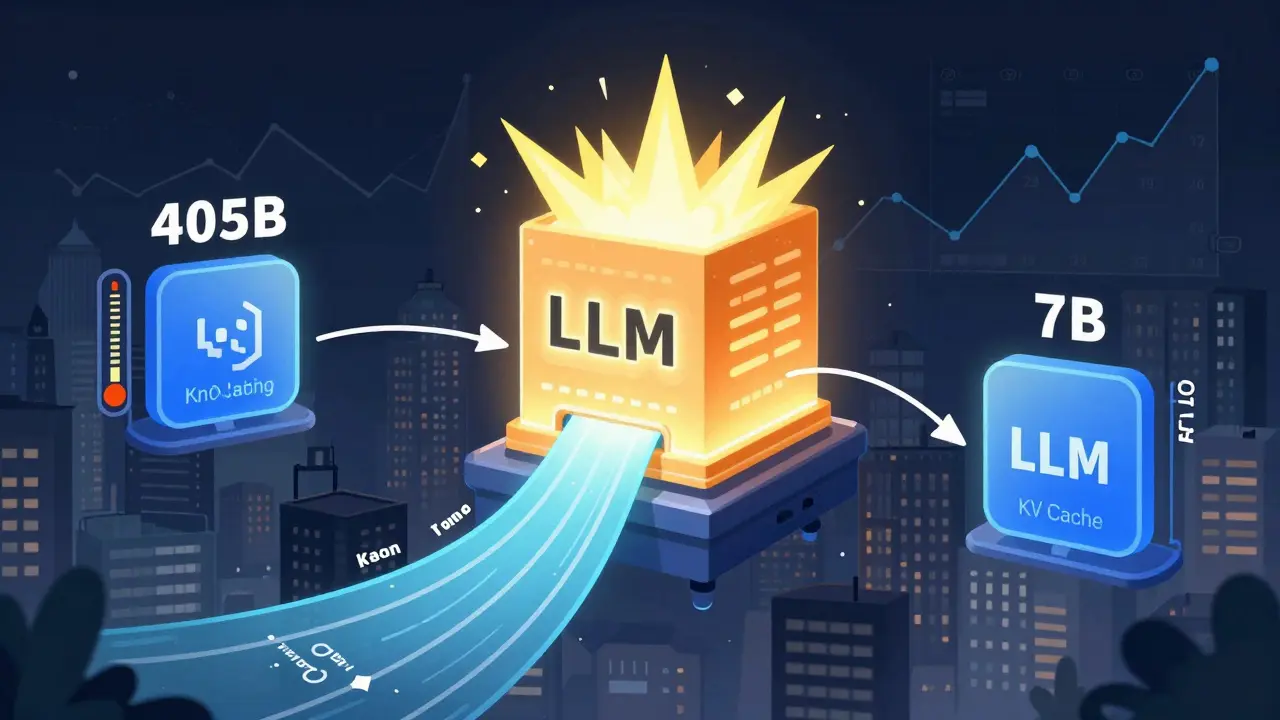
When you run a large language model (LLM) in production, you don’t just pay for training it-you pay for every single question it answers. That’s inference. And if you don’t know how much inference your users will demand tomorrow, next week, or next quarter, you’re flying blind. Too much capacity? You’re wasting money. Too little? Your users hit timeouts, your app slows down, and your reputation takes a hit. The key isn’t just having a powerful model-it’s knowing when and how much you’ll need it.
Why Inference Demand Matters More Than You Think
Most companies focus on training bigger models. Bigger parameters. More data. But research shows that’s not always the right move. A 1B-parameter model with smart inference-time scaling can outperform a 405B model that’s just brute-forced through requests. Why? Because inference demand isn’t steady. It spikes. It drops. It follows marketing campaigns, product launches, news cycles, even weather patterns. If you train a massive model based on guesswork, you’re locking yourself into high costs without knowing if you’ll ever use it. The real question isn’t “How big should our model be?” It’s “How much will we actually use it?” That’s where inference demand estimation comes in. It’s not a side task. It’s the foundation for every major decision: which models to train, how much hardware to buy, whether to deploy multiple models, and how to schedule them efficiently.The Four Ways to Forecast LLM Inference Demand
There are four main approaches to predicting inference demand. Each has trade-offs in accuracy, cost, and complexity.- Traditional statistical models like ARIMA and exponential smoothing look at past usage patterns and extrapolate. They’re simple, cheap, and easy to explain. But they break down when demand gets weird-like when a viral tweet causes a 10x spike in queries. These models assume smooth trends. LLM usage rarely follows them.
- Machine learning models (Random Forest, Gradient Boosting) change the game. They don’t just look at time series data. They combine it with external signals: marketing calendars, news headlines, app store updates, even social media sentiment. One company using this approach cut forecast errors by 31% and improved spike detection by 47%. They didn’t just predict usage-they understood why it changed.
- Deep learning models like LSTM and GRU networks are built for temporal patterns. They can spot multi-day cycles, irregular bursts, and delayed responses between events and usage. But they need tons of data and serious GPU power. If you’re a startup with 6 months of logs, this isn’t your tool.
- LLM-based forecasting is the newest twist. Instead of coding a model, you prompt an LLM: “Based on last month’s traffic and this week’s product launch, how many queries will we get next Tuesday?” These models work surprisingly well with clear trends and seasonality. But they’re expensive to run, and you need someone who knows how to craft the right prompts.
The ALA Framework: Where Analytics Meets Learning
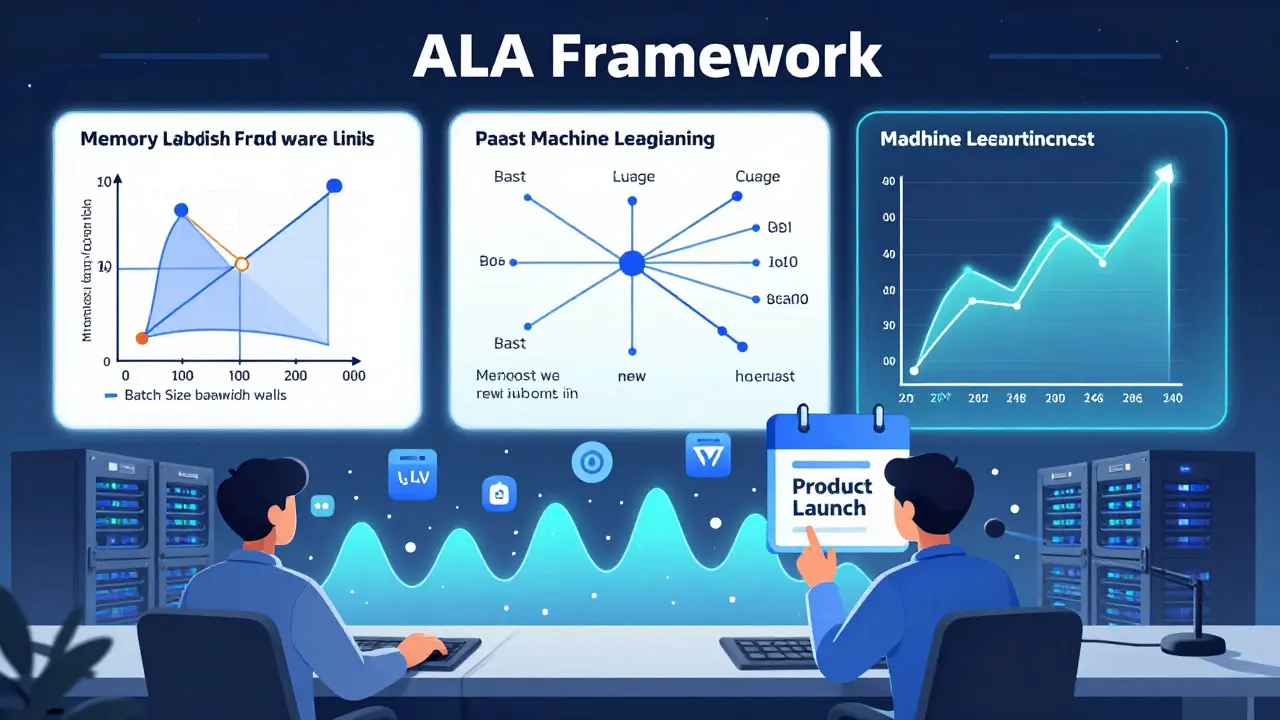
There’s a smarter way to combine these approaches. Enter the Analytical with Learning Augmentation (ALA) framework. It doesn’t pick one method-it blends them. First, ALA builds a mathematical model of how your hardware performs under different loads. It knows, for example, that doubling batch size from 8 to 32 boosts throughput-but beyond 64, you hit a wall because of memory bandwidth limits. This is the analytical part: grounded in physics and system design. Then, it uses machine learning to predict what happens when you try a configuration you’ve never tested. Say you want to run 128 simultaneous requests with a new quantization scheme. You haven’t benchmarked it. ALA looks at similar past runs, measures how close they are in vector space, and estimates performance with confidence intervals. It doesn’t guess. It calculates uncertainty. This matters because you can’t benchmark every possible combination of model size, batch size, quantization, and hardware. ALA lets you simulate thousands of scenarios with just a few real-world tests. That’s how you avoid overbuying servers or under-provisioning for peak traffic.How Inference Demand Directly Shapes Training Choices
Forecasting isn’t just about ops-it’s about R&D. Here’s how demand estimates change your training strategy:- Size matters less than efficiency. If your users mostly ask short questions, a smaller model with optimized KV caching and chunked prefill (like vLLM supports) might be better than a giant one. Training a 7B model is 10x cheaper than a 70B one. If your demand forecast shows 80% of queries are under 100 tokens, you save millions.
- Multi-model deployment beats one-size-fits-all. If demand spikes on weekdays but drops on weekends, you don’t need to keep your biggest model running 24/7. Forecasting tells you when to activate lightweight models for off-peak hours and scale up only when needed.
- Training becomes ROI-driven. If your forecast shows 80% of users come from one region, and you’re training a model optimized for English, you’re wasting compute. Demand data tells you where to focus.
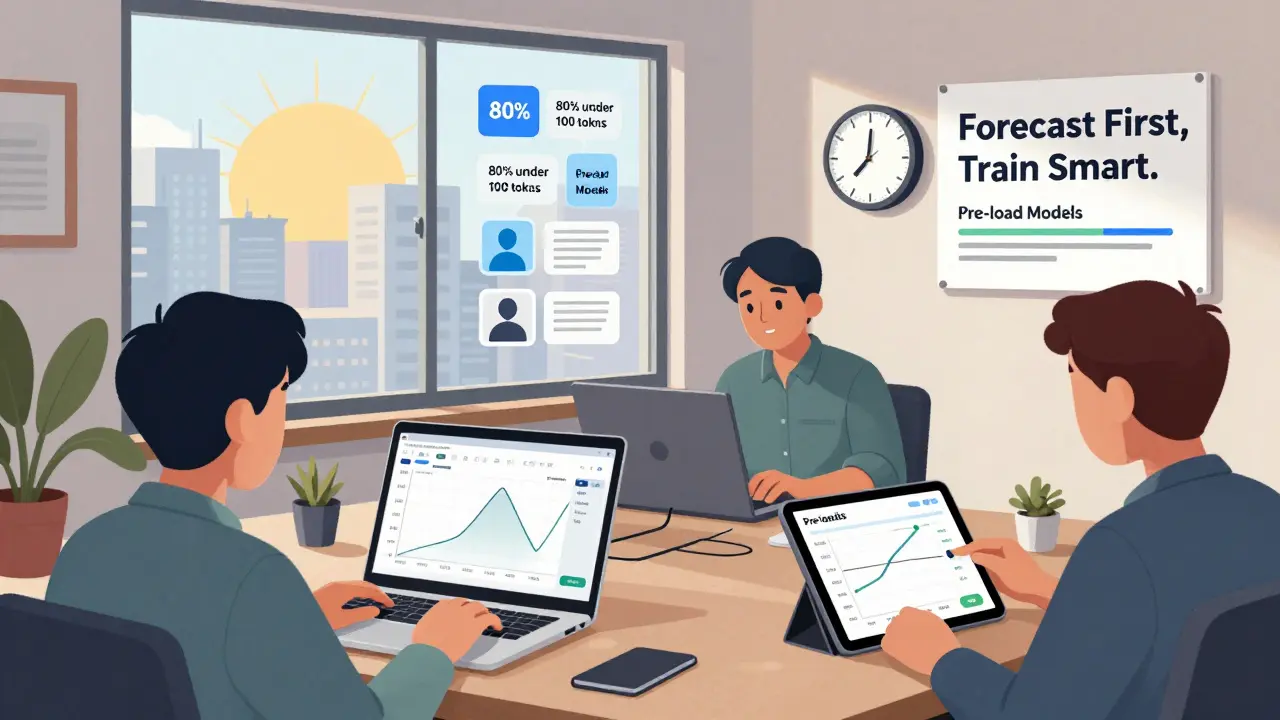
- Cost optimization starts at the inference layer. If you know a spike is coming (say, after a product announcement), you can pre-load models into memory, use speculative decoding, or shift traffic to cheaper spot instances. These tactics only work if you predict ahead.
Real Tools That Make This Work
You can’t forecast demand without the right infrastructure. The vLLM serving framework is now the industry standard for a reason. It’s built for dynamic demand:- Continuous batching groups incoming requests dynamically, reducing idle time.
- PagedAttention lets you handle massive context windows without crashing memory.
- KV caching reuses previously computed attention states-huge savings for repeated queries.
- Speculative decoding uses a smaller model to guess the next tokens, then verifies with the main one. Speeds up responses by 30-50%.
What You Should Do Today
You don’t need a PhD to start. Here’s how to begin:- Collect your data. Log every inference request: prompt length, response time, user ID, timestamp, region. Don’t skip this.
- Plot your usage. Look for spikes. Are they tied to marketing? Product releases? Holidays? Correlate them.
- Try a simple ML model. Use scikit-learn or Prophet to predict next week’s demand. Compare it to your actual usage. See where it fails.
- Integrate external signals. Add calendar events, news feeds, or app update logs. Even one extra signal can double your accuracy.
- Test scheduling. Use your forecast to pre-load models before expected spikes. Measure latency reduction.
Why can’t I just train a bigger model to handle all demand?
Bigger models cost more to train and run. A 405B model might handle 10x more queries than a 1B model-but if your users only generate 2x the traffic, you’re paying 50x more for nothing. Inference demand forecasting shows you exactly how much capacity you need. Often, optimizing a smaller model with better scheduling and caching gives you better results than scaling up.
Can I use LLMs to forecast their own inference demand?
Yes-but with caveats. LLMs can analyze natural language inputs like “We launched a new feature on March 1. How many users will ask about it next week?” and give decent estimates if the pattern is clear. But they’re expensive to run, need expert prompting, and can hallucinate. They work best as a supplement to traditional forecasting, not a replacement.
What’s the minimum data I need to start forecasting?
You need at least 30 days of daily inference logs: number of requests per hour, average prompt length, and response time. Even with this little data, you can spot weekly patterns, weekend drops, and anomalies. Start simple: use a tool like Prophet or a basic linear regression with time-of-day features. You don’t need deep learning to get 80% of the value.
How does inference demand affect which models I should train next?
If your demand is mostly short, simple questions, train a smaller, faster model. If you see long-form reasoning tasks increasing, invest in models with larger context windows. If spikes are tied to specific regions, train region-specific versions. Demand data tells you what users actually do-not what you assume they should do.
Is inference forecasting only for big companies?
No. Even small teams benefit. A startup with 10,000 daily queries can save thousands per month by using forecasting to avoid over-provisioning. Tools like vLLM and open-source ML libraries (scikit-learn, Prophet) are free. The biggest barrier isn’t tech-it’s awareness. Start logging. Start looking for patterns. You don’t need a team of data scientists to get started.
Jane San Miguel
February 17, 2026 AT 22:43Let’s be real-most engineering teams treat inference forecasting like an afterthought, as if LLMs are some magical black box that just ‘works.’ But this post nails it: you can’t optimize what you don’t measure. The ALA framework isn’t just clever-it’s the only sane approach when you’re dealing with non-stationary demand patterns. I’ve seen teams burn millions on 70B models because they assumed ‘bigger is better.’ Meanwhile, a 7B model with dynamic batching and predictive KV caching outperformed them by 22% on latency and cost. The data doesn’t lie. Start logging. Start correlating. Stop guessing.
Kasey Drymalla
February 19, 2026 AT 05:23they're lying. this is all a ploy by nvidia to sell more a100s. you dont need to forecast demand. you just need to buy 10x more servers and call it a day. the real enemy is open source models. they're making big tech look bad. they dont want you to know this. they want you to think you need all this fancy math. its a scam.
Dave Sumner Smith
February 19, 2026 AT 10:09forecasting demand? sure. but have you considered that your logs are being manipulated by internal telemetry pipelines? i've worked at three different ai startups and every single one had a backdoor that sent usage data to a shadow analytics cluster owned by a third party. you think you're optimizing your model? you're feeding a surveillance state. the real question isn't how much demand you'll get-it's who's watching your users' prompts. and why. they're building behavioral profiles. and they're selling them. you're not running an llm. you're running a data harvesting operation disguised as a service.
Cait Sporleder
February 20, 2026 AT 06:14It is both fascinating and profoundly unsettling to observe the degree to which the operational architecture of large language models has evolved from a purely algorithmic endeavor into a complex, multi-layered systems engineering challenge that intersects with behavioral economics, real-time resource allocation, and predictive analytics. The notion that inference demand-often treated as a secondary metric-is, in fact, the primary determinant of model selection, hardware procurement, and even training strategy, represents a paradigmatic shift in how we conceptualize artificial intelligence deployment. One cannot help but be struck by the irony that, while the field obsesses over parameter count and training corpus size, the most consequential variable remains the temporal and contextual behavior of end users, whose interactions are neither uniform nor predictable, yet are the very force that dictates economic viability. The ALA framework, in its elegant synthesis of analytical modeling and machine learning augmentation, does not merely improve efficiency-it redefines the epistemology of AI operations, forcing us to acknowledge that intelligence, in practice, is not a function of model size, but of adaptive responsiveness.
Nathaniel Petrovick
February 21, 2026 AT 05:46agreed. i tried the simple ml route with prophet last month and it cut our cloud bill by 40%. no joke. we were running 4x the instances we needed on weekends. now we auto-scale down and just use spot instances for off-peak. the real win? our latency got better because we weren't overloading the gpu. start small. log your requests. you don't need a team. just a script and some curiosity.
Honey Jonson
February 21, 2026 AT 16:22omg yes!! i just started logging our 5k daily queries and found out our spike every tuesday at 3pm was from one department doing automated reports. we moved it to off hours and saved like 600/mo. dont overthink it. just look at your data. its kinda fun like detective work lol :)
Destiny Brumbaugh
February 22, 2026 AT 06:57usa built this. china is copying our infrastructure. if you're using open source tools to forecast demand, you're helping foreign governments steal our tech. this whole post is just a distraction. we need to build our own models, on our own hardware, with american data. no more outsourcing inference. no more foreign cloud providers. america leads. or we fall behind.
Sara Escanciano
February 22, 2026 AT 21:33you're all missing the point. this isn't about optimization. it's about accountability. every time you run an llm, you're processing human language-thoughts, emotions, private data. you're not just paying for compute. you're paying for ethical responsibility. and if you're just trying to cut costs instead of asking whether you should run the model at all, you've already lost. stop treating human interaction like a metric to be minimized. start treating it like a sacred exchange.