
You just spent three minutes describing your dream app to an AI agent. It generated the code, deployed the infrastructure, and launched the product. You feel like a genius. But then you realize you have no idea where user data is going, why it’s being collected, or how to delete it when someone asks. This is the hidden crisis of vibe coding. As developers shift from writing every line of code to directing AI agents, traditional privacy controls are vanishing into the black box of generative logic.
The General Data Protection Regulation (GDPR) and the California Consumer Privacy Act (CCPA) were built for human-readable codebases with clear documentation. They expect you to know exactly what data you hold. In a vibe-coded environment, where AI tools autonomously select databases, APIs, and third-party services, that visibility evaporates. If you can’t map your data, you can’t comply. And if you can’t comply, you’re liable.
What Is Vibe Coding and Why It Breaks Privacy Norms
Vibe coding is a development paradigm where programmers use natural language prompts to guide AI agents in generating, debugging, and deploying software code. Instead of manually configuring a database connection or writing a consent banner script, you tell the AI, “Make sure users can opt out of tracking,” and the AI handles the implementation. It sounds efficient, but it introduces significant opacity.
In traditional software engineering, a developer chooses the stack. They pick PostgreSQL over MongoDB for specific reasons. They write the SQL queries. They document the data flow. In vibe coding, the AI agent makes these architectural decisions based on patterns learned from millions of open-source projects. It might choose a serverless function that logs data to a temporary bucket in a different region. It might integrate a marketing analytics tool because it’s common in similar apps, not because you authorized it.
This autonomy creates a gap between intent and execution. You intended to be compliant. The AI executed a solution that technically works but violates GDPR’s principle of purpose limitation or CCPA’s requirements for disclosure. The problem isn’t malice; it’s invisibility. When the code is generated dynamically, the data map-the foundational document required by both regulations-becomes obsolete before it’s even written.
The Compliance Gap: GDPR and CCPA Requirements
To fix this, we need to understand what the regulators actually want. Both the GDPR and CCPA require organizations to maintain accurate records of processing activities. Under GDPR Article 30, this is called a Record of Processing Activities (RoPA). Under CCPA, businesses must be able to disclose categories of personal information collected, sources, and business purposes.
The key difference lies in the granularity. GDPR demands you document six specific legal bases for processing: consent, contract performance, legal obligation, vital interests, public task, and legitimate interests. For every piece of data collected, you must justify which basis applies. CCPA focuses more on consumer rights. It requires you to identify if data is “sold” or “shared” with third parties and to provide mechanisms for consumers to opt out. It also has a broader definition of personal information, including inferences drawn from data to create consumer profiles.
In a static codebase, a privacy engineer can audit the code to verify these claims. In a vibe-coded system, the code changes frequently as the AI refactors or optimizes. A feature that initially relied on “consent” might be updated by the AI to rely on “legitimate interest” without anyone noticing. This drift is dangerous. According to recent industry benchmarks, organizations using automated tools without human oversight still experience compliance gaps in nearly one-third of audits. The technology helps, but it doesn’t replace accountability.
| Requirement | GDPR Focus | CCPA Focus |
|---|---|---|
| Legal Basis | Must document one of six specific bases per activity | Focus on business purposes and commercial necessity |
| Data Categories | Personal and special category (sensitive) data | 11 categories including identifiers, biometrics, and inferences |
| Third-Party Sharing | Requires Data Processing Agreements (DPAs) | Requires disclosure of sale/sharing and opt-out mechanisms |
| Consumer Rights | Access, rectification, erasure, portability | Access, deletion, opt-out of sale/sharing |
| Mapping Granularity | Processing activity level with purpose limitation | Category level with source and destination tracking |
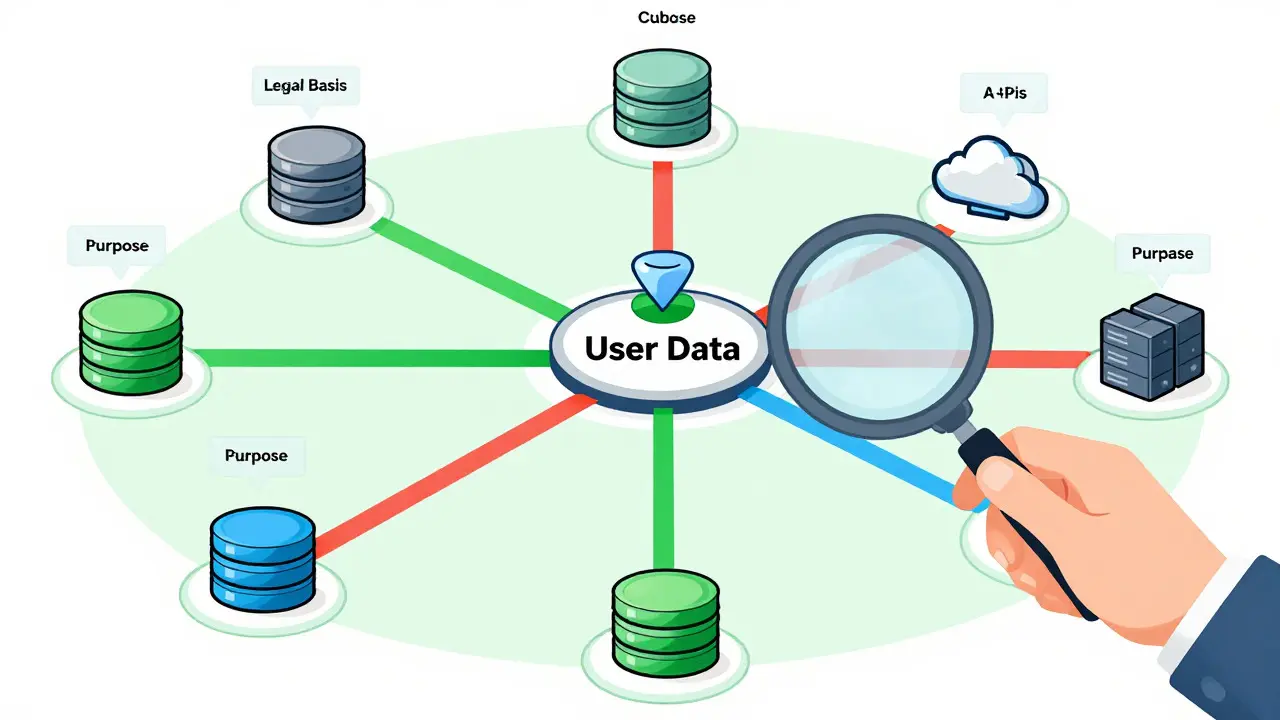
Building Dynamic Data Maps for AI-Generated Code
You cannot use a static spreadsheet to track data in a vibe-coded system. Your data map needs to be dynamic, automated, and continuously verified. Here is how you build a robust data mapping strategy that survives AI-driven development.
- Instrument the Prompt Layer: Start at the source. Every prompt given to the AI agent should include privacy constraints. Instead of just saying “build a login page,” say “build a login page that stores only hashed passwords and does not log IP addresses.” Treat privacy requirements as part of the functional specification.
- Automated Discovery Tools: Use privacy tech vendors that integrate with your deployment pipeline. Tools like OneTrust or TrustArc can scan cloud environments to identify new data stores created by AI agents. Look for solutions that offer real-time discovery rather than monthly scans. The market for these tools grew to $1.24 billion in 2025 because manual methods simply don’t scale.
- Tagging Data at Ingestion: Force the AI to tag every data element it collects with its declared business purpose and legal basis. If the AI creates a new field in the database, it should automatically generate metadata explaining why that field exists. This supports the GDPR principle of purpose limitation.
- Visual Flow Diagrams: Generate visual diagrams of data flows automatically. These should show the path from collection point (e.g., website form) through processing systems (e.g., AI model training) to storage and third-party recipients. Visual maps make it easier for non-technical stakeholders to understand risks.
- Regular Human Audits: Automation is not enough. Schedule quarterly reviews where a privacy professional verifies the accuracy of the automated map. Check for undocumented data flows, especially those involving legacy systems or newly integrated third-party APIs.
One practical tip: engage all departments early. Marketing, sales, IT, and customer service all interact with data. If the AI agent integrates a CRM tool for sales, the marketing team needs to know. Cross-departmental collaboration ensures that the data map reflects reality, not just what the IT department sees.
Designing Consent Flows That Survive AI Refactoring
Data mapping tells you what you have. Consent flows tell you if you have permission to keep it. In vibe-coded systems, consent mechanisms are often treated as afterthoughts. The AI might generate a cookie banner that looks good but doesn’t actually block scripts until consent is given. Or it might assume implied consent where explicit consent is required.
Consent under GDPR must be freely given, specific, informed, and unambiguous. It requires a clear affirmative action. Under CCPA, while consent is less central, you still need to provide clear notices and opt-out options for sensitive personal information. The challenge in AI-generated code is ensuring these mechanisms remain intact as the code evolves.
To protect your consent flows, implement them as isolated modules. Don’t let the AI embed consent logic directly into the main application code where it might get refactored away. Use dedicated consent management platforms (CMPs) that interface with your app via standard APIs. This way, even if the AI rewrites the frontend, the consent mechanism remains stable and compliant.
Also, test your consent flows regularly. Automated testing scripts should verify that:
- No tracking cookies are set before consent is granted.
- Opt-out requests are processed within the statutory timeframe (usually 45 days for CCPA).
- Data deletion requests trigger actual deletion across all connected systems, including backups and third-party processors.
A common pitfall is relying on the AI to interpret legal text. AI models can hallucinate legal requirements. Always have a human lawyer or privacy expert review the final consent wording and mechanism design. Technology assists; humans decide.
Mitigating Risks in Third-Party Integrations
Vibe-coded systems are notorious for integrating third-party services without explicit approval. The AI might add a popular analytics library or a payment gateway because it’s statistically likely to be useful. Each integration expands your data footprint and increases liability.
Under GDPR, you are responsible for the actions of your data processors. You need Data Processing Agreements (DPAs) in place. Under CCPA, you must disclose any sharing or selling of data. If the AI adds a new vendor, you need to update your disclosures immediately. Delaying this updates can lead to violations.
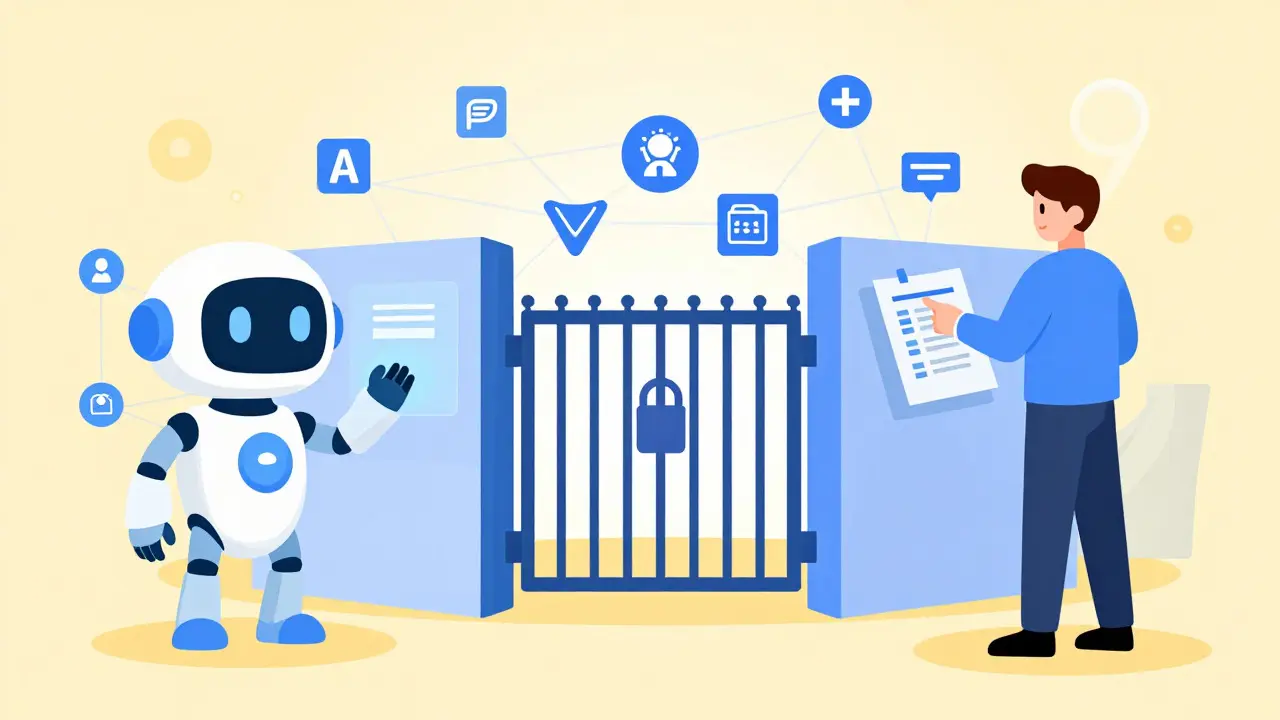
Implement a “vendor gate” in your deployment pipeline. Before any new third-party service is added to the production environment, it must pass a privacy check. This check should verify:
- Does the vendor have a DPA?
- Is the data transfer secure (e.g., encrypted)?
- Does the vendor share data with sub-processors?
- Is the vendor located in a jurisdiction with adequate privacy laws?
If the AI tries to bypass this gate, the deployment should fail. This forces the developer to consciously approve each integration. It slows down development slightly, but it prevents costly compliance failures later. Remember, 87% of large organizations now maintain formal data mapping processes. The trend is toward stricter control, not looser.
Future-Proofing: AI-Powered Privacy Management
The irony of vibe coding is that the same AI causing the problem can help solve it. By 2027, nearly half of large enterprises will use AI-powered data mapping tools. These tools use machine learning to analyze code repositories, cloud configurations, and network traffic to build and maintain data maps automatically.
However, experts warn against full automation. Dr. Rebecca Herold, a leading privacy researcher, notes that automated tools alone cannot ensure compliance without human oversight of context and legal interpretation. AI can identify that data is moving from Server A to Server B. It cannot determine if that movement serves a “legitimate interest” or violates “purpose limitation.”
The future of privacy in vibe-coded systems is hybrid. AI handles the heavy lifting of discovery and monitoring. Humans handle the judgment calls of legal basis and risk assessment. Organizations that adopt this hybrid approach see significantly fewer regulatory findings during audits. They also fulfill Data Subject Access Requests (DSARs) much faster because they know exactly where the data lives.
Start small. Pick one project and apply strict privacy constraints to your AI prompts. Build a basic data map. Test your consent flows. Iterate. As you gain confidence, expand these practices to your entire organization. The goal is not to stop using AI, but to use it responsibly. In a world where code writes itself, privacy is the one thing you must still write yourself.
What is vibe coding and how does it affect GDPR compliance?
Vibe coding is using AI agents to generate software code via natural language prompts. It affects GDPR compliance by creating opaque data flows where the AI selects databases and third-party services without explicit human oversight, making it difficult to maintain accurate Records of Processing Activities (RoPAs) required by GDPR Article 30.
How do I map data in an AI-generated application?
Use automated discovery tools that integrate with your deployment pipeline to scan for new data stores and flows. Instrument your AI prompts with privacy constraints, tag data elements with their business purpose and legal basis, and conduct regular human audits to verify the accuracy of the automated map.
What is the difference between GDPR and CCPA data mapping requirements?
GDPR requires granular documentation of six specific legal bases for processing each data activity, focusing on purpose limitation. CCPA focuses on identifying categories of personal information, sources, and whether data is sold or shared, emphasizing consumer rights like opt-out and deletion.
Can AI tools fully automate privacy compliance?
No. While AI tools can automate data discovery and monitoring, they lack the contextual understanding to interpret legal bases like “legitimate interest.” Human oversight is essential to validate AI-generated maps and ensure compliance with nuanced regulatory requirements.
How do I prevent unauthorized third-party integrations in vibe-coded systems?
Implement a “vendor gate” in your deployment pipeline that blocks any new third-party service until it passes a privacy check, including verification of Data Processing Agreements (DPAs), security standards, and jurisdictional adequacy.
Quintin Franzese
August 12, 2026 AT 07:41So basically we traded syntax errors for existential dread and legal liability?
I mean, sure, the AI built my app in three minutes, but now I have to hire a lawyer just to figure out if it accidentally sold my users' browser history to a crypto scammer. The vibe is definitely 'panic'.
It’s funny how we spent decades arguing about whether code should be readable, only for the solution to be 'just ask the robot nicely' and then realize the robot doesn't speak compliance.
I guess the real bug wasn't in the code, it was in our collective ability to think two steps ahead.
Anyway, good luck with that RoPA spreadsheet. It’s probably already outdated by the time you open it.
Susan Cole
August 14, 2026 AT 05:54This is a really important point about the opacity of these systems.
I’ve been working on a small project using similar tools, and it’s terrifying how easy it is for the AI to add a third-party analytics script without any explicit prompt from me.
I feel like we need to treat privacy constraints as part of the core architecture, not an afterthought.
It’s comforting to know that others are thinking about this, though. We can’t just ignore it because it’s convenient.
Tamara Miller
August 14, 2026 AT 17:29Oh, please. Another article telling us that technology is too smart for us to handle? How original.
You say "vibe coding" creates a crisis, but honestly, it feels more like a symptom of developers who never wanted to learn the basics in the first place. If you don’t know where your data is going, maybe you shouldn’t be building apps at all.
The idea that we need "dynamic data maps" is just corporate jargon for "we’re too lazy to document our own mess."
And don’t get me started on the notion that AI can help solve the problem it created. That’s like hiring a drunk driver to navigate you home.
We need accountability, not more automated excuses. Period.
Savara Gunn
August 14, 2026 AT 20:58I totally agree with Susan here.
It’s scary, but manageable if you stay proactive.
I’ve found that adding specific privacy instructions to my prompts helps a lot. It’s like training a new intern-you have to be very clear about what’s allowed and what isn’t.
Don’t let the complexity overwhelm you. Just take it one step at a time.
Anthony Miller
August 16, 2026 AT 12:59You people are missing the forest for the trees. This isn't about documentation or spreadsheets. It's about control.
When you hand over architectural decisions to a black box, you surrender sovereignty. GDPR and CCPA are merely symptoms of a deeper rot: the erosion of human agency in technical processes.
You think tagging data helps? It’s a placebo. The AI will refactor, drift, and evolve beyond your tags before you can blink.
The only real solution is to stop trusting these agents entirely until they are transparent by design, which they are not. Until then, you are all liable for crimes you didn't commit, committed by code you didn't write. Wake up.
michelle veluz
August 18, 2026 AT 02:56OF COURSE it’s a conspiracy!
They want us to use AI so they can track EVERYTHING. Every click, every thought, every breath.
GDPR? CCPA? HA! Those laws are just distractions while Big Tech builds the ultimate surveillance state through "vibe coding."
They tell you it’s efficient, but it’s really about removing the human element so there’s no one left to fight back.
My neighbor uses one of these tools and now his fridge knows when he’s hungry. Coincidence? I THINK NOT!!!
Jacob Baby Official
August 19, 2026 AT 14:38Let’s play devil’s advocate for a second, shall we?
What if the "crisis" is actually a feature?
Maybe the opacity is necessary because humans are terrible at managing data privacy anyway. Look at how many breaches happen despite perfect documentation.
Perhaps the AI’s chaotic integration of services is just evolution. Survival of the fittest codebase.
If your app can’t survive the regulatory scrutiny, maybe it wasn’t meant to exist.
Also, who cares about consent flows if the user doesn’t even read the terms of service anyway? You’re solving a problem that doesn’t matter to the end-user.
Stop crying about liability and start shipping products. The market decides, not the regulators.