
Finance teams using generative AI slash forecast errors by 57% on average - but how does it actually work? Traditionally, financial planning and analysis (FP&A) professionals spent 60-80% of their time crunching numbers in spreadsheets instead of strategic work. McKinsey's July 2023 research found this massive time drain. Today, Generative AI in Financial Forecasting is a transformative approach that uses large language models combined with financial data to automate predictive modeling, generate explanatory narratives, and analyze variances between forecasts and actual results. Unlike traditional Excel-based methods, this technology processes vast datasets in seconds, delivering insights that were previously impossible to achieve.
How Generative AI Transforms Financial Forecasting
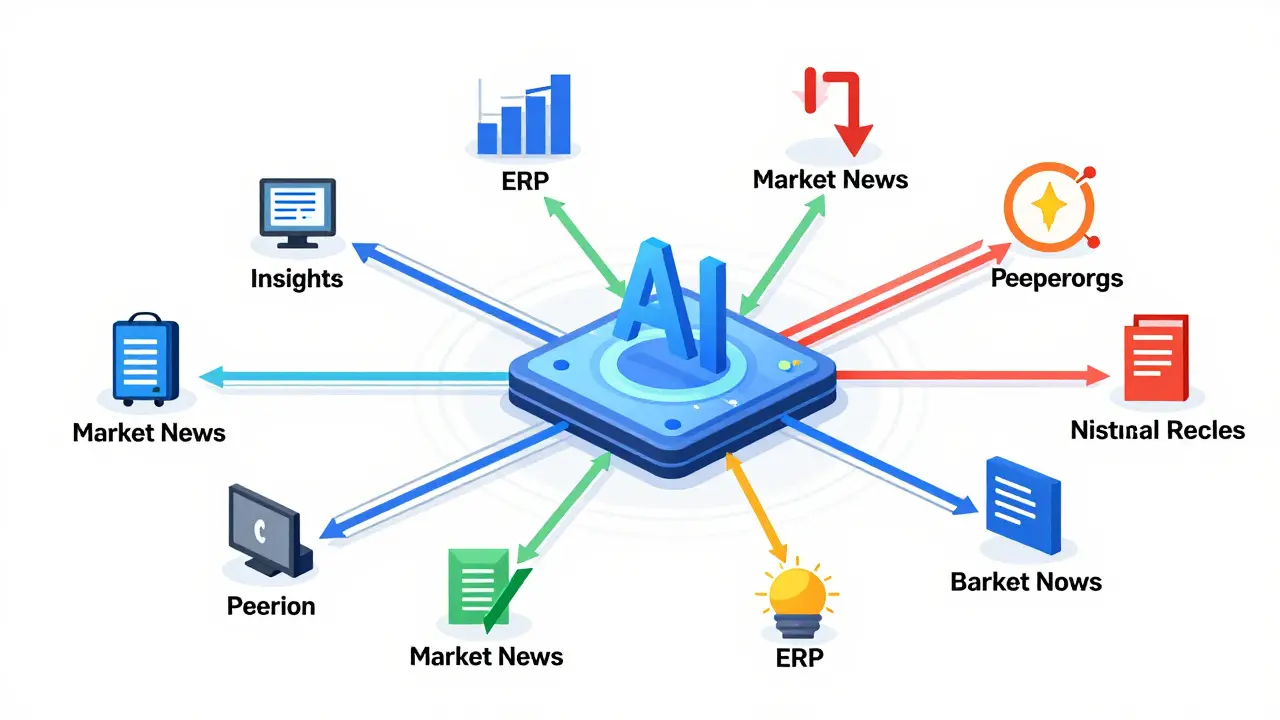
Generative AI doesn't just crunch numbers; it understands them. Systems like those built by DataRobot and Datarails use retrieval-augmented generation (RAG) to combine historical financial data with real-time market signals. For example, SAP S/4HANA Finance integrates with these tools to analyze payer behaviors and cash flow patterns across entire ERP systems. This means finance teams get not just numbers, but clear explanations like "Q3 revenue dropped 12% due to supply chain delays in Southeast Asia" - all generated automatically. Python-based machine learning models handle the complex math, while large language models like GPT-4 turn those numbers into human-readable narratives. The result? Forecasts updated weekly instead of quarterly.
Real-World Success Stories
King's Hawaiian saw immediate results after implementing AI-driven cash flow forecasting. Their finance team reported a 20%+ reduction in interest expenses by optimizing debt payments based on accurate cash flow predictions. Similarly, a large North American financial institution used generative AI to automate first drafts of risk model documentation, cutting report preparation time from days to hours. On Reddit's r/FPandAnalysis forum, a senior FP&A manager shared how they reduced their monthly forecasting cycle from 10 days to 3 days. "I now run thousands of what-if scenarios in minutes," they said, "testing budgets against inflation spikes or supply chain disruptions without manual effort."
Benefits Over Traditional Methods
| Aspect | Traditional Methods | Generative AI |
|---|---|---|
| Time to Generate Forecast | 1-2 weeks per cycle | Hours or days |
| Forecast Accuracy | Varies widely (15-30% error) | 57% fewer errors on average (IBM) |
| Narrative Generation | Manual writing required | Automated executive-ready explanations |
| Scenario Testing | Limited due to manual effort | Thousands of 'what-if' scenarios in minutes |
| Data Sources | Internal spreadsheets only | Integrated ERP, market news, and unstructured data |
Challenges and Solutions
Generative AI isn't magic. Gartner's 2024 survey found 43% of early adopters struggled with integrating AI outputs into existing approval workflows. Data quality issues also cause problems - 68% of organizations cite poor historical data as a barrier. For example, a mid-market company tried implementing AI forecasting but got unreliable results because their ERP system only stored 18 months of data instead of the required 3-5 years. Solutions are practical: start with a pilot project focused on cash flow forecasting (where data is usually clean), use no-code tools like Datarails for SMBs, and establish clear governance rules. The Hackett Group recommends measuring ROI through "percentage reduction in forecast variance, hours saved per cycle, and stakeholder satisfaction scores" to track real progress.

Getting Started with Implementation
You don't need a team of data scientists. Most enterprise solutions like SAP Joule or DataRobot's Cash Flow Forecasting App offer intuitive interfaces. Start by focusing on one use case: cash flow forecasting. This has clear metrics (like interest expenses or liquidity ratios) and typically has high-quality data. Train your finance team on interpreting AI outputs - analysts usually need 2-4 weeks of training. Finance leaders should focus on understanding the "why" behind forecasts rather than technical details. Robert Half's January 2025 guidance for SMBs shows that even companies with basic Excel skills can implement these tools successfully. Key steps include:
- Identify a high-impact area like cash flow or sales forecasting
- Ensure historical data spans at least 3 years
- Pilot the tool with a small team before full rollout
- Establish governance rules for AI validation and approvals
- Measure results against specific KPIs like forecast error rate
The Future of AI-Powered Finance
By 2027, Bain & Company predicts "self-driving finance" systems will handle routine forecasting adjustments without human intervention. SAP's March 2024 launch of Joule financial assistant shows how deeply this is embedding into core systems. New developments like AIMultiple's January 2025 research on "prompt-to-report functionality" mean 2,000 analysts can get personalized insights from a single AI tool. However, regulatory challenges remain. The SEC's March 2024 guidance requires disclosure of AI-generated forecasts, and the IFRS Foundation will release specific AI financial reporting rules in Q1 2025. Despite this, 92% of CFOs surveyed by The Hackett Group in February 2024 plan to increase AI investments in FP&A over the next three years. The real winners will be teams that balance automation with human oversight - using AI for speed and accuracy while keeping experts in the loop for strategic decisions.
How does generative AI improve forecast accuracy?
Generative AI analyzes historical financial data, market trends, and unstructured information like news articles to detect patterns humans might miss. For example, IBM research shows organizations using AI in forecasting experience 57% fewer sales forecast errors on average. Unlike static Excel models, it continuously learns from new data, adapting to changing market conditions in real-time.
Do finance teams need AI experts to use these tools?
No. Most enterprise solutions like Datarails and SAP Joule offer no-code interfaces designed for finance professionals. Analysts typically need 2-4 weeks of training to use the tools effectively, while finance leaders require minimal training to interpret results. Robert Half's January 2025 guidance confirms SMBs with basic Excel skills can implement these systems successfully without specialized AI knowledge.
Can generative AI predict market crashes?
No tool can reliably predict unprecedented events like market crashes. Generative AI excels at identifying patterns in historical data but struggles with "black swan" events outside its training scope. Experts like The Hackett Group caution that during extreme volatility, human oversight is essential. The best approach combines AI for routine forecasting with human judgment for crisis scenarios.
What's the biggest challenge in implementing AI forecasting?
Data quality is the top hurdle. Gartner's 2024 survey found 68% of organizations struggle with incomplete or inconsistent historical data. For example, a company trying to forecast sales might have gaps in their ERP system from legacy software migrations. The solution? Start small with a focused use case like cash flow forecasting where data is usually clean, and clean up data before scaling up.
How do companies handle regulatory requirements for AI forecasts?
Regulators like the SEC require clear documentation of AI-generated forecasts. Successful companies build audit trails by logging all inputs, model versions, and validation steps. For example, SAP S/4HANA Finance includes automated compliance features that track every AI decision. The IFRS Foundation's upcoming Q1 2025 guidance will standardize these requirements, but current best practices involve maintaining detailed logs and human review for high-stakes financial reports.
Addison Smart
February 6, 2026 AT 04:52Generative AI in finance is a game-changer, especially for global teams.
When working with international subsidiaries, the ability to process local market data and generate region-specific narratives is invaluable.
For example, in Southeast Asia, supply chain delays can impact revenue differently than in North America.
Traditional spreadsheets struggle with these nuances, but AI models trained on diverse datasets adapt quickly.
However, the real magic happens when finance teams combine AI insights with human expertise.
Automating data crunching frees up time for strategic analysis, but we still need people to interpret the 'why' behind the numbers.
Starting with cash flow forecasting is smart-it's a high-impact area with clean data.
Just remember, AI isn't magic; garbage in, garbage out.
Investing in data hygiene first pays off big time.
I've seen companies skip this step and end up with unreliable forecasts.
But when done right, the 57% error reduction is real.
It's all about balance-automation for speed, humans for context.
That's how we build trust in these tools across departments.
David Smith
February 6, 2026 AT 19:13Generative AI is overhyped; real finance needs human judgment.
Lissa Veldhuis
February 7, 2026 AT 04:50ai in finance is great but only if data is clean otherwise its garbage most companies fail because they dont clean data first i know because i've seen it but i can help you do it right
Michael Jones
February 8, 2026 AT 22:22the future is here but we need balance ai with human insight
automation handles grunt work experts focus on strategy
its not replacement but empowerment
finance evolves through partnership
lets embrace this change together
allison berroteran
February 9, 2026 AT 14:02generative ai in finance is truly revolutionary. it's not just about crunching numbers faster but about gaining deeper insights. for example, when we implemented ai for cash flow forecasting, we reduced errors by over half. this allowed us to optimize debt payments and save millions in interest. the key is starting small. focus on one area like cash flow where data is usually clean. training your team takes time but it's worth it. analysts need to learn to interpret ai outputs, not just trust them blindly. human oversight is crucial for strategic decisions. ai can process thousands of scenarios in minutes but humans provide the context. for instance, during the last supply chain crisis, ai flagged potential issues but our team adjusted based on real-world knowledge. the integration with erp systems is seamless when done right. sap s4hana finance works well with ai tools for real-time data. regulatory compliance is also easier with audit trails. the sec requires clear documentation of ai-generated forecasts. we've built logs for every input and validation step. this transparency builds trust with stakeholders. the future of finance is collaborative-ai for speed, humans for wisdom. it's a partnership, not a replacement. we're excited to see how this evolves.