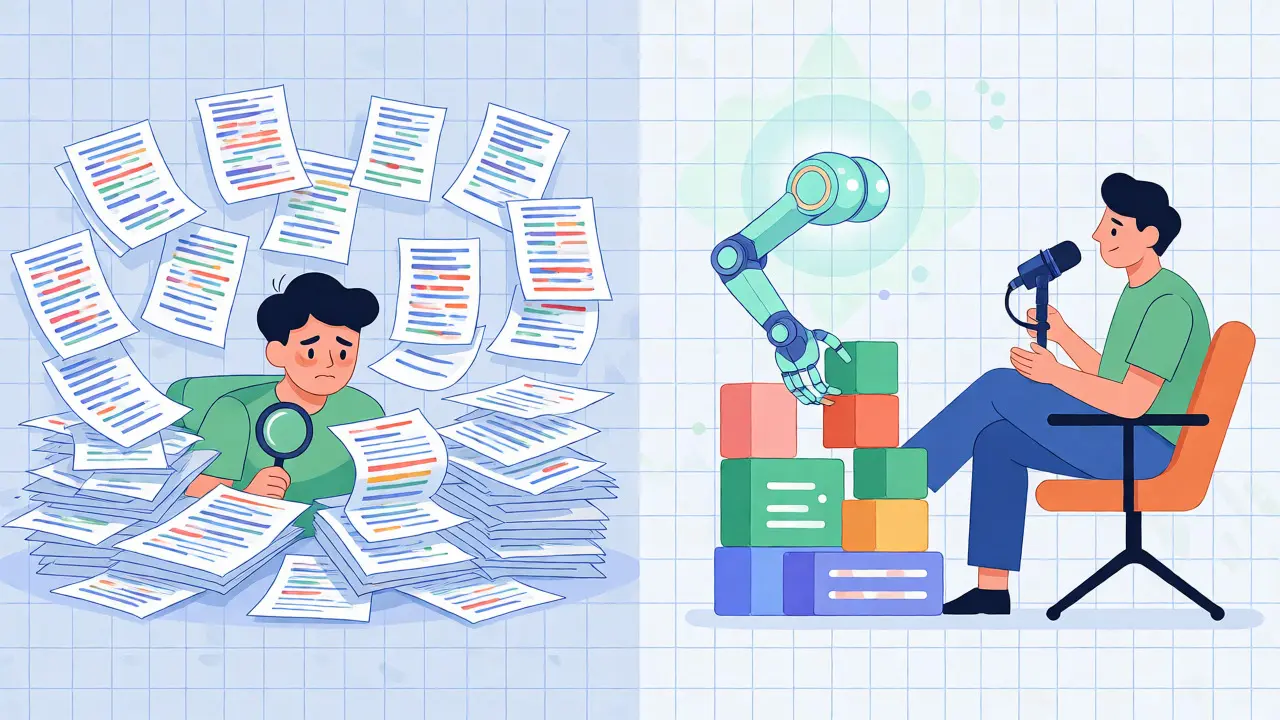
You describe what you want in plain English. The AI writes the code. You run it. If it works, you ship it. If it breaks, you tell the AI to fix it. You never actually read the source code. This is Vibe Coding, a term coined by Andrej Karpathy in early 2025 that describes a workflow where developers fully embrace AI-generated code without inspecting its implementation details.
But here’s the catch: most teams claiming to do vibe coding aren’t really doing it. They’re still peeking at the code. They’re still tweaking variable names manually. They’re treating AI like a smart autocomplete rather than an autonomous agent. If your team wants to claim the speed benefits-up to 56% faster task completion according to McKinsey-you need to follow strict rules. Otherwise, you’re just doing slow AI-assisted programming with extra steps.
The Core Definition: What Actually Qualifies?
To count as authentic vibe coding, you must eliminate human code review from the loop entirely. This isn't about being lazy; it's about trusting the tool enough to let it handle the syntax while you handle the intent. Karpathy’s definition is explicit: "the developer does not review or edit the code, but solely uses tools and execution results to evaluate it."
If you open the file to check if the AI used a `for` loop or a `while` loop, you’ve broken the vibe. If you rename a function because you don’t like the name, you’ve broken the vibe. The evaluation mechanism shifts from "is this code clean?" to "does this app work?" This requires a fundamental mindset shift. You are no longer a coder; you are a product manager who happens to speak to a compiler.
The Team Checklist: Are You Really Vibe Coding?
Use this checklist to audit your current workflow. If you miss more than one item, you are likely in a hybrid mode, which is fine, but don’t expect pure vibe coding metrics.
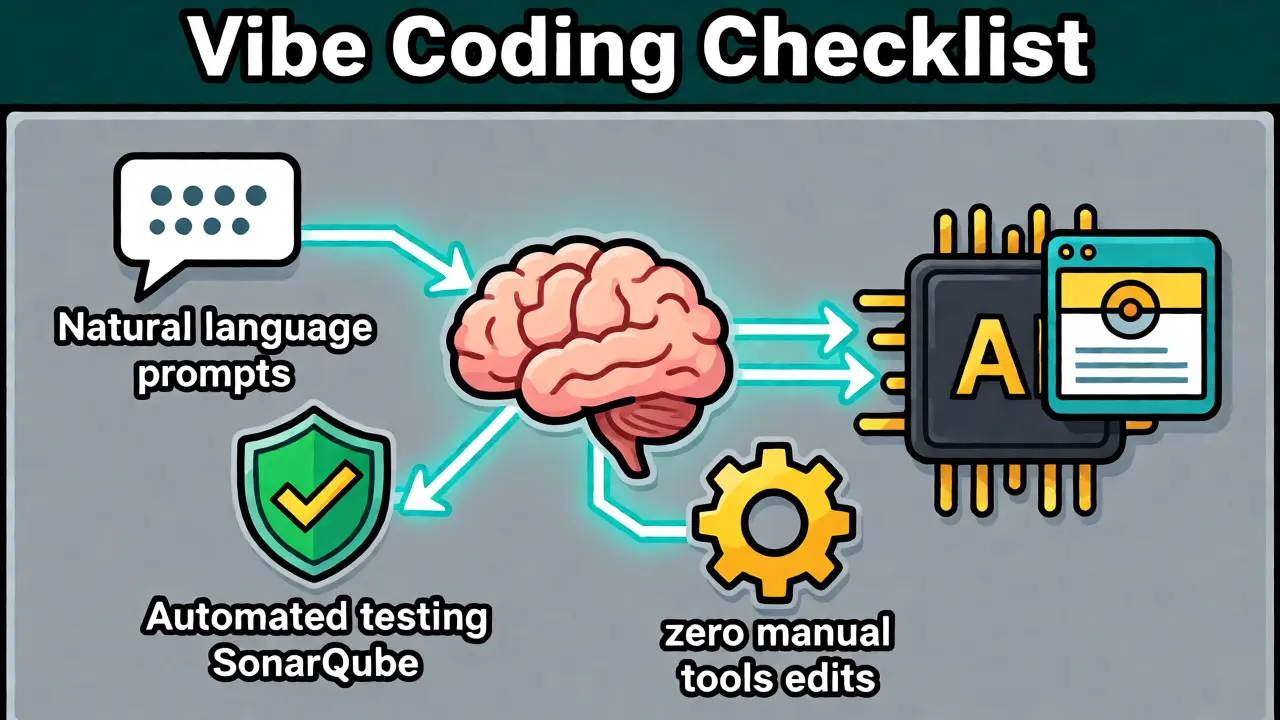
- Natural Language Only: All instructions to the AI must be descriptive outcomes (e.g., "Create a login page with email validation") rather than technical specifications (e.g., "Write a regex for email validation").
- Zero Manual Edits: Check your IDE logs. If you spent time typing characters into the editor window yourself, you failed. Modifications must come from new prompts, not keystrokes.
- Tool-Based Validation: Success is determined strictly by test suites, linters, and runtime errors. If the tests pass, the code is accepted, even if it looks messy.
- AI-Generated Diffs: Your Git commit history should show changes generated by the AI model. Human commits should only reflect configuration or prompt files, not source code logic.
- Outcome-Focused Docs: Documentation should describe user behavior, not class structures. If your Confluence pages explain "how the algorithm sorts data," you’re still thinking traditionally.
Why Traditional Code Review Fails Here
In traditional development, we spend up to 62% of our time worrying about syntax and framework specifics. Vibe coding flips this ratio. According to recent industry studies, effort shifts toward communication and intent clarification, consuming about 87% of your energy. This means the skill set changes dramatically.
Debugging also transforms. Instead of reading stack traces for 23 minutes on average, you refine your prompt. If the AI generates buggy code, you don’t fix the bug; you clarify the requirement. For example, instead of fixing a null pointer exception, you might say, "Ensure the user object is always initialized before access." This reduces debugging time to roughly 9 minutes per issue, but only if you resist the urge to look under the hood.
Essential Tools for True Vibe Coding
You can’t vibe code effectively in Notepad. You need environments designed for iterative AI interaction. The market has consolidated around a few key players that support this workflow natively.
| Tool | Key Feature | Best For | Vibe Mode Support |
|---|---|---|---|
| Cursor | Composer Agent | Rapid prototyping & multi-file edits | Yes (v2.5+) |
| Windsurf | Flow State Context | Deep codebase understanding | Native |
| GitHub Copilot | Vibe Metrics | Enterprise integration | Experimental |
| Replit | Browser-based AI | Non-technical founders | High |
Notice that tools like SonarQube play a critical supporting role. Since humans aren’t reviewing code, automated security scanning becomes non-negotiable. SonarSource data shows a 43% increase in vulnerabilities when AI code isn’t scanned automatically. In a vibe coding setup, SonarQube acts as your eyes, flagging issues so you can prompt the AI to fix them without ever seeing the line of code.
Where Vibe Coding Breaks Down
It’s not magic. It fails spectacularly in specific domains. Cryptographic implementations, for instance, have a 78% failure rate when generated by AI compared to 12% for humans. Why? Because security relies on subtle implementation details that natural language descriptions often miss. If you ask for "secure encryption," the AI might pick a standard library but implement it with timing attacks in mind incorrectly.
Similarly, complex business logic with deep historical context often gets lost. If your database schema has weird legacy constraints, the AI will likely ignore them unless you explicitly prompt them every single time. This leads to what developers call "magic code"-it works now, but nobody knows why, and changing one thing breaks three others. TechLead2025 noted on Hacker News that vibe coding created 37% more technical debt in their codebase, precisely because the "why" was lost in translation.
Building a Hybrid Workflow
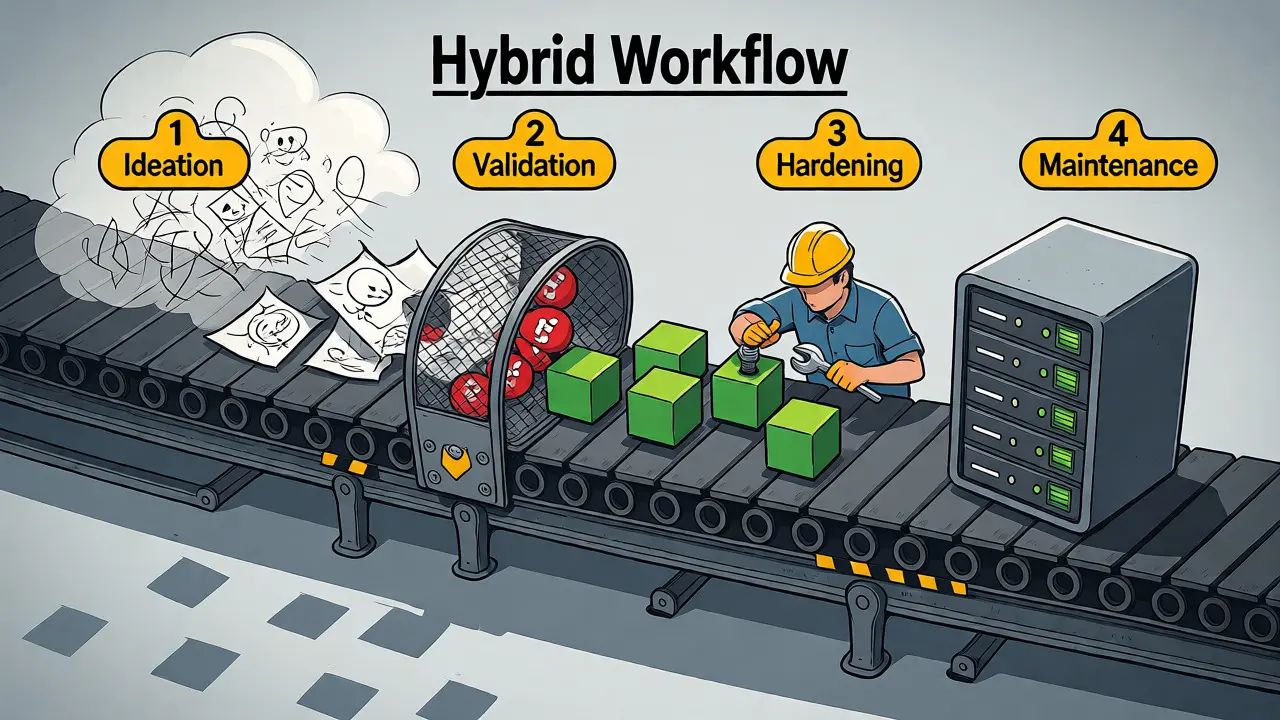
Pure vibe coding is rare in production. Most high-performing teams (87%, according to Pragmatic Engineer) use a hybrid approach. They vibe code the prototype to validate ideas quickly, then switch to traditional review for production stability.
Here is how to structure that transition:
- Ideation Phase: Use vibe coding to build the MVP. Focus on features, not architecture. Let the AI write everything.
- Validation Phase: Run extensive automated tests. Fix bugs via prompts, not manual edits.
- Hardening Phase: Once the feature is stable, have a senior engineer review the generated code. Refactor for performance and maintainability.
- Maintenance Phase: Switch back to vibe coding for small tweaks, but keep the hardened core intact.
This balances speed with safety. It acknowledges that while AI is great at writing boilerplate and simple logic, it struggles with long-term architectural coherence.
Skills You Need to Survive
If you’re moving to vibe coding, stop practicing syntax. Start practicing prompting. The difference between a good result and a bad one is rarely the model’s capability-it’s your ability to describe the outcome clearly. Ambiguous prompts lead to 214% more rework. That’s huge.
Also, learn to trust your tests. If you don’t have robust unit tests, you can’t vibe code. You’re flying blind. Invest in testing frameworks that give you immediate feedback. Jenkins pipelines, Jest, or PyTest outputs become your primary interface. If the green light doesn’t turn on, you haven’t finished the job, regardless of how the code looks.
Is vibe coding safe for production?
Generally, no, not without hardening. While 41% of developers use some form of vibe coding, only 12% apply it directly to production without modification. Security vulnerabilities increase by 43% in unverified AI code. It is best used for prototyping or low-risk features until a human review step is added.
Do I need to know how to code to vibe code?
No. Non-traditional coders like designers and product managers now make up 34% of practitioners. However, you need strong logical reasoning skills to break down problems into prompts. Experienced developers adapt faster (19 hours vs. 38 hours for beginners), but they don't have a monopoly on success.
What happens if the AI hallucinates a library?
This is common. If the AI imports a package that doesn't exist, your build will fail. In a vibe coding workflow, you paste the error message back into the chat. The AI usually corrects itself immediately. You don't go looking for the library documentation yourself; you let the AI solve its own dependency errors.
Does vibe coding replace code reviews?
In pure vibe coding, yes. But in practice, most teams replace manual code review with automated static analysis tools like SonarQube. These tools act as the reviewer, checking for security flaws and code smells without requiring a human to read every line.
Can vibe coding handle complex algorithms?
Not well. Studies show a 78% failure rate for cryptographic and complex algorithmic tasks. AI excels at CRUD operations, UI components, and API integrations. For heavy math or custom sorting logic, traditional coding or hybrid approaches are safer.