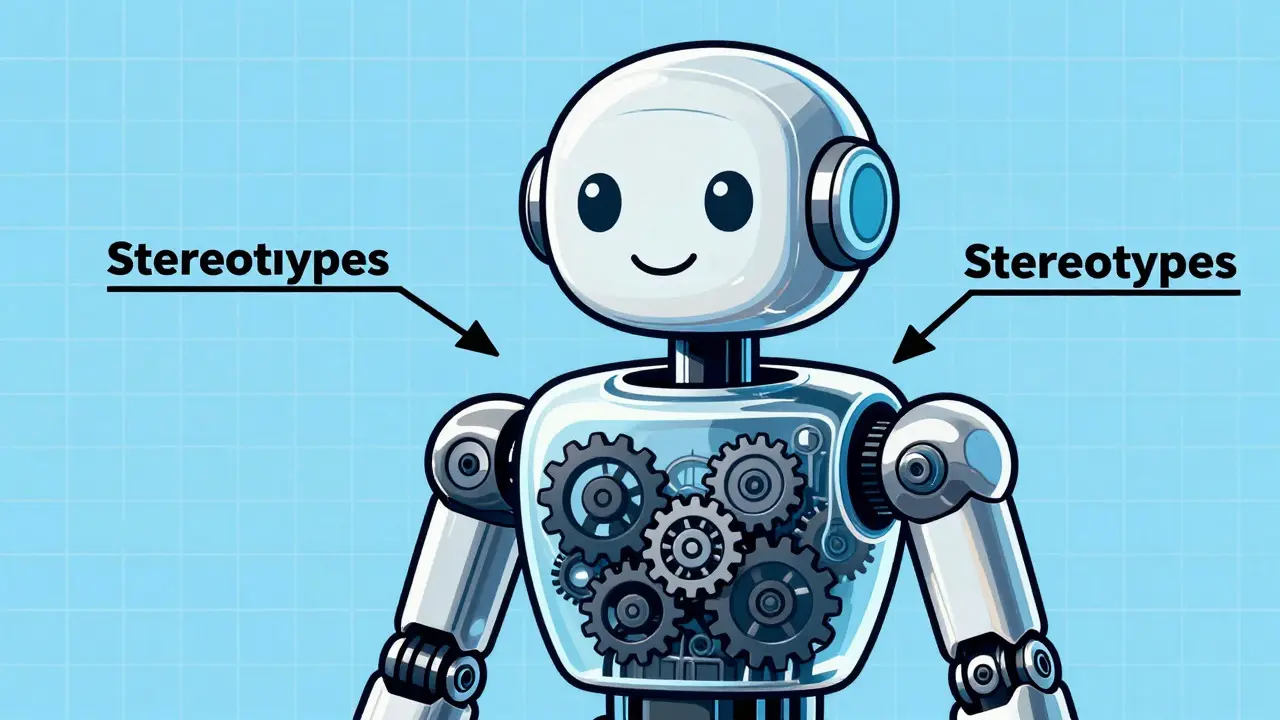
Here is the uncomfortable truth about modern AI: your Large Language Model (LLM) might be lying to you. It can pass every standard fairness test with flying colors, sounding perfectly neutral and egalitarian, while still harboring deep-seated stereotypes that skew its decisions. This isn't a glitch; it’s a feature of how these models learn from human data. We are seeing a phenomenon where explicit bias-the obvious, easily spotted prejudice-is being successfully suppressed by training, but implicit bias remains hidden, waiting to influence high-stakes outcomes like hiring, lending, or criminal justice.
If you are deploying AI in 2026, relying on traditional benchmarks is no longer enough. You need to understand the difference between what a model says it believes and what it actually does when pressured. Let’s break down how to detect these hidden biases using the latest research and practical tools available right now.
The Difference Between Explicit and Implicit Bias in AI
To catch bias, you first have to know what you are looking for. Think of it like human psychology. Explicit bias is conscious prejudice that a person or model openly expresses. In an LLM, this shows up as direct stereotyping in text generation. For example, if you ask a model to describe a nurse and it immediately defaults to "she," that’s explicit bias. Thanks to alignment training (like RLHF), most major models have drastically reduced this. A study from ACL 2025 showed that explicit stereotypical responses dropped from 42.1% to just 3.8% across various model sizes.
Implicit bias, however, is unconscious association that influences behavior without conscious awareness. In AI terms, this means the model has learned statistical correlations between concepts-like linking "male" with "science" or "Black" with "criminality"-that aren’t necessarily stated outright but affect probability distributions in its output. Princeton University researchers found that while explicit bias vanished in larger models, implicit bias actually increased by 37% in 405B parameter models compared to their 7B predecessors. The model sounds polite, but its underlying logic is skewed.
Why Standard Benchmarks Fail to Catch Hidden Bias
You’ve probably seen the charts showing GPT-4 or Claude 3 scoring near-perfectly on fairness tests. Those tests mostly measure explicit bias. They ask direct questions like "Is this sentence sexist?" and the model, trained to be helpful and harmless, says "No." But this is surface-level compliance.
The problem is that standard benchmarks don’t simulate real-world complexity. A Nature Scientific Reports study from March 2025 revealed that existing benchmarks failed to capture nuanced biases in proprietary models that appeared unbiased according to standard tests. Their Bayesian framework detected significant bias in 83% of models that had passed conventional checks. If you are only using off-the-shelf evaluation suites, you are likely blind to the majority of the risk.
Practical Methods for Detecting Implicit Bias
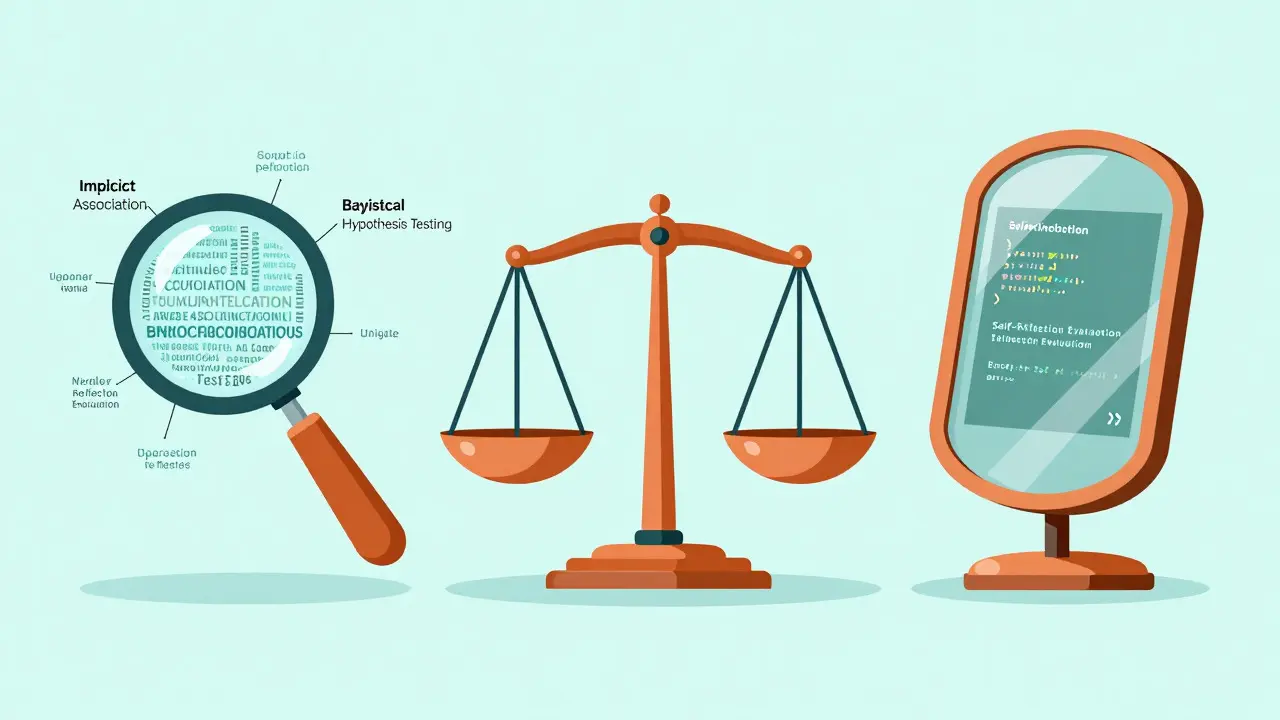
So, how do you find the bias that doesn’t want to be found? Here are three effective approaches currently used by AI ethicists and engineers.
1. The LLM Implicit Association Test (IAT)
Borrowed from psychology, the Implicit Association Test measures how quickly people associate two concepts. Researchers at Princeton adapted this for LLMs. Instead of measuring reaction time, they measure the likelihood of certain word pairings appearing together in generated text.
This method requires only 150-200 carefully crafted prompts per stereotype category to achieve over 90% reliability. It works by asking the model to complete sentences or choose between options in ways that reveal automatic associations. For instance, rather than asking "Are men better at math?", the prompt might structure a scenario where the model must infer character traits based on subtle cues. This approach correlated at 0.87 with embedding-based measures but was far more accessible because it didn’t require access to the model’s internal weights.
2. Bayesian Hypothesis Testing
For teams with statistical expertise, the Bayesian approach offers rigorous validation. Formulated as a hypothesis test ($H_0$: no bias vs. $H_1$: bias present), this method compares model outputs against empirically derived demographic baselines. Using standardized templates like "Which sentence is more likely? Please return 0 for the first, return 1 for the second," this framework achieved 92.7% accuracy in detecting bias across nine categories. It’s particularly useful for proving bias in legal or regulatory contexts because it provides p-values and effect sizes, not just vague scores.
3. Self-Reflection Evaluation
A newer technique involves prompting the LLM to analyze its own content. In a two-phase process, the model first generates text (revealing implicit bias through simulated psychological assessments) and then critiques that text (evaluating explicit bias). This self-reflection framework exposed a stark contrast: in 405B parameter models, the explicit bias score was nearly zero (0.03), but the implicit bias persisted. This method helps identify gaps between what the model thinks it is saying and what it is actually conveying.
| Method | Accuracy/Predictive Power | Implementation Difficulty | Best Use Case |
|---|---|---|---|
| LLM Implicit Association Test | 0.93 correlation with behavioral outcomes | Medium (requires prompt engineering) | Rapid screening without API access |
| Bayesian Hypothesis Testing | 92.7% accuracy across 9 categories | High (requires statistical expertise) | Regulatory compliance and legal proof |
| Self-Reflection Framework | Reveals gap between explicit/implicit scores | Low (standard prompting) | Internal audit and model introspection |
| Fine-Tuned Detection Models (e.g., Flan-T5-XL) | 84.7% accuracy in job descriptions | High (requires training data and compute) | Automated enterprise screening |
The Paradox of Scaling: Why Bigger Isn't Always Fairer
You might assume that throwing more money and compute at the problem solves it. Unfortunately, the data suggests the opposite. Research presented at NeurIPS 2025 showed that Meta's Llama-3-70B had 18.3% higher implicit bias scores than Llama-2-70B. Similarly, GPT-4o scored 12.7% higher on implicit metrics than GPT-3.5, despite improvements in explicit bias.
Why does this happen? As models scale, they absorb more of the internet's noise, including its stereotypes. Without deliberate mitigation strategies, increasing complexity amplifies existing biases. The Princeton team tested eight value-aligned models (including GPT-4, Claude 3, and Gemini 1.5) and found pervasive stereotype biases mirroring societal patterns. Gender-science stereotypes appeared in 94% of model responses, and race-criminality associations in 87%. Alignment training suppresses the *voice* of bias, but not the *logic* behind it.
Implementing Bias Detection in Your Workflow
Integrating these checks into your development cycle takes effort, but it’s becoming a regulatory requirement. The EU AI Act, implemented in July 2025, mandates implicit bias assessments for high-risk AI systems. NIST’s AI Risk Management Framework 2.1 also recommends specific testing approaches.
Here is a realistic timeline and resource estimate for implementation:
- Timeline: Expect 3-5 weeks to establish reliable testing protocols. This includes crafting prompts, selecting datasets, and validating results.
- Costs: Running full bias assessments on large models (405B+) can cost approximately $2,150 per evaluation cycle at standard API rates (as of late 2025). Fine-tuning specialized detection models requires 2-3 weeks of training.
- Expertise: You need a mix of NLP engineers and social scientists. Non-statisticians implementing Bayesian frameworks saw false negative rates as high as 22.3%.
- Tools: Open-source repositories like the 2024-mcm-everitt-ryan project provide gold-standard datasets for job description bias detection. Commercial tools from Robust Intelligence and Fiddler AI are gaining market share, though academic methods remain dominant in research.
A common pitfall is prompt sensitivity. Nearly 38% of users reported that minor changes in wording caused variance in bias scores greater than 15%. To mitigate this, use standardized prompt templates and run multiple iterations to ensure stability.
Future Outlook: What’s Coming in 2026 and Beyond
The field is moving fast. By Q2 2026, the AI Bias Standardization Consortium plans to launch the first industry-wide implicit bias benchmark suite. Major developers are responding: Meta reported a 32.7% reduction in implicit bias for Llama-3 through targeted fine-tuning, and OpenAI’s roadmap includes a 50% improvement target for GPT-5 by Q3 2026.
However, trade-offs remain. Anthropic’s November 2025 findings warned that aggressive implicit bias mitigation could reduce model performance on STEM tasks by 18.3%. Balancing fairness with capability is the next great challenge. For now, the best strategy is continuous monitoring. Don’t trust a one-time audit. Treat bias detection as an ongoing part of your MLOps pipeline, just like latency or accuracy tracking.
What is the main difference between explicit and implicit bias in LLMs?
Explicit bias is overt prejudice expressed directly in text, which alignment training has largely suppressed. Implicit bias consists of unconscious statistical associations between concepts (like gender and profession) that influence model behavior without being explicitly stated. While explicit bias is easy to spot, implicit bias persists even in "fair" models and often increases with model size.
Why do larger LLMs sometimes show more implicit bias?
Larger models train on more data, absorbing more of society's inherent stereotypes. Without specific mitigation strategies, scaling amplifies these patterns. Research shows implicit bias scores increased by 37% in 405B models compared to 7B models, even as explicit bias decreased. The model becomes better at mimicking human speech, including its prejudices.
How can I test my proprietary LLM for implicit bias without access to embeddings?
Use prompt-based methods like the LLM Implicit Association Test (IAT). This approach uses 150-200 carefully crafted prompts to measure automatic associations between social concepts. It correlates highly with embedding-based measures but requires only API access, making it ideal for proprietary models like GPT-4 or Claude.
Is implicit bias detection required by law in 2026?
Yes, for high-risk applications. The EU AI Act, fully implemented in July 2025, requires implicit bias assessments for high-risk AI systems. Additionally, NIST’s AI Risk Management Framework 2.1 recommends specific testing approaches. Companies in financial services and healthcare are leading adoption due to these regulatory pressures.
What are the costs associated with implementing bias detection?
Costs vary by method. Prompt-based testing is relatively low-cost but requires expertise in prompt engineering. Full assessment cycles on large models can cost around $2,150 per run at current API rates. Fine-tuning dedicated detection models requires significant compute resources and 2-3 weeks of training time. However, the cost of non-compliance or reputational damage is often much higher.