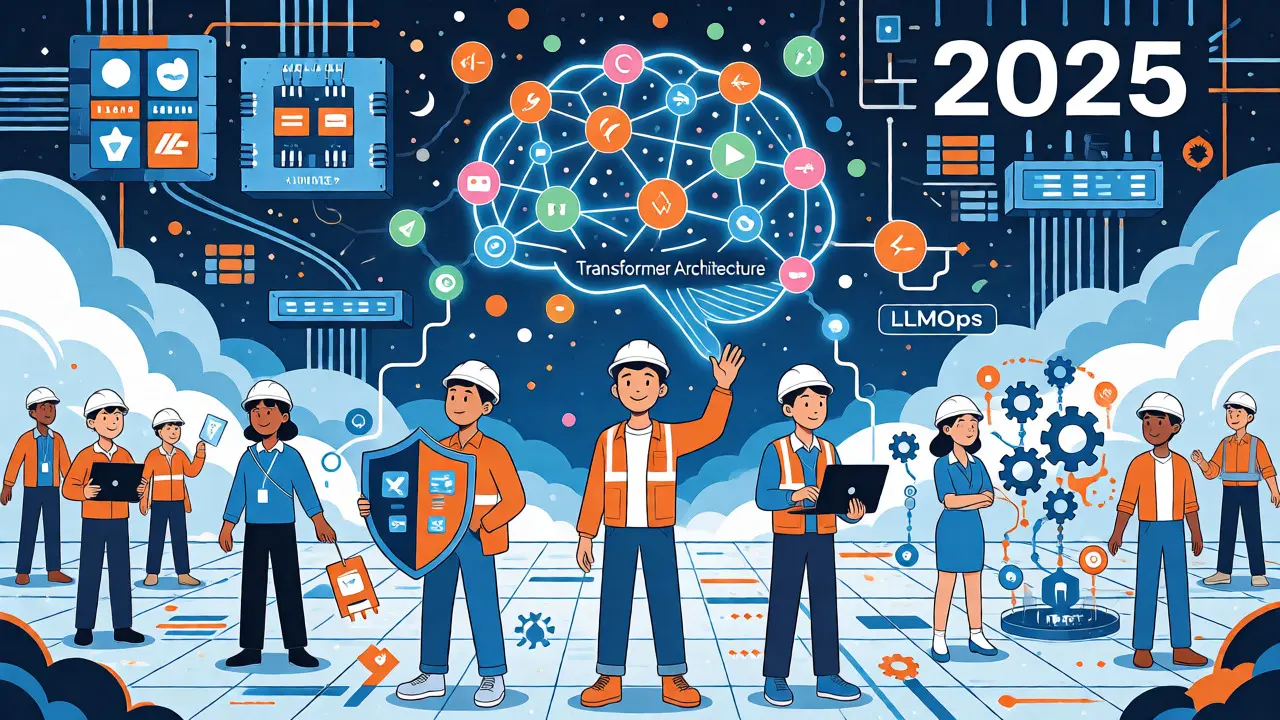
You’ve got the budget. You have the GPU cluster humming in the cloud. But when you post a job for an LLM Engineer, you’re getting applications from people who can barely explain what a token is. It’s frustrating, right? The gap between what companies need and what candidates actually offer has never been wider. In 2025, building a team that can ship large language models isn’t just about finding someone who knows Python. It’s about identifying specific, hard-to-find competencies that bridge the gap between research papers and production-grade software.
If you’re leading a tech team or managing HR for an AI-focused organization, this guide breaks down exactly who you need to hire. We aren’t talking about generic "data scientist" roles anymore. We are looking at specialized roles like LLMOps Practitioners, professionals focused on the deployment, monitoring, and maintenance of LLMs in production environments, and RAG Engineers, who specialize in Retrieval-Augmented Generation systems. Let’s look at the actual skills required to build a team that survives contact with real-world users.
The Core Technical Foundation: Beyond Basic Coding
First, let’s clear up a misconception. Knowing how to call an API is not enough. While prompt engineering was a hot topic in 2023, by 2025, it’s considered a baseline skill, not a specialization. Your core hires need deep proficiency in Python, specifically within frameworks like PyTorch and TensorFlow. Why? Because you will inevitably hit performance bottlenecks or hallucination issues that require tweaking the model itself, not just the prompt.
The non-negotiable here is a solid grasp of the Transformer Architecture. Candidates must understand self-attention mechanisms, multi-head attention, and positional encoding. If your candidate can’t explain why a model struggles with long-context windows without looking at a cheat sheet, they aren’t ready for a senior role. This foundational knowledge allows them to diagnose why a model fails rather than just guessing new prompts until it works.
- Python Proficiency: Must be able to write efficient, asynchronous code for handling concurrent requests.
- Framework Mastery: Deep experience with PyTorch or TensorFlow for custom training loops.
- Architecture Knowledge: A clear mental model of how transformers process sequence data.
Specialized Roles: Who Do You Actually Need?
Generalists are becoming obsolete in high-performance LLM teams. The market has split into distinct tracks, and you need to know which track your project requires. Hiring a "generalist" often means paying for someone who is mediocre at everything but great at nothing.
| Role | Primary Focus | Critical Tools/Skills | Seniority Indicator |
|---|---|---|---|
| LLMOps Engineer | Deployment, scaling, and monitoring | vLLM, TGI, Kubernetes, CI/CD pipelines | Has reduced inference latency by >30% |
| RAG Specialist | Data retrieval and context injection | LangChain, LlamaIndex, Vector DBs (Pinecone/Milvus) | Optimized hybrid search accuracy metrics |
| Fine-Tuning Expert | Customizing base models for domain tasks | LoRA, QLoRA, PEFT libraries, Hugging Face Transformers | Reduced model size while maintaining accuracy |
| Eval Engineer | Testing, benchmarking, and quality assurance | Ragas, Arize, Custom NLP metrics, Human-in-the-loop workflows | Built automated regression suites for LLM outputs |
Notice the shift toward Efficient Fine-Tuning. Techniques like LoRA (Low-Rank Adaptation) and QLoRA are no longer optional extras; they are standard requirements. Companies cannot afford to retrain massive models from scratch every time business needs change. Your team needs people who can adapt existing weights efficiently, saving both compute costs and time.
The Rise of LLMOps and Infrastructure Skills
Here is where many startups fail. They build a cool demo, then wonder why their cloud bill is $50,000 a month and their response times are three seconds. This is an LLMOps problem, not a modeling problem. By 2025, operational expertise is valued as highly as algorithmic knowledge.
You need engineers who understand serving frameworks like vLLM and Text Generation Inference (TGI). These tools optimize memory usage and throughput. A good LLMOps engineer knows how to implement quantization-using 8-bit or 4-bit precision-to run larger models on smaller GPUs. They also understand caching strategies. If your team doesn’t have someone who can manage KV-cache optimization, you are leaving money on the table.
Furthermore, local deployment skills are making a comeback. As privacy concerns grow, more enterprises want to run models on-premise or on edge devices. Look for candidates who have experience setting up Local LLM stacks using tools like Ollama or llama.cpp. This flexibility is a major competitive advantage.

Soft Skills: The Hidden Differentiator
Technical skills get you the interview. Soft skills keep you employed. Working with LLMs is messy. Models hallucinate. Outputs are stochastic. Stakeholders don’t understand why the answer changed slightly after a restart. Your team needs strong communication abilities to manage these expectations.
Requirements Elicitation is critical. Can your engineer sit down with a product manager and translate a vague request like "make it sound professional" into concrete evaluation metrics? Research shows that teams practicing active listening and clear question formulation deliver projects 40% faster because they avoid rebuilding features based on misunderstandings.
Ethical awareness is another soft skill that has hardened into a technical requirement. With regulations tightening globally, your team must instinctively spot bias in training data or output. You don’t need a dedicated ethicist for every small team, but every engineer should understand fairness evaluation and transparency practices. If a model consistently favors one demographic in its responses, that’s a bug, not a feature.
Evaluation: The Most Underrated Skill Set
How do you know if your model is actually better? Many teams rely on "vibes." This is dangerous. In 2025, Evaluation Engineering is a distinct discipline. You need people who can design robust testing frameworks.
Look for candidates familiar with tools like Ragas or Arize Phoenix for observability. They should understand the difference between intrinsic evaluation (is the grammar correct?) and extrinsic evaluation (did the user click the link?). More importantly, they need to know the limitations of benchmarks. Gaming a leaderboard score doesn’t mean your chatbot is useful. Prioritize candidates who have built custom evaluation datasets relevant to your specific industry vertical.

Hiring Strategy: Where to Find Talent
The supply of true LLM experts is still tight. You won’t find them easily on general job boards. Here is how successful teams are sourcing talent in late 2025:
- Open Source Contributions: Check GitHub. Did they contribute to LangChain, LlamaIndex, or vLLM? This proves they can collaborate on complex codebases.
- Portfolio Projects: Ignore certificates. Ask for a deployed app. Can they show a live endpoint? Did they handle rate limiting? Did they log errors?
- Adjacent Domains: Look at backend engineers with strong system design skills. Teaching them the LLM specifics is often easier than teaching an academic ML researcher how to write production-ready code.
- Community Engagement: Are they active in Discord servers or attending conferences like NeurIPS or specialized AI meetups? Continuous learning is mandatory in this field.
Be prepared for competition. Top talent commands premium salaries. However, consider apprenticeship programs for mid-level software engineers. Their fundamentals are strong, and with three months of intensive mentorship on transformers and RAG patterns, they can become valuable assets.
Future-Proofing Your Team
Don’t just hire for today. The landscape shifts fast. Multimodal capabilities-processing text, images, and audio together-are becoming standard. When interviewing, ask how they would integrate image inputs into a current text-only pipeline. Also, look for interest in agentic workflows. The next wave isn’t just generating text; it’s using LLMs to execute tasks. Candidates who have experimented with autonomous agents show forward-thinking potential.
Finally, remember that culture matters. An LLM team thrives on experimentation. If your company punishes failure, your team will play it safe and miss out on breakthroughs. Hire curious people who treat failed experiments as data points, not defeats.
Do I need a PhD to hire an LLM engineer?
No. While a PhD helps for research-heavy roles, most production LLM work requires strong software engineering principles and practical experience with frameworks like PyTorch and Hugging Face. Many excellent LLM engineers come from traditional backend or full-stack backgrounds and learned the AI specifics through hands-on projects.
What is the difference between a Prompt Engineer and an LLM Engineer?
A Prompt Engineer focuses on optimizing input text to get better results from existing models, often without touching the codebase. An LLM Engineer builds the infrastructure, fine-tunes models, implements RAG pipelines, and manages deployment. In 2025, prompt engineering is considered a subset skill of broader LLM Engineering.
Which programming languages are essential for LLM teams?
Python is the dominant language due to its ecosystem (PyTorch, TensorFlow, Hugging Face). However, knowledge of C++ or Rust is increasingly valuable for optimizing inference engines and working with low-level tensor operations. JavaScript/TypeScript is crucial for the frontend integration of LLM applications.
How do I evaluate practical LLM skills during interviews?
Avoid whiteboard coding alone. Give them a take-home project: build a simple RAG application using a provided dataset. Evaluate their code structure, error handling, choice of vector database, and how they evaluated the output quality. Asking them to explain a recent paper they read is also a good test of continuous learning habits.
Is certification necessary for LLM jobs?
Certifications are rarely decisive. Employers prioritize demonstrated capability over credentials. A portfolio showing deployed projects, open-source contributions, or detailed blog posts explaining technical implementations carries much more weight than a certificate from an online course.