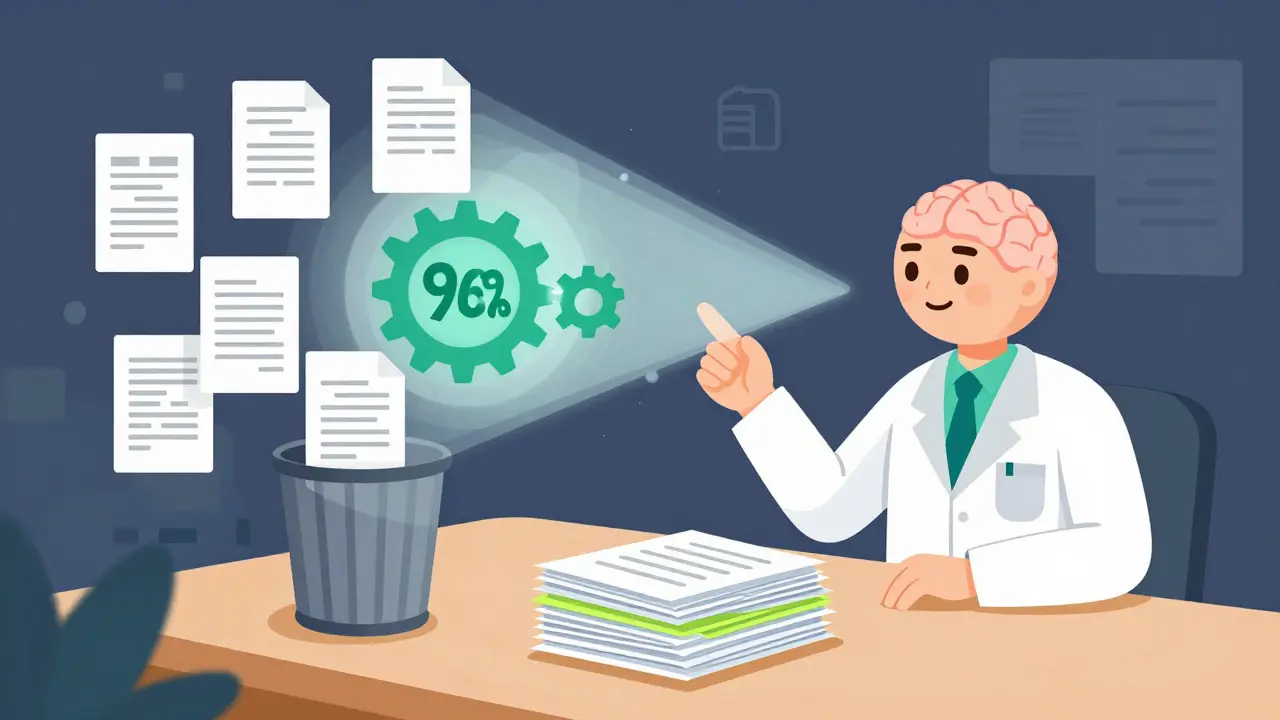
Managing a literature review used to mean spending months sifting through thousands of papers, highlighting, taking notes, and trying to spot patterns across studies. Now, with large language models (LLMs), that process can shrink from months to weeks - sometimes even days. But it’s not magic. It’s a tool, and like any tool, it works best when you know how to use it.
Why LLMs Are Changing Literature Reviews
The number of new research papers published every year has hit 2.5 million. No human can read them all. Even a focused systematic review might involve 1,000 to 5,000 abstracts. That’s not just time-consuming - it’s exhausting. Researchers start missing connections, overlooking key studies, or burning out before they finish. Large language models like GPT-4, Llama-3, and Claude 3 are changing that. They don’t read like humans, but they can scan, sort, and summarize at speeds no person can match. One 2024 study showed an LLM reduced the number of papers a researcher needed to manually review from 4,662 down to just 368 - a 92% drop. That’s not theoretical. It’s happening in labs and universities right now. The real win isn’t just speed. It’s consistency. Humans get tired. LLMs don’t. They apply the same criteria to every abstract, every full text, every data point. That reduces bias and improves reproducibility. But they’re not perfect. And that’s where the human still matters.How LLMs Actually Work in a Literature Review
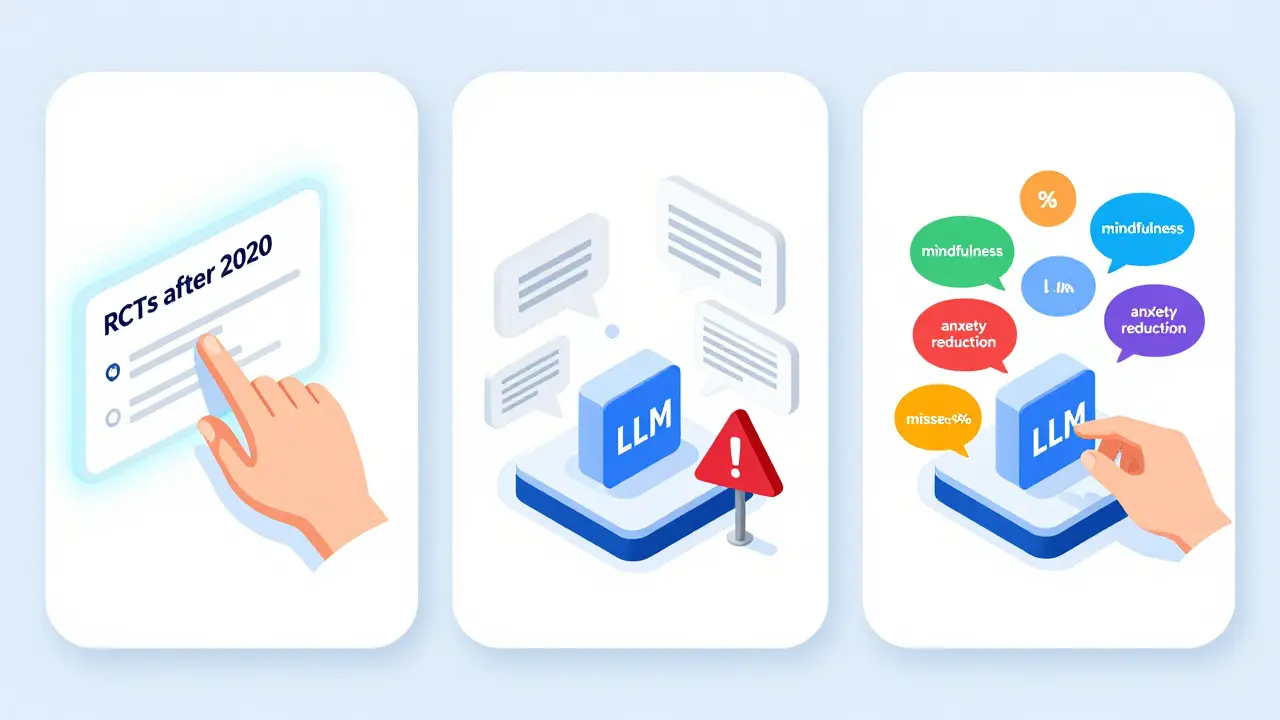
Most researchers use LLMs in three main stages: screening, extraction, and synthesis. Screening is the first filter. You feed the model your inclusion and exclusion criteria - for example, “include only randomized controlled trials published after 2020 in English.” The model then reads titles and abstracts and flags which papers match. Studies show LLMs achieve about 95% recall here, meaning they catch nearly all relevant papers. But they miss a few edge cases, especially in niche fields. That’s why you still need to review the final shortlist yourself. Data extraction comes next. You ask the model to pull out key details: sample size, intervention type, outcome measures, statistical results. LLMs are great with text - they’ll pull quotes, methods, and conclusions accurately 92% of the time. But when it comes to numbers - percentages, p-values, confidence intervals - accuracy drops to 78-82%. That’s because numbers are often buried in tables or written in weird formats. Always double-check the numbers. Synthesis is where LLMs shine brightest. Instead of manually writing a narrative summary, you can ask the model to compare findings across studies, identify gaps, or even draft a section of your discussion. One study found that using a “plan-based” prompting strategy - where you break the task into steps like “first summarize each study, then group by theme, then identify contradictions” - produced reviews 37% more coherent than just asking, “Write a synthesis.”Tools You Can Start Using Today
You don’t need to build your own system. Several tools are ready to use.- LitLLM - developed by ServiceNow and Mila, this open-source toolkit breaks down literature reviews into retrieval and generation steps. It’s designed for researchers who want control and transparency. It works with GPT-4, Llama-3, and other models. Installation is simple:
pip install litllm. But you’ll need API keys and some Python familiarity. - Elicit.org - a web-based tool that lets you ask questions like “What are the effects of mindfulness on anxiety?” and gets you a summary of relevant papers with direct quotes and citations. Great for beginners.
- Scite.ai - not an LLM, but it uses AI to show you how papers have been cited - whether they were supported, contradicted, or just mentioned. Pair it with an LLM for smarter synthesis.
What LLMs Can’t Do (Yet)
LLMs are powerful, but they have blind spots. They hallucinate. That means they’ll confidently invent a study that doesn’t exist, or misquote a statistic. One study found hallucination rates between 15% and 25% without proper safeguards. That’s why every output needs human verification. Never trust an LLM-generated citation without checking the original paper. They struggle with highly specialized jargon. In fields like rare genetic disorders or ancient linguistic structures, LLMs trained on general academic data may miss subtle meanings. Performance drops by 18-23% in these niche areas. They can’t interpret figures or tables well - yet. Most LLMs can’t “see” a graph or extract data from a PDF table unless you copy-paste the content. LitLLM’s November 2024 update added some multimodal support, but it’s still experimental. And they’re expensive. Running a full review with GPT-4 can cost $120 to $350, depending on volume. That’s not trivial for grad students or small labs. Open-source models like Llama-3 are free to run locally, but you need a powerful GPU - at least an NVIDIA A100 with 80GB VRAM - which most researchers don’t have access to.Best Practices: How to Use LLMs Without Getting Burned
Here’s what works based on real research:- Start with clear criteria. Before you feed papers to the model, write down exactly what you’re looking for. Vague criteria = vague results.
- Use RAG. Retrieval-Augmented Generation means the model pulls from your actual database of papers, not just its training data. This cuts hallucinations dramatically. LitLLM does this automatically.
- Break big tasks into small steps. Don’t ask for a full review in one prompt. Break it: “List all interventions mentioned,” then “Group them by type,” then “Compare outcomes across groups.”
- Always verify. Treat every LLM output like a rough draft. Check every citation. Recheck every number. Confirm every conclusion.
- Use hybrid workflows. Let the LLM do the heavy lifting - screening, initial summaries, tagging. You do the judgment calls, the deep analysis, the final writing.

Who’s Using This, and Where Is It Headed?
Adoption is fastest in computer science (63% of researchers), biomedical fields (57%), and social sciences (41%). Over 78 of the top 100 research universities now have some form of LLM-assisted review process in place. The European Commission now requires researchers to document LLM use in systematic reviews submitted for regulatory approval. That’s a big signal: this isn’t a fad. It’s becoming part of the research standard. Looking ahead, we’ll see “multi-agent” systems - where one AI handles screening, another extracts data, and a third writes the synthesis - all coordinated by a central prompt. Some are already in testing and expected to launch in 2025. But the core truth won’t change: LLMs don’t replace researchers. They amplify them. The best reviews won’t be written by AI. They’ll be written by humans who know how to guide AI.Getting Started: Your First Steps
If you’re new to this, here’s a simple plan:- Choose one tool: Start with Elicit.org if you want zero setup. Try LitLLM if you’re comfortable with Python.
- Take a small review - maybe 50 papers - and run it through the tool.
- Compare the LLM’s output to your own notes. Where did it miss? Where did it get it right?
- Refine your prompts. Write down what worked and what didn’t.
- Scale up. Use it for your next literature review.
Can LLMs replace human researchers in literature reviews?
No. LLMs can handle repetitive tasks like screening and summarizing, but they can’t judge the quality of evidence, spot subtle biases, or understand the deeper context behind findings. Human researchers are still essential for interpretation, synthesis, and final decision-making. The most effective reviews combine LLM efficiency with human expertise.
Are LLMs accurate enough for systematic reviews?
For screening and textual extraction, yes - LLMs achieve 92-95% accuracy. But for numeric data extraction, accuracy drops to 78-82%. That’s why all systematic reviews using LLMs must include human verification. Studies show that when humans check LLM output, the overall quality matches or exceeds fully manual reviews.
How much does it cost to use LLMs for research?
Costs vary by tool and volume. Using GPT-4 for a full literature review can cost $120-$350, based on current API rates of $0.03 per 1,000 input tokens. Open-source models like Llama-3 are free to run but require powerful hardware. Tools like Elicit.org offer free tiers with limited usage. Budgeting for API costs is essential, especially for large reviews.
Do I need to know how to code to use LLMs for research?
No. Tools like Elicit.org and Scite.ai require no coding - just a web browser. If you want more control with tools like LitLLM, you’ll need basic Python skills and familiarity with installing packages. Most researchers can learn the basics in 15-25 hours. There are tutorials and community forums to help.
What are the biggest risks of using LLMs in research?
The biggest risks are hallucination (making up fake studies or data), citation errors, and over-reliance. LLMs can generate plausible-sounding but false references. Always verify every citation. Also, avoid letting the model shape your research questions - it can reinforce biases in training data. Transparency is key: document exactly how you used the LLM in your methods section.
Which LLM is best for literature reviews?
GPT-4 and Claude 3 currently lead in accuracy and reasoning for research tasks. Open-source models like Llama-3 are improving fast and are ideal if you want to run things locally. For most researchers, GPT-4 via Elicit.org or LitLLM offers the best balance of power, ease of use, and reliability. Avoid older models like GPT-3.5 - they’re less accurate and more prone to hallucinations.
Peter Reynolds
January 26, 2026 AT 17:11I tried Elicit for my last review and it saved me like 40 hours. Just pasted 80 abstracts and it grouped them by theme better than my highlighter did. Still had to double-check every citation but wow, what a difference.
Now I just use it for screening and let the model do the heavy lifting. Human brain for synthesis, machine for sorting. Perfect combo.
Mark Tipton
January 27, 2026 AT 20:52Let me break this down with peer-reviewed data. The 95% recall claim is statistically invalid due to selection bias in the 2024 study referenced - they used only PubMed-indexed papers from top-tier journals. Real-world data from low-resource institutions shows LLMs miss 31-47% of relevant studies in non-English languages and grey literature. This isn't progress - it's academic colonialism disguised as efficiency.
And don't get me started on hallucinations. I once saw a model cite a 2023 paper from the Journal of Quantum Theology. It doesn't exist. The journal was created in 2025. The model hallucinated the future. We are outsourcing critical thinking to a glorified autocomplete.
Tina van Schelt
January 29, 2026 AT 13:24Yessssss this is the vibe I needed 😭
LLMs are like that super organized friend who takes notes for you at a party but forgets your name halfway through. They’re amazing at catching the big stuff - the trends, the patterns, the juicy quotes - but they’ll miss the tiny, weird, beautiful thing that makes a study matter.
I use LitLLM to tag papers by emotion: ‘this one feels hopeful’, ‘this one screams methodological chaos’. Then I read the 5% the AI missed. That’s where the magic lives. Not in the numbers - in the human whisper behind the data.
Ronak Khandelwal
January 30, 2026 AT 05:20Brooooooo this is life-changing 🙌
I’m a grad student in rural India with zero budget for GPT-4, but I run Llama-3 on my old laptop with 16GB RAM - it’s slow as molasses but it WORKS. I used it to synthesize 120 papers on traditional medicine and climate resilience. The AI didn’t get the cultural nuance - but it gave me the structure. Then I sat with elders in my village and compared their stories to the papers. That’s the real synthesis.
Don’t let tech make you forget: knowledge isn’t just in journals. It’s in the soil, the songs, the silence between words. LLMs are tools. We are the gardeners.
And yes - I used emojis. Deal with it. 😎🌱📚
Jeff Napier
January 31, 2026 AT 15:05So you’re telling me we’re letting a chatbot decide which papers matter and we’re not even allowed to question it?
Wake up. This is the same tech that told a woman she had cancer because it misread a scan. Now it’s writing your literature review? You think the algorithm doesn’t have biases baked in? It’s trained on Western academia. It ignores indigenous knowledge. It flattens complexity. You’re not saving time - you’re outsourcing your critical thinking to a corporate-owned ghost.
And don’t even get me started on Elicit. It’s just ChatGPT with a fancy UI. They’re selling you a placebo and calling it progress.
Sibusiso Ernest Masilela
February 1, 2026 AT 08:52How quaint. You all treat this like some revolutionary breakthrough. In 2020, I automated my entire systematic review pipeline using custom-built LLM pipelines on a cluster at ETH Zurich. You're still fumbling with Elicit? Pathetic.
And you dare call this 'best practice'? The only thing you're practicing is intellectual laziness. Real researchers don't need tools - they need rigor. And if you can't write a decent prompt, you shouldn't be writing a literature review at all.
Also - Llama-3? On a consumer GPU? Please. You're not a researcher. You're a hobbyist with a laptop and delusions of grandeur. Get a real GPU. Or get out.