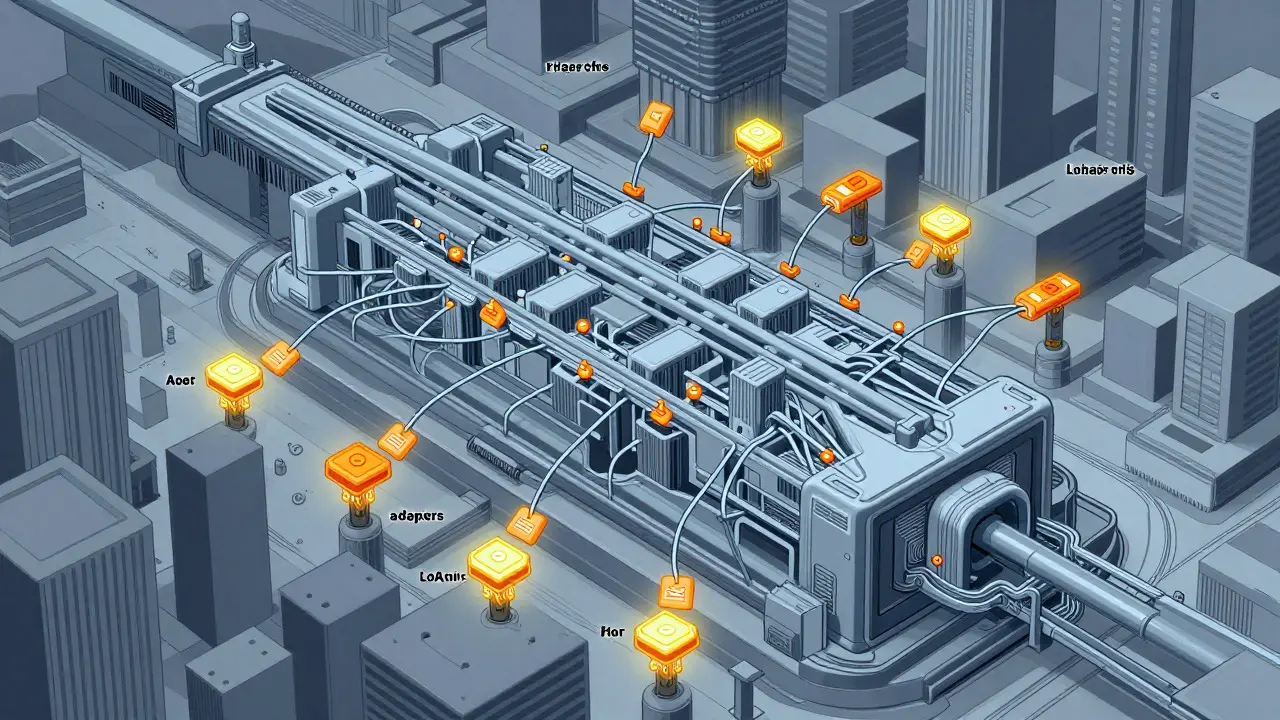
Imagine needing to customize a 70-billion parameter language model for your company's specific legal terminology. Full fine-tuning would require massive GPU clusters and weeks of training time. But what if you could achieve 97% of that performance by updating just 0.2% of the parameters? That is the core promise of Parameter-Efficient Fine-Tuning, or PEFT, a technique that has fundamentally changed how developers approach large language model (LLM) customization. Instead of retraining an entire neural network, you attach small, trainable modules to a frozen base model. The two dominant methods here are Low-Rank Adaptation (LoRA) and Adapter modules. Both solve the same problem-making LLMs accessible without billion-dollar compute budgets-but they do it in distinctly different ways that affect speed, memory usage, and deployment complexity.
The Core Problem: Why Full Fine-Tuning Fails for Most Teams
Full fine-tuning updates every single weight in a model. For a model with 13 billion parameters, this means storing gradients and optimizer states for all 13 billion values. In practice, this requires 80GB of VRAM or more, often necessitating multiple high-end GPUs like A100s or H100s. For most startups, mid-sized enterprises, and even many research labs, this hardware barrier is prohibitive. Furthermore, maintaining separate fully fine-tuned models for different tasks (e.g., one for coding, one for medical QA, one for marketing copy) leads to storage bloat. If you have ten specialized models, you need ten copies of the base weights, multiplying your infrastructure costs exponentially.
PEFT techniques break this cycle. By freezing the backbone model and only training small auxiliary components, you reduce the trainable parameter count by orders of magnitude. This allows you to fine-tune large models on consumer-grade hardware. A 13B parameter model can be fine-tuned using LoRA with just 24GB of VRAM, fitting comfortably on a single RTX 3090 or 4090 GPU. Even larger models become accessible through quantization variants like QLoRA. The result is not just cost savings; it is democratization. Teams that previously relied on API calls to generic models can now own their specialized versions, reducing latency and data privacy risks while keeping operational costs down by approximately 70% compared to full fine-tuning pipelines.
How LoRA Works: Low-Rank Decomposition Explained
Low-Rank Adaptation, or LoRA, was introduced by Microsoft Research in 2021. The mathematical insight behind LoRA is that the update matrix required to adapt a pre-trained model to a new task does not need to be full-rank. Instead, it can be approximated by the product of two smaller matrices. Let $W$ be the original weight matrix of dimension $d \times k$. In full fine-tuning, you learn a dense update $\Delta W$. In LoRA, you constrain $\Delta W = A \times B$, where $A$ is $d \times r$ and $B$ is $r \times k$. The key variable here is $r$, the rank, which is typically much smaller than $\min(d, k)$ (often between 8 and 64).
In practice, LoRA injects these low-rank matrices into the attention layers of a Transformer, specifically targeting the Query ($Q$) and Value ($V$) projection matrices. During training, the base model weights remain frozen, and only $A$ and $B$ are updated. At inference time, you can either keep the adapter active (adding negligible latency) or merge $A$ and $B$ back into $W$ to create a new, static weight matrix. Merging eliminates any runtime overhead, making the adapted model indistinguishable from a fully fine-tuned one in terms of speed. This flexibility is why LoRA has captured roughly 65% of the PEFT market share as of late 2025. It offers the best balance of simplicity, performance, and ease of deployment.
Adapter Modules: The Sequential Approach
Adapter modules take a different architectural route. Rather than modifying the internal weight matrices of existing layers, adapters insert small bottleneck neural networks between standard Transformer blocks. Typically, an adapter consists of two linear layers with a non-linear activation function in between. The first layer down-projects the hidden state to a lower dimension (the bottleneck, usually 64-128 dimensions), and the second layer up-projects it back to the original size.
This design increases the depth of the model slightly but keeps the parameter count very low. However, there is a trade-off. Because adapters are inserted sequentially into the forward pass, they add computational steps that cannot be parallelized as efficiently as native matrix multiplications. Benchmarks from Coralogix in 2023 showed that adapter-based models incur 15-20% higher inference latency compared to LoRA-based models. While this might seem minor, in high-throughput production environments serving thousands of requests per second, that percentage adds up to significant GPU utilization costs. On the other hand, adapters can converge faster during training for certain tasks, completing optimization cycles 15-20% quicker than LoRA when minimal parameter updates are sufficient. They are also modular, allowing you to swap out specific adapter blocks without touching the rest of the architecture, which is useful for multi-task learning scenarios where you want to enable or disable specific capabilities dynamically.
QLoRA: Pushing Limits with Quantization
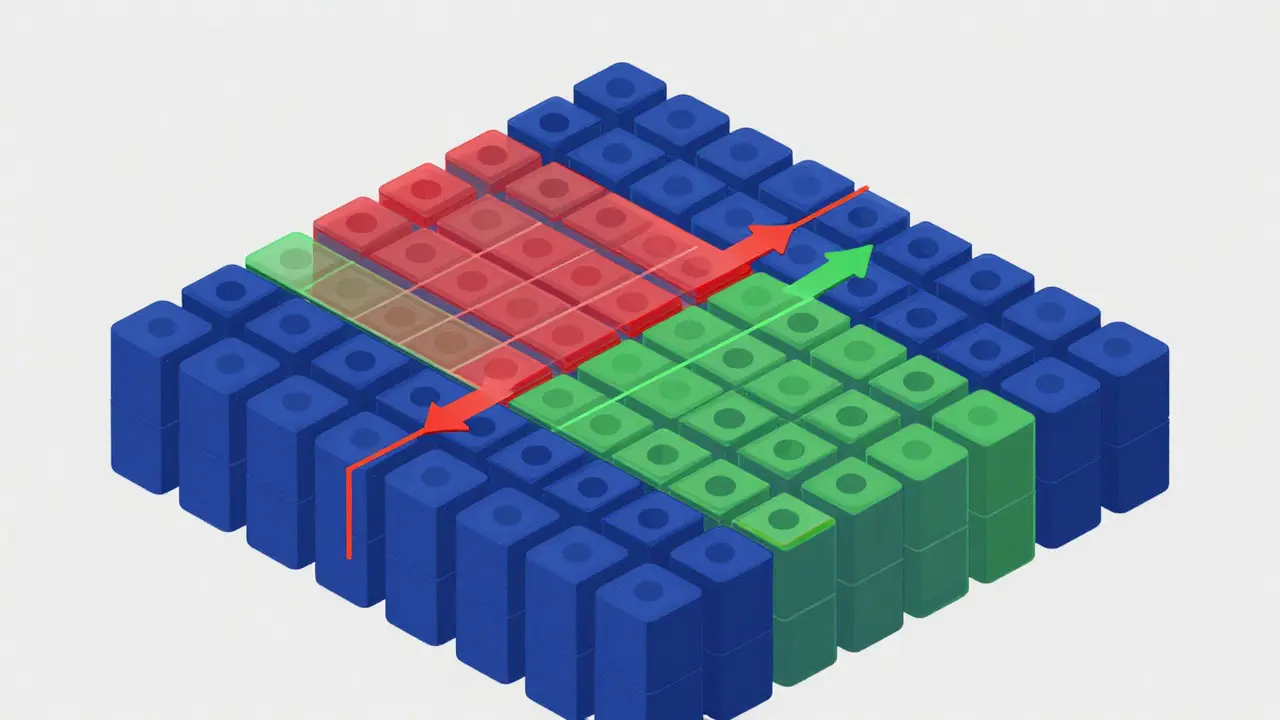
While standard LoRA works well for models up to 13B or 30B parameters on modern hardware, it struggles with massive models like Llama-65B or Mixtral-8x7B. This is where QLoRA comes in. Introduced by Dettmers et al. in 2023, QLoRA combines 4-bit quantization of the base model with LoRA adaptation. The base model weights are stored in 4-bit format, drastically reducing memory footprint, while the LoRA adapters remain in higher precision (typically 16-bit) to ensure stable gradient updates.
The magic of QLoRA lies in its ability to fine-tune 65B parameter models on a single 24GB GPU. How? By using double quantization and paged optimizers, it manages memory fragmentation and peak usage effectively. For example, fine-tuning a 65B model with standard LoRA would require hundreds of GBs of VRAM. With QLoRA, it fits into 24GB. This has been a game-changer for organizations that want to leverage state-of-the-art open-source models without renting expensive cloud instances. If your target model exceeds 30B parameters, QLoRA is almost always the recommended starting point over standard LoRA.
| Feature | LoRA | Adapters | QLoRA |
|---|---|---|---|
| Trainable Parameters | ~0.1% - 1% | ~0.5% - 2% | ~0.1% - 1% |
| Inference Latency Impact | <1% (if merged) | 15-20% increase | <1% (if merged) |
| Memory Efficiency | High | Medium | Very High (supports 65B+ models) |
| Implementation Complexity | Low | Medium | Medium (requires quantization setup) |
| Best Use Case | General task-specific customization | Multi-task modular learning | Fine-tuning very large models (>30B) |
Choosing the Right Hyperparameters: Rank and Alpha
Selecting the right hyperparameters is often the most challenging part of implementing PEFT. For LoRA, the two critical settings are the rank ($r$) and the scaling factor ($\alpha$). The rank determines the capacity of the adapter. A low rank (e.g., $r=8$) is suitable for simple tasks like sentiment analysis or basic classification, where the model needs to learn only minor adjustments. Complex tasks, such as few-shot reasoning or domain-specific code generation, may require higher ranks (e.g., $r=64$ or $r=128$) to capture more nuanced patterns.
The alpha parameter scales the effect of the low-rank update. The effective weight update is calculated as $\Delta W \times (\alpha / r)$. A common rule of thumb is to set $\alpha$ equal to $r$ or $2r$, resulting in a ratio of 1.0 or 2.0. Deviating significantly from these ratios can lead to unstable training or underfitting. According to Hugging Face’s technical documentation, sticking to these standard ratios provides optimal results across diverse NLP benchmarks. If you find that your model is underfitting, try increasing the rank before adjusting alpha. If it is overfitting, consider reducing the rank or adding dropout to the adapter layers.
Practical Implementation and Common Pitfalls
Implementing LoRA or Adapters today is straightforward thanks to libraries like Hugging Face’s PEFT library. You don’t need to write custom PyTorch modules; you simply specify which layers to target and the rank value. However, several pitfalls can trip up developers. One common issue is "adapter conflict" when loading multiple LoRA weights simultaneously. If you load two adapters that modify the same layers without proper scheduler configuration, you can see a 12% performance degradation in multi-task scenarios. Using the `adapter_source` parameter or carefully managing the loading order can resolve this.
Another pitfall is numerical precision loss during merging. When you merge LoRA weights back into the base model, floating-point arithmetic can introduce small errors. In some cases, this causes a 0.8% drop in accuracy. To mitigate this, perform the merge in float32 precision before converting back to the inference dtype. Additionally, remember that PEFT is not a silver bullet for continued pre-training. If you are adding massive amounts of new domain data (billions of tokens), full fine-tuning still maintains a 3-5% accuracy advantage. PEFT shines when you are adapting an existing model to a new task with a smaller dataset (thousands to millions of examples).
Deployment Strategies: Serving Multiple Adapters
One of the biggest advantages of PEFT is the ability to serve multiple specialized models from a single base model instance. Instead of spinning up separate servers for each task, you can load one base model and attach different adapters on the fly. Tools like LoRAX (from Predibase) enable multi-adapter batching. This means you can handle requests for medical QA, legal summarization, and customer support simultaneously on the same GPU. The latency increase per additional adapter is sub-linear; after the first 10 adapters, each new one adds only 3-5% latency. This makes it feasible to serve 100+ distinct use cases with less than 50% total latency overhead compared to a single-adapter setup. For enterprises, this translates to significant cost savings. American Express, for example, reduced fraud detection model deployment time from 14 days to 8 hours by managing 237 adapters on a single Llama-2-70B backbone, saving $1.2M annually in GPU costs.
Is LoRA better than full fine-tuning?
For most downstream tasks, LoRA achieves 97-99% of full fine-tuning accuracy while requiring 500x less memory. It is superior in terms of cost and scalability. However, for continued pre-training on massive datasets, full fine-tuning still holds a slight accuracy edge (3-5%).
What is the difference between LoRA and Adapters?
LoRA modifies existing weight matrices via low-rank decomposition, allowing for zero-latency inference when merged. Adapters insert new sequential layers into the network, which adds 15-20% inference latency but offers greater modularity for multi-task learning.
Can I use LoRA on a 70B parameter model?
Yes, but you should use QLoRA. Standard LoRA requires too much VRAM for 70B models. QLoRA uses 4-bit quantization to fit the base model into 24GB of VRAM, enabling fine-tuning on a single high-end consumer GPU like an RTX 4090.
How do I choose the rank (r) for LoRA?
Start with r=8 for simple tasks and increase to r=64 or r=128 for complex reasoning or domain-specific tasks. Monitor validation loss; if underfitting, increase rank. If overfitting, decrease rank or add regularization.
Does merging LoRA weights cause accuracy loss?
Sometimes. Numerical precision issues can cause a small drop (around 0.8%) in accuracy. To minimize this, perform the merge operation in float32 precision before casting back to the inference format.