You ask a large language model about a project you started three weeks ago. It looks at you blankly (metaphorically speaking). Why? Because standard Transformers are like goldfish with expensive degrees. They have massive processing power but zero long-term memory once the conversation window closes. This isn't just annoying; it's a fundamental architectural flaw that stops AI from becoming truly useful in real-world scenarios where history matters.
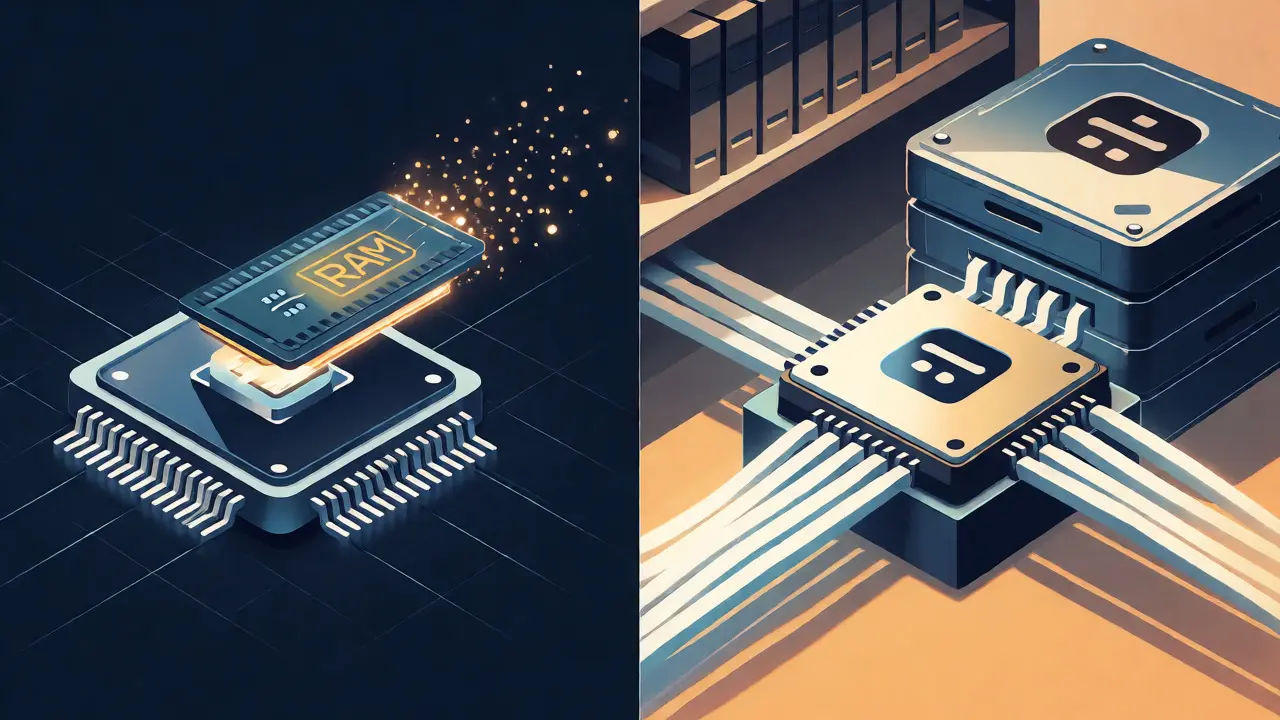
This is where Memory-Augmented Transformers (MATs) step in. These aren't just minor tweaks to existing models. They represent a shift toward giving AI systems persistent, external storage-like adding a hard drive to a CPU that previously only had RAM. By integrating external memory modules, MATs allow models to retain knowledge across sessions, learn continuously without retraining, and handle context lengths that would crash traditional architectures. If you're building or using LLMs today, understanding how these external stores work is no longer optional-it's essential for escaping the "context window" trap.
The Core Problem: Fixed Context Windows and Catastrophic Forgetting
Standard Transformer models rely on attention mechanisms that scale quadratically with sequence length. Double the input size, and you quadruple the computational cost. To keep things manageable, engineers cap the context window-often between 4k to 128k tokens. Once text falls out of this window, it’s gone. The model doesn’t "remember" it; it literally can’t see it.
Worse, when you try to teach a standard model new information via fine-tuning, you often hit catastrophic forgetting. The model learns new facts but overwrites old ones because all knowledge is stored in its static weights. There’s no separate place to stash new data without risking damage to existing capabilities. This makes continuous learning nearly impossible without expensive, frequent retraining cycles.
| Feature | Standard Transformer | Memory-Augmented Transformer |
|---|---|---|
| Knowledge Storage | Static model weights | Weights + External Memory Store |
| Context Limit | Fixed (e.g., 128k tokens) | Effectively infinite (limited by storage) |
| Learning Type | Batch training / Fine-tuning | Continual / Test-time learning |
| Complexity | O(n²) attention scaling | O(n) or O(log n) with hierarchical memory |
How External Memory Stores Actually Work
Think of a Memory-Augmented Transformer as having two brains. One is the standard neural network responsible for reasoning and generation. The other is an explicit, differentiable memory module-a database that lives alongside the model but isn't part of its frozen weights. This external store can be read from and written to dynamically during inference.
The magic lies in the integration mechanism. Instead of just looking at previous tokens in the current prompt, the model uses special attention heads to query this external memory. It asks, "Do I have anything relevant stored here?" If yes, it retrieves those vectors and injects them into the current computation. If no, it might write the new information to memory for later use. This process is end-to-end trainable, meaning the model learns *how* to remember and retrieve, not just what to say.
There are three main types of memory representations used in modern MATs:
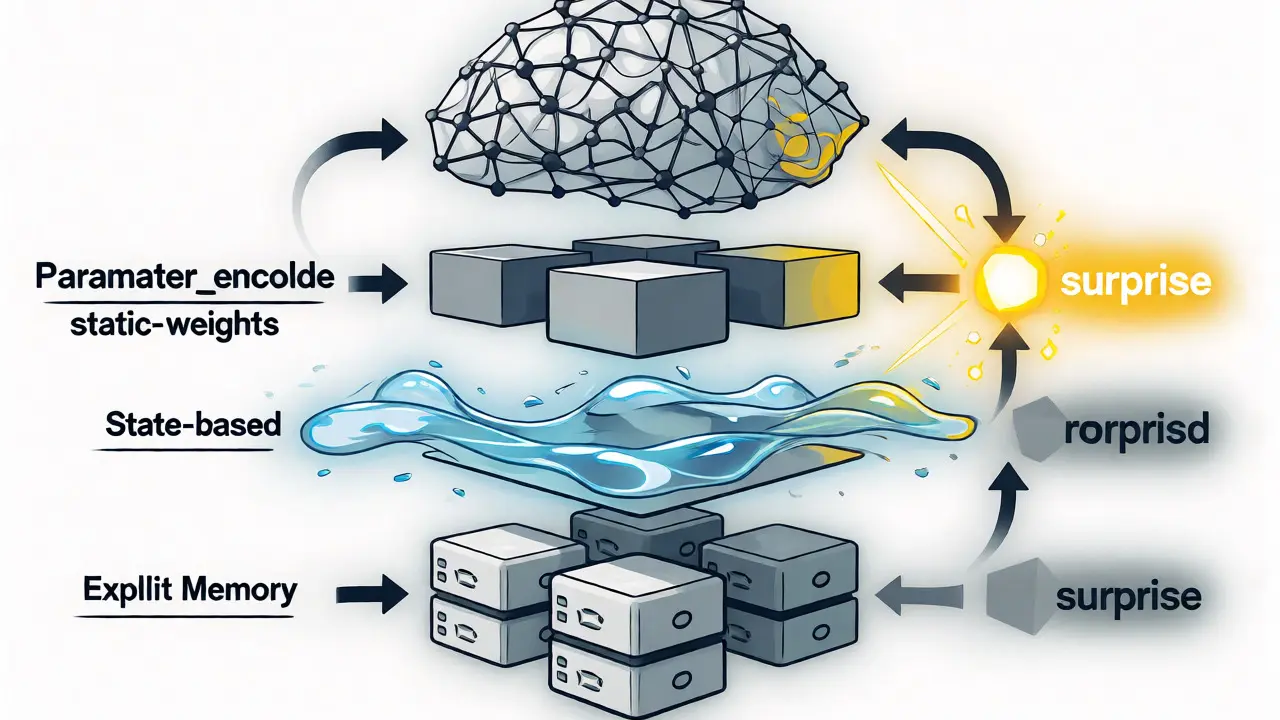
- Parameter-encoded memory: Knowledge baked into the model weights (like traditional LLMs).
- State-based memory: Temporary activations that hold immediate context (like the KV cache in standard Transformers).
- Explicit memory: Structured external storage (databases, vector stores) that persists independently of the model instance.
Advanced systems combine all three. For example, Titans, introduced by Behrouz et al. in 2024, uses a hierarchical approach. It combines fast state-based attention for immediate context with a slow, parameter-encoded long-term memory module that adapts during test time. This allows the model to update its internal understanding without full retraining.
Key Architectures Leading the Charge
Several specific implementations demonstrate how effective these external stores can be. You don't need to build one from scratch to benefit from this tech; knowing the leaders helps you choose the right tool.
MemGPT: Operating System for Your AI
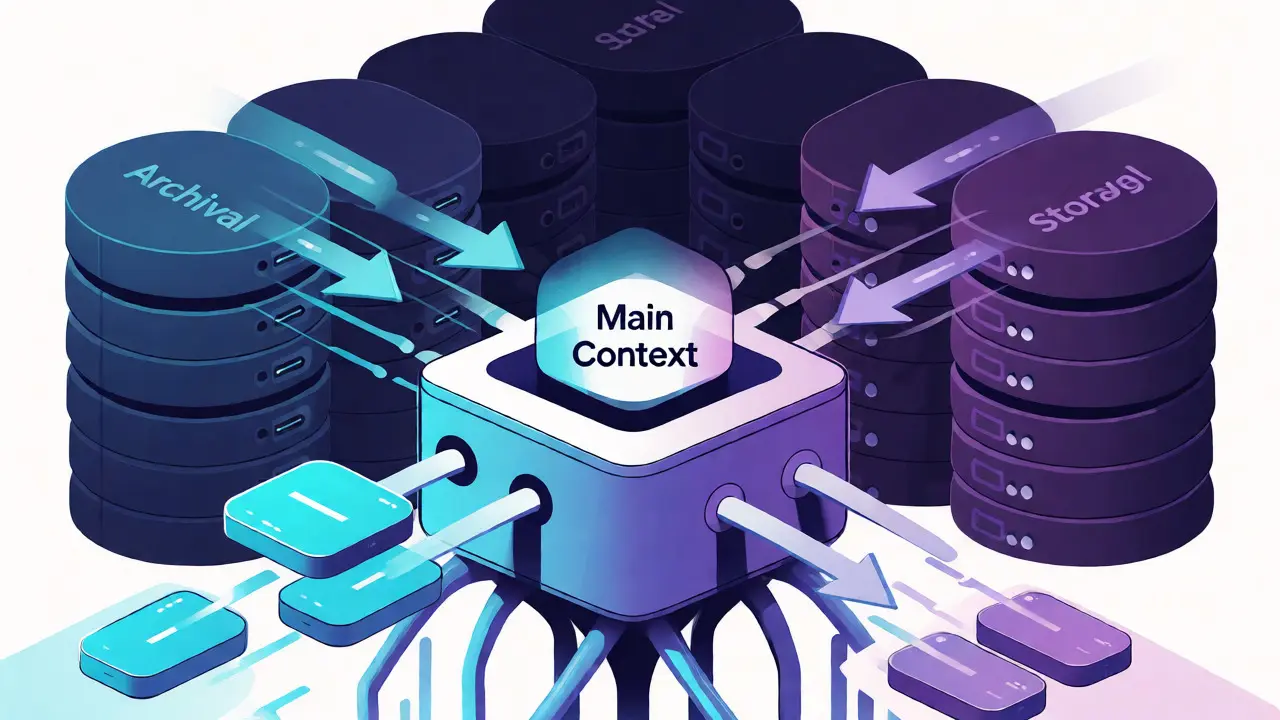
MemGPT (Packer et al., 2023) treats memory management like an operating system manages virtual memory. It divides memory into "main context" (working set) and "external context" (archival storage). When the working set gets too full, the model decides what to move to archival storage. Crucially, the model itself controls this paging process. It can explicitly request to fetch data from external storage when needed. This mimics how humans recall details from long-term memory when prompted, rather than keeping everything in short-term focus.
Titans: Linear Scaling and Surprise-Based Updates
If quadratic complexity scares you, look at Titans. It achieves linear scaling O(n) compared to the standard O(n²). How? By using surprise-based attention routing. The system calculates entropy-based novelty detection. If incoming information is highly predictable (low surprise), it requires less computational resources to process. Novel information triggers higher resource allocation. This dynamic distribution prevents the model from wasting compute on redundant data while ensuring critical new insights are processed thoroughly.
LM2 and ATLAS: Hybrid Coordination
LM2 integrates external memory modules with learnable gates directly into each decoder layer. This tight coupling ensures that every step of generation considers both internal state and external knowledge. Meanwhile, ATLAS (Behrouz et al., 2025) takes a more adaptive approach. It uses context-aware optimization to distribute memory resources based on task demands. If a task requires deep historical recall, ATLAS allocates more capacity to long-term memory. If it’s a quick factual lookup, it leans on faster, smaller caches.
Why Biological Inspiration Matters
This isn't just engineering guesswork. Researchers are explicitly borrowing from neuroscience. The brain doesn't store memories in one giant blob. It uses a hierarchy: hippocampal indexing for quick access, neocortical consolidation for long-term stability, and neuromodulatory gating to decide what’s worth remembering.
Global Workspace Theory suggests that consciousness-and by extension, effective AI reasoning-relies on broadcasting salient information to multiple subsystems. MATs mimic this by using gated control mechanisms. A gate decides whether new information should enter permanent storage, stay in temporary state, or be discarded. This solves the stability-plasticity dilemma: how to learn new things without erasing old skills. By separating fast-learning components (state/explicit memory) from slow-learning components (weights), MATs maintain stability while allowing plasticity.
Practical Applications: Where MATs Shine
So, who actually needs this? If you’re chatting casually, maybe not yet. But for enterprise and specialized tasks, MATs are game-changers.
- Customer Support Agents: Imagine an agent that remembers your ticket history from six months ago without you repeating yourself. MATs enable true continuity in dialogue systems.
- Cybersecurity Monitoring: Network traffic has patterns that evolve over weeks. A memory-augmented model can detect anomalies by comparing current traffic against a persistent baseline of normal behavior, updating that baseline as legitimate changes occur.
- Financial Trading: Market sentiment shifts. MATs can integrate real-time news feeds into their decision-making process without requiring the core trading model to be retrained every hour.
- Multi-Object Tracking: In video analysis, tracking objects over long periods requires remembering identities even when they disappear behind occlusions. Long-term memory decouples detection from tracking, resolving conflicts between temporal continuity and accuracy.
Challenges and Pitfalls
It’s not all smooth sailing. Adding external memory introduces complexity. Interference is a real risk-new memories can corrupt old ones if retrieval isn't precise. Capacity management becomes a bottleneck; searching through a million stored vectors takes time. Developers must design efficient indexing strategies, often using approximate nearest neighbor search to keep latency low.
Another hurdle is the "forgetting curve." Without active maintenance, rarely accessed memories may become stale or irrelevant. Effective MATs implement forgetting mechanisms-either by decay rates or explicit deletion policies-to prevent clutter. You also need to consider privacy. Storing user-specific data in external memory means managing GDPR compliance and data retention policies carefully.
Getting Started with Memory-Augmented Systems
If you want to experiment, start small. Don't rebuild the whole stack. Use frameworks that support plugin-style memory integrations. LangChain and LlamaIndex already offer basic retrieval-augmented generation (RAG) features, which are the precursors to full MATs. The next step is moving from static RAG (where memory is read-only) to dynamic MATs (where memory is writable and self-managing).
Look for libraries implementing Titans or MemGPT patterns. Monitor your inference latency closely. If adding memory slows down responses significantly, check your retrieval efficiency. Are you querying the entire database every time? Or using smart caching? Optimize your indexing before scaling up your memory size.
What is the difference between RAG and Memory-Augmented Transformers?
Retrieval-Augmented Generation (RAG) typically involves fetching static documents from a database and injecting them into the prompt. The model reads but doesn't necessarily update the database. Memory-Augmented Transformers (MATs) feature tightly integrated, differentiable memory modules that the model can actively write to and manage. MATs enable continual learning and dynamic adaptation during inference, whereas standard RAG is often a read-only retrieval step.
Do Memory-Augmented Transformers require retraining to learn new facts?
No, that's one of their biggest advantages. Because knowledge is stored in external memory modules separate from the core model weights, new information can be added to the memory store during inference (test-time learning). The model accesses this new data immediately without needing to undergo expensive gradient updates or full retraining cycles.
How do these systems handle limited computational resources?
They use intelligent arbitration and gating mechanisms. Inspired by biological systems, MATs prioritize information based on salience or "surprise." High-novelty inputs get more computational attention and are written to memory, while predictable inputs are processed quickly and may not be stored. Hierarchical buffering also reduces search complexity by organizing memory into tiers based on access frequency and recency.
Can Memory-Augmented Transformers suffer from catastrophic forgetting?
Less so than standard models, but interference remains a challenge. Since long-term knowledge resides in external stores rather than being overwritten in neural weights, the risk of losing foundational skills is lower. However, poor retrieval algorithms can cause new memories to overshadow old ones. Effective forgetting mechanisms and stable indexing strategies are required to mitigate this.
What is the Titans architecture known for?
Titans is known for achieving linear scaling O(n) instead of the standard quadratic O(n²) complexity of Transformers. It uses a hierarchical memory system with surprise-based attention routing, dynamically allocating computational resources based on information novelty. This allows for efficient processing of very long sequences and supports real-time learning via a differentiable neural dictionary.