
You can throw the biggest GPU cluster at a problem, but if your training data pipeline is messy, you’re just burning cash to teach your model bad habits. Think about it: if 20% of your dataset is duplicate blog posts scraped from the same website, your model doesn't learn "how to write"; it learns to repeat one specific author’s quirks until they become hallucinations. This isn't theoretical. CDInsights found that rigorous deduplication alone improved output quality by 22%. That is a massive jump for something that sounds like janitorial work.
Building these pipelines isn't just about moving files from point A to point B. It’s an end-to-end workflow involving ingestion, transformation, cleansing, and versioning. If you are building or maintaining Generative AI models in late 2026, you know that raw web-crawled data is dirty. It’s full of boilerplate, ads, broken code snippets, and near-duplicates. Your job is to turn that noise into signal. Let’s break down the three pillars that actually move the needle: Deduplication, Filtering, and Mixture Design.
Why Raw Data Breaks Large Language Models
Before we get into the tools, let’s look at why this matters so much. Large Language Models (LLMs) are pattern matchers. They don’t have common sense; they have statistics. If your training set contains the phrase "The mitochondria is the powerhouse of the cell" ten thousand times because every high school biology site copies Wikipedia, your model assigns disproportionate weight to that fact. Worse, it might start associating unrelated concepts with that phrase simply due to co-occurrence frequency.
Microsoft’s Azure documentation defines these pipelines as workflows ensuring data quality through tagging and indexing. But the real danger lies in what you *don't* see. Poorly filtered data leads to garbage predictions at scale. Dr. Andrew Ng has pointed out that teams often waste six-figure cloud bills training on unfiltered data. Why? Because the model spends its capacity memorizing spam instead of learning syntax, logic, or reasoning. In 2024, benchmarks showed that typical web datasets contain 15-30% duplicates. Removing them isn't optional; it's the baseline for any serious attempt at model performance.
Deduplication: The Art of Finding Near-Duplicates
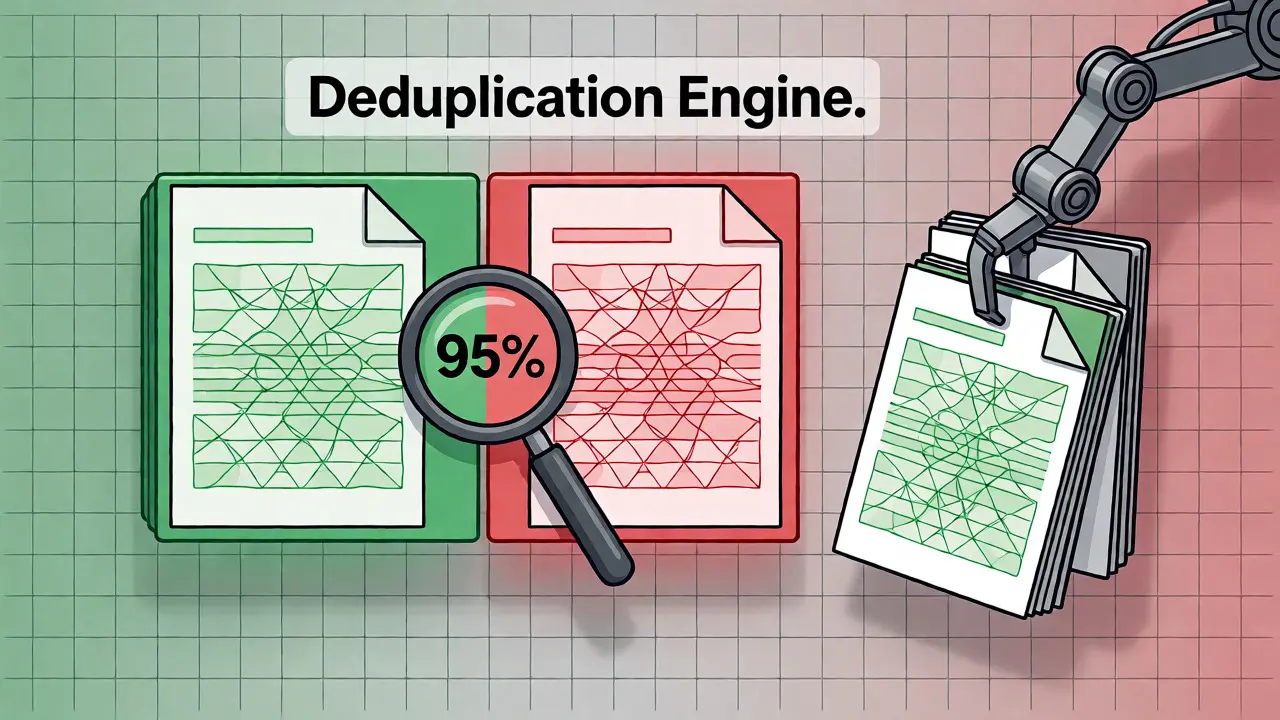
Exact duplicates are easy to find. You hash the file, compare hashes, done. But the web is weird. Two articles might be 95% identical but differ by a date stamp or a single paragraph. These are near-duplicates. Traditional hashing fails here. Enter MinHash and Locality-Sensitive Hashing (LSH).
These algorithms estimate similarity between sets. Instead of comparing two massive text documents character-by-character (which is computationally expensive), MinHash creates a small signature of each document. If the signatures match closely, the documents are likely similar. Apache Airflow pipelines using LSH have achieved 98.7% accuracy in detecting these sneaky duplicates. Meta’s Llama 3 team used this approach to cut their dataset size significantly while keeping semantic diversity intact.
Here’s the practical catch: parameter tuning. Setting the threshold too low means you delete unique content. Too high, and you keep redundant noise. One Reddit user reported spending two weeks debugging MinHash parameters before seeing results. Start conservative. Test on a small sample. Measure the impact on validation loss before running the whole corpus.
Filtering: Quality Over Quantity
Once you’ve removed the echoes, you need to remove the junk. Data filtering involves several layers:
- Toxicity Removal: Using classifiers like Perspective API to strip hate speech or extreme bias.
- Quality Scoring: Calculating perplexity. High perplexity often indicates gibberish or machine-generated noise.
- Domain Relevance: Ensuring the text matches your target domain. If you’re building a coding assistant, you don’t need 50 million cooking blogs.
Speed matters here. For real-time applications, streaming ingestion systems must process filters in under 50ms per document. If your filter is too slow, your pipeline bottlenecks. Proprietary systems like Google’s Dataflow offer high precision (99.2%) for toxicity detection but hide their logic. Open-source frameworks like Meta’s DataComp provide transparency, which is crucial if you need to audit why certain data was excluded.
Be careful not to over-filter. Yann LeCun argues that removing "imperfect but diverse" content homogenizes datasets, reducing model creativity by up to 15%. Sometimes, slang, typos, or unconventional structures are features, not bugs. They help the model handle real-world input.
Mixture Design: Balancing the Diet
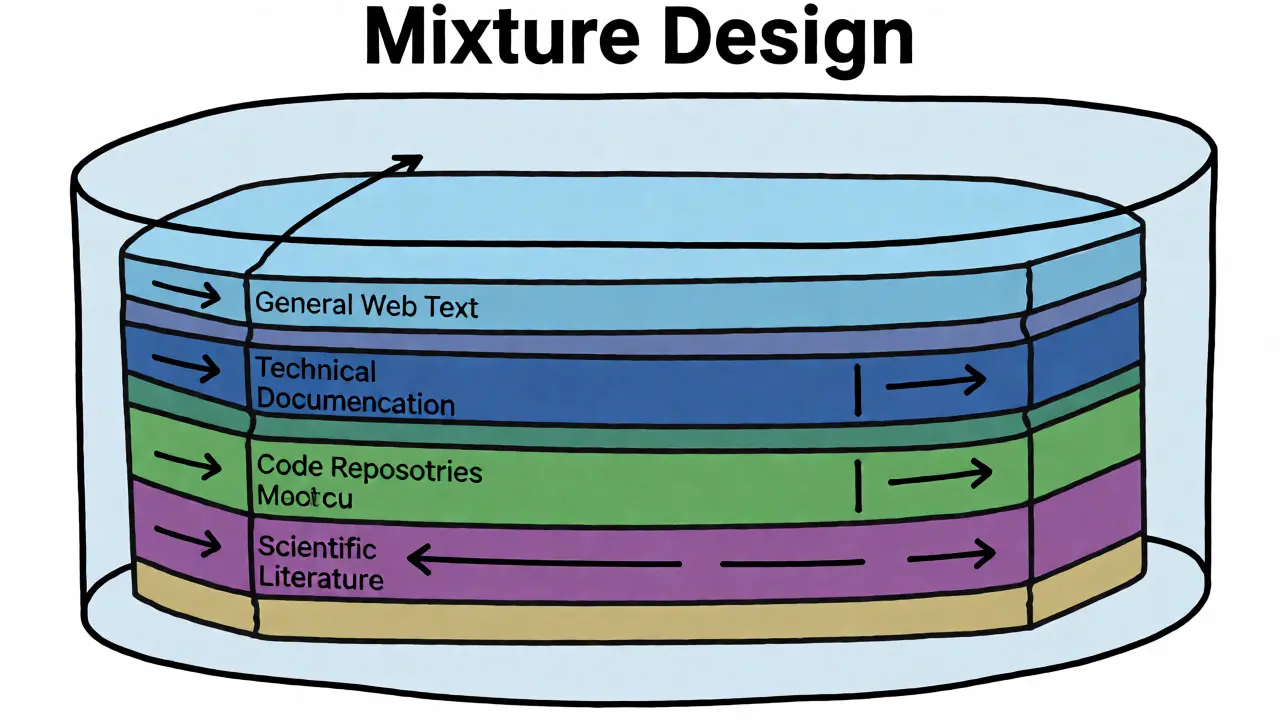
This is where many projects fail silently. Mixture design is the strategic composition of data sources. Imagine feeding a human only candy; they’ll lack protein. Same for AI. If your mixture is 90% social media chatter and 10% technical documentation, your model will struggle with formal reasoning.
Leading practices suggest weighted sampling. For a coding-focused model, Anthropic’s Claude methodology suggests a mix like:
| Data Source | Recommended Weight | Purpose |
|---|---|---|
| General Web Text | 60% | Broad language understanding |
| Technical Documentation | 20% | Specific terminology and structure |
| Code Repositories | 15% | Syntax and logic patterns |
| Scientific Literature | 5% | Complex reasoning examples |
Static mixtures are common in academia, but enterprise pipelines use dynamic adjustment. Microsoft’s recent updates introduced "intelligent mixture balancing," which tweaks weights based on real-time performance metrics. If the model starts failing at math tasks, the pipeline automatically increases the weight of mathematical texts in the next batch. This reduces manual tuning effort by nearly 65%.
Infrastructure and Versioning
You cannot manage petabytes of evolving data without strict version control. Tools like DVC (Data Version Control) track changes down to 0.1% mixture shifts. This granularity is vital for reproducibility. If a model performs worse in v2 than v1, you need to know exactly which data slice changed.
Integration with distributed storage like AWS S3 or Azure Data Lake is standard. Prefetching mechanisms can reduce I/O wait times by 35-40%, speeding up training loops. However, computational overhead is real. Deduplication alone consumes 25-35% of total processing time. Budget for this. Don't assume your compute costs will drop linearly with data size reduction; the preprocessing cost is front-loaded.
Common Pitfalls and How to Avoid Them
Most failures aren't technical glitches; they're process errors. Here’s what goes wrong most often:
- Inadequate Mixture Balancing: Accidentally including non-medical content in a medical QA model caused a 40% accuracy drop for one practitioner. Always validate your mixture against downstream task performance.
- Ignoring Data Drift: Data changes over time. Microsoft recommends monitoring for drift with retraining triggers every 7-14 days for production systems. Stale data teaches outdated facts.
- Lack of Provenance Tracking: With the EU AI Act enforcing documentation of training sources, you need clear lineage. If you can’t trace a training example back to its source URL and processing step, you’re non-compliant.
Start small. Implement modular sub-pipelines. If you update your feature transformation, you shouldn't have to retrain the entire model from scratch. Modular design allows you to swap components-like changing your deduplication algorithm-without breaking the whole system.
How much does deduplication improve model performance?
Research from CDInsights shows a 22% improvement in output quality when training on pipelines with rigorous deduplication compared to those without. Additionally, Iguazio benchmarks indicate that removing duplicates can reduce dataset sizes by 15-30%, directly lowering training costs and time.
What algorithms are best for identifying near-duplicates?
MinHash combined with Locality-Sensitive Hashing (LSH) is the industry standard for identifying near-duplicates in large text corpora. These methods allow for efficient similarity estimation without pairwise comparison of all documents, achieving detection accuracies above 98% in tested environments.
Why is mixture design critical for generative AI?
Mixture design determines the balance of knowledge domains the model learns from. An imbalanced mixture can lead to poor performance in specific tasks; for instance, a 5% increase in low-quality code samples can cause a 22% degradation in code generation accuracy. Dynamic mixture adjustments help maintain optimal performance across varying tasks.
What are the risks of over-filtering training data?
Over-filtering can create homogenized datasets that limit model creativity and flexibility. Yann LeCun noted that removing imperfect but diverse content reduced model flexibility by 15% in experimental trials. It is essential to retain some level of linguistic diversity and imperfection to ensure the model generalizes well to real-world inputs.
How do regulatory requirements affect data pipelines?
Regulations like the EU AI Act require detailed documentation of training data sources and processing steps. This drives the need for robust data provenance tracking within pipelines. Enterprises are increasingly adopting tools that offer granular versioning and lineage tracking to ensure compliance and auditability.