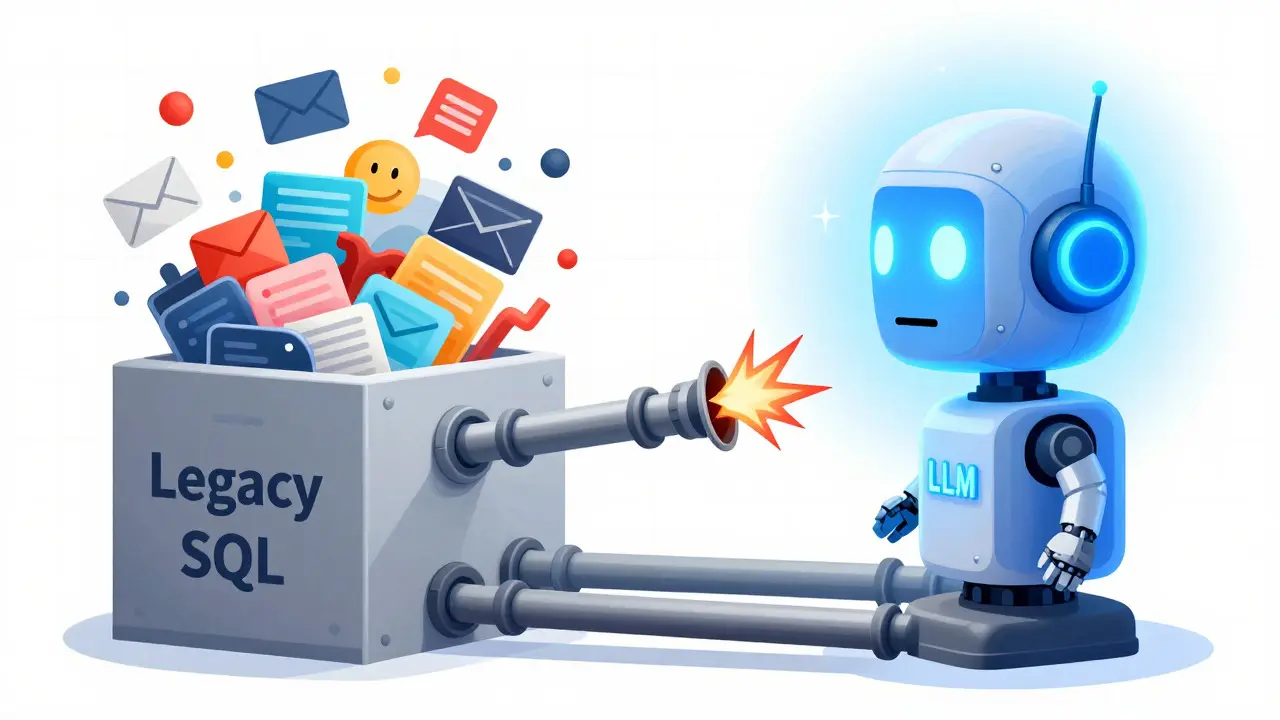
You have the model. You have the budget. But when your generative AI chatbot gives a customer wrong account details or hallucinates a product feature that doesn’t exist, the problem isn’t the algorithm-it’s your data. In 2026, building a data strategy for generative AI is no longer optional if you want to move beyond expensive experiments to actual business value.
Traditional data strategies were built for structured tables, billing records, and inventory counts. They work fine for dashboards. They fail miserably for Large Language Models (LLMs). LLMs need unstructured, contextual, and real-time information. Without a dedicated strategy, you are feeding noise into a powerful engine. The result? High costs, low trust, and compliance risks.
Why do most GenAI projects fail?
According to an MIT study cited by the World Economic Forum in October 2025, 95% of generative AI pilot projects failed to deliver measurable ROI. The primary reason was inadequate data strategy. Successful projects established a single source of truth, implemented end-to-end quality controls, and traced data origin. Without these, models lack the reliable context needed for accurate outputs.
The Core Problem: Why Traditional Data Architecture Fails GenAI
Think about how you used to manage data. You had clean SQL databases. You ran nightly ETL jobs. You produced monthly reports. This approach assumes data is static, structured, and isolated within specific departments.
Generative AI breaks every one of those assumptions. It requires:
- Unstructured content: PDFs, emails, code repositories, and support tickets.
- Contextual understanding: Not just what happened, but why it matters in relation to other events.
- Real-time access: Answers that reflect the current state of inventory or customer status, not last month’s snapshot.
Dr. Elena Rodriguez, Chief Data Officer at N-iX, points out that traditional architectures simply cannot handle this cross-functional demand. When you try to force old infrastructure to serve new AI needs, you create bottlenecks. Your latency spikes. Your accuracy drops. And your users lose trust.
The shift is from "data as a record" to "data as a first-class asset." This means treating your proprietary information with the same rigor you apply to financial audits. If the data is messy, the AI is messy. Simple as that.
Pillar 1: Data Quality and Lineage
Quality in generative AI is different from quality in reporting. In reporting, a missing number might mean a null cell. In generative AI, a missing or incorrect fact leads to a hallucination-a confident lie.
To combat this, you need rigorous data validation. BlackHills AI’s 2025 roadmap highlights that proper data strategy can reduce hallucination rates by up to 47%. How? By implementing automated checks on 100% of training and retrieval data.
Data Lineage is the process of tracking data from its origin through all transformations to its final use in AI inference. It ensures you know exactly where a piece of information came from.If your AI cites a regulation, you need to know which document it pulled that text from. If it suggests a medical treatment, you need to trace it back to the clinical trial data. Without lineage, you have no audit trail. For industries like finance and healthcare, this is a regulatory nightmare waiting to happen.
Here is what high-quality data looks like in practice:
- Deduplication: Removing conflicting versions of the same document.
- Completeness: Ensuring metadata tags are present for every file.
- Accuracy: Validating facts against trusted sources before ingestion.
MIT’s 2025 study found that organizations using comprehensive data validation reduced model errors by 58% compared to those with partial checks. It is not about being perfect; it is about being consistent.

Pillar 2: Unified and Contextual Architecture
You cannot run a modern generative AI strategy on a legacy data lake alone. You need a unified architecture that connects structured and unstructured data seamlessly.
This is where Vector Databases come in. Unlike traditional databases that search by keywords, vector databases store data as numerical embeddings-mathematical representations of meaning. This allows the AI to find concepts, not just words.
For example, if a user asks about "customer churn," a keyword search might miss documents discussing "client attrition" or "subscription cancellations." A vector database understands these are semantically similar and retrieves them all.
Performance matters here. Summit Partners’ analysis shows that high-performing implementations require vector databases capable of handling at least 10,000 queries per second. Tools like Pinecone or Weaviate are commonly used for this purpose. But speed is only half the battle. The other half is relevance.
This leads us to Retrieval-Augmented Generation (RAG), a pipeline that fetches relevant proprietary data and feeds it to the LLM alongside the user’s prompt. This grounds the AI in your specific knowledge base, drastically reducing hallucinations.
| Feature | Traditional Data Lake | GenAI-Ready Vector Architecture |
|---|---|---|
| Data Type | Primarily Structured | Structured + Unstructured (Text, Images, Code) |
| Search Method | Keyword Matching | Semantic Embedding Search |
| Latency Requirement | Hours/Days (Batch Processing) | Sub-second (Real-time Streaming) |
| Primary Use Case | Business Intelligence Reports | RAG Pipelines and Chatbots |
Pillar 3: Governance, Access, and Security
Access control in the age of generative AI is tricky. In a traditional system, you grant access to a table. In a generative system, the AI synthesizes answers from thousands of documents. How do you ensure the AI doesn’t reveal a salary figure to an intern who shouldn’t see it?
You need dynamic access control integrated into your RAG pipeline. Before the AI generates an answer, the system must check if the user has permission to view the retrieved documents. If they don’t, those documents are filtered out before the LLM even sees them.
Security is not just about permissions; it is about privacy. With regulations like GDPR and CCPA tightening, and new AI-specific laws emerging, you must track how personal data is used. 73% of organizations cite compliance as a major driver for enhanced governance, according to EWSolutions’ 2025 analysis.
Key security practices include:
- Anonymization: Stripping PII (Personally Identifiable Information) from training data.
- Audit Trails: Logging every query and response for compliance reviews.
- Data Minimization: Only feeding the AI the minimum amount of data necessary to answer the question.
Ignoring these steps is risky. Harvard Business Review’s November 2025 case studies showed that organizations skipping proper governance experienced 3.2 times more compliance violations. That is a risk no CIO wants to take.

Implementation Roadmap: From Assessment to Scale
Building this strategy takes time. It is not a weekend project. BlackHills AI outlines a realistic timeline for enterprise adoption:
- Assessment (1-3 Months): Identify opportunities, evaluate current data capabilities, and align stakeholders. Don’t skip this. Many teams rush to build and fail because they didn’t understand their data landscape.
- Strategic Planning (2-3 Months): Prioritize use cases. Allocate resources. Define success metrics. Decide which problems are worth solving with GenAI.
- Pilot Implementation (3-6 Months): Deploy a controlled solution. Monitor performance. Iterate based on feedback. This is where you test your RAG pipelines and vector stores.
- Scaling (6-12 Months): Expand infrastructure. Integrate across functions. Drive organization-wide adoption.
The learning curve is steep. Your data engineers will need to learn vector databases and embedding techniques. McKinsey notes that 87% of successful implementations required upskilling in these areas. Budget for training. Budget for tools. Initial investments typically range from $500,000 to $2 million depending on organization size.
But the payoff is significant. Organizations with mature strategies achieve 2.3 times greater ROI than those without. A major retailer, for instance, used GenAI with mature data practices to forecast seasonal demand with 89% accuracy, generating $47 million in additional revenue in Q4 2025 alone.
Common Pitfalls to Avoid
Even with a plan, things can go wrong. Here are the most common traps:
- Ignoring Data Silos: 63% of enterprises struggle with siloed data. If your sales data lives in Salesforce and your support data in Zendesk, and they don’t talk to each other, your AI will give fragmented answers. Break down the silos early.
- Over-Engineering: Gartner warns against focusing on perfection rather than business impact. Start simple. Get a working RAG pipeline running. Then optimize. Don’t spend six months building the perfect metadata schema before testing a single query.
- Neglecting Real-Time Needs: Scheduled batch updates are too slow for many GenAI use cases. If your inventory data is 24 hours old, your chatbot will tell customers an item is in stock when it isn’t. Invest in streaming pipelines.
Remember, the goal is not to build the most complex system. The goal is to build the most trustworthy one. Trust comes from accuracy, and accuracy comes from clean, accessible, and secure data.
How much does a GenAI data strategy cost?
Initial investments for enterprise deployments typically range from $500,000 to $2 million. This covers assessment, planning, pilot implementation, and initial scaling. Costs vary based on organization size, existing infrastructure maturity, and the complexity of data integration required.
What is the role of RAG in data strategy?
Retrieval-Augmented Generation (RAG) is critical for grounding AI responses in proprietary data. It reduces hallucinations by fetching relevant documents from your vector database before the LLM generates an answer. High-performing RAG pipelines operate with latency under 500ms and require high-quality, deduplicated data to be effective.
Which industries benefit most from GenAI data strategies?
Financial services (78% adoption), healthcare (72%), and retail (69%) are leading implementation efforts. These sectors deal with large volumes of unstructured data and strict compliance requirements, making robust data strategies essential for both efficiency and risk management.
How long does it take to implement a data strategy?
A full implementation cycle takes 12-18 months to reach maturity. This includes 1-3 months for assessment, 2-3 months for planning, 3-6 months for pilot deployment, and 6-12 months for scaling. Rushing this process often leads to failure due to poor data quality and integration issues.
What skills do data teams need for GenAI?
Teams need expertise in vector databases, embedding techniques, and RAG pipeline development. Additionally, strong domain knowledge is required to ensure contextual relevance, and MLOps skills are necessary for monitoring model performance and data drift over time.