
Imagine telling a computer to "make this chair lighter but stronger," handing it a rough sketch, and watching it generate fifty viable engineering models in minutes. That is the reality of Multimodal Generative AI, which integrates text, images, audio, and data parameters to accelerate product design cycles through automated generation and analysis. For product designers, this technology shifts the workflow from manual drafting to strategic curation. You are no longer just drawing lines; you are directing an intelligent system that explores thousands of design possibilities simultaneously.
The shift isn't just about speed. It is about depth. Traditional Computer-Aided Design (CAD) tools require precise inputs and linear thinking. Multimodal AI allows for ambiguous, exploratory prompts. You can upload a photo of a competitor’s product, type a description of your target user’s pain points, and specify material constraints. The AI synthesizes these disparate inputs-visual, textual, and numerical-to propose solutions you might never have considered manually.
The Six-Stage Generative Design Workflow
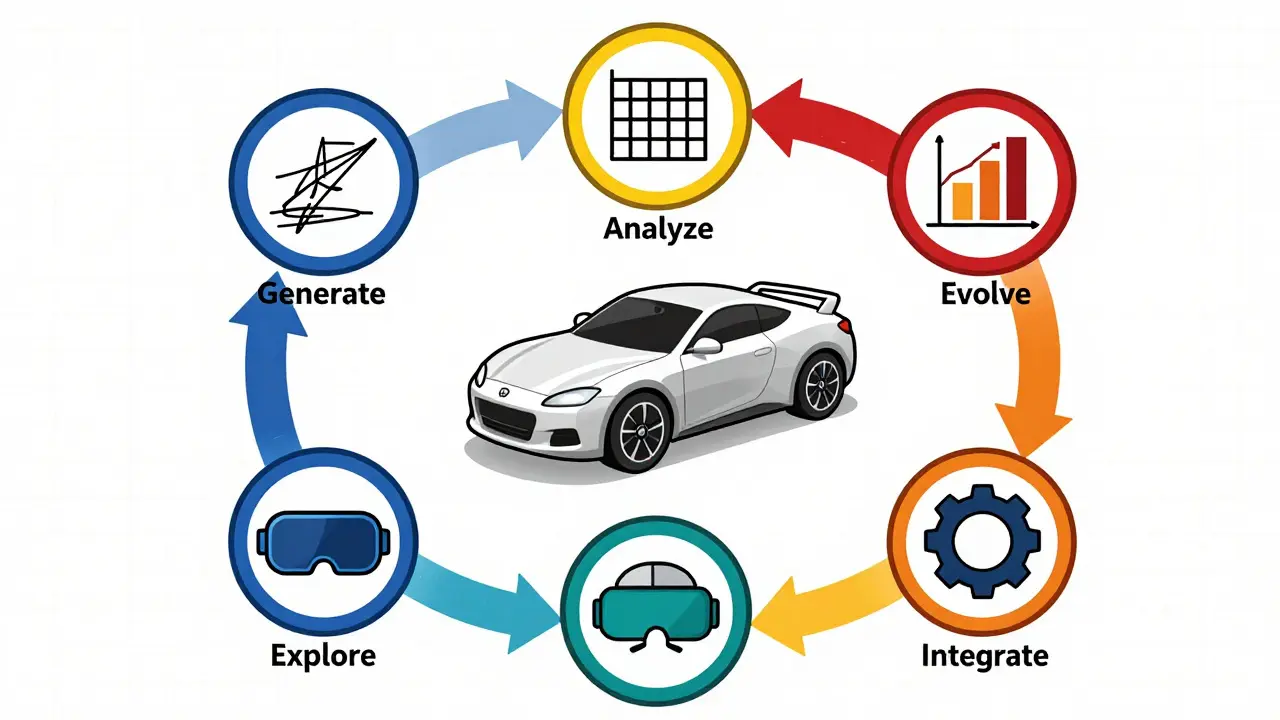
To understand how this works in practice, we need to look at the structured process behind the scenes. Researchers at NVIDIA have documented a six-stage framework that defines how multimodal AI handles product creation. This isn't magic; it is a rigorous loop of computation and validation.
- Generate: Instead of manually entering every parameter, you use natural language or sketches to guide the AI. The system creates initial design options based on your goals, such as maximizing strength while minimizing weight.
- Analyze: The AI evaluates these options using predictive modeling. It runs real-time simulations, including Computational Fluid Dynamics (CFD) and Finite Element Analysis (FEA), to check for structural integrity and airflow without needing physical prototypes.
- Rank: Designs are prioritized against multiple criteria you set. Maybe one design is 10% lighter but costs 5% more to manufacture. The AI ranks them so you can see the trade-offs clearly.
- Evolve: You provide feedback in plain English, like "reduce the curvature here" or "make it easier to grip." The AI refines the top options based on this input.
- Explore: Interactive visualization lets you rotate, zoom, and inspect the generated models. Virtual Reality (VR) integration often comes into play here, allowing immersive testing.
- Integrate: The final chosen design is exported into your broader project ecosystem, ready for detailed engineering or manufacturing preparation.
This workflow compresses months of work into weeks. By automating the heavy lifting of simulation and iteration, designers can focus on high-level strategy and user experience rather than getting stuck in technical dead ends.
From Concept to Digital Prototype
The true power of multimodal AI lies in its ability to bridge the gap between abstract ideas and concrete engineering specs. In the past, moving from a sketch to a testable prototype required significant time and resources. Now, platforms like Neural Concept automate the design and simulation phases, evaluating multiple variations rapidly.
Consider a case study in consumer electronics. A design team needed to explore new form factors for a wearable device. Using generative design, they explored thirty distinct product idea categories. The AI generated over 2,500 concept design images. From this massive pool, the team refined down to twelve finalized concepts and videos. This volume of exploration would have been impossible with traditional methods, where each variation required manual modeling and rendering.
The key here is Surrogate Modeling. These are AI-based models that predict the performance of new designs without rerunning full, computationally expensive simulations. If a standard CFD simulation takes hours, a surrogate model can provide a reliable estimate in minutes. This allows designers to iterate dozens of times in the time it used to take to run a single test.
Industry Applications: Where It Matters Most
Different industries leverage multimodal AI in unique ways, driven by their specific constraints and goals.
| Industry | Primary Use Case | Key Benefit |
|---|---|---|
| Automotive & Aerospace | Lightweighting components, aerodynamic optimization | d>Reduced fuel consumption, faster FEA simulations|
| Consumer Electronics | Form factor exploration, ergonomic fitting | Rapid adaptation to market trends, reduced R&D costs |
| Fashion & Apparel | Virtual clothing design, digital fitting rooms | Immediate customer feedback, zero waste prototyping |
| Medical Devices | Patient-specific implants, ergonomic tool design | Mass customization, improved safety profiles |
In automotive and aerospace, the stakes are high. Safety regulations demand rigorous testing. Multimodal AI accelerates CFD and FEA simulations, allowing engineers to optimize parts for weight reduction without compromising structural integrity. In fashion, companies use AI to create virtual garments that customers can view in augmented reality. This provides immediate visual feedback and collects preference data before any fabric is cut, drastically reducing inventory waste.
Implementing Multimodal AI in Your Workflow
Adopting this technology doesn't mean replacing your existing tools overnight. It starts with setting clear design goals and constraints. Before prompting the AI, define your design space, load conditions, and material limits. Garbage in, garbage out still applies. If your constraints are vague, the AI will generate designs that look cool but fail in production.
Recent methodological advances have lowered the barrier to entry. No-code and low-code platforms like Bolt allow designers to build interactive prototypes quickly. AI assistants can help generate interview scripts for user research or even write code snippets for custom integrations. This enables rapid iteration on ideas, gathering user feedback, and refining concepts before advancing to robust, data-driven prototypes.
For mobile experiences, researchers have proposed methods for prototyping directly on devices using hybrid "Wizard-of-Oz" techniques. This grounds evaluation in authentic contextual interactions rather than abstract specifications. You can test how a user interacts with a multimodal AI interface in real-world settings, collecting valuable data on usability and sentiment.
Limitations and Human Validation
Despite its capabilities, multimodal AI is not a replacement for human judgment. The technology has limitations that designers must navigate carefully.
- Input Specification: AI requires precise definitions of constraints. Maximum stress levels, material properties, and manufacturing tolerances must be explicitly stated. Ambiguity leads to impractical designs.
- Manufacturability: AI-generated geometries can be complex and difficult to produce. Human engineers must evaluate feasibility. A design might be optimal on paper but impossible to mold or machine with current equipment.
- Data Quality: Surrogate models depend on high-quality training data. If the historical simulation data is flawed, the AI's predictions will be inaccurate.
- Physical Validation: Digital prototypes are powerful, but they cannot replace final physical testing. Real-world variables like temperature fluctuations, user handling abuse, and supply chain variations require tangible verification.
The role of the designer is shifting from creator to curator. You are guiding the AI, interpreting its outputs, and making the final call on what aligns with brand identity and user needs. This partnership between human intuition and machine efficiency is where the real innovation happens.
The Future of Design: Mass Customization
Looking ahead, the trajectory points toward mass customization. With the ability to explore hundreds of thousands of design possibilities, manufacturers can tailor products to individual users. Imagine eyeglass frames designed specifically for your facial structure and style preferences, generated instantly by AI and sent to a local 3D printer.
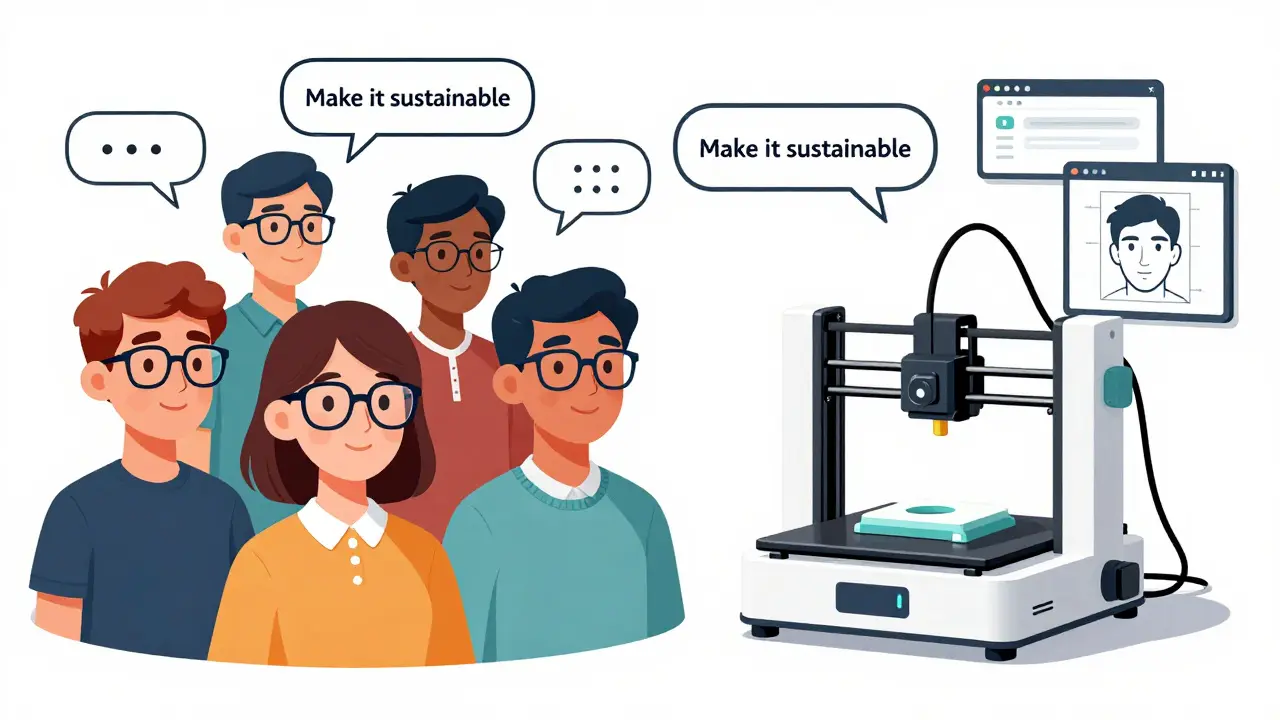
Natural Language Processing (NLP) integration will make interaction even more intuitive. You will converse with your design software, asking questions like "How does this handle vibration?" or "Can we make this sustainable?" The AI will adjust parameters in real-time, providing explanations for its decisions. This democratizes design expertise, allowing non-engineers to contribute meaningfully to the development process.
As competitive pressures drive the need for faster time-to-market, multimodal generative AI will become standard. Companies that adopt these workflows early will gain a significant advantage, able to adapt to changing consumer demands with agility that traditional methods cannot match. The future of product design is not just about making things faster; it is about making things smarter, more personalized, and more responsive to the world around us.
What is multimodal generative AI in product design?
Multimodal generative AI is a technology that combines various types of data-such as text descriptions, images, audio, and numerical specifications-to automatically generate and refine product designs. It allows designers to use natural language or sketches to guide the creation of complex 3D models, accelerating the prototyping process significantly compared to traditional CAD methods.
How does multimodal AI reduce prototyping costs?
It reduces costs by enabling extensive digital testing before any physical prototype is built. Through surrogate models and rapid simulations like CFD and FEA, AI can identify flaws and optimize performance in minutes. This minimizes the number of physical iterations needed, saving money on materials, labor, and shipping.
Can multimodal AI replace human designers?
No, it augments them. While AI can generate thousands of design variations quickly, it lacks human intuition, ethical judgment, and understanding of brand identity. Human designers are essential for defining constraints, validating manufacturability, and curating the final output to ensure it meets user needs and business goals.
What are the main limitations of using AI for product design?
Key limitations include the need for precise input specifications, potential issues with manufacturability of complex AI-generated geometries, dependence on high-quality training data, and the necessity of final physical validation. AI cannot fully account for real-world variables like user misuse or environmental extremes without human oversight.
Which industries benefit most from multimodal generative AI?
Industries with high complexity and strict performance requirements benefit most, including automotive, aerospace, consumer electronics, and medical devices. These sectors face intense pressure to innovate quickly while maintaining safety and efficiency standards, making the speed and optimization capabilities of AI invaluable.