
Running a massive Large Language Model on your smartphone feels like trying to fit an elephant into a sedan. The math is brutal: a standard 70-billion parameter model in full precision demands over 140 GB of memory just to load the weights. Most edge devices have a fraction of that RAM and nowhere near the power budget to handle the compute. This is where quantization becomes the unsung hero of modern AI deployment. It’s not magic; it’s a clever compression technique that reduces the numerical precision of model parameters from high-bit formats like FP16 or BF16 down to lower-bit representations like INT8, INT4, or even FP4. The result? Models shrink dramatically, inference speeds up, and energy consumption drops, all while keeping accuracy surprisingly intact.
But here’s the catch: you can’t just slap any quantization method onto any Transformer architecture and expect good results. Standard Transformers are notoriously sensitive to precision loss, especially in attention mechanisms where outliers can wreck performance. That’s why researchers and engineers are now designing quantization-friendly transformer designs specifically for Edge Large Language Models. These aren’t just compressed versions of cloud giants; they’re architectures built with low-precision arithmetic in mind from day one. If you’re looking to deploy LLMs on laptops, phones, or IoT devices without sending data to the cloud, understanding how these designs work is critical.
The Core Problem: Why Precision Matters at the Edge
Let’s get real about the numbers. A typical Transformer layer involves matrix multiplications in the attention heads and feed-forward networks. In full precision (FP32 or BF16), each weight takes up 2 bytes. For a model with billions of parameters, this balloons quickly. When we talk about edge deployment, we’re usually dealing with devices that have limited thermal headroom and battery life. Running a model in FP16 might require 10W of power; dropping to INT8 cuts that significantly, often by half or more, depending on the hardware accelerator.
The challenge isn’t just memory bandwidth-it’s computational efficiency. Modern NPUs (Neural Processing Units) and GPUs are optimized for integer operations. However, naive quantization introduces noise. Imagine rounding every number in a complex equation to the nearest whole number. Small errors accumulate. In deep neural networks, this accumulation can lead to catastrophic accuracy loss, particularly in tasks requiring nuanced reasoning or mathematical precision. This is why generic quantization often fails on large language models unless the architecture itself supports it gracefully.
Two Paths: Post-Training vs. Quantization-Aware Training
You generally have two options when approaching quantization: Post-Training Quantization (PTQ) and Quantization-Aware Training (QAT). Each has its place, but they serve different needs.
PTQ is fast and easy. You take a pre-trained model, run a small set of calibration data through it to determine optimal scaling factors, and convert the weights. Methods like HyQ (Hardware-aware Hybrid Quantization) exemplify this approach. HyQ is designed for hybrid architectures (mixing CNNs and Transformers) and can reduce static storage to about 25% of the original size. On FPGAs, it cuts resource usage by nearly half. The beauty of PTQ is speed-you don’t need to retrain the model. But there’s a trade-off: because the model wasn’t trained to handle low precision, you might see a dip in accuracy, especially if the model has large activation outliers.
QAT, on the other hand, integrates quantization constraints during the training phase. Think of it as teaching the model to be robust against rounding errors before it ever sees production data. Techniques like LLM-QAT use this approach to balance task accuracy with training efficiency. They employ methods like KV cache quantization to improve inference throughput. Another standout is SpinQuant, which achieves near-BF16 accuracy at W4A8 precision (4-bit weights, 8-bit activations). QAT requires significant computational resources upfront, but the payoff is often higher stability and better performance on downstream tasks.
| Method Type | Key Technique | Accuracy Impact | Deployment Speed | Best Use Case |
|---|---|---|---|---|
| PTQ | HyQ, SmoothQuant | Moderate degradation possible | Very Fast (Hours) | Rapid prototyping, existing models |
| QAT | LLM-QAT, GradQ-ViT | Minimal degradation | Slow (Days/Weeks) | High-stakes applications, custom fine-tunes |
| Native Low-Precision | FP8 Training (e.g., DeepSeek-R) | High fidelity | Moderate | New models built for edge from scratch |
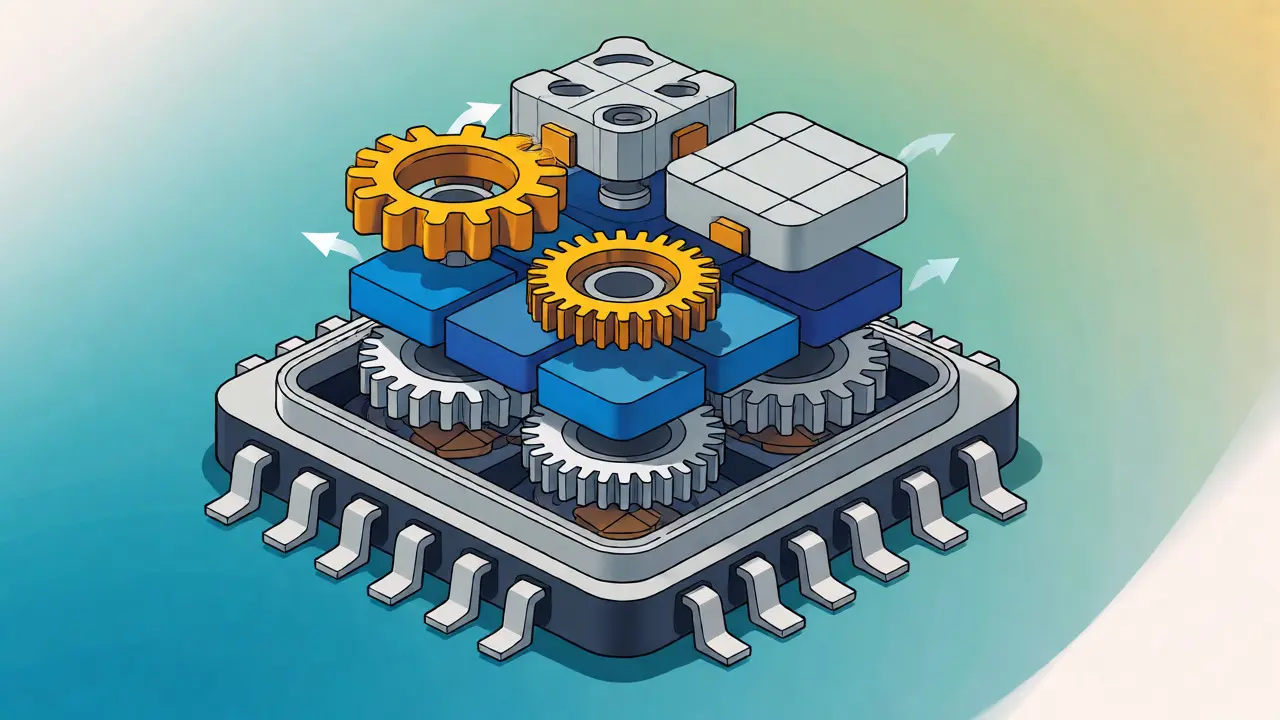
Anatomy of a Quantization-Friendly Transformer
So, what makes a Transformer "quantization-friendly"? It’s not just about swapping data types. It’s about architectural choices that minimize sensitivity to noise. One major culprit in standard Transformers is the softmax function in attention layers. Softmax outputs probabilities between 0 and 1, but intermediate values can vary wildly. Quantizing these directly causes huge errors. Advanced designs replace exact softmax computations with integer-only approximations using linear functions within the Transformer module. This drastically reduces computational load and avoids the precision pitfalls of floating-point division.
Another key aspect is handling outliers. Convolutional layers and certain attention heads produce activation values that are orders of magnitude larger than the average. These outliers skew the quantization range, forcing most values into a tiny bucket and losing resolution. Solutions like quantization-aware distribution scaling adjust the scale factors per channel or per tensor, ensuring that the majority of data fits comfortably within the available bit-width. Activation-Aware Weight Quantization (AWQ) takes this further by identifying important weights based on activation magnitudes and protecting them with higher precision, while compressing less critical weights more aggressively.
Selective quantization is also vital. Not all layers benefit equally from low precision. Matrix multiplications in attention and feed-forward networks gain the most from INT8 or INT4. However, normalization layers, residual connections, and final output projections often need to stay in higher precision (like FP16 or BF16) to prevent error propagation. A well-designed edge Transformer mixes precisions strategically-this is known as mixed-precision quantization.
The Frontier: FP8 and NVFP4 Formats
We are moving beyond INT8. The industry is shifting toward native low-precision formats like FP8 and even FP4. NVIDIA’s TensorRT Model Optimizer supports NVFP4, a format optimized specifically for Blackwell GPUs. NVFP4 delivers extreme compression-often reducing model size by 4x compared to FP16-while maintaining stable accuracy recovery through sophisticated calibration techniques like AutoQuantize.
Experimental data shows that NVFP4 quantization can boost token generation throughput by 2-3x for models like Qwen 23B and Llama Nemo Ultra. This isn’t just theoretical; it means faster chat responses and lower latency on compatible hardware. Similarly, models like DeepSeek-R have begun natively training in FP8, bypassing the need for post-hoc conversion entirely. This trend suggests that future foundation models will likely be born in low-precision formats, making them inherently easier to deploy on edge devices.

Real-World Performance: What to Expect
How much accuracy do you actually lose? It depends heavily on the benchmark. For general language understanding tasks like MMLU (Massive Multitask Language Understanding), methods like LLM-QAT on Llama models show minimal degradation. However, for complex reasoning tasks like GSM8K (Grade School Math 8K), AWQ often outperforms other methods because it preserves the precision needed for multi-step logical deductions.
A compelling real-world example is MobileBERT. By combining quantization with architectural pruning, MobileBERT achieved a 160x reduction in model footprint compared to BERT-Large, with only a 4.1% drop in accuracy. Crucially, it could process at least one tweet per second on constrained edge hardware. This demonstrates that with the right design, you don’t need a data center to run useful NLP tasks locally.
Privacy is another hidden benefit. When models run on-device, data never leaves the user’s phone or laptop. This serverless inference model eliminates the risk of transmitting sensitive information to the cloud, a major selling point for healthcare, finance, and personal assistant applications.
Implementation Pitfalls and Pro Tips
If you’re planning to implement these techniques, watch out for these common traps:
- Ignoring Calibration Data Quality: PTQ relies on representative calibration samples. If your calibration data doesn’t match production traffic, your quantized model will fail silently.
- Over-Quantizing Attention Heads: Attention scores are highly sensitive. Keep them in higher precision or use specialized approximations.
- Neglecting Hardware Compatibility: An INT4 model won’t run efficiently on hardware without INT4 support. Check your target device’s ISA (Instruction Set Architecture) first.
- Forgetting the KV Cache: During long-context inference, the Key-Value cache grows linearly with sequence length. Quantizing the KV cache (as done in LLM-QAT) is essential for memory management on edge devices.
To succeed, start with a strong baseline. Fine-tune your model in BF16 first, then apply PTQ. If accuracy drops too much, move to QAT. Always test on your specific hardware, not just simulated environments. Tools like NVIDIA TensorRT or AMD’s quantization frameworks provide the necessary infrastructure to map these abstract concepts to actual silicon performance.
What is the difference between INT8 and INT4 quantization?
INT8 uses 8 bits per weight, reducing model size by ~50% compared to FP16. INT4 uses 4 bits, reducing size by ~75%. INT4 offers greater compression and speed but carries a higher risk of accuracy loss, requiring more sophisticated techniques like group-wise scaling or zero-point correction to remain viable.
Can I quantize any Transformer model?
Technically yes, but not all models respond well. Models with heavy reliance on precise attention calculations or those trained without regularization may suffer significant accuracy drops. Newer architectures designed with quantization in mind (like those using RMSNorm instead of LayerNorm, or GQA) tend to tolerate low precision better.
Does quantization affect inference speed?
Yes, positively. Lower precision allows more operations per cycle on specialized hardware (NPUs, TPUs). Additionally, smaller models fit better in cache, reducing memory access bottlenecks. Throughput improvements of 2-3x are common when moving from FP16 to INT8/INT4 on supported accelerators.
What is KV Cache Quantization?
KV Cache stores previous attention keys and values to avoid recomputation. As context length grows, this cache consumes massive memory. Quantizing the KV cache to INT8 or INT4 reduces memory usage significantly, enabling longer context windows on memory-constrained edge devices.
Is FP8 better than INT8?
FP8 is a floating-point format with 8 bits, offering dynamic range similar to FP16 but with lower precision. INT8 is fixed-point. FP8 often preserves accuracy better for distributions with wide variance (common in activations), while INT8 is simpler and widely supported. Choice depends on hardware support and model characteristics.
Bonnie Watt
September 15, 2026 AT 21:37Oh please, spare me the technical jargon. You're all missing the point because you're too busy worshipping at the altar of 'efficiency' to see that we are actively degrading our cognitive tools for the sake of convenience. It’s pathetic how everyone just accepts this loss of fidelity as a necessary evil without questioning who actually benefits from these 'compressed' models. We aren't getting smarter; we're just getting faster at being wrong.
Deb Kortyna, MBA
September 17, 2026 AT 13:03I must respectfully disagree with the previous assertion regarding the degradation of cognitive tools. The architectural innovations described herein represent a triumph of engineering over resource constraints, not a failure of intellect. To dismiss quantization as mere convenience is to ignore the rigorous mathematical foundations that allow for such compression without significant loss in semantic integrity. Furthermore, the distinction between Post-Training Quantization and Quantization-Aware Training is crucial; one cannot simply conflate the two approaches when their methodologies and outcomes differ substantially. I urge readers to consider the broader implications for privacy and local processing power before dismissing these advancements as inferior.
alex kobri
September 18, 2026 AT 12:14i think there's a deeper philosophical question here about what 'intelligence' even means if it's compressed
if we strip away the precision do we lose the soul of the model or just the noise
maybe the edge devices force us to be more honest about what we actually need vs what we want
Zach Loescher
September 20, 2026 AT 09:27This is a really balanced overview. I've been struggling with KV cache management on my local setup and the mention of INT8 quantization for keys and values was exactly what I needed to look into. It seems like the trade-off between memory bandwidth and compute efficiency is becoming less painful with newer hardware support.
Quintin Franzese
September 21, 2026 AT 05:52Sure, let's pretend your phone has the thermal headroom to run a 7B parameter model without turning into a hand warmer. Great guide if you have a laptop that costs more than my rent, but for the average person trying to run stuff on an old Android, it's still mostly fantasy land. But hey, thanks for the info on NVFP4, might be useful when my hardware catches up to the hype cycle in five years.
Susan Cole
September 21, 2026 AT 16:16The section on privacy was particularly resonant for me. Knowing that data doesn't leave the device changes the entire dynamic of using AI assistants for personal tasks. It feels safer, even if the model isn't quite as sharp as the cloud-based giants.
Tamara Miller
September 22, 2026 AT 14:51Ugh, finally someone explains this without drowning us in useless academic fluff!! The part about calibration data quality is so important, people always skip that step and then wonder why their models hallucinate!! If you don't use representative data, you're basically flying blind, and that's unacceptable!! Also, the comparison table was actually helpful, which is rare for these kinds of posts!!!
Savara Gunn
September 23, 2026 AT 03:55Great read! Really helped clarify the difference between PTQ and QAT for me. I'm going to try out some of these techniques on my current project. Keep up the good work!
Anthony Miller
September 24, 2026 AT 00:55Your analysis lacks depth. You fail to address the fundamental incompatibility of integer arithmetic with the continuous nature of neural activation distributions. This is not merely a technical hurdle but a conceptual failure of the entire quantization paradigm. By forcing discrete representations onto continuous phenomena you introduce systematic bias that accumulates through layers. This approach is intellectually lazy and technically flawed. It prioritizes marketing metrics over scientific rigor.
michelle veluz
September 24, 2026 AT 18:29WAKE UP PEOPLE!!! They're hiding the real cost of this 'edge computing' revolution!!! Who owns the patents for NVFP4??? It's all controlled by big tech monopolies trying to lock us into their proprietary formats!!! And don't get me started on the 'privacy' argument-it's a smokescreen!!! They want us running models locally so they can harvest metadata without sending the actual content!!! We are being manipulated by algorithms we don't understand!!! Check the source code!!! Don't trust the benchmarks!!!