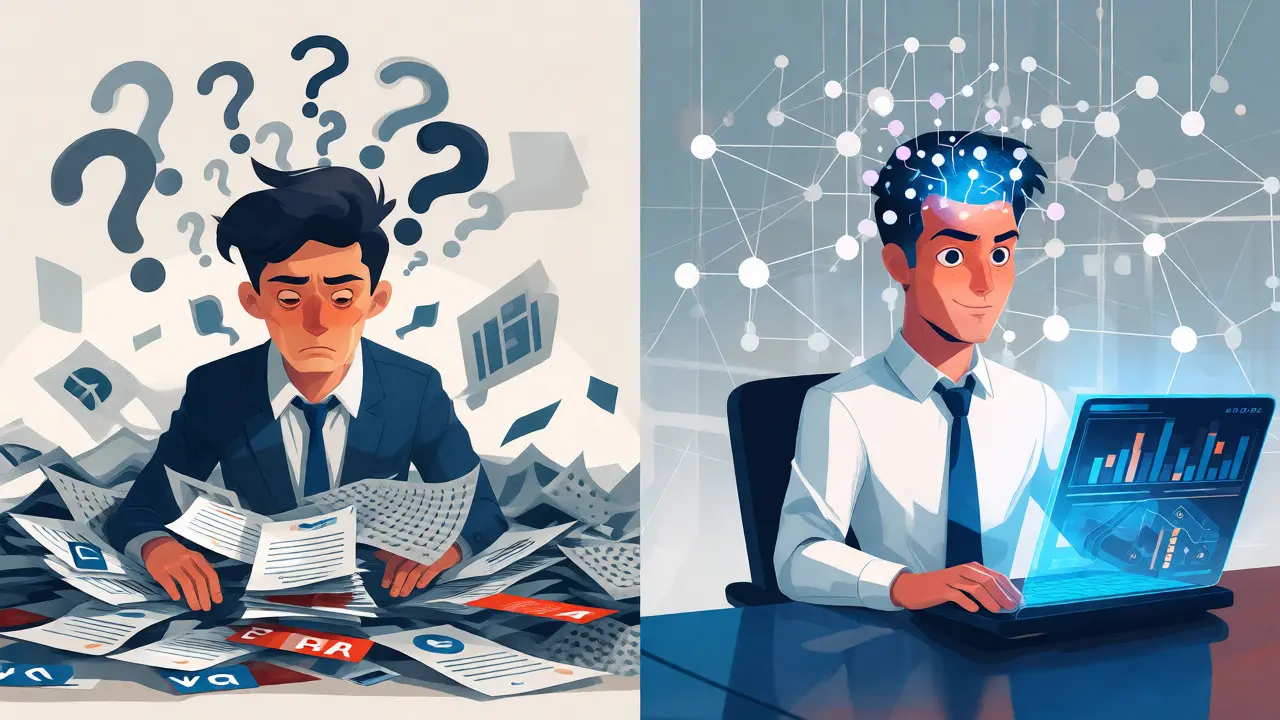
Imagine you are three minutes into a high-stakes negotiation. The prospect just dropped the name of your biggest competitor, citing a feature gap that supposedly kills your deal. Ten years ago, you’d be scrambling to remember if you had the right counter-argument, hoping your memory held up under pressure. Today, thanks to Generative AI, a subset of artificial intelligence that creates new content by learning patterns from existing data, that moment looks entirely different. Your screen lights up with a real-time alert, pulling specific competitive intel, pricing comparisons, and tailored rebuttals directly from a live analysis of the conversation.
This isn’t science fiction; it’s the current state of modern sales enablement. The shift from static PDFs to dynamic, AI-driven resources has fundamentally changed how teams handle competitive intelligence. According to Crayon's 2023 Competitive Enablement Benchmark Report, 68% of enterprise sales organizations now use some form of AI-enhanced tooling, a massive jump from just 22% in 2021. But what does this actually mean for the average seller? It means less time spent prepping and more time selling. Let’s break down how these tools work, specifically focusing on battlecards, call summaries, and objection handling, and why they are becoming non-negotiable for revenue teams in 2026.
The Evolution of Sales Battlecards
A traditional Sales Battlecard, a one-page cheat sheet containing competitor info, pricing, and objection responses, was always a compromise. You needed it to be concise enough to scan quickly but detailed enough to be useful. In practice, most reps ignored them because they were outdated before they were even distributed. Manual updates took 8-12 hours per quarter per product line, leading to the "stale data" problem where 63% of reps reported using incorrect information during critical deals.
AI-Powered Battlecards, dynamic competitive intelligence assets that update in real-time using natural language processing, solve this by connecting directly to your CRM and market data sources. Platforms like Gong and Crayon don't just store static text; they analyze live sales calls. If a competitor launches a new feature on Tuesday, the AI detects mentions of it in customer conversations or news feeds and updates the battlecard by Wednesday morning. This reduces information gaps by nearly 78%, according to case studies with companies like Adobe and Zoom.
The technical backbone here is robust. These systems rely on Natural Language Processing (NLP) engines trained on industry-specific terminology. To get good results, you typically need 500-1,000 domain-specific documents for fine-tuning. Once integrated, the system processes transcripts with over 97% accuracy, identifying competitive mentions and triggering alerts within seconds. For example, Gong’s platform can flag a competitor mention within 7.2 seconds of it happening during a live call, giving the rep immediate context without breaking their flow.
Automated Call Summaries That Actually Help
If battlecards help you win the deal, Call Summaries, automated, structured recaps of sales conversations generated by AI, help you keep track of the process. Reps hate writing follow-up emails and updating CRM fields. It’s tedious administrative work that eats into selling time. Generative AI automates this by transcribing the call, extracting key action items, identifying next steps, and drafting the follow-up email.
But not all summaries are created equal. Early versions were often too generic, summarizing everything rather than highlighting what mattered. Modern tools, however, allow for customization. You can configure the AI to focus on specific criteria: Did the prospect mention budget? What was the timeline? Who else needs to sign off? This structured extraction ensures that the summary serves as a reliable source of truth for both the rep and the account manager.
The impact on efficiency is measurable. Teams using automated summaries report significant reductions in post-call administrative time. More importantly, these summaries feed back into the training loop. By analyzing thousands of successful calls, the AI identifies patterns-such as which questions correlate with higher win rates-and suggests them to newer reps. It turns individual experience into institutional knowledge almost instantly.

Mastering Objection Handling with Contextual Intelligence
Objections are where deals die. "It’s too expensive," "We’re happy with our current vendor," or "I don’t see the ROI." Traditional training involves role-playing scenarios, but in the heat of the moment, reps often freeze or give canned responses that feel robotic. Objection Handling, the strategic response to customer concerns or resistance during the sales process, becomes far more effective when supported by contextual AI.
Instead of a generic list of objections, AI-driven tools provide situation-specific guidance. If a rep is talking to a CFO who cares about cost savings, the AI won’t suggest a feature-heavy argument; it will highlight financial models and ROI calculators relevant to that persona. Forrester’s 2023 study noted that early AI tools failed because they over-indexed on feature comparisons. The best current solutions focus on value-based positioning, incorporating customer success stories that match the prospect’s industry and pain points.
Consider the difference between a static answer and an AI-assisted one. A static card might say, "Competitor X lacks integration." An AI-assisted prompt might say, "Prospect mentioned Competitor X. They have a similar integration issue with Salesforce. Here is a case study from a client in the same sector who switched due to API limitations. Ask them about their current API maintenance costs." This level of nuance helps reps sound like consultants rather than order-takers.
Implementation: What It Takes to Make It Work
Buying the software is the easy part. Making it stick is where most projects fail. Jill Rowley, former Senior VP at Salesforce, warned that over 60% of implementations fail due to poor data hygiene and lack of leadership buy-in. You cannot pour bad data into a sophisticated engine and expect gold out.
Successful deployments usually follow a 14-18 week cycle. First, you spend four weeks auditing your data. You need at least 500 historical sales calls and clear win/loss records to train the model effectively. Next comes six weeks of customization, where you teach the AI your specific product language and competitor set. Then, three weeks of integration with your CRM (Salesforce, HubSpot, etc.) and finally, five weeks of team training.
| Feature | Traditional Static Tools | AI-Powered Dynamic Tools |
|---|---|---|
| Update Frequency | Quarterly (Manual) | Real-time / Daily (Automated) |
| Data Accuracy | ~60% (High error rate) | ~90%+ (Context-aware) |
| Personalization | Generic | Persona-Specific |
| Setup Time | Weeks | Months (Requires Data Prep) |
| Cost Structure | Low upfront ($3k avg) | Higher ongoing ($50-$150/user/mo) |
One critical success factor is appointing a "Battlecard Champion." Teams with a dedicated owner for this initiative see 43% higher adoption rates. This person ensures the content stays fresh and encourages reps to provide feedback. Without that human element, the AI risks becoming shelfware.

Pitfalls and How to Avoid Them
Despite the hype, there are real downsides. One major concern is "over-automation." A December 2023 Harvard Business Review survey found that 64% of sales leaders worry AI might herd reps toward templated responses, killing authentic engagement. If every rep sounds exactly the same because they are reading the same AI suggestion, you lose the human connection that closes deals.
Another pitfall is false positives. Goodmeetings’ validation study showed that while accuracy for major competitors is high (94%), it drops to 72% for niche players. If the AI misidentifies a competitor, the suggested rebuttal could be irrelevant or confusing. Always verify niche claims manually until the model learns your specific market landscape.
Finally, consider privacy. As battlecards incorporate more customer-specific data, GDPR compliance becomes tricky. Gong, for instance, implemented automatic PII redaction with 98.7% accuracy to handle sensitive information. Ensure your chosen platform complies with local regulations, especially if you operate across borders.
The Future: Predictive and Prescriptive
We are moving beyond reactive tools. Companies like OctaveHQ are developing predictive battlecards that forecast competitor responses based on historical deal patterns. Imagine knowing before you pick up the phone that Competitor Y is likely to undercut on price because they did so in the last three similar deals. This shifts sales from reactive firefighting to proactive strategy.
Gartner predicts that by 2026, AI battlecards will be standard equipment for 90% of enterprise sales teams. The winners won’t necessarily be those with the most features, but those who integrate these tools seamlessly into their workflow. The goal isn’t to replace the salesperson; it’s to remove the friction that prevents them from being their best selves.
How much do AI-powered sales battlecards cost?
Pricing varies widely based on features and scale. Entry-level solutions like Kompyte start around $49/user/month, while enterprise-grade platforms like Crayon or OctaveHQ can range from $95 to $149/user/month, often requiring minimum user commitments. Implementation costs can add another $20,000-$30,000 depending on data cleanup needs.
Do I need a lot of historical data to start using AI battlecards?
Yes, quality input is crucial. Most vendors recommend a minimum of 500 historical sales calls and win/loss records to effectively train the AI models. Without sufficient data, the system may struggle to identify relevant competitive mentions or generate accurate summaries, leading to lower initial performance.
Can AI handle complex, nuanced objections better than humans?
AI excels at retrieving facts and suggesting data-backed arguments quickly, but it lacks emotional intelligence. It provides the "what" and "why" based on data, but the human rep still needs to deliver the message with empathy and adapt to tone. Think of AI as a super-fast research assistant, not a replacement for the salesperson's judgment.
What is the biggest risk of implementing AI in sales?
The biggest risk is poor data hygiene and low adoption. If your CRM data is messy, the AI outputs will be flawed. Additionally, if sales leadership doesn't drive adoption, reps may ignore the tools. Over-reliance on templated responses is also a risk, potentially making interactions feel robotic and impersonal.
How long does it take to see ROI from these tools?
Typical implementation takes 14-18 weeks. However, many organizations see measurable improvements in cycle time and win rates within the first quarter after full rollout. Gong’s analysis showed a 17-29% reduction in sales cycle length for teams effectively using AI-driven competitive intelligence.