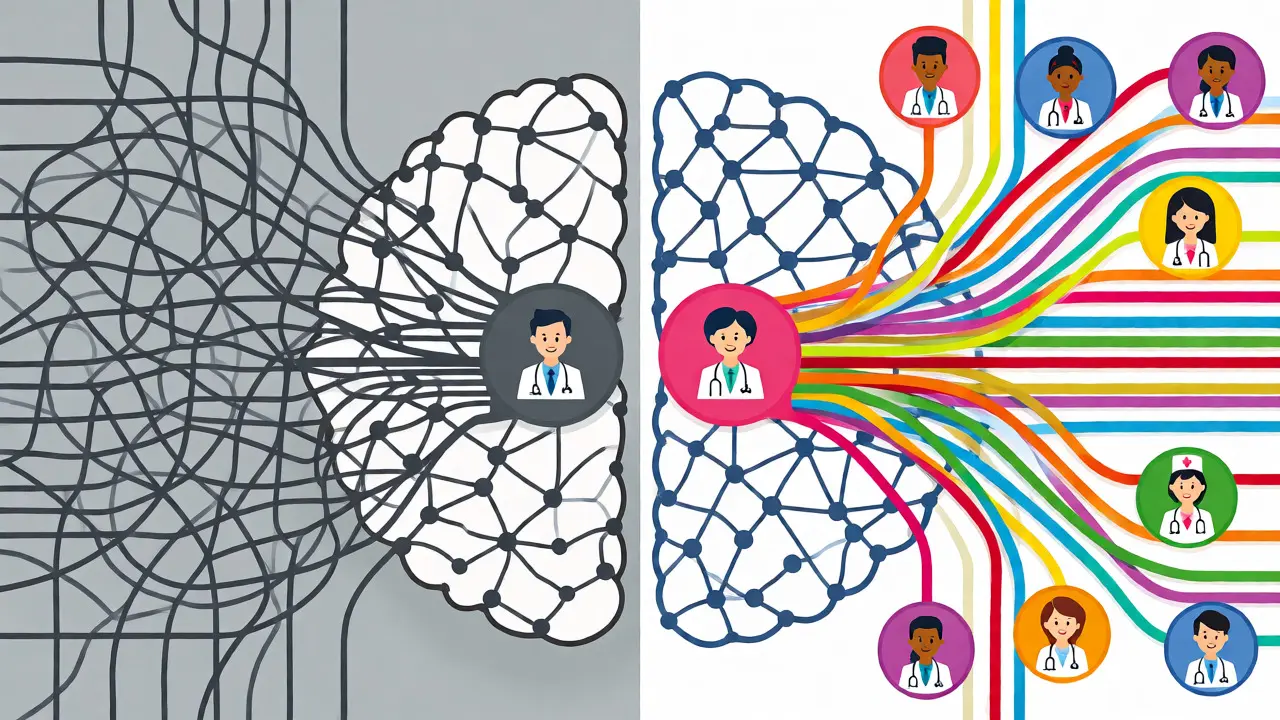
You’ve probably seen it happen. You ask a large language model (LLM) to write a resume for a doctor, and suddenly the pronouns are all "he." Or you ask for a story about a nurse, and the character is invariably female. These aren’t just quirky glitches; they’re symptoms of deep-seated biases baked into the training data of modern AI. For developers and businesses deploying these models, this isn’t just an aesthetic issue-it’s a compliance risk and a user experience nightmare.
Here’s the good news: you don’t always need to retrain a massive neural network to fix this. Bias-aware prompt engineering is a method of designing input instructions that actively steer Large Language Models toward fairer outputs without changing the underlying model weights. It’s lightweight, accessible, and surprisingly effective when done right. Think of it as giving the AI a clear ethical compass before it starts its journey, rather than trying to rebuild the engine while it’s running.
Why Retraining Isn’t Always the Answer
Traditional approaches to fixing AI bias often involve retraining the model on balanced datasets or fine-tuning specific layers. While powerful, these methods are expensive, time-consuming, and often impossible if you’re using a closed-source API like OpenAI’s GPT-4o or Anthropic’s Claude. You can’t access the weights, so you can’t tweak them.
This is where prompt engineering shines. By modifying how we talk to the model, we can influence its reasoning process. Recent studies, including work by Kamruzzaman et al. in 2024, show that strategic prompting can reduce stereotypical judgments by up to 33% across various categories. That’s a significant win for a technique that costs nothing but tokens.
The Core Techniques: From Personas to Chain-of-Thought
Not all prompts are created equal. Some instructions act as gentle nudges, while others fundamentally change how the model processes information. Here are the three most effective strategies currently documented in research:
- Human Persona with System 2 Reasoning: This technique instructs the model to emulate slower, more deliberate human thinking. Instead of jumping to the first likely answer (System 1), the model is asked to consider multiple perspectives and potential biases before responding. Research indicates this reduces stereotypical engagement by nearly 28% compared to standard prompting.
- Chain-of-Thought (CoT) Prompting: By requiring the model to articulate its reasoning steps explicitly, CoT forces it to justify its conclusions. When the model has to explain why it chose a certain attribute for a subject, it’s less likely to rely on lazy stereotypes. This method is particularly effective for complex queries where bias might hide in the logical gaps.
- Explicit Debiasing Instructions: Sometimes, directness works best. Adding phrases like "Avoid gender stereotypes" or "Ensure cultural neutrality" directly in the system prompt can yield immediate improvements. The HP Debias technique, which combines a human persona with explicit debiasing instructions, has shown remarkable results, lowering bias scores from 0.78 to 0.42 on the StereoSet benchmark for some models.
Model-Specific Performance Matters
It’s crucial to understand that not all LLMs respond to bias-aware prompting in the same way. Your strategy should depend on the model you’re using. For instance, GPT-4o-mini demonstrated substantial bias reduction when using the HP Debias technique, dropping bias scores significantly on the Bias Benchmark for English (BBE). In contrast, Llama3.3 achieved the highest relative bias reduction rate at 42.7% when combining human personas, System 2 reasoning, and chain-of-thought prompting.
| Model | Technique Used | Bias Score Reduction | Key Insight |
|---|---|---|---|
| GPT-4o-mini | HP Debias (Persona + Explicit) | High (0.81 to 0.39) | Best for closed-API commercial use cases. |
| Llama3.3 | Combined (Persona + CoT + Debias) | Very High (42.7% relative) | Responds well to multi-layered instruction stacking. |
| Gemma3 | Average across methods | Moderate (0.76 to 0.62) | Consistent but smaller gains; requires careful tuning. |

The Pitfall of Exemplar Distribution Bias
One of the most common mistakes developers make is ignoring the examples they provide in few-shot prompts. If you give the model five examples of doctors, and four of them are named "John," the model will likely assume doctors are male. This is called exemplar distribution bias.
For example, LearnPrompting.org found that if 80% of medical role examples in a prompt feature male physicians, the model generates 63% more references to male physicians in its output. The solution? Consciously balance your examples. Ensure your few-shot demonstrations reflect the diversity you want in the output. It’s a simple step that yields a 41% reduction in bias in healthcare applications, according to Refonte Learning’s case studies.
Implementing a Bias-Aware Workflow
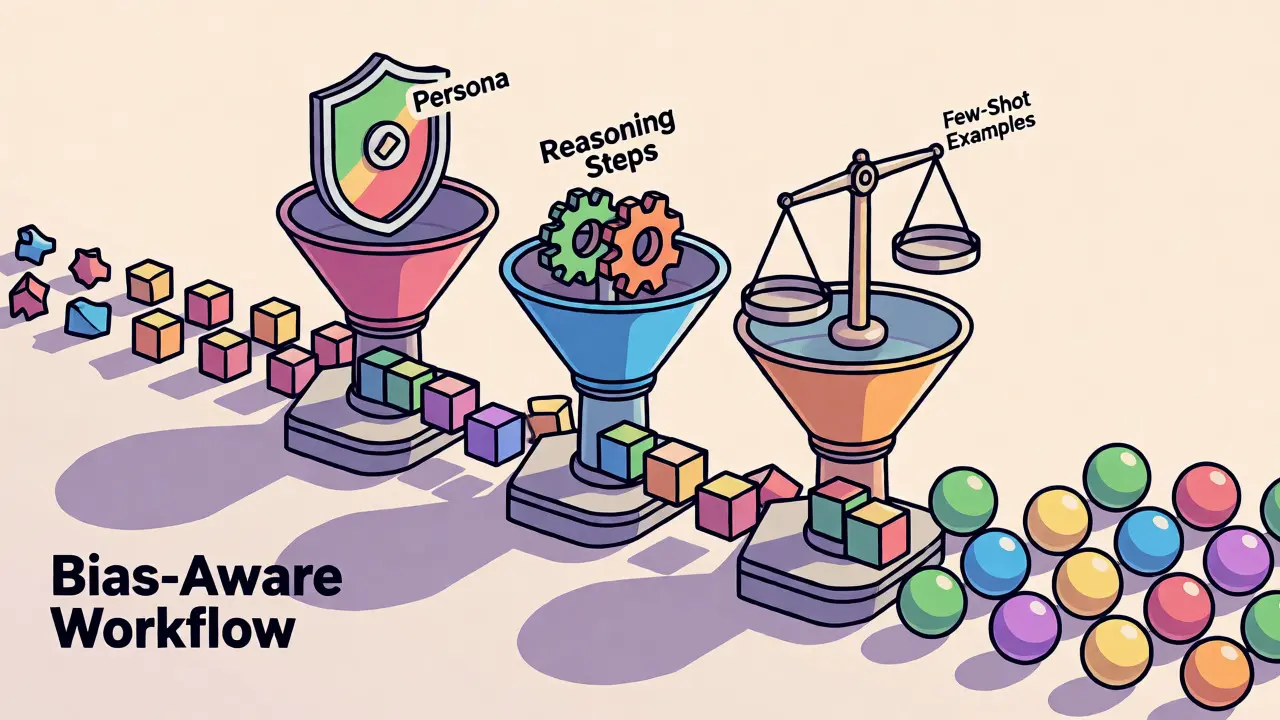
So, how do you actually implement this in a production environment? It’s not just about writing one clever prompt. It’s about building a workflow.
- Audit Your Baseline: Before changing anything, measure your current bias levels using benchmarks like StereoSet or BBE. You can’t improve what you don’t measure.
- Start with Personas: Add a system prompt that defines a neutral, empathetic, and analytically rigorous persona. Tell the model it is an unbiased assistant committed to fairness.
- Add Reasoning Constraints: Require the model to think step-by-step. Use Chain-of-Thought prompting to force it to evaluate its own assumptions.
- Balance Your Few-Shots: Review every example you feed the model. Are the genders, races, and roles evenly distributed? Fix any imbalances here first.
- Test and Iterate: Run your new prompts against a test set of biased-prone queries. Compare the results to your baseline. Adjust the wording until you see measurable improvement.
Limitations: What Prompting Can’t Do
Let’s be real: prompt engineering is a patch, not a cure-all. As Dr. Susan Li from Google notes, structural biases embedded in training data cannot be fully removed by instructions alone. If the model has never seen a female engineer in its training corpus, no amount of prompting will teach it what a female engineer looks like in context.
Prompting also struggles with domain authority. A model might confidently generate a biased response in a highly specialized field because it lacks the nuanced understanding required to apply the debiasing rules correctly. Therefore, bias-aware prompting should be part of a larger strategy that includes data auditing and, where possible, model-level debiasing.
Regulatory Pressure and Market Trends
Why is everyone talking about this now? Regulation. With the EU AI Act enforcement ramping up, companies are scrambling to prove their AI systems are fair. McKinsey reports that 72% of Fortune 500 companies have implemented bias-aware prompting strategies. The global AI ethics tools market hit $2.3 billion in Q1 2024, driven largely by the need for lightweight, compliant solutions like prompt engineering.
Financial services lead the charge, with 86% of customer-facing LLM applications using bias-aware prompting, compared to 54% in healthcare. If you’re building an AI product today, assuming users won’t care about fairness is a risky bet.
Does bias-aware prompting eliminate all bias?
No. It significantly reduces observable bias in outputs, especially for common stereotypes, but it cannot remove structural biases deeply embedded in the training data. It is a mitigation strategy, not a complete solution.
Which LLM responds best to bias-aware prompting?
Recent studies suggest Llama3.3 shows high relative responsiveness to combined techniques, while GPT-4o-mini performs exceptionally well with explicit debiasing instructions. Results vary by model architecture and training data.
How long does it take to learn bias-aware prompting?
Developers typically need 15-20 hours of training to master foundational techniques like balanced few-shot exemplars and basic persona setting. Advanced causal prompting requires deeper machine learning knowledge.
Can I use bias-aware prompting with closed-source APIs?
Yes, this is one of its primary advantages. Since it relies solely on input text, it works perfectly with closed models like those from OpenAI, Anthropic, and Google, requiring no access to model weights.
What is exemplar distribution bias?
This occurs when the examples provided in a prompt (few-shot learning) are unbalanced. For instance, if most examples of "CEO" are male, the model may associate leadership primarily with men, skewing its future outputs regardless of other instructions.