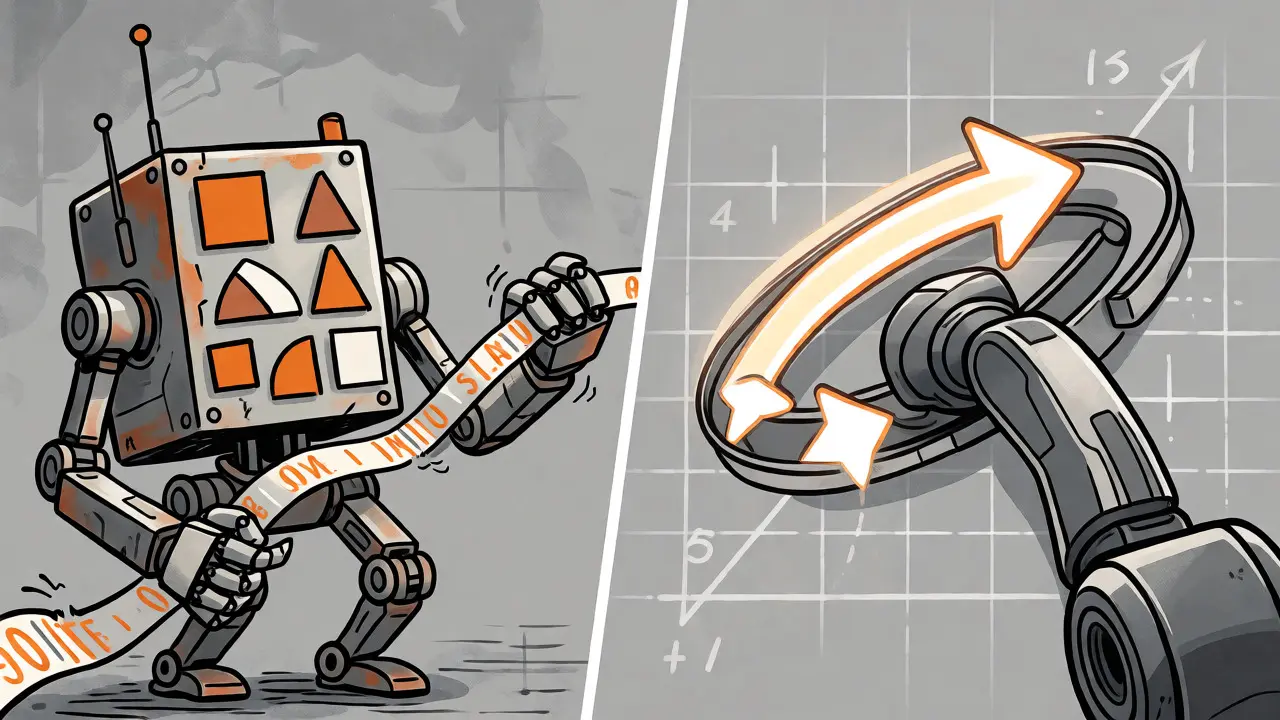
Imagine trying to read a book where every sentence you read forgets the previous one. That’s what early Transformers struggled with: they had no innate sense of order. They needed artificial hints about where each word sat in a sequence. For years, we used simple additive tricks-like sticking a label on every token saying "I am word number 5." But as models grew and contexts stretched from hundreds to millions of tokens, those labels broke down. Enter Rotary Position Embeddings (RoPE), the mathematical trick that changed how machines understand position.
If you’ve ever wondered why modern open-source models like Llama or Falcon can suddenly handle entire books or codebases without crashing, RoPE is likely the reason. It doesn’t just tag positions; it rotates them. This subtle shift allows models to grasp relative distance intuitively, making extrapolation to longer sequences not just possible, but efficient. Let’s break down why this technique became the industry standard and where it might trip you up.
The Core Problem: Why Old Positional Encodings Failed
Before RoPE, most Transformers relied on absolute positional encodings. Think of these as fixed vectors added to the word embeddings. If a word was at position 10, it got a specific vector added to its representation. The problem? These vectors were learned or predefined for a maximum length, say 512 or 2048 tokens. If you tried to feed the model a 3000-token document, it simply didn’t know what to do with positions beyond its training horizon. The performance would plummet, often catastrophically.
Relative positional encodings tried to fix this by focusing on the distance between words rather than their absolute spot. While better, they introduced significant computational overhead because the attention mechanism had to calculate distances for every pair of tokens dynamically. It was accurate but slow and memory-hungry. We needed something that offered the best of both worlds: the efficiency of absolute encodings and the flexibility of relative ones.
How RoPE Actually Works: Rotation, Not Addition
RoPE works by treating the query and key vectors in the attention mechanism as complex numbers. Instead of adding a position signal, it rotates these vectors by an angle proportional to their position. Imagine two arrows on a graph. If arrow A is at position 1 and arrow B is at position 5, RoPE rotates arrow A slightly and arrow B more. When the model calculates attention, it looks at the dot product of these rotated vectors. Mathematically, the rotation cancels out the absolute positions, leaving only the relative distance between them.
This is elegant because it embeds relative position information directly into the geometry of the attention scores. The formula involves frequencies defined as $\theta_i = 10,000^{-2i/d}$, where $d$ is the embedding dimension. Each pair of dimensions gets a different rotation speed. Low-frequency dimensions rotate slowly, capturing long-range dependencies, while high-frequency dimensions spin fast, handling local structure. This multi-scale approach lets the model attend to nearby words sharply and distant words broadly, all within a single framework.

Why Everyone Switched to RoPE: The Benefits
The adoption rate tells the story. By late 2025, nearly 92% of major open-source LLMs with over 7 billion parameters used RoPE. Why? Because it solves the length extrapolation problem surprisingly well. In benchmarks, models trained with RoPE could process sequences 4.7 times longer than their training limit with minimal performance drop. Compare that to older methods, which failed completely once past their max length.
- Seamless Context Extension: You don’t need to retrain the whole model to increase context window. Techniques like NTK-aware scaling allow you to adjust the base frequency, letting a model trained on 4K tokens handle 32K or even 128K tokens with minor fine-tuning.
- Computational Efficiency: Unlike some relative encoding methods, RoPE adds negligible compute cost during inference-about 3.7% overhead according to NVIDIA studies. It fits neatly into existing matrix multiplication operations.
- Better Convergence: Training runs faster and more stably. Google Research found that RoPE accelerated convergence by nearly 19% compared to sinusoidal embeddings, saving weeks of GPU time for large teams.
For developers, this means cheaper training and more robust deployment. If you’re building an app that needs to summarize legal contracts or analyze massive codebases, RoPE gives you the stability to trust the output even when the input is huge.
The Tradeoffs: Where RoPE Struggles
No technology is free, and RoPE has its quirks. The biggest issue arises in extremely long contexts, specifically beyond 64,000 tokens. Researchers have identified "rotary offset features," where certain dimension pairs exhibit large magnitudes regardless of content. This creates attention biases, causing the model to focus too much on specific patterns unrelated to meaning. It’s like having a microphone that picks up static at high volumes-the signal is there, but it’s noisy.
Another pain point is implementation complexity. Converting real-valued vectors to complex numbers and back isn’t trivial. A survey of developers showed that 41% cited RoPE as the hardest part of implementing Transformers correctly. Common bugs include mishandling the frequency conversion or pairing dimensions incorrectly. If you’re writing custom CUDA kernels, you’ll spend days debugging NaN errors that stem from these math mishaps.
| Feature | RoPE | Absolute PE (Sinusoidal) | ALiBi |
|---|---|---|---|
| Length Extrapolation | Excellent (up to 4x+) | Poor (fails beyond train length) | Good (linear bias) |
| Compute Overhead | Low (~3.7%) | Negligible | Medium |
| Implementation Ease | Moderate/Hard | Easy | Easy |
| Long-Range Accuracy | High (78.4% on LRA) | Lower (72.1% on LRA) | Moderate |
| Adoption in Top LLMs | ~92% | Legacy/Rare | Niche (e.g., MPT) |
Also, RoPE assumes that relative position matters. In tasks like code generation, absolute line numbers sometimes matter more than token distance. Here, RoPE underperformed absolute embeddings by nearly 6% in GitHub’s 2025 benchmark. If your use case depends heavily on rigid structural positioning, you might need hybrid approaches.

Real-World Impact and Recent Innovations
Companies aren’t just using RoPE; they’re optimizing it. Meta’s Llama 3 uses a higher base frequency (500,000) to support 4K-dimensional embeddings, allowing for better resolution in long contexts. Anthropic’s Claude 3 incorporates learned frequency parameters, adapting the rotation speeds based on data rather than fixing them. This evolution shows that while the core idea remains stable, the details are being tuned for specific enterprise needs.
A standout example comes from Jasper AI. After switching to RoPE in their 20B parameter model, they reported a 37% improvement in long-form content quality and a 62% reduction in positional hallucinations. Their engineers noted that the model stopped "forgetting" earlier paragraphs in long articles, a direct result of RoPE’s superior relative position tracking.
Looking ahead, we see hybrids emerging. Carnegie Mellon recently tested "RoPE-Mamba," combining rotary embeddings with state-space models. Early results show 28% faster training for trillion-parameter models. This suggests RoPE’s principles are versatile enough to survive even if Transformers themselves evolve.
Implementation Tips for Developers
If you’re rolling your own RoPE layer, watch out for the real-to-complex conversion trap. Most errors happen here. Use established libraries like xFormers or Hugging Face’s `apply_rotary_emb` function unless you have a very good reason not to. Validation is critical: run sanity checks that verify rotation properties hold true for known inputs.
When choosing a base frequency, start with 10,000 for standard models. If you plan to extend context significantly, consider increasing it to 500,000 or higher. This reduces aliasing issues at long distances. Remember, there’s no one-size-fits-all value; experiment with your specific dataset.
Do I need to retrain my model to switch to RoPE?
Yes, typically. RoPE changes the internal geometry of attention layers. While you can initialize weights similarly, the model must learn to interpret the new rotational signals. However, you can often fine-tune rather than pre-train from scratch if you use techniques like NTK-aware scaling.
Can RoPE handle infinite context lengths?
Not literally infinite. While it extrapolates much better than absolute embeddings, performance degrades eventually due to numerical precision limits and rotary offset features. Current practical limits hover around 128K-1M tokens depending on hardware and optimizations like YaRN or Dynamic RoPE.
Is RoPE patented?
The original RoPE concept by Jianlin Su was released under an Apache 2.0 license, making it free to use. However, some companies have filed patents on specific optimization variants (like dynamic scaling). Always check the license of specific library implementations if you’re deploying commercially.
Why does my RoPE implementation produce NaN values?
This usually happens during the complex number conversion phase. Ensure you are correctly interleaving or splitting the real and imaginary parts according to the framework’s expectation. Also, check that your embedding dimension is even, as RoPE requires paired dimensions for rotation.
Should I use RoPE for small models?
If your context window is short (under 2K tokens), the benefits might not outweigh the implementation complexity. Simpler absolute embeddings may suffice. However, for any model intended to scale or handle variable-length inputs, RoPE is generally recommended due to its future-proofing.