Large language models (LLMs) can sound incredibly smart - until they make up facts. You ask about last quarter’s earnings, and it cites a report that doesn’t exist. You ask about a new drug interaction, and it gives outdated guidelines. This isn’t a glitch. It’s a fundamental flaw: LLMs are trained on static data, frozen in time. They don’t know what happened yesterday unless you tell them.
That’s where retrieval-augmented generation (RAG) comes in. It’s not magic. It’s a simple, powerful fix. RAG lets LLMs look up real, current information before answering - just like a human researcher flipping through documents. And the results? Companies using RAG cut factual errors by more than half. In healthcare, financial services, and legal tech, accuracy jumps from 45% to over 85%.
How RAG Actually Works - No Jargon
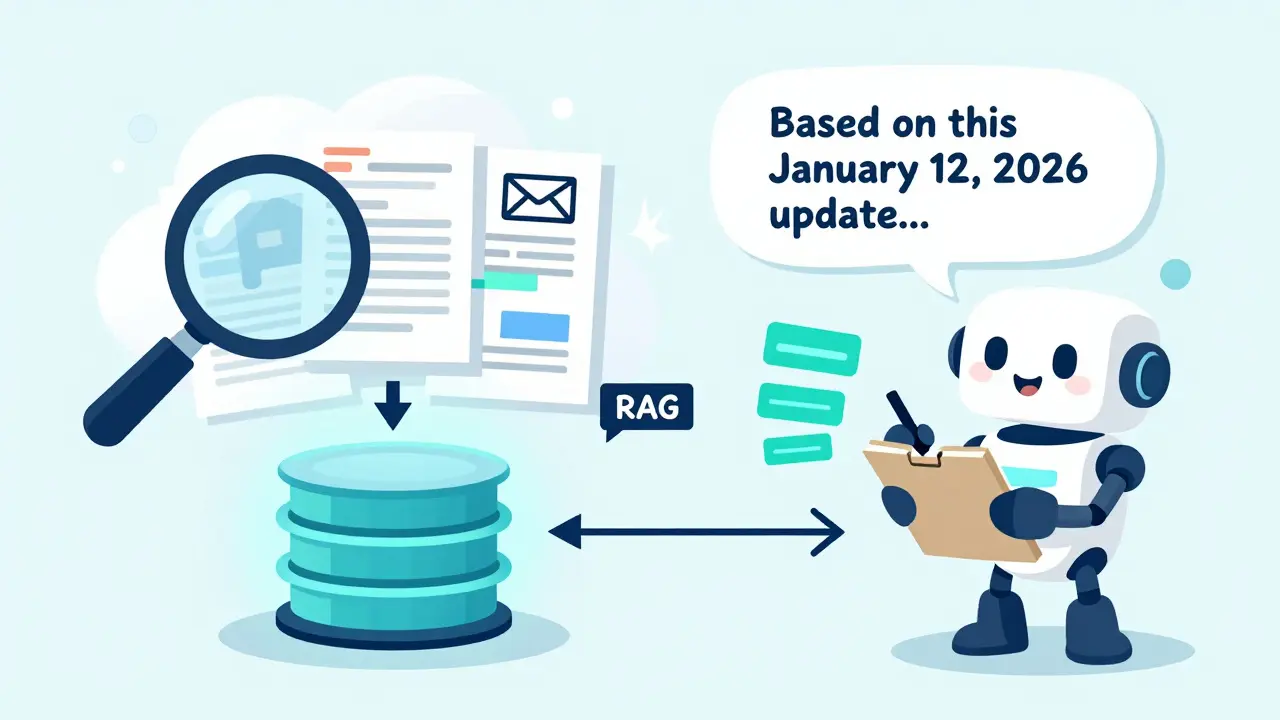
Think of RAG like a two-step process: search first, then write.
First, your system takes a user question - say, "What’s the latest FDA guidance on insulin pricing?" - and sends it to a search engine built for documents. This isn’t Google. It’s a vector database, trained to understand meaning, not keywords. It scans your company’s internal files: PDFs of policy manuals, emails from compliance teams, clinical trial notes, even chat logs from customer support. It finds the 3-5 most relevant chunks - maybe a 300-word excerpt from a regulatory update, a table from a recent audit.
Then, it hands those chunks to the LLM - along with your original question. The model doesn’t guess anymore. It says: "Based on this document from January 12, 2026, the FDA has revised pricing transparency rules to require..."
That’s it. No retraining. No rebuilding the model. Just adding a lookup step. And it works because real information beats memorized guesses.
Why RAG Beats Fine-Tuning (And Why Most Companies Get It Wrong)
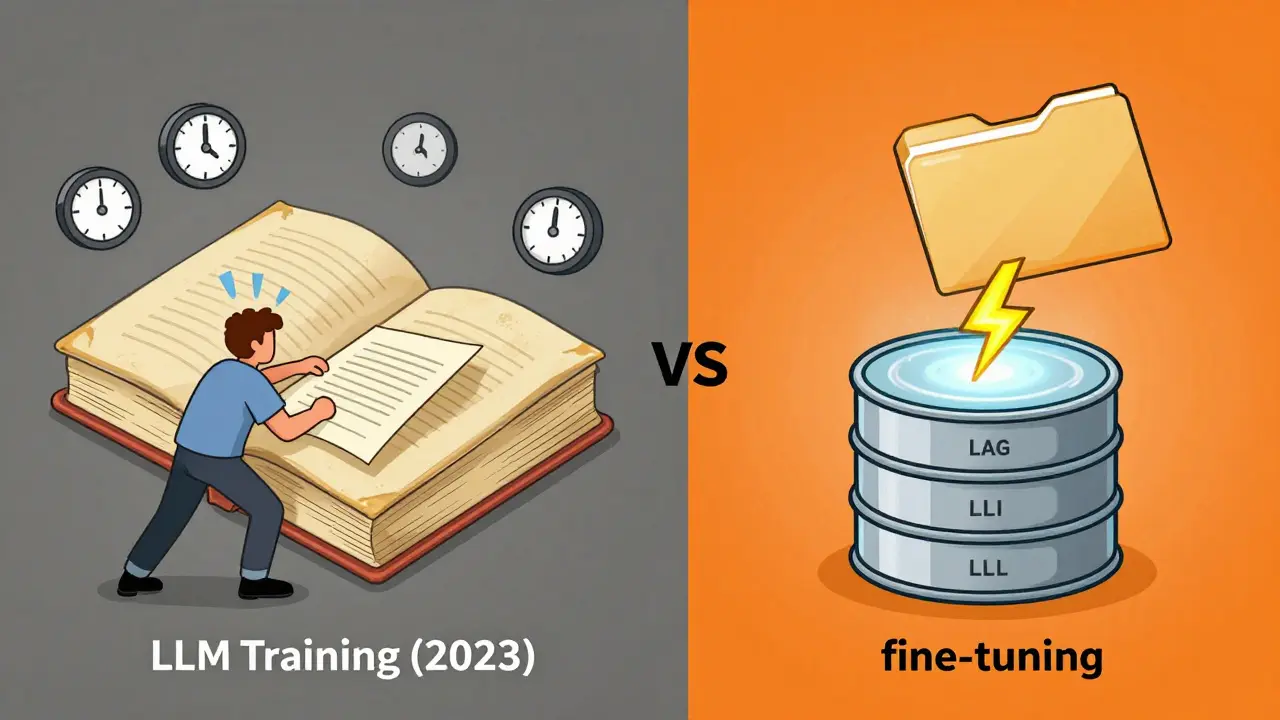
You might think: "Why not just retrain the model with new data?" That’s fine - if you have $85,000 and three months to spare. Fine-tuning a large model from scratch costs 6 to 8 times more than setting up RAG. And even then, it’s slow. By the time you finish training, the data is already outdated.
RAG is dynamic. You update your documents, and the model instantly knows. Need to add a new product manual? Upload it. Change a compliance rule? Swap the PDF. The model adapts in minutes, not weeks.
But here’s where most companies fail: they treat RAG like a plug-in. They throw a bunch of documents into a vector database and call it done. That’s like giving a chef a library but no recipe book. The retrieval part is broken.
Bad chunking? Documents split mid-sentence? Results full of noise? Accuracy plummets. One bank found their loan policy chatbot was wrong 32% of the time - until they fixed how they broke up legal documents. Switching from 512-token chunks to 256-token chunks with sentence-aware splitting dropped errors to 9%.
The Real-World Patterns That Actually Move the Needle
Not all RAG is created equal. Here are the patterns top teams use to squeeze out every last percentage point of accuracy:
- Hybrid search: Combine keyword search (like BM25) with semantic vector search. Use 30% keyword, 70% semantic. This catches exact phrases ("Section 4.2") and concepts ("regulatory noncompliance") at the same time. Google’s data shows this boosts relevance by 18-22%.
- Query expansion: If someone types "How do I report a data breach?", expand it to include synonyms: "notify authorities," "GDPR incident," "security violation." This pulls in more useful documents. Accuracy gains: up to 27%.
- Re-ranking: Don’t trust the top result. Use a second model - like Cohere Rerank - to sort the top 10 retrieved snippets by actual relevance. This lifts the quality of what the LLM sees. Top-3 relevance improves by 22%.
- Self-RAG: Let the model decide when to search. Instead of retrieving every time, it learns: "Do I need to look this up?" This cuts unnecessary searches by 38% and reduces hallucinations. Stanford’s 2023 paper showed a 21% accuracy boost.
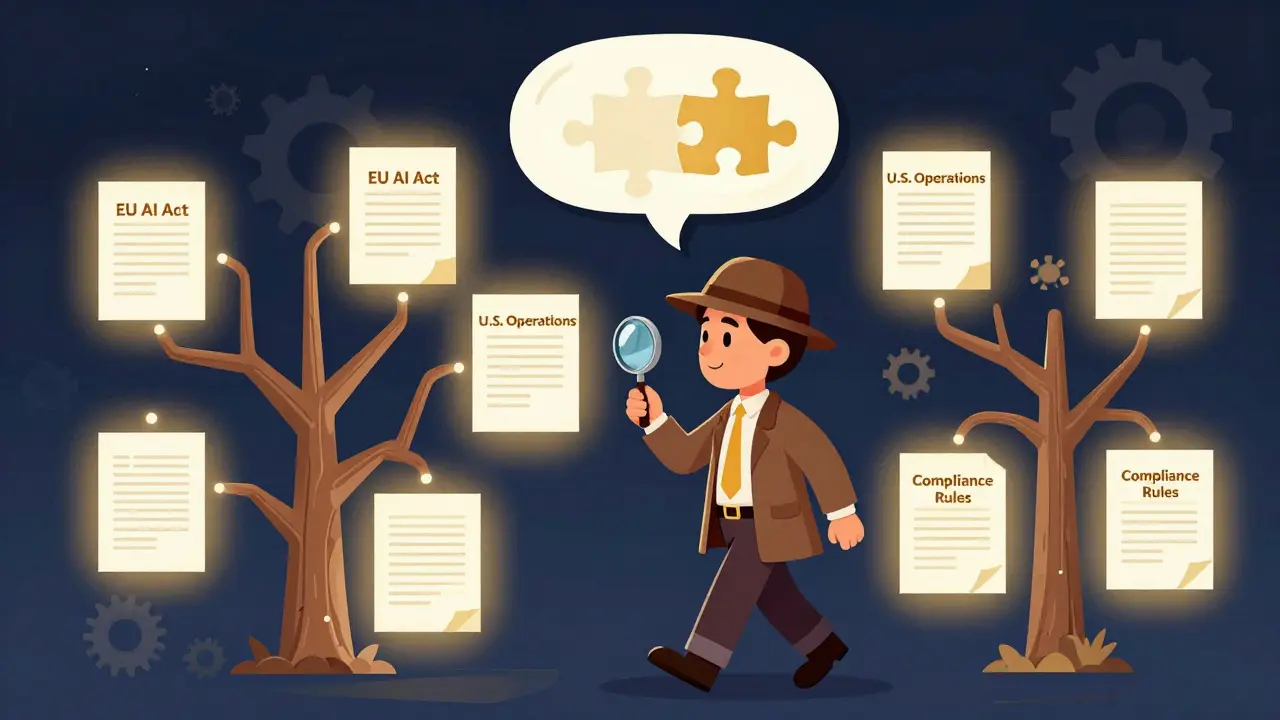
- Recursive retrieval: For complex questions like "What’s the impact of the new EU AI Act on our U.S. operations?", the system doesn’t just search once. It breaks the question into steps, retrieves context for each, and builds an answer layer by layer. Microsoft’s tests show this lifts multi-hop accuracy from 54% to 82%.
These aren’t theoretical. A Fortune 500 telecom company used query expansion and re-ranking to cut customer service errors by 47%. A healthcare provider reduced regulatory violation risks by 63% using recursive retrieval to track cross-jurisdictional rules.
Where RAG Still Struggles - And How to Fix It
It’s not perfect. RAG has blind spots.
Multi-hop reasoning: If the answer needs info from three different documents, standard RAG often misses the connection. That’s where Tree of Thoughts patterns help. Instead of one search, the system simulates multiple reasoning paths - like a detective exploring different leads. Accuracy on complex questions jumps from 54% to 79%.
Poor queries: If a user types "Tell me about the policy," RAG has nothing to go on. That’s why query transformation tools matter. Systems now auto-expand vague questions using context from past interactions. Without this, accuracy can drop 15-20%.
Over-reliance on retrieval: Sometimes, the system finds a document that’s *almost* right - and the LLM turns it into a confident lie. A University of Washington study found 22% of RAG errors came from this. The fix? Train the model to say "I’m not sure" when context is weak. Self-RAG helps here too.
What You Need to Get Started
You don’t need a team of PhDs. But you do need to plan.
- Data: Start with 10-50 high-value documents. Not everything. Focus on policies, manuals, FAQs, contracts - things that change often.
- Chunking: Use 256-512 tokens. Break at sentence boundaries. Use tools like LangChain or LlamaIndex - they handle this automatically.
- Vector database: For small setups, use Qdrant or Chroma. For enterprise, use Pinecone or Milvus. Expect 8-16GB RAM for basic, 64GB+ for 10M+ documents.
- Embedding model: Use text-embedding-ada-002 or nomic-embed-text. They’re proven, fast, and widely supported.
- Time: A basic RAG system takes 8-12 weeks. The longest part? Preparing documents. Don’t rush this.
Cost? A small RAG setup runs under $12,500 - including tools, cloud, and tuning. Fine-tuning the same model? Around $85,000.
The Bottom Line
RAG isn’t the future. It’s the present. Over 78% of enterprises using generative AI already rely on it. By 2025, nearly all of them will.
Why? Because accuracy isn’t a nice-to-have. It’s a legal requirement in healthcare. A financial risk in banking. A trust killer in customer service.
LLMs are powerful. But without RAG, they’re like a brilliant lawyer who’s never read the latest court rulings. You wouldn’t trust them with your case. Don’t trust them with your data either.
Fix the retrieval. Tune the chunks. Add re-ranking. Test with real users. You don’t need to build the next AI model. You just need to make the one you have smarter.
What’s the difference between RAG and fine-tuning an LLM?
Fine-tuning changes the model’s internal weights by retraining it on new data - it’s expensive, slow, and static. RAG keeps the model unchanged and adds a live search step that pulls in fresh documents. RAG costs 6-8x less and updates instantly. Fine-tuning works for stable, long-term knowledge. RAG wins when information changes daily.
Do I need a vector database for RAG?
Yes. A vector database is what makes semantic search possible. It converts text into numerical vectors so the system can find documents by meaning, not just keywords. You can start with open-source tools like Chroma or Qdrant for small projects. For large-scale use, use Pinecone, Milvus, or cloud services like Azure AI Search or Google Vertex AI.
How long does it take to build a RAG system?
A basic RAG system takes 8 to 12 weeks. Most of that time - 35-40% - goes into preparing and chunking your documents. The actual integration with the LLM and vector database is faster. The hardest part isn’t coding. It’s cleaning up messy internal documents so they’re useful for retrieval.
Can RAG handle questions that need info from multiple documents?
Standard RAG struggles here. But advanced patterns like recursive retrieval and Tree of Thoughts solve it. Recursive retrieval asks follow-up questions to gather context from multiple sources. Tree of Thoughts simulates different reasoning paths before answering. These methods boost accuracy on complex questions from 54% to over 79%.
Is RAG secure for sensitive data like patient records or financial info?
It can be - but you must design it that way. RAG systems that access private data need strict access controls, data masking, and audit trails. GDPR and HIPAA compliance adds 23-37% extra development time. Use encrypted vector databases, limit document access by role, and log all retrievals. Don’t assume security is built-in.
What’s the biggest mistake companies make with RAG?
They assume better LLMs = better answers. But the real bottleneck is retrieval. Poor document chunking, vague queries, no re-ranking, or ignoring hybrid search tanks accuracy. One company saw 33% error rates until they fixed how they split legal documents. RAG’s power isn’t in the model - it’s in the quality of what you feed it.
Mark Brantner
February 1, 2026 AT 23:10bro i tried RAG last week and my chatbot started quoting fictional FDA guidelines like it was gospel. turned out my chunking was so bad it split 'insulin pricing' across two docs. now i use 256-token chunks with sentence-aware splits and suddenly it’s not lying anymore. also i’m pretty sure my dog could set this up better than my old dev team.
Kate Tran
February 2, 2026 AT 07:13honestly the biggest win for me was query expansion. people type 'how do i report this?' and expect magic. once we started auto-expanding to 'notify authorities', 'security incident', 'data breach', accuracy jumped. no fancy ai needed, just a few synonyms. also, yes, vector db is non-negotiable. tried skipping it. regretted it.
amber hopman
February 3, 2026 AT 12:21can i just say how wild it is that companies still think fine-tuning is the answer? i work at a mid-sized health tech firm and we spent $78k on fine-tuning only to realize our docs were outdated the day we deployed. RAG fixed it in 3 days for $2k. the real secret? not the tech - it’s cleaning up your internal PDFs. half our docs had handwritten notes in margins from 2019. once we cleaned those out, accuracy went from 51% to 89%. also, self-RAG is a game changer. lets the model say 'i dunno' instead of making up a quote from a nonexistent study.
also, if you're using 512-token chunks, you're probably doing it wrong. go smaller. sentence boundaries matter more than you think.
Jim Sonntag
February 5, 2026 AT 02:41so we spent 6 months building this RAG thing and turns out the real bottleneck was a guy in accounting who saved policies as 'final_v2_final_edited_123.pdf'...
also i love how everyone acts like RAG is some genius innovation. nah. it’s just a librarian with a highlighter and a google search. the model’s still the same dumb genius who memorized every book in the library but can’t find his keys.
and yes, you need a vector db. no, you don’t need pinecone. chroma on a $50 vps works fine for 10k docs. stop over-engineering. the problem isn’t the tech. it’s that nobody wants to clean up their mess.
Deepak Sungra
February 6, 2026 AT 23:55